
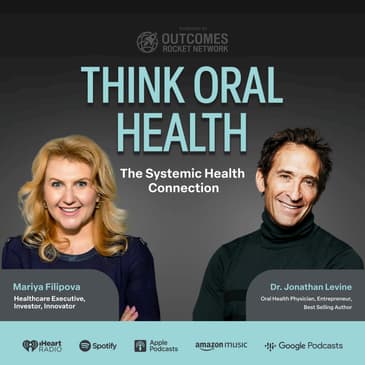
It’s time to reflect on an inspiring year of conversations with trailblazers and look into the future!
In this episode, Dr. Jonathan Levine and Mariya Filipova reflect on their podcast journey, highlighting insights from 45 episodes and their vision for healthcare in 2025, emphasizing the need for seamless, integrated care. They also celebrate AI-driven personalization, periodontal care, and dental-medical integration, along with the growing role of Dental Support Organizations in enhancing patient outcomes through technology and sharing best practices.
Tune in to look back on game-changing innovations and guests on the Think Oral Health podcast, and be inspired by bold visions for seamless healthcare in 2025 and beyond!
Resources:
- Mariya Filipova - https://filipova.health/
- Systemic Health Investor - https://www.4100dx.com/
- Care Convergence Thought Leader: Dental Economics
- Forbes Technology Council Member
- Jonathan Levine - www.drjonathanlevine.com
- Founder - JBL New York City www.jblnyc.com
- Founder - GLO Science LLC www.gloscience.com
- Co-Founder - GLO GOOD Foundation www.glogoodfoundation.org
- Watch the entire episode on YouTube and get more details at Think Oral Health.
[00:00:04] Welcome to Think Oral, where we connect the interconnected between oral and physical health.
[00:00:10] I'm your host, Dr. Jonathan Levine.
[00:00:13] And I'm your host, Maria Filipova.
[00:00:15] Let's get at it.
[00:00:22] Hi everyone, and welcome to another exciting edition of the Think Oral Health podcast.
[00:00:27] I am very excited about our podcast today because in so many of our guests, in so many
[00:00:35] of our podcasts, I actually, we don't know for our listeners is after the podcast ends,
[00:00:41] the recording ends, Jonathan and I stay after and continue the conversation and all kinds
[00:00:47] of ideas spark.
[00:00:49] And we are both saying, oh, I wish we could do this.
[00:00:52] I wish we could record this and let's get after this.
[00:00:54] And so today is this episode where we get to indulge ourselves to have a conversation about
[00:01:01] all the amazing topics we've had in the last year and really spend a little bit of time
[00:01:06] reflecting on 2024 and wishing ahead for 2025.
[00:01:13] So Jonathan, I say this as honestly and as excitedly as it can be.
[00:01:17] I'm so happy to have this protected time for us to actually have a conversation.
[00:01:23] Yeah, no, I agree.
[00:01:25] Well, I can only say this, Maria, it's been an absolute joy doing this with you this year.
[00:01:28] And we've been learning a lot from the people who are coming on the show as we think about
[00:01:34] health care in a way of how do we improve the lives of our people and our patients and elevate.
[00:01:42] And if you look back, Maria, so how many episodes have we done since we started?
[00:01:48] So this is our second year doing the podcast.
[00:01:51] The first full year, we started in the distant July, 2023 with a little known first guest.
[00:02:02] Who was our first guest?
[00:02:03] That is actually a trick question for our audience.
[00:02:06] We had a rock star dentist and a dentist who wanted to be a rock star on the podcast.
[00:02:13] So we had Dr. Jonathan Levine and aspiring dentist Lenny Kravitz on our podcast.
[00:02:21] He's good, too.
[00:02:22] He's good.
[00:02:23] He knows.
[00:02:23] How amazing was that first kickoff?
[00:02:26] So we just did the numbers, right?
[00:02:28] We just looked over the last year and a half of us doing this.
[00:02:33] We've had 45 episodes, 45 guests.
[00:02:37] That's amazing.
[00:02:38] Well, so what do we want to do?
[00:02:40] We really want to highlight this past year, right?
[00:02:43] That's right.
[00:02:44] And really, what would be fun, which was a great idea that you told me and you suggested it,
[00:02:52] is let's look at the future and think about it in a way of what are we wishing for to improve health
[00:02:59] outcomes, both from equality of health and health equity and also for everyone in general.
[00:03:07] And take a little bit of the learnings from our 45 guests, right?
[00:03:11] Yeah.
[00:03:11] And project them forward.
[00:03:12] So why don't we do this?
[00:03:13] We haven't done this before, right?
[00:03:15] So let's just, maybe I should just, why don't we go through the list of our episodes last year
[00:03:20] and just pick up a handful of them.
[00:03:21] Let's do it and mention some highlights.
[00:03:23] That would be fantastic.
[00:03:24] We're doing this together in real time and our listeners are with us.
[00:03:29] So hopefully you're seeing this website and it looks familiar to you because you've probably
[00:03:34] come here before.
[00:03:36] And here it is.
[00:03:38] Let's look at our latest episodes.
[00:03:40] Jonathan, how about these last series of episodes from health?
[00:03:44] Talk about health.
[00:03:45] We had somebody who has inherited the entrepreneurial gene.
[00:03:50] You had Cody Levine talking about amazing work of an entrepreneur and a rebel in oral health.
[00:03:57] The poor kid couldn't get away from it.
[00:03:59] Listening, sitting at the dinner table when he's five years old, him and his brother, Julian.
[00:04:04] And they picked it up and they started this company twice.
[00:04:10] They were inspired on our missions with all of the team and the healthcare team and all
[00:04:16] the great people that help us deliver care in the Bahamas.
[00:04:19] And that was a fun episode for sure.
[00:04:23] That was a fun episode.
[00:04:23] And Cody was joined in one of our other episodes at health with Dr. Ali Shazib and what he's
[00:04:30] doing at the Workman School of Dental Medicine at High Point.
[00:04:34] Talk about walking the walk and talking the talk, if you will.
[00:04:39] Look, education in all of these places, medicine and dentistry in general, it's time for some
[00:04:47] reinvention.
[00:04:48] You look at medicine, there's still only about 15 to 20% of all medical schools teach nutrition.
[00:04:53] And we can say many of those types of things in dentistry.
[00:04:56] The connection of the mouth and the body, oral systemic health, the only school that really
[00:05:01] the dental school is part of the medical school is Harvard.
[00:05:03] So here's Ali surrounded by a board of really great thought leaders telling us what does
[00:05:09] the future look like for dental education?
[00:05:11] It was absolutely inspiring.
[00:05:13] Absolutely.
[00:05:13] I must listen.
[00:05:14] And then we were there at health celebrating dental health, which was a phenomenal momentum
[00:05:22] to see all the activity around dental health.
[00:05:25] And we had a dedicated dental health awards.
[00:05:28] And this year they were won by one of the companies that was recognized, Grin, and Dr.
[00:05:35] Adam Shuloff joined us together with Mark Goldstein, who was the founder of the digital health
[00:05:41] hub, the organizer who was putting together the award.
[00:05:44] So that was a very strong episode and made me so happy to see that presence.
[00:05:49] Yeah, that was really fun.
[00:05:51] I know Adam for at least over a decade.
[00:05:54] And it was great to see a professional, an orthodontist who's been extremely successful
[00:05:58] to really get his entrepreneurial chops going, building a team and really creating a great
[00:06:06] service for the general dentist and the orthodontist.
[00:06:09] So it was really a lot of fun to listen to his journey.
[00:06:12] Talk about the future of dentistry, right?
[00:06:13] The other company that was also recognized was Overjet.
[00:06:16] And we did have the CEO of Overjet, Warder, with us talking about AI as well this past year.
[00:06:22] So phenomenal to see all these faces and experts.
[00:06:25] And here's a familiar face, one of our recurring guests.
[00:06:29] But you can't help it because Pacific Dental or PDS Health and Steve have been so busy.
[00:06:34] So we have to invite Steve to come back for a follow-up conversation at Health.
[00:06:40] And that was really exciting.
[00:06:42] That was fun.
[00:06:43] Look, Steve Thorne is a legend.
[00:06:45] Here he is, over a thousand dental practices, privately held.
[00:06:49] And how he has taken this DSO, the Dental Service Organization, in a direction of dental medical
[00:06:58] integration.
[00:06:59] And from a standpoint of the DSO world, of really doing it.
[00:07:03] Not just talking about it, really doing it.
[00:07:06] Taking those learnings.
[00:07:07] And taking those learnings and sharing them with the industry to help elevate the industry.
[00:07:12] I have so much regard and respect for Steven.
[00:07:15] He's a dear friend of ours.
[00:07:17] And he's been absolutely terrific on our podcast.
[00:07:19] It's been phenomenal to see how he's actually implementing the things we're talking about.
[00:07:24] And we would love to see more of those examples highlighted for next year.
[00:07:28] So more on this to come for all our listeners.
[00:07:32] Great episode.
[00:07:32] For those of you, in case you haven't listened to it, Jonathan and I refer to the mission
[00:07:37] or the mission in Eleuthera, the Glow Good Foundation, together with Let's Smile,
[00:07:43] Let Love Rule Foundation, are doing annually in Eleuthera.
[00:07:47] And what a great example of integrated care delivery model where the infrastructure is
[00:07:52] almost non-existent, right?
[00:07:54] If you think about the island of Eleuthera, this is not Manhattan.
[00:07:57] And still, you're able to put together, Jonathan, with a team that you're building and support
[00:08:02] of friends like Henry Schein and friends like volunteers, like world-class oral surgeons, like
[00:08:09] Dr. Eric Pulver, to put all of this together with the volunteers, with the support of large
[00:08:15] organizations, global organizations, and the local community is really inspiring.
[00:08:20] It's absolutely phenomenal.
[00:08:22] It really is.
[00:08:23] And I've been so fortunate to be able to bring like-minded professionals together and companies
[00:08:29] to say, hey, in the underserved area, and here's the microcosm of Eleuthera where people
[00:08:36] do not have access to both medical and dental.
[00:08:38] What happens when you bring in the dental and the metal?
[00:08:42] And dental, really, from a full specialty standpoint, what happens when you do integrate care,
[00:08:48] go into the schools, teach the children, and prevent them from developing the diseases,
[00:08:55] and also for their parents, their grandparents, to be able to bring back function and aesthetics.
[00:09:01] And what has happened for me personally, because this is near and dear to my heart, is it's
[00:09:06] the realization of why we do what we do as professionals, but in the overall message to everyone that by doing
[00:09:15] good, it will really help lead to doing well.
[00:09:19] And that's the truth, because you really figure out why it helps these types of things of doing
[00:09:25] good for people and to serve people, to help people, really elevates whatever you're doing,
[00:09:31] whatever profession, restaurant, business, whatever computer software, you can elevate your mindset
[00:09:37] just that way, and then like-minded folks come together, and the energy and the culture
[00:09:42] that you can build is something special.
[00:09:44] That's amazing.
[00:09:45] Let's talk about energy, culture, and that convergence of technology.
[00:09:49] And the one thing that I have to highlight is, in the mission, the convergence between the medical
[00:09:55] and the dental teams was almost seamless, because you have the nurse practitioners at the triage,
[00:10:01] figuring out what patient needs to go where.
[00:10:04] But also, you had completely adopted technology to accelerate all the different pieces in the
[00:10:10] clinic.
[00:10:11] You had fully digital workflow.
[00:10:13] People were coming in and leaving with fully restored teeth in like hours.
[00:10:20] And so that ability to bring in siloed specialties together with the help of technologies is what I
[00:10:28] think we're going to see in 2025 that would enable leaders like the chief clinical officer, Dr. Claire
[00:10:35] Levesque, who was in one of our early episodes this year, talked a lot about what dental teams could
[00:10:42] do for chronic conditions and how that could impact not only outcomes, but cost.
[00:10:48] And so to me, I go back to not only putting medical and dental teams in the same facility together,
[00:10:54] but equipping them with technology that makes their lives easier because they're already overburdened.
[00:11:00] Yeah, that's absolutely right.
[00:11:02] That's great.
[00:11:03] Let's keep scrolling.
[00:11:04] I love this.
[00:11:04] I love this.
[00:11:05] You're seeing a lot of high quality research.
[00:11:08] Yeah, that's Atis Asterik, who is at Foresight.
[00:11:11] She is one of the top heredial researchers in the country.
[00:11:13] She's amazing.
[00:11:15] She's amazing.
[00:11:15] And she really gave us a great view of the connection of the mouth and the body and what
[00:11:21] happens when the inflammation of the mouth is chronic.
[00:11:24] How does that impact chronic inflammatory diseases that we have systemically in our body,
[00:11:31] like cardiovascular disease, diabetes, Alzheimer's, inflammatory bowel disease, all these inflammatory
[00:11:37] diseases.
[00:11:38] Right.
[00:11:38] Exactly.
[00:11:39] She articulates the pathway well, but she's been a researcher in this field for her career
[00:11:44] of at least the last 25 years.
[00:11:47] That was an amazing episode.
[00:11:48] And for our listeners, it's safe to assume that Jonathan and I will be continuously digging
[00:11:53] in into the topic of inflammation, periodontal disease, and the impact it has on human health,
[00:11:59] but also human performance.
[00:12:01] Right.
[00:12:01] It's one of the things that I hope we've been able to bring to our listeners is, A, the
[00:12:06] connection between dental health, dental interventions, dental treatment, and disease, right?
[00:12:13] The impact on chronic diseases.
[00:12:15] But I also want to make sure that we are highlighting the connection between oral health and human
[00:12:21] performance, optimizing health.
[00:12:23] So even if you're a healthy, relatively healthy individual, and you're training for a marathon,
[00:12:29] if you want to live your best optimal life, you still want to take care of inflammation,
[00:12:33] and you still want to aid your muscle recovery and respiratory rate.
[00:12:38] So let's not, we're focusing a lot.
[00:12:40] I'm an economist.
[00:12:41] Jonathan is a clinician.
[00:12:42] We are wired to look at the data.
[00:12:44] Where's the biggest impact and the return on investment?
[00:12:47] But it's not only for chronic conditions, right?
[00:12:50] Optimizing health and human performance is also part and parcel of what oral health means.
[00:12:56] It's such a great point.
[00:12:58] And it's something that we'll talk about as we think about what we wish for in 2025.
[00:13:02] Exactly.
[00:13:03] That's right.
[00:13:04] One of my favorite futurists.
[00:13:06] Oh, rock star Daniel Crabb.
[00:13:08] There he is.
[00:13:09] Amazing.
[00:13:10] We brought in Daniel at the very beginning was a signal of the type of connections we want
[00:13:14] to bring.
[00:13:15] We love bringing non-oral health experts and visionaries into oral health.
[00:13:20] So Daniel is just one of the multiple examples of folks who we brought in.
[00:13:25] We brought in the CEO of Tela 911, which is the company that connects people who have
[00:13:30] called 911 and the EMTs are connected to specialists.
[00:13:35] And they do a little bit of triage right there on the spot.
[00:13:39] And then they're able to direct the patient to the right care.
[00:13:42] And sometimes, as we all know, the right care is not the ED.
[00:13:46] It's the expensive care.
[00:13:47] And while saving millions of dollars.
[00:13:49] It's a more efficient model, right?
[00:13:51] But we have to give Daniel Crabb a big thank you because he's the reason we met each other.
[00:13:56] That's right.
[00:13:57] That's right.
[00:13:58] Don't forget.
[00:13:58] Oh, goodness.
[00:13:59] Yes.
[00:13:59] He gets the credit and the blame.
[00:14:01] And he's like, what am I going to start?
[00:14:03] Exactly.
[00:14:04] That's right.
[00:14:04] A couple more episodes.
[00:14:06] And I think what we probably want to do, Jonathan, is look ahead a little bit, not only
[00:14:10] reflect back.
[00:14:11] I probably want to highlight.
[00:14:13] Yeah.
[00:14:13] Did you have Kravitz in there?
[00:14:15] Dr. Kravitz.
[00:14:17] That's right here.
[00:14:18] Yeah.
[00:14:19] Yeah.
[00:14:19] He's something special.
[00:14:21] And he is a soulful human being.
[00:14:23] And he shows everybody that giving back and caring about people is cool.
[00:14:31] And because he's cool.
[00:14:32] He is one cool guy.
[00:14:34] And blessed to have him as my foundation partner.
[00:14:37] But really, he shares this with everybody.
[00:14:39] And there's going to be more to come as we take what we have figured out at our missions
[00:14:45] where Glow Good Foundation and Let Love Rule have joined forces and think about how we
[00:14:50] scale this in these underserved areas that are really all over.
[00:14:55] And we're working hard on that.
[00:14:57] Exactly.
[00:14:57] More to come.
[00:14:58] So please stay tuned.
[00:14:59] A couple of other topics.
[00:15:01] A lot of, as I said, we had Warda Inham from Overjet.
[00:15:04] We had amazing female leaders.
[00:15:07] Stephanie Goddard from Glidewell was with us talking about the future of the lab industry
[00:15:14] and disrupting itself before others do.
[00:15:17] So great cluster of female leaders, including Alice.
[00:15:21] There's Alice.
[00:15:22] Yes.
[00:15:23] Great.
[00:15:23] Yeah.
[00:15:24] Yeah.
[00:15:25] Well, what has happened is, and Alice's timing is so fantastic because diagnostics on sleep
[00:15:32] and sleep issue today is shared by the dental and medical profession.
[00:15:36] And it's one of these issues that people face that you really need both.
[00:15:42] You need both to collaborate and work together because airway that we diagnose now through the
[00:15:48] cone beams, which are CAT scans for the jaws that will become a standard of care in dental offices.
[00:15:54] It tells us so much information.
[00:15:56] And with our medical colleagues together, we can come to very good solutions to help people
[00:16:00] have amazing sleep, which will then help them regenerate their bodies at night.
[00:16:05] And as many of us know, is critical to fighting any of these oxidative stresses and cancers that
[00:16:11] we can develop.
[00:16:12] And of course, hypertension and all these other diseases by being able to get into this deep
[00:16:17] sleep.
[00:16:18] So we can talk endlessly about that, but Alice has built a terrific platform for dentists
[00:16:23] to understand how they can do this diagnostics and get solutions to the patient.
[00:16:28] That's right.
[00:16:29] Pure care coordination.
[00:16:31] Sometimes technology could just be in the background and being seamless.
[00:16:35] Well, don't go too fast.
[00:16:36] You're going too fast past my pals.
[00:16:38] You've got Christian Coachman and Miguel Stanley.
[00:16:41] These guys are leading the charges, thought leaders, bringing great thinking.
[00:16:45] They are on stage many times talking to the dental community.
[00:16:50] Christian created a company called Digital Smile Design, and he's doing some great new
[00:16:56] things in bringing innovation to life.
[00:16:59] And so is Miguel.
[00:17:00] So the two of them, Christian now lives in Madrid.
[00:17:03] Miguel is in Portugal.
[00:17:04] They were great, great podcasts.
[00:17:06] We had a lot of fun.
[00:17:07] We had a lot of fun.
[00:17:08] And talk about another celebrity in the dental world, right?
[00:17:11] Dr. Auerbach.
[00:17:12] That was an amazing conversation, too.
[00:17:15] And I've been so fortunate to get close to him.
[00:17:18] He comes with on our missions.
[00:17:20] He has built incredible oral surgical offices.
[00:17:23] He's done it with humility and incredible high level of competence as he's built amazing
[00:17:28] cultures in his company.
[00:17:30] And the podcast is so much about building teams, building culture, and supporting the mindset
[00:17:36] that you put as much effort into your people as you put into your patients.
[00:17:40] It's equal.
[00:17:41] Because if you don't do that, then you can't really serve the people also.
[00:17:45] And he's a fantastic leader.
[00:17:47] I was just recently reflecting actually on our conversation with Jason because I read somewhere
[00:17:53] that the way to think about your front office staff, your front desk staff, you shouldn't
[00:17:59] be calling them receptionists.
[00:18:00] You should be calling them chief first impression officers.
[00:18:06] Because when you think about it that way, right?
[00:18:08] You have only one shot to make a first impression.
[00:18:10] You could be a stellar and amazing surgeon or clinician.
[00:18:13] But if your team around you is not delivering the customer service at the same level you
[00:18:18] are, then your whole business is in a completely different space.
[00:18:21] So to me, that was one of the key pieces of that conversation that I keep coming back to.
[00:18:26] And then talk about legends and people who've created disproportionate impact and legacy in
[00:18:32] the industry.
[00:18:33] Stanley is a very special human being.
[00:18:37] He is focused equally on volunteering, philanthropy, along with innovation, and along with building
[00:18:46] a unique culture and a sustainably profitable business.
[00:18:51] But on so many fronts, this is not a company that just sells products or equipment.
[00:18:58] They do so much.
[00:19:00] And Stanley has been an amazing CEO, I think, for the last 28, 29 years.
[00:19:04] And he's built an amazing C-suite team and just a tremendous company.
[00:19:09] But what a leader.
[00:19:10] And that's a really fun episode.
[00:19:12] And testament to his leadership about the team he's been able to build around him, right?
[00:19:16] We've been fortunate to bring in David Coachman in our podcast.
[00:19:21] Gerard has been on the podcast.
[00:19:23] Yes.
[00:19:24] And so a couple of other senior executives who share that same vision and quality of mensch,
[00:19:30] if you will, that extremely good humans that are driven by impact.
[00:19:34] And so that's been really consistent across all our interactions and conversations with
[00:19:38] leaders from Can We Shine so far.
[00:19:41] Stay tuned for more.
[00:19:42] That's the only thing that I would like to wish for us for next year.
[00:19:45] And maybe this is where we close it, because I do want to make sure we have enough time,
[00:19:49] Jonathan, for our what do we wish for in 2025?
[00:19:52] And I think it's going to be super fun.
[00:19:54] But I do wanted to spend a little bit of time on the set of episodes that we had around
[00:20:00] investors and investing in oral systemic health.
[00:20:03] And I love the episode with Lee Shapiro because he's a veteran investor.
[00:20:08] He's an operator turned investor.
[00:20:10] He's built companies like Scripps, like Livongo.
[00:20:14] And he's investing in managing chronic diseases.
[00:20:17] And so I love that we I was able to have Lee and I go way back since my days at Deloitte,
[00:20:24] even not even at Yansom.
[00:20:25] And I was able to rope him into some of our oral conversations.
[00:20:29] So fantastic conversations with him.
[00:20:31] Yeah.
[00:20:31] Yeah.
[00:20:32] No, and it was great you brought him on the show because it really highlights this growing
[00:20:37] trend of venture capital investors looking at oral health as a tip of the spear for health
[00:20:46] care, where we can get an improved way of really getting upstream in our diagnostics and
[00:20:53] listening to him of what are the companies he's investing in health care.
[00:20:57] That's a fascinating episode.
[00:20:58] Yeah, I love that episode and I love to see how we're starting to use venture capital as
[00:21:05] a vehicle for change, right?
[00:21:08] Because we can't keep telling dental teams or medical teams, oh, you have to do more and
[00:21:13] you have to take K1C levels and you have to check what oral head and neck cancers and
[00:21:17] you have to check for obstructive sleep apnea.
[00:21:19] We need to build the solutions that make this easy for the teams.
[00:21:23] And that's what I'm very much excited about for 2025.
[00:21:26] Well, it's very funny you should say that because I'm a small version of Steve Thorne, but I'm
[00:21:35] tired about talking about it also.
[00:21:37] So also the concept of dental medical integration is getting built in New York City in a new project
[00:21:44] that I've taken on with some really interesting people.
[00:21:47] And Maria, I always rope you into everything I do as you rope me into what you do.
[00:21:51] And it is very exciting to try to figure out what we can do in dentistry from a diagnostic
[00:21:58] standpoint using innovation in an incredible high hospitality focus approach to the patient
[00:22:06] in a way that puts the best people under the umbrella in the office.
[00:22:12] Yeah.
[00:22:13] Diagnosing and treating, and I mean dental specialists, and also who are those medical professionals
[00:22:19] to also bring under the umbrella in a way that we can get to a wellness approach and we could
[00:22:26] prevent chronic inflammatory diseases earlier and really focus on staying healthy.
[00:22:32] You alluded to it before, where if we can control inflammation in our body, we understand our
[00:22:37] sleep.
[00:22:38] We understand how important motion is.
[00:22:40] We understand how important our mindfulness is and how we deal with stress and, and of course,
[00:22:47] nutrition.
[00:22:47] And we take all these things together, the dental and medical professionals, when they team up
[00:22:52] together, patient outcomes are going to improve and our spend in healthcare in this country
[00:22:57] is going to go way down.
[00:22:58] It's easy, as easy as that, right?
[00:23:00] So it's just like, do all these things.
[00:23:02] No, not easy.
[00:23:02] But I think that is the, execution is the recipe.
[00:23:06] And you've heard me talk about care convergence a lot.
[00:23:09] And maybe if I could start our list for our wishlist for 2025.
[00:23:15] Start it off.
[00:23:15] If you will.
[00:23:16] Maybe in that theme of care convergence, and it's becoming a term of its own and a buzzword,
[00:23:22] but I think for what it means for me in 2025, I'd like to say goodbye to silos and
[00:23:29] hello to seamless care.
[00:23:32] And seamless care means getting care when you need it, how you need it in a way that
[00:23:39] is accessible.
[00:23:40] And seamless care means if you don't know you're a diabetic and if you're going to the
[00:23:45] dentist, maybe they will help you diagnose you as a diabetic.
[00:23:49] And then not only just hand you a PDF or a printout and say, hey, you're a diabetic,
[00:23:53] go seek care.
[00:23:53] But they're able to refer you somewhere.
[00:23:56] And frankly, if I, since we're talking about wishlist, maybe they could even schedule the
[00:24:01] appointment for you.
[00:24:02] So that's what I think about goodbye silos and hello seamless care because your health,
[00:24:09] whether or not it's taken care by your dental team as the entry point or your primary care
[00:24:17] team or frankly, your wellness coach and your nutritionist, all of these need to be coming
[00:24:24] together for that.
[00:24:25] And so that's one of, that's my first wishlist for seamless care across silos.
[00:24:33] I love that.
[00:24:34] You go now.
[00:24:35] You're next.
[00:24:36] Well, I'm going to jump on that bandwagon because we're doing this podcast because we always
[00:24:41] said we're going to connect the dots between dentistry and medicine.
[00:24:44] And what this last year and a half has shown us is that we have a growing trend of like-minded
[00:24:50] people coming together to do just that in all of their individual capacities and superpowers,
[00:24:57] right?
[00:24:58] So what I'm wishing for is exactly what you're talking about.
[00:25:01] And I have an initiative that we're working on with like-minded people throughout the country
[00:25:07] talking about what is the state of affairs today for dental medical integration?
[00:25:12] What has different groups figured out?
[00:25:16] And we're going to bring those groups on our future podcast.
[00:25:19] So that's going to be really exciting.
[00:25:21] Our project that we're calling Smile House, where we're putting dental medical integration
[00:25:27] as one of the pillars of what we're doing, a main focus that's going to get developed in
[00:25:33] 25.
[00:25:34] But as nothing happens alone, everything's going to really start happening.
[00:25:39] When you put like-minded people together that you really like hanging out with, like I really
[00:25:45] like hanging out with you and you really love these people, like I love you.
[00:25:50] And we come together with a big vision, which a vision that we've articulated from early on,
[00:25:57] right?
[00:25:57] How does dental medical and medical dental improve the outcomes for our patients?
[00:26:01] And I'd like to see in 25 for us to continue to move the ball on this in a very big way.
[00:26:06] It wouldn't be our podcast if we didn't disperse a myth, right?
[00:26:11] This is our last podcast of the year.
[00:26:13] We have to disperse a myth.
[00:26:14] And I hear you talk, Jonathan, and I hear myself sometimes like seamless integration,
[00:26:19] seamless care.
[00:26:20] I do believe that we should focus and maybe even preface this whole conversation that
[00:26:26] implementing convergence solutions or implementing care convergence, medical dental integration,
[00:26:31] oral system health in practice does not require necessarily vast amounts of investments immediately.
[00:26:40] There are specific things, there are individual things that a dental practice could do that are
[00:26:46] just small tweaks to the workflow or the mindset that would have a huge, that would have a huge
[00:26:53] impact to an overall health of the patient, right?
[00:26:57] I like to say teeth talk, right?
[00:27:01] Teeth lead to talks about all kinds of systemic health conditions.
[00:27:06] And if you're in the dental chair and your dentist is seeing signs in your mouth of substance use
[00:27:12] or cigarette or smoking or nutrition, these are conversations, these are hard conversations,
[00:27:19] but these are conversations that could still start in the dental chair, in the dental office.
[00:27:23] And so I do want to disperse the myth that oral systemic health or medical dental integration
[00:27:31] requires, let's just get another CBCT machine and like it's thousands of dollars of investment.
[00:27:37] It's paying attention to those connections and just bringing awareness to your patients,
[00:27:41] because when they're aware of what inflammation could do to the rest of their body, they're more
[00:27:46] likely to engage in periodontal treatment or thinking about the orthodontia and the structural
[00:27:52] health of their jaw, of their mouth.
[00:27:54] Yeah, Maria, you keep it up and they're going to think you got that DDS from Harvard, not
[00:27:59] the MBA.
[00:28:00] I'd be spending a lot of time with you, Jonathan.
[00:28:02] That's what it is.
[00:28:03] No, but that was absolutely spot on.
[00:28:05] Look, it's very exciting.
[00:28:07] We really feel people in the profession and being in the profession as an executive and
[00:28:12] an economist that we're in a golden age in dentistry.
[00:28:16] And dentistry, people go to the dental office more than they go to the physicians.
[00:28:19] And we've talked about this.
[00:28:21] Dentists are oral physicians.
[00:28:24] That's what we do.
[00:28:25] And because of our new technology, CAT scans that we're seeing from the top of the nose to
[00:28:31] the airway, we could diagnose sleep, sinus problems, joint problems, so many things in
[00:28:36] the realm of aesthetics, but structure, function, and biology.
[00:28:40] Well, because of our new technology, like talk about oral genome.
[00:28:44] Gina saw, we had her on with Brian.
[00:28:47] And it's so incredible because the dental offices now will be able to screen for inflammatory
[00:28:52] disease, early diabetes risk, decay and periodontal disease risk.
[00:28:58] And then that'll lead to deeper, deeper studies and diagnostics in the office.
[00:29:03] So it's these type of companies, these innovative companies with open-minded professionals coming
[00:29:09] together, converging together in their thinking and saying, this is going to improve our outcomes
[00:29:14] for our patients.
[00:29:15] Maybe let's call out a couple of innovations that we are interested about, excited about
[00:29:19] next year.
[00:29:20] I like where you started in terms of oral biomarkers because I think AI has allowed us to make
[00:29:27] dentistry more precise.
[00:29:29] I think in the next wave of innovation, we'll see precision getting personal, right?
[00:29:35] So you have precise ability to diagnose and then ability to personalize based on the patient
[00:29:41] who is in the chair, right?
[00:29:43] I think that's where that personalization and precision that technology would allow us to
[00:29:50] get to.
[00:29:50] I'm excited about anything that touches periodontal disease.
[00:29:54] I think we should be able to seamlessly and with zero pain, be able to diagnose period more
[00:30:02] frequently, more consistently and allow us to treat and intervene and maintain much easier.
[00:30:08] So I'm looking as an investor now, investing out of our care convergence fund.
[00:30:15] I'm looking for solutions that would be able to just with an image subgingivally be able
[00:30:20] to do a perio chart.
[00:30:23] And then solutions that are able to deliver narrow spectrum antibiotics to treat perio rather
[00:30:29] than maybe in addition to scaling and replaning, maybe instead, maybe maintenance.
[00:30:34] And direct to consumer solutions that are able to wash your gums for you with minimal effort
[00:30:41] and high consistency.
[00:30:43] And so I'd love to see that personalization going forward with these types of solutions.
[00:30:48] And we'll get to some of those companies that are working on that in the next year or so.
[00:30:54] That's exactly right.
[00:30:55] Look, the innovation pace right now in oral health and dentistry has never been like this before.
[00:31:03] So I think what we did in 24 is we highlighted the stakeholders, right?
[00:31:09] That's right.
[00:31:10] We had researchers.
[00:31:12] We had venture capital who provide the capital and organizational management and modern thinking.
[00:31:19] We had the company founders and entrepreneurs.
[00:31:23] We had academics.
[00:31:24] We had insurance C-suite people, right?
[00:31:28] Keep going.
[00:31:29] I mean, we've had all the stakeholders necessary to make change.
[00:31:33] We had dental transplants, right?
[00:31:33] We had people from outside of dentistry coming in to innovate in dentistry, right?
[00:31:38] Right.
[00:31:38] We had growth stage investors.
[00:31:41] We had DSOs.
[00:31:42] We had deal makers and bankers.
[00:31:45] And so I'm really excited because neither of us, and it's so interesting because we try to put titles on each other.
[00:31:53] Jonathan is clinician, but he's also an entrepreneur.
[00:31:55] And he's also a nonprofit philanthropist and an author.
[00:31:59] And we like to bring, frankly, people who don't always fit in one category.
[00:32:04] None of us do.
[00:32:06] None of us do.
[00:32:07] If you're curious and you're going after it and you're excited about doing new things and you understand that life is a team sport and so is the industry you're in.
[00:32:15] You bring people together.
[00:32:17] But when talking about innovation, one of the things I want to highlight is the DSOs.
[00:32:21] What's happening in the DSO world is as it's gaining traction within the industry, you're putting organized business people, and they're now focused really on optimum patient care.
[00:32:34] We're going to have improved outcomes for our patients when done right.
[00:32:38] And so many of them now are doing it right.
[00:32:41] And because of that, dentistry can really now embrace technology because you have people who can really help dentists with training, with IT, with all of the component pieces of how do you run a successful business, share ideas, share best practices.
[00:32:59] You have a human resource department.
[00:33:01] Dentists in the past have had to wear how many hats?
[00:33:04] 10, 12, 14 hats.
[00:33:06] And it's impossible to really become expert in all.
[00:33:10] Today, the multi-doctor dental practices that are privately held where you share or the DSOs is such a great growing trend and I believe will enhance and improve both the profession and the integration of dentistry and medicine.
[00:33:24] I will tag on this thought and let me just take it a little bit even further.
[00:33:30] At Anthem, I kept seeing most of our claims, the highest claim for costly interventions were when we failed to connect the dots, right?
[00:33:39] We failed moms who needed to take care of their oral health before they had a preterm labor.
[00:33:46] We failed to connect the diabetic to an ophthalmologist, right?
[00:33:51] For a diabetic, to diagnose diabetic issues with the retina.
[00:33:54] And so in the future, I actually think that both as an investor and as somebody who understands the cost of the medical system we've built,
[00:34:04] I would like to see chronic care become community care.
[00:34:08] Because whether or not you're treating a diabetic patient in the ophthalmologist office or in the dental office,
[00:34:14] or frankly, as they walk into the Walmart and trying to get their food supply, right?
[00:34:21] We need to think about how all of these pieces of the community come together.
[00:34:25] Come together.
[00:34:25] That's right.
[00:34:27] And that's what some of these DSOs are going into, right?
[00:34:30] They're bringing in multi-specialty together.
[00:34:32] They're also extending into the community.
[00:34:35] So chronic care, chronic disease care is community care at the end of the day.
[00:34:40] And I'm excited to keep building on that.
[00:34:43] Love that.
[00:34:44] Love that.
[00:34:44] That's right.
[00:34:45] Well, that's a pretty good place to land where we're really hoping for improved outcomes for people in 25.
[00:34:54] And I think, Marie, if we can keep bringing these great people on our show and building awareness to their story and what they're doing,
[00:35:04] that you and I will help move that needle towards this improvement for health care and for the people we serve.
[00:35:12] That's the plan.
[00:35:14] All right.
[00:35:15] I'll link to that.
[00:35:16] And cheers to another, the next set of 45 episodes, right?
[00:35:20] There we go.
[00:35:21] We got lots to do.
[00:35:23] All right.
[00:35:24] See you soon.
[00:35:25] Thanks everyone for listening.
[00:35:26] Thank you, everybody.
[00:35:33] Thanks for listening to the Think Oral podcast.
[00:35:36] For the show notes and resources from today's podcast, visit us at www.outcomesrocket.health.com.
[00:35:47] Or start a conversation with us on social media.
[00:35:50] Until then, keep smiling.
[00:35:52] And connecting care.