
This podcast is brought to you by Outcomes Rocket, your exclusive healthcare marketing agency. Learn how to accelerate your growth by going to outcomesrocket.com
Nurses are integral to care coordination, and their efforts directly influence the ability of providers to bill for services, yet their role is often undervalued.
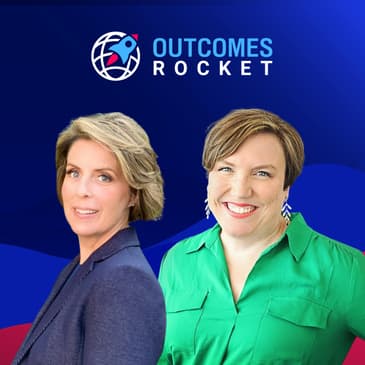
In this episode, Amanda Schleede, CEO, and Dr. Kelly Ayala, co-founder of Streamline Flow, discuss how their platform helps visualize and manage patient care plans across specialties. Streamline Flow is an EHR-agnostic solution that extracts data to create a visual timeline, alerting providers and patients to potential care plan deviations. Originally developed after nurses in a pulmonary clinic noticed patients missing appointments, the platform now supports diverse care settings, including assisted living. Amanda and Dr. Ayala also highlight the challenge of securing investment due to the non-billable nature of nursing services, revealing a misalignment of incentives.
Tune in and learn how this nurse-led innovation is transforming patient care!
Resources:
- Connect and follow Amanda Schleede on LinkedIn and email her here.
- Connect and follow Dr. Kelly Ayala on LinkedIn.
- Learn more about Streamline Flow on their LinkedIn and website.
Fast Track Your Business Growth:
Outcomes Rocket is a full-service marketing agency focused on helping healthcare organizations like yours maximize your impact and accelerate growth. Learn more at outcomesrocket.com
[00:00:01] This podcast is produced by Outcomes Rocket, your healthcare-exclusive digital marketing agency. Outcomes Rocket exists to help healthcare organizations like yours to maximize their impact and accelerate growth. Visit outcomesrocket.com or text us at 312-224-9945.
[00:00:29] Hello, everyone, and welcome back to another episode of the Outcomes Rocket. I'm excited to have you guys join me because I have two outstanding leaders in healthcare. First, I want to introduce you to Amanda Schleede. She is the CEO of Streamline Flow. And I also want to introduce you to Kelly Ayala. She's a nurse co-founder of Streamline Flow. And so excited to be joined by them to talk to us about what they do and how they're making a difference in healthcare.
[00:01:00] So welcome, Kelly and Amanda. Thank you. Thank you. So to kick things off, tell us what inspires your work in healthcare. Yeah, I am a practicing adult geriatric primary care nurse practitioner. I have been a nurse for more than 20 years. And what inspires me every day is actually knowing that quality and improving outcomes is not just a saying or something that we just talk about.
[00:01:29] It can actually be accomplished. And that's what I want for my patients. This kind of work is really often best accomplished when clinicians partner with their patients. And something that I'm trained in is motivational interviewing, which is a practice that helps me be a better listener. And it helps me be a better clinician. So it helps me look for how to engage patients and encourage them to select their own health journey and improve their own care. And it's individualized for everyone.
[00:01:57] It sounds like a really neat approach to care that's very, very intentional. So I love that, Kelly. Thanks for sharing that. You're welcome. Amanda, what about you? What inspires me to work in healthcare is I've actually been in healthcare for almost my entire career. I always jokingly say I play a nurse on TV, but I am not a nurse or a doctor, but have been involved in healthcare. And really for me, it's in my early years, it was always like, I really want to change healthcare.
[00:02:25] And then I realized, like, I just want to change a little bit of healthcare. So it's really just with what we do, putting it in front of patients and providers so that they can see really where patients are within their care plan and really manage that to keep them healthier and have better outcomes. That's awesome. Okay. Well, thank you, Amanda. Thank you, Kelly, for that. Certainly the North Star of many of the leaders on our show is strong, just like yours. Talk to us about Streamline Flow.
[00:02:53] What do you guys do and how do you add value to the ecosystem? Right. So Streamline Flow is a centralized platform that can track and manage patient care regardless of diagnosis. So we are EHR agnostic. We, through interoperability, we connect to any current EHR in the system through that hospital provider's instance of that EHR.
[00:03:14] And what we're able to do is pull the data out of electronic medical records and create a timeline, a visual timeline for patients and providers to see with regard to care. And it could be a simple timeline. Everybody has a care plan. So it could be a simple timeline of just a primary care, or you could have some, it could be more complex. So we could have cardiology, pulmonology, endocrinology involved.
[00:03:35] But we are the only technology that we are aware of that can visualize that timeframe and then also acknowledge when a patient is either at risk or at high risk of falling off that care plan so that the provider or the patient can then intervene and get themselves back on that care plan that's been identified by the doctor. Super interesting. And so really helping people stay on track of their care journey. What's an area that you guys have seen is really different?
[00:04:04] And any, as you guys have developed the technology, any obstacles that you guys have run into? What's interesting is when we talk to providers and you ask them a question, because one of the things that we can also do is identify patients that have been lost in the system or lost to care and leakage. Not my favorite word, but it is in healthcare. But we can identify when a patient or somebody has not fallen or has fallen off their care plan is not following it so that you can bring them back into your system.
[00:04:32] As I lovingly say, which is kind of the ugly side of healthcare, if a provider is not providing care, they can't bill for it. And so if you're able to keep your patients within the health system or within your provider practice, you can actually bill for those care items. What's been really interesting to us is when we talk to large provider systems is they have no way of tracking the loss of their patients or even tracking the care of the patients.
[00:04:57] So we can ask nurses or providers all the time, like, how do you know how many patients you've lost in the last year? Or how do you know that Amanda stayed on her care plan? And they just, they look at you like sometimes they're like, well, we use Excel. We send ourselves future emails. Like there's a bunch of different things that come on or that come up from them. And so for us, it's really being able to put all that data and information in one place. Thanks, Amanda. And Kelly, were you going to comment on that as well?
[00:05:23] Yeah, so we started Streamline Flow myself and my nurse co-founder Shannon in an academic pulmonary clinic. And when we originally started Streamline Flow, it was only because we started noticing we were missing patients that we expected to show up for care. And we thought when we originally developed Streamline Flow that it was only applicable to lung diseases. But what we discovered is that it's applicable to anyone receiving care in any setting.
[00:05:53] Including the assisted living that we did a pilot that was successful for. And the reason that we can make that claim is because nurses work everywhere. And when you're trying to get your care, you are going through a nurse no matter what your specialty is. And so we're really excited and trying to encourage health systems who want to innovate and who talk about innovating to think about how Streamline Flow could support their staff and get better outcomes at the same time. Love that. Yeah, appreciate you both.
[00:06:24] And yeah, there's a huge opportunity here. You hear about that patient leakage as Amanda had shared. And it's hard to put your finger on it. You guys have a solution for that. And that's exciting. As you think about biggest setbacks that have happened as you've built the company, what's one that sticks out and a learning that came out of it? Yeah.
[00:07:14] It wasn't something that they wanted to invest in, in a solution. And the reason was because the work of nurses is not billable in the United States. And I know, Saul, you've done a lot to support the work of nurses and try to encourage. And this is just, this is a true story. This is what we ran into was the answer is no, because there's a misalignment of incentives.
[00:07:36] So what ended up happening, the learning was at first we did nothing for a long time, except just sit there and think, what can you do? If you're a nurse that has an idea and you can't get support for it. Nurses are not independently wealthy because we can't bill. We're not building practices. And the learning really was, came out of actually Rebecca Love, who is one of my mentors. And she said, you're going to have to bet on yourself. And I, and so that's what we did.
[00:08:06] We developed Streamline Flow with our tech partners. Amanda came along and they helped bet on us. And I think that's, that's what we learned is we can forge a pathway forward here, even if the, at the federal level or the CMS level, we're not reimbursed for our services. I think that's great. And congrats. I love Rebecca, by the way. I was just with her at JP Morgan in San Francisco a couple of weeks ago.
[00:08:32] So I love that advice she gave that you took and you've surrounded yourself with an awesome team, with a leader in Amanda as well. I think it's such a great and inspirational story. Thank you for sharing that. Amanda, were you going to comment on that as well? The only thing I was going to add to it, and just to be a little bit more blunt, because I'm not the nurse, but I can say this. Nurses are the ones who are responsible for care follow-up and the scheduling and the coordination of patients and keeping patients on their care plans.
[00:09:01] Doctors write the orders and they determine the care for the patient. But even though nurses aren't billable, if nurses aren't doing their job to keep the patients on track and in the plan, then the doctors don't have anything to bill for. So at times we've had people say to us, well, nurses aren't billable, like Kelly brought up. And it's like, yeah, but if nurses aren't doing their job and keeping Amanda and Saul in the system and moving to their test results or their scan or whatever, then you aren't billing for anything.
[00:09:31] So it's kind of like this, as Kelly said, the incentives are misaligned because doctors need nurses to keep the care moving forward. Well said. Well said. I love that. I guess for the most part, but like, what about NPs? What they do in a practice that's billable, right? Yeah. So NPs, physician assistants and physicians, PTs, OTs, these folks all bill.
[00:09:56] They have, and what's called NPI numbers, registered nurses, which are the largest subgroup of healthcare providers. That's right. Got it. And we're the largest. We're commonly like, this is like year 24 of the most trusted group in America. People trust nurses and it's for good reason, but our services are hidden and because they're not billable. That's why there's a misalignment of incentives is because we're basically showing the value.
[00:10:26] We're using a different tool to show the value of what's actually being provided. And in addition, we're decreasing the work on the care team, which is really important. So a lot of stuff that comes up is presented to staff like you're going to do this. It's an innovation and it's extra clicks. It's extra work. That is not the case with Streamline Flow. We are decreasing the work on the care teams while improving outcomes. That's awesome. Well, super, super insightful discussion here, Kelly and Amanda.
[00:10:55] I really appreciate the work that you guys do to keep patients in the continuum of care, to keep nurses at the center of care, to raise the level of importance and value that we place on nurses. And I just want to say thank you. And for everybody listening, what closing thought would you leave them with? And what's the best place they could get in touch with you so they could learn more? Yeah, you can reach out to me easily at Amanda at StreamlineFlow.com.
[00:11:23] And our website is StreamlineFlow.com as well. So happy to talk to anybody who is interested. We're definitely looking for provider systems that are looking to increase patient outcomes. One of the things that we didn't talk about was our whole analytics engine, which is really something that is not available within EHR systems. And what we're doing is starting to get some interest from clinical trials about the ability to actually search and find patients that fit within clinical trials. Instead of digging through the EHR, you actually can find that information really quickly.
[00:11:53] But I think closing, we know that this is a new concept. We know that people want this. We know that providers want this. And they want to be able to visually see what's going on with their patients. But we also, on the flip side, think that and believe that patients want to see where they are in their own care continuum. If you just simply put a woman between the ages of 40 or 50 together with one high risk, their normal primary care physician with high risk like hypertension or diabetes,
[00:12:21] that could be over 25 tasks or appointments that need to be done in a year. And so for the average American who is not as well in depth of the health care, that can be very overwhelming and can be really easy to fall off their care plan. Totally. No, I appreciate that, Amanda. Thanks for sharing that. There's a big need. And Kelly, take us home. All right. So we're really grateful to be invited here. I've listened to Outcomes Rocket for some time.
[00:12:50] I originally liked it because it was called Outcomes Rocket. And I thought, you're welcome. So often I see health systems speaking out and advertising their outcomes, maybe like what they're doing to improve burnout rates on staff. Maybe you can get a second opinion on cancer care. It's a number of sort of advertisements or marketing tools. And what we've discovered in Streamline Flow is that we're climbing this hill to get systems to actually engage with us on a nurse-driven tool
[00:13:20] that will meet a lot of those claims. And so we are a solution created by nurses who are doing the work to get patients through their care plans. And who we're looking for is the people listening to have courage, the executives listening here who know that what we're saying is true, are willing to stand behind their enterprise's advertisements of innovation and care, and agree that we can do better for our patients and care teams. And as nurses, we know this. So let's do it.
[00:13:49] Let's make strides in improving quality concerns. Really, let's stop pinning the patient's entire care plan on the patient's job or the provider who can't take a vacation. Let's engage and make that change that's needed. You can find us all on LinkedIn individually, and you can find Streamline Flow on LinkedIn, and we'd welcome conversations around this. Outstanding. Kelly, thanks for that final close.
[00:14:14] And for everybody tuning in, yeah, let's put our actions behind our advertisements. I think that's where the wins are. And I want to congratulate Kelly and Amanda for taking bold moves and betting on themselves. The solution is super valuable. Check out the show notes to learn more. We'll have all the team's LinkedIn profiles there, as well as a link to streamlineflow.com for you to reach out, request a demo. Now's the time for you guys to make a difference.
[00:14:44] And Kelly, Amanda, thank you guys so much for spending some time with us today. Great. Thanks. It was wonderful. Thank you. This podcast is produced by Outcomes Rocket, your healthcare-exclusive digital marketing agency. Outcomes Rocket exists to help healthcare organizations like yours
[00:15:14] to maximize their impact and accelerate growth. Visit outcomesrocket.com or text us at 312-224-9945.