
How can dental practices adapt to the trend of dropping out of insurance networks while still maintaining financial stability and patient access?
In this episode, Marko Vujicic emphasizes the need for patient-centered, transparent dentistry, reimagining dentists as oral health physicians to drive preventive care. He highlights how leveraging technology, addressing insurance reform, and fostering innovative technologies and strategic partnerships are essential steps for creating a more efficient healthcare model and uncovering the potential for dentistry to enter a new "golden age."
Stay tuned for a stimulating conversation that promises to reshape your perspective on oral health and the future of dentistry.
Resources:
[00:00:00] Welcome to Think Oral, where we connect the unconnected between oral and physical health.
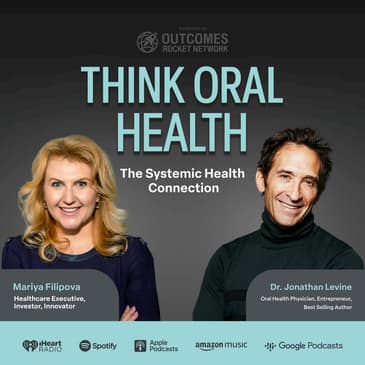
[00:00:11] I'm your host, Dr. Jonathan Levine.
[00:00:13] And I'm your host, Maria Filipova.
[00:00:15] Let's get at it.
[00:00:16] Dr. Levine, how are you today?
[00:00:26] I'm great, Maria.
[00:00:27] Great to see you.
[00:00:28] It's been a little while, right?
[00:00:29] It's been a while.
[00:00:30] I'm very excited because today we have a guest who not only knows the numbers, he is self-proclaimed
[00:00:38] data wonk and a nerd and an economist, a PhD, who has the creativity to envision a different
[00:00:47] world and the courage to go after it.
[00:00:49] And that's a very rare combo, right?
[00:00:52] The numbers, the creativity, the courage that goes with it.
[00:00:55] So I am incredibly excited about our conversation partner today.
[00:01:00] I'm pretty excited also.
[00:01:02] He's had such a senior role.
[00:01:04] When you think about an economist, the truth sets you free, right?
[00:01:08] So we're in a healthcare industry that needs change.
[00:01:13] And we've been talking so much about the integrated healthcare model, integration in dentistry
[00:01:18] where we talk better with the colleagues, but also the colleagues of dentistry can talk
[00:01:23] to the medical side.
[00:01:25] And how is that going to happen?
[00:01:26] It's going to be so interesting to hear Marco's take on this, some of these problems, solutions
[00:01:32] of what change would look like.
[00:01:35] And at the end of the day, we all have a choice to make.
[00:01:38] Do we take this change in front of us as doomsday scenario and see it as a threat to what we're
[00:01:45] doing today?
[00:01:46] Or do we see it as an opportunity?
[00:01:49] And there I say, there we say the golden age of dentistry coming up around the corner.
[00:01:54] And so let's get into it and see if this is truly a doomsday scenario or the opportunity
[00:02:00] that we might all be have been waiting for.
[00:02:03] I know you and I being eternal optimists, I know where we fall on that.
[00:02:06] So let's go.
[00:02:07] And I look forward to this podcast.
[00:02:10] Hello everyone and welcome to another exciting episode of the Think Oral Health podcast.
[00:02:15] I am pleased to share with you our conversation partner for today.
[00:02:20] Dr. Jonathan Levine and I are welcoming Dr. Marco Vujicic who is currently the chief economist
[00:02:27] and vice president of the Health Policy Institute at the American Dental Association.
[00:02:32] Some of you may know him previously as the senior economist with the World Bank in Washington,
[00:02:37] D.C.
[00:02:38] Personally, I'm very pleased to welcome another economist with a perspective of a business
[00:02:43] side into clinical and oral health.
[00:02:46] The little known fact about Marco is that he is a Canadian.
[00:02:50] So we're very excited to bring a Canadian to this conversation.
[00:02:53] And he also, he started his career as a ski instructor.
[00:02:58] So for those of you who are braving the ski slopes on the East Coast, you know,
[00:03:02] if you're on the East Coast, you could ski anywhere.
[00:03:04] Marco, welcome to the podcast.
[00:03:06] And we now know you don't like easy things if you're skiing on the East Coast and if
[00:03:10] you're taking on oral health and being an economist.
[00:03:13] We like people who take on big audacious objectives here.
[00:03:16] You got it good.
[00:03:17] So we'll talk about that in dentistry.
[00:03:19] But no, I'm super happy to be here.
[00:03:21] I'm excited to talk to you both and see where we can go.
[00:03:25] All right.
[00:03:26] So how about we just kick it off with the baseline, Marco.
[00:03:28] Give us the baseline.
[00:03:30] You have the data, you're looking at it longitudinally.
[00:03:33] What is the state of the dental practice today?
[00:03:36] And what are the key challenges that you're seeing in this post-pandemic world that regular
[00:03:41] dentists or dentists that are part of a larger organization like the DSO need to be thinking
[00:03:47] about?
[00:03:48] Sure.
[00:03:49] All right.
[00:03:50] And then just where am I drawing this?
[00:03:52] As you've heard, I lead a group called the Health Policy Institute.
[00:03:55] And just think of us as like data wonks.
[00:03:57] So we're like a think tank within the ADA.
[00:03:59] We crunch a lot of numbers.
[00:04:01] So a lot of the insights I'm bringing are based on that.
[00:04:04] But to get to your question, look, there are two big things right now that are super pain
[00:04:09] points.
[00:04:10] One is staffing shortages.
[00:04:12] And I'll talk a little bit about that.
[00:04:14] And the second is reimbursement and other pain points with insurers.
[00:04:19] Right?
[00:04:20] So I source a lot of data from a representative sample of dental practices across the board,
[00:04:25] right?
[00:04:26] DSOs, large groups, small practices, solos, et cetera.
[00:04:29] The last time we surveyed folks at the end of last year, we asked a series of questions
[00:04:34] about looking ahead to 2024.
[00:04:37] What do you see as the biggest challenges?
[00:04:39] And with staffing, I got to reiterate, the thing is we have roughly 90% of practices
[00:04:46] saying it's super difficult to recruit hygienists or assistants, okay?
[00:04:50] Among those that are on the job market.
[00:04:52] What's concerning me is that data point has not changed in 12 months.
[00:04:57] So it is a significant issue and it has not improved.
[00:05:02] Now we'll talk a bit, hopefully it has to be what I think in the next 18 months.
[00:05:06] That's issue number one.
[00:05:07] Number two is we have-
[00:05:09] Marco, could you reconcile that data point with the fact that we're seeing record admissions
[00:05:13] in hygiene schools and dental schools.
[00:05:16] So how do you look at those two data points as a data wonk?
[00:05:20] How do you look at those two data points and reconcile them?
[00:05:23] There's simply a lag.
[00:05:25] So admissions took a nosedive big time during COVID.
[00:05:28] They are now on the upswing, right?
[00:05:31] So we've had two or three years now, and I just posted this the other day on LinkedIn.
[00:05:35] We've had two, three years now of steady increases in admissions, in hygiene programs.
[00:05:40] And in 2023, last fall, we had the highest level ever.
[00:05:44] Almost 9,000 admissions in hygiene programs.
[00:05:48] That takes a couple of years to trickle into the job market.
[00:05:51] Two years ago, 18 months ago, I predicted we're not going to get out of this labor shortage
[00:05:56] quickly because it takes some adjustment for the pipeline to adjust.
[00:06:01] We're finally seeing that, but it takes a couple of years for those admissions to trickle
[00:06:05] into graduates and then to trickle into the job markets.
[00:06:09] In 18 to 24 months, we will see that incoming grad class and hopefully ease some of the shortages.
[00:06:16] So great point, Maria.
[00:06:18] And the second issue around the third-party pairs is, again, this is a theme I want to
[00:06:25] drive home and I want to talk to you both about.
[00:06:27] My theme in 2024 is margin compression.
[00:06:32] So we are seeing squeezes on the reimbursement side for various reasons we could talk about.
[00:06:38] I don't know where those will go, but if you ask me right now, we've seen pretty steady
[00:06:43] trends of reimbursement rates to dentists from insurers not keeping up with inflation.
[00:06:48] They've been rising, but not at the same rate of inflation.
[00:06:52] Whereas the expense side, staffing, equipment, even to some extent PE.
[00:06:58] Yeah, supplies, consumables.
[00:06:59] Right.
[00:07:00] We've seen those costs rising.
[00:07:02] So there is this squeeze and we got to face up to this.
[00:07:06] That's not going to go away in the immediate term here, in the short term.
[00:07:10] Marco, just to clarify this, you're touching one of my favorite topics around insurance
[00:07:16] models and reimbursement models.
[00:07:18] And I call it the payments infrastructure because you refer to it as insurance.
[00:07:24] In reality, are you distinguishing between dental benefits plans and medical insurance
[00:07:30] when you say compression of margin?
[00:07:32] How do you think about the role of dental benefit plans versus medical insurance coming
[00:07:37] in for some of the services and paying for some of the services that are delivered in
[00:07:41] the dental office?
[00:07:42] Well, I'm talking your classic private insurance dental benefit.
[00:07:47] I use insurance, I use it loosely.
[00:07:49] Let's clarify.
[00:07:50] So you're right, as economists, it's not true insurance in the sense of protecting against
[00:07:56] catastrophic costs and risk and all that.
[00:07:58] And now listeners are well versed in a distinction because Jonathan and I always go back to when
[00:08:02] you get a dental insurance, what you're getting is predefined set of services at predefined
[00:08:06] cost.
[00:08:07] Let's call it a benefit.
[00:08:08] And that's it.
[00:08:09] You're not, yeah.
[00:08:10] Yes.
[00:08:11] But the providers, the force I'm talking about, the reimbursement kind of stagnation, that's
[00:08:16] irrelevant to the type of risk model it is.
[00:08:19] It's just simply how we're paying you.
[00:08:20] I want to talk, let's get into the future of dental insurance.
[00:08:26] To close this loop, I feel in 2024, we're getting to perhaps some kind of tipping point
[00:08:35] because our latest round of data show a significant share of practices, 40% saying in 2024, they
[00:08:44] plan to drop out of at least some of the networks there in terms of insurance.
[00:08:50] Now, we haven't seen those kinds of numbers ever in terms of how high that is.
[00:08:55] So I could be reaching a point where the practices are saying, I don't think it's, I'm getting
[00:09:00] out of the insurance provider network full bore.
[00:09:04] I don't think it's that.
[00:09:05] I think it's let me be a little bit more selective about what networks I'm in, what plans I accept
[00:09:11] versus, oh, I'll take any kind of patient.
[00:09:14] Right?
[00:09:15] So I don't know, maybe that will lead to some changes in 2024.
[00:09:19] But as of now to go back to big pain points, the hiring, the shortages of labor.
[00:09:25] And as we said, 18 to 24 months, I think that will ease, but not immediately.
[00:09:29] And then this third party payer pain points.
[00:09:32] Again, we'll talk about how that ends.
[00:09:34] But right now it's to me looking like dentists are potentially saying I need to be more selective
[00:09:41] on which plans I'm in and out.
[00:09:43] And if I could just throw out to us, no, look, there's a large percentage of the overall
[00:09:49] dental revenue is 127 billion and growing in the next few years, always at about, I
[00:09:56] don't know, 3%, 4% CAGR.
[00:09:58] When we're looking at this whole industry, we have the fee-for-service dentist.
[00:10:02] Now you're looking at one, Prostanon, it's multi-specialty dental clinics, started a
[00:10:06] bunch of companies.
[00:10:07] But I look at it also on the fee-for-service side.
[00:10:10] The compression and the largest cost on a PNL or a provider is headcount.
[00:10:16] And so here you have the hygiene cost per hour is going up.
[00:10:21] You have consumables going up.
[00:10:23] And as Marco said, you have this compression on the margin and there's gotta be a tipping
[00:10:28] point where the dentist saying a little bit raised their hand and they say no mass, like
[00:10:32] I can't run a business like this.
[00:10:34] But then let's think about the fee-for-service side, American Dental Association, who is accountable
[00:10:40] to all of dentistry of on the fee-for-service side, how do the fee-for-service docs address
[00:10:46] this issue?
[00:10:48] And they have this advantage because they're not getting compressed on their pricing that
[00:10:53] they can have a coordinated fee service raise in relationship to inflation and the cost
[00:11:01] of goods and expenses.
[00:11:02] Marco, maybe you can talk a little bit about that from an economist standpoint and a data
[00:11:06] point standpoint.
[00:11:07] Yeah, is that what you're saying?
[00:11:08] If you're a fee-for-service dentist, you have more of your ability to weather that
[00:11:12] margin compression is higher.
[00:11:14] Is that what I'm hearing you both say?
[00:11:17] And Jonathan is completely right.
[00:11:19] Here's the challenge.
[00:11:20] That market from the patient pool is shrinking.
[00:11:24] So this is a really important point I want to bring in.
[00:11:28] We did a very detailed analysis.
[00:11:31] Think about taking all the butts and chairs in America.
[00:11:34] Select the patient pool of 160, 170 million people that go to the dentist.
[00:11:39] And we track over time, how are they paying for their care?
[00:11:43] Are they insured?
[00:11:44] Are they out of pocket fully?
[00:11:45] Like to Jonathan's point, a fee-for-service patient.
[00:11:48] Are they Medicaid covered?
[00:11:49] Are they Medicare covered?
[00:11:51] Because Jan 1, now Medicare is starting to pay for some select services for people.
[00:11:55] Okay.
[00:11:56] Long story short, we see a significant expansion of the patient pool that is covered by private
[00:12:04] dental benefits.
[00:12:06] We see a significant shrink in the patient pool that is fully out of pocket payment and
[00:12:12] uninsured.
[00:12:13] And then the Medicaid, depending on the timeframe we look at, in some timeframes it's ballooned
[00:12:18] like post ACA.
[00:12:19] In the last five years, it's actually stabilized.
[00:12:22] So Jonathan, my point is yes, if you're a dentist, that would be a market where you can avoid
[00:12:29] some of these pain points that we talked about through third-party payers.
[00:12:33] The challenge is that patient pool is actually shrinking.
[00:12:36] So we can't have more and more dentists going after that market.
[00:12:41] And I want to say this really bluntly, and this is very controversial, but it's just
[00:12:44] my take on the data, right?
[00:12:46] We can't be telling all the new grads coming out of dental school, you know what?
[00:12:50] You don't need to be in insurance networks.
[00:12:52] You can make a great practice just being full fee-for-service like Jonathan, right?
[00:12:57] They can't all do that.
[00:12:59] It's a great market.
[00:13:00] It's a niche market.
[00:13:01] It's segmenting of the patient pool, but on mass, it's not a growing sector of the patient.
[00:13:07] But Marco, knowing where is right down the middle of the highway.
[00:13:12] How did these young dentists then, and maybe they're joining a DSO or they're joining an
[00:13:15] existing practice, and look, you got 22, 23% of the industry being DSOs and growing exponentially
[00:13:21] as we all know.
[00:13:23] Isn't there a middle ground?
[00:13:24] As you say, you have growth in the private dental type programs.
[00:13:28] So maybe we need to think about what is that middle ground that addresses the dental insurance
[00:13:33] or the dental benefit world, but also addresses the ability to deliver care at a high level
[00:13:38] as it relates to technology and all the things that are the headcount and quality people
[00:13:43] and training and all the things necessary to really build a robust dental practice that
[00:13:49] addresses the needs of the patient.
[00:13:51] Where is that?
[00:13:52] One better, forget the middle of the road.
[00:13:53] Why don't we work full press, full court press on actually fixing this broken dental
[00:13:59] insurance model?
[00:14:01] So Jonathan, you're right.
[00:14:02] We're stuck and I'm very blunt about this.
[00:14:05] We are stuck with the worst of both worlds, so to speak.
[00:14:09] Right now, we have an insurance paradigm in dentistry that's broken for the patient, for
[00:14:14] me.
[00:14:15] Why all of a sudden does my treatment plan stop at $1,200, $1,400, $1,500 that has nothing
[00:14:21] to do with my clinical needs?
[00:14:23] Okay, for the provider side, we've talked a lot.
[00:14:26] It's also broken, right?
[00:14:28] Clinicians can't do the care that's medically necessary and can't get me back into optimal
[00:14:32] oral health because I have this whole set of rules that are not science and clinical based,
[00:14:37] but the market is the market.
[00:14:38] So my point is, I see the huge opportunity, Jonathan, is to reform and regulate this private
[00:14:47] dental insurance model in a way that now benefits patients and clinicians, and you know who
[00:14:52] it won't benefit, right?
[00:14:54] So I got to tell you, this is priority one within the ADA and our DC team and our advocacy.
[00:14:59] There's been a lot of great activity.
[00:15:01] For example, in Massachusetts, we have something called medical loss ratio requirements.
[00:15:06] It's a way to regulate insurance so that, hey, if you bring in X dollars in premiums,
[00:15:12] you have to pay out 83% of that in claims.
[00:15:16] You can't just keep it all in administration and profits.
[00:15:19] So that's a reform that January 1 went into effect in Massachusetts.
[00:15:23] Many other states are doing it.
[00:15:25] We're working hard in DC at the federal level that ERISA reform and these larger things
[00:15:31] trying to regulate this insurance so it actually behaves like true insurance.
[00:15:34] I think that's more important, Jonathan, than trying to, in a sense, accept this status quo
[00:15:40] and find some middle ground.
[00:15:41] How do you do it?
[00:15:42] So I think that's big.
[00:15:43] I love that you went there because the DLR, I mean, I'm not saying that it's not a good
[00:15:48] DLR, and I got to tell you, we all have seen the parallel to this in the medical side,
[00:15:53] the medical loss ratio versus the dental loss ratio.
[00:15:56] And at a conceptual level, we see that it makes sense to us, the insurer, to make sure
[00:16:03] that they do what they're paid to do, right?
[00:16:06] Some of the premiums are going to actual clinical claims rather than administrative work.
[00:16:12] And that would, at least in an ideal state, encourage all of these benefit providers to
[00:16:18] be more efficient.
[00:16:20] That said, though, what we've seen, the way this has played out on the medical side is
[00:16:24] that even though we've had MLR, medical loss ratio, on the medical side for decades now,
[00:16:30] we're seeing that it becomes effectively the battle for the denominator.
[00:16:34] What is qualified as medical expense and what is qualified as admin expense?
[00:16:40] In effect, we haven't seen the cost of care come down dramatically after the MLR has been
[00:16:47] adopted on the medical side.
[00:16:49] So I love that you're going there because I think there is an opportunity to redesign
[00:16:54] and make the dental benefits industry more effective and help with access to care and
[00:17:01] higher quality care.
[00:17:02] I don't know if just passing a DLR is the answer.
[00:17:06] We need to make sure that once it's...
[00:17:08] The work doesn't stop there because we need to make sure that both the benefit companies
[00:17:12] and the patients and the providers are actually behaving in the intent of the law rather than
[00:17:19] trying to maximize where things are qualified.
[00:17:21] You're absolutely right.
[00:17:22] So it's not a panacea, to be clear.
[00:17:24] So it's not a silver bullet.
[00:17:25] I love how you frame this up.
[00:17:27] To me, it's one tactic in a larger kind of game plan to bring accountability and reform,
[00:17:34] right?
[00:17:35] The MLCA, the MLR was one provision, right?
[00:17:38] There was also a lot of other provisions saying we will define an essential health benefit,
[00:17:43] right?
[00:17:44] The Affordable Care Act did that for the first time.
[00:17:46] It said if you sell insurance, you must cover these 10 essential services.
[00:17:50] Okay?
[00:17:51] So there was another thing that said, frankly, I feel we need some of that in dentistry.
[00:17:56] Like you look at these ads late at night on TV and what they're selling in terms of Medicare
[00:18:01] Advantage and you get dental and you look at the data.
[00:18:03] It's okay.
[00:18:04] This is some of these plans are covering one visit and that's it.
[00:18:07] That shouldn't be the case, right?
[00:18:08] I think there's a need to define an essential oral health package of services that's core
[00:18:15] and regulate that.
[00:18:16] MLR is another one.
[00:18:18] It's another thing.
[00:18:19] The Affordable Care Act put in out-of-pocket limits.
[00:18:23] So a family cannot incur more than, I don't know what it is today, $15,000 in out-of-pocket
[00:18:29] healthcare costs.
[00:18:30] So if you get really sick pre-ACA, you would potentially have to go bankrupt.
[00:18:36] If you have coverage now under the medical side, again, it's governed by the ACA regs
[00:18:42] and you get super sick, like your out-of-pocket is limited.
[00:18:46] Not what the insurer pays, which is our world, right?
[00:18:49] So our world does the insurer liability is limited.
[00:18:53] Whatever it is, $1,500 on average.
[00:18:56] Sick or healthy, Marco, you're on the hook.
[00:18:58] Only after that, you want to do crowns and endo and all this.
[00:19:02] Great.
[00:19:03] But once you run out of the money, you're on the hook.
[00:19:05] So my point is we're dancing around this issue, right?
[00:19:08] The bigger picture, Maria, I think that you're raising is, and maybe this is not to go into
[00:19:14] detail here today, but because dentistry is governed outside of broad healthcare, frankly,
[00:19:21] the plans are exempt from so much regulation.
[00:19:25] And a lot of this regulation really makes sense.
[00:19:28] And I think that's something maybe we missed along the way.
[00:19:32] There's a strong desire for independence among clinicians.
[00:19:36] People want to keep dentistry separate and not part of healthcare and all that.
[00:19:41] There's consequences.
[00:19:42] I'm not saying do it or don't do it, but understand the consequences.
[00:19:45] The consequences are that the plans were also exempt from a lot of these accountability
[00:19:50] regulations and that's where we are today.
[00:19:53] But I think there's a way to change this.
[00:19:55] And what's the role of dentists?
[00:19:57] Like Jonathan is the outlier here who is a pioneer and who loves change.
[00:20:02] Probably he is in a, in the very much the, I would call it a minority of the dentists
[00:20:07] we practice today.
[00:20:09] Change is a scary thing.
[00:20:12] It's going to require a lot of change to take dentistry from a trade that's being on its
[00:20:18] own, doing its own thing to an integral part of the team, clinical or health team for a
[00:20:26] patient.
[00:20:27] And so how do you as part of the health policy institute at the ADA, how do you see the role
[00:20:32] of the dentist changing so that we could have this integrated view of what is the necessary
[00:20:40] intervention and treatment for the patient irrespective if it lives on the dental side
[00:20:44] or in the medical side, because practitioners are oral physicians, oral health physicians
[00:20:49] like Jonathan here are talking about C.
[00:20:52] They're talking about A1C levels, right?
[00:20:55] It's just, what is the role of the dentist here and how do you see the path to creating
[00:20:59] more of those integrated health staff?
[00:21:01] Now you're getting it Maria, that's where we want to go.
[00:21:05] But Margot, this is all about connecting the dots of oral health and overall health.
[00:21:09] And I do think where Maria is going is an exciting place within the context of the reinvention
[00:21:14] of the dental insurance.
[00:21:16] Because if we go upstream in dentistry, they go to the dentist or they go to their physicians
[00:21:21] and we're looking at blood pressure and even the basic vitals and we think wellness versus
[00:21:26] sickness model, we can save insurance companies millions of dollars and dentistry can become
[00:21:31] part of the healthcare system the way it needed to be.
[00:21:34] I love that question Maria and it's the heartbeat of what we love to talk about.
[00:21:39] Look, I'll be very clear.
[00:21:42] I think we are about to enter a golden age for this profession.
[00:21:47] I feel we have an opportunity and we're at a crossroads with all the trends and forces
[00:21:53] going on to really redefine and elevate dentistry and leverage dental care providers in ways
[00:22:00] we've never done before.
[00:22:02] It is super exciting.
[00:22:03] As Jonathan mentioned, there's people that are walking heart attacks waiting to happen
[00:22:08] that are seeing their dentist, but they're not going to any sort of other primary care provider.
[00:22:13] What if dentists were actively engaged in screening for these chronic conditions and
[00:22:20] reimbursed for it?
[00:22:22] That's complicated.
[00:22:23] Jonathan, data systems.
[00:22:25] I don't know your personal practice, but how many practices are using something like an
[00:22:29] epic patient record that is easily integrated, right?
[00:22:33] Very few.
[00:22:34] But that's where the future is going.
[00:22:37] I see dentistry finally being able to flex its muscle as the beacon of prevention, leveraging
[00:22:44] dentists as an additional touch point to the population to leverage all the preventive
[00:22:49] care not in the mouth, but taking salivary diagnostic, taking basic vitals in the office
[00:22:55] and somehow getting rewarded and reimbursed through that.
[00:22:59] That's the challenge, but that's not going to happen if we keep wanting to be separate
[00:23:04] and not part of healthcare.
[00:23:06] We're at this road where you got to almost reimagine what the profession is.
[00:23:11] And I certainly have my viewpoints on where the young generation of dentists sees themselves.
[00:23:16] I think it's much more open to this.
[00:23:18] Let's be core primary care providers.
[00:23:20] And by the way, there'd be millions of more people coming into the dental offices as well.
[00:23:24] Can you imagine if every newly diagnosed diabetic in America in 2024 automatically had to go
[00:23:31] get a dental screening?
[00:23:32] Thank you.
[00:23:34] This is millions of more people coming into dental offices, right?
[00:23:38] Okay.
[00:23:39] Maybe we're super busy today and we don't have the staff to absorb them, but I mean,
[00:23:43] we'll fix that.
[00:23:44] You're talking about expanding the reach and the power of oral health.
[00:23:48] And I feel things are aligning.
[00:23:50] That's why I'm super excited.
[00:23:52] So this is an economist excited by the way.
[00:23:56] This is always as exciting as it gets.
[00:23:59] You are absolutely right because we are looking at it from the oral health perspective.
[00:24:04] Outsiders are looking at this space and actually happen to agree with you, right?
[00:24:08] I was just at a conference with Judy Faulkner, the CEO founder of Epic.
[00:24:12] We know, actually, I don't know if our audience knows, but Epic looks at oral health and the
[00:24:18] dental space as their next frontier for growth.
[00:24:21] Not only are they developing the kind of a dental specific product that is being piloted
[00:24:27] with Pacific Dental, but they also are having a team that is right at the core of their
[00:24:33] new product offering.
[00:24:34] So when you talk about dental as an opportunity for integrated care delivery, that's if we
[00:24:41] don't do it on ourselves from as the people who are doing dentistry, dentistry, the outsiders
[00:24:47] are going to come in.
[00:24:48] Right?
[00:24:49] What's your reaction?
[00:24:50] Like you're, you're in the front lines, right?
[00:24:52] So is this, do you feel like most dentists are like, interesting, but like what I'm doing
[00:24:57] the dental part only, or do you feel they're excited en masse for this new opportunity?
[00:25:02] It's a great question.
[00:25:03] Look, for me, it always comes down to leadership.
[00:25:06] The leadership has to drive certain changes.
[00:25:09] The changes we're talking about within the industry.
[00:25:11] If those changes are in place, the word dentist is a problem.
[00:25:15] We have to rebrand the industry.
[00:25:17] We're oral physician, number one.
[00:25:19] 58 systemic inflammatory diseases directly correlate to inflammation in the mouth as
[00:25:24] we know.
[00:25:25] The pH of the mouth is a huge indicator of health in the mouth.
[00:25:28] Stylopathy diagnostic.
[00:25:30] In my practice, I'm multi-specialty.
[00:25:31] I'm prosthodontist, two other prosthodontists, I'm periodontist, two orthodontists, ceramist,
[00:25:37] the whole thing.
[00:25:38] But the hygiene room is the center of innovation.
[00:25:41] Stylopathy diagnostic, basic, standard of care.
[00:25:45] Anybody with inflammation, CBCT, standard of care.
[00:25:48] Everybody gets a CBCT.
[00:25:50] Less radiation, much more information.
[00:25:52] I got bite wings off the new Ray Scan and Planvaca, and all of them, all the new CBCTs.
[00:25:58] Everybody gets scanned.
[00:25:59] Everybody gets an internal scan.
[00:26:01] If we had reimbursement for mad appliances for CBCT and scanning, we would be able to
[00:26:06] get very upstream in a preventative model.
[00:26:10] Why?
[00:26:11] Because hypertension, diabetes, and cardiovascular disease is directly related to how well people
[00:26:15] get into deep regenerative sleep.
[00:26:17] We need leadership.
[00:26:18] So I think practices like mine, these kind of conversations with people who could really
[00:26:23] start reinventing how we think about benefits and dental insurance and drive that, especially
[00:26:30] with this young generation.
[00:26:32] This young generation, it's exciting for everybody because the dental schools are now training
[00:26:37] them on digital workflow, all the new technologies.
[00:26:41] And our diagnostics are really going deep.
[00:26:44] And as we were saying, people come to the dental office more than they come to physicians.
[00:26:48] So if they're able to share on a universal health record, and I'm working on some things
[00:26:52] where we're looking at patient portals for our patients so they have access to all that
[00:26:56] care.
[00:26:57] The dental model is broken.
[00:26:59] I'm going to send to a periodontist, I have a perio issue, I'm not going to get an information
[00:27:04] or call back maybe in two weeks, they're going to lose my records.
[00:27:08] And here we go again, and they steal the patient of the general dentist.
[00:27:11] So that's over.
[00:27:13] That's over.
[00:27:14] So we have specialists, restorative dentists, the general dentist in an ecosystem, shared
[00:27:18] information with an integrated business model of medicine and dentistry and integrated within
[00:27:22] dentistry.
[00:27:24] We've been so fragmented, but you said something so true, we have such a convergence of trends,
[00:27:28] it's feeling it now.
[00:27:30] Things can really change.
[00:27:31] But I think it does take leadership and I think the group like the American Dental Association
[00:27:36] can drive some of this change, rebrand what a dentist, who they really are, and really
[00:27:41] build the roadways to this integration and to make the change.
[00:27:47] And God bless this new generation because they got the energy, they're going to bring
[00:27:50] the energy to make the change.
[00:27:51] Dentists make people healthy.
[00:27:53] This is not just about the mouth.
[00:27:56] Dentists make, or the dental team makes people healthy.
[00:27:59] So the point is, let's position ourselves that way.
[00:28:03] Let's get reimbursed that way.
[00:28:04] And then what are the rules?
[00:28:05] I love that you said like at the ADA, this is where honestly we have an incredible influence.
[00:28:11] We have a great lobbying arm.
[00:28:13] What are the rules and regs that need to change to unleash the power of Jonathan and his team?
[00:28:19] You know what I mean?
[00:28:20] Because there's so many things standing in the way right now.
[00:28:23] And how do we de-risk and make this change less scary?
[00:28:26] And make it less scary, right?
[00:28:28] But I think that's part of educating and identifying the opportunities and all that.
[00:28:32] And there's a lot of, this is not, this is boring stuff, but there's a lot of nitty gritty
[00:28:37] that I think people don't understand goes on behind the scene.
[00:28:41] Like electronic information exchange, the fact that a record from Jonathan's office should
[00:28:46] talk to a record from another office and should talk to a physician's record in a seamless way.
[00:28:52] There are technical specs like the ADA does so much of this behind the scenes, right?
[00:28:57] AI, we can touch on this, but AI is going to revolutionize dentistry.
[00:29:01] Great.
[00:29:02] Make sure there are proper standards on what that AI is doing, right?
[00:29:07] We're working on that.
[00:29:08] So this is very non-dramatic stuff, but in the end of the day, providers I feel don't
[00:29:14] understand how important it is that kind of these behind the scenes regulations go on.
[00:29:19] And we do that every day.
[00:29:21] Look, if we take the new innovation, we take new technology, salivary diagnostics, understanding
[00:29:26] of sleep, the new CBCT, the cone beams that we have for our patients, there becomes some
[00:29:32] reimbursement model, some benefit model for this prevention.
[00:29:37] We drive more people to the dental office than we have an integrated healthcare model
[00:29:40] with our medical colleagues.
[00:29:42] You take a blood pressure, it's high, it's up, cardiologists, internists need to know
[00:29:46] about it.
[00:29:47] We could prevent an event from happening on and on of going to a wellness model.
[00:29:52] But integrating the service side coupled with these young dentists, the young energy coming
[00:29:57] out with the proper changes coming from places like the American Dental Association, because
[00:30:02] we need to architect this change.
[00:30:03] It's happening.
[00:30:04] It's happening.
[00:30:05] It's going to come.
[00:30:07] I think all three of us are optimists, Maria.
[00:30:09] We are optimists.
[00:30:10] You heard it here.
[00:30:12] Dentistry is about to enter in the golden age of dentistry.
[00:30:16] And so this is, it's ours to make the most out of it.
[00:30:20] And I go back to, I think we covered the role of the dentist.
[00:30:23] We covered the role of organizations with huge influences and platforms like yours.
[00:30:28] We covered the role of plans providers a little bit.
[00:30:32] What do you think the role of the patient needs to be and how does it change?
[00:30:38] And what is also the role of the ultimate payer?
[00:30:42] Because when we talk about there's this misnomer that insurance company pays for the claim,
[00:30:46] it's actually the self-insured employer or CMS.
[00:30:50] And so is there any talking about rebranding and reframing the conversation to the self-insured
[00:30:56] employer?
[00:30:57] Walmart spends $2 billion on healthcare costs for their employees and their dependents.
[00:31:03] That's not a small amount on the P&L of a company.
[00:31:06] So how do we need to engage patients differently, self-insured employers differently to bring
[00:31:13] them along in that future state of oral systemic health?
[00:31:16] I love the question.
[00:31:18] I don't, I can give you some thoughts, but that is the next right question.
[00:31:23] On the employer side, I think we need to rebrand what Jonathan said, the value proposition
[00:31:30] of oral health and by surrogate, the dental benefit employers are buying for their employees
[00:31:35] or self-funding.
[00:31:36] This idea of, okay, we'll take the status quo to checkups a year, this and that, maybe pregnant,
[00:31:42] maybe diabetes, you get some enhanced benefit.
[00:31:44] That's the next innovation we're seeing in the market.
[00:31:47] I think we need to step back and say, let us absolutely rethink all of this.
[00:31:53] So one thing there's a group of us under the World Economic Forum that have started an
[00:31:58] oral health interest group that is trying to now talk to Fortune 500 communities, to
[00:32:04] the CFOs to say, look, your employees will be healthier, happier, miss less work, be
[00:32:12] more productive.
[00:32:13] If you have...
[00:32:14] More loyal.
[00:32:15] They're more likely to stay with you.
[00:32:17] If you have a true comprehensive dental benefit that actually gets their mouth back to a true
[00:32:22] speak smile happily, not these procedures are covered.
[00:32:26] These are not this many times, not get the mouth back to optimal oral health.
[00:32:31] So I feel we're starting there, but we need to do that Maria.
[00:32:35] We need to be in different circles.
[00:32:37] We need to be talking to financial people.
[00:32:40] Jonathan mentioned all the cost savings, right?
[00:32:44] It's not a public health ministry of health conversation.
[00:32:46] That's literally the CFO in the ministry of finance.
[00:32:49] That's exactly right.
[00:32:50] It's not even the head of benefits, right?
[00:32:52] We have huge respect for the folks that had a benefit.
[00:32:55] They're trying to do so much with little resources.
[00:32:58] This needs to be a C-suite conversation.
[00:33:00] So that's part of leadership, right?
[00:33:02] We were like, okay, and this was in partnership with Colgate and Henry Schein and the ADA.
[00:33:06] We're like, Hey, World Economic Forum, can you convene some conversations among the Fortune
[00:33:10] 500 community for us?
[00:33:12] So that's moving.
[00:33:13] That's an example on the public.
[00:33:15] I think that is a, I have two thoughts there, right?
[00:33:19] One is we are seeing more consumerism, that type of behavior of, I want outcomes, I want
[00:33:29] results.
[00:33:30] I want things super quick.
[00:33:31] I want things super convenient.
[00:33:33] I need to quickly be able to book a dental appointment and I want to know the quality
[00:33:37] and the outcomes and this guy and the price.
[00:33:39] So there's a whole wave of young generation consumers, patients bringing a consumerist
[00:33:45] attitude to healthcare and dentistry is caught up in that.
[00:33:49] I fundamentally think that's a good thing because I think it will push us to be much more patient
[00:33:54] centric, much more convenient for patients, much more transparent.
[00:33:59] The days of iPhone, a receptionist gives me options, they're over.
[00:34:04] This is a few clicks on your phone to book an appointment.
[00:34:07] It's not that I'll move on to the next provider.
[00:34:10] That's the future.
[00:34:11] The other thing is, I don't know how successful we've been in actually talking to the public
[00:34:19] about the value of oral health and I'm not an expert in this, although it doesn't stop
[00:34:23] economists from pontificating, but I think we are talking too much in an echo chamber
[00:34:29] to ourselves and I think we need to think of very different influencers or messengers.
[00:34:37] Like it's different if the dental community says you should do X, right?
[00:34:42] You should see your dentist boy C or you should, if you're, if are a high risk for
[00:34:46] diabetes, you should be going for screening.
[00:34:49] So let me take up on this.
[00:34:50] Yeah.
[00:34:51] A hundred percent agree with you.
[00:34:52] I believe we are, there are strong messages, but the, in that echo chamber of the oral
[00:34:58] health ecosystem, why is it that organizations with platforms like yours are not picking
[00:35:05] up on the data points?
[00:35:07] Like recently in January, as early as recently as January, there was an article about a former
[00:35:13] NFL player who died at 36 because he didn't treat his cavities and he had infection and
[00:35:21] sepsis and travel to his brain.
[00:35:23] And he flatlined when he fell at a construction site.
[00:35:26] Why is it that your association and is not partnering with these other sports athlete,
[00:35:33] professional sports associations to raise awareness because peak performance includes
[00:35:40] your oral health and pick your any other ones, the hockey league, the national basketball
[00:35:45] association.
[00:35:46] It's, it doesn't have to be the NFL only.
[00:35:48] So the door is getting open.
[00:35:51] It's the truth.
[00:35:52] Look at Andrew Huberman, look at Mark Hyman, look at all of the functional medicine doc,
[00:35:59] taking a different approach than Western medicine philosophy of a sickness model.
[00:36:03] Talking about nutrition, talking about sleep, talking about fitness, talking about mindfulness
[00:36:09] and stress management for longevity, all of these types of things.
[00:36:12] It's the same thing in dentistry.
[00:36:14] The collective healthcare model that now 20% of the GDP has to change.
[00:36:19] We got a problem.
[00:36:20] Everybody agrees with that.
[00:36:21] Okay, good.
[00:36:22] How do we get upstream?
[00:36:23] This whole conversation is literally about upstream.
[00:36:26] And I love what you said, Margo, about, about the consumerism because as Steve Thorne would
[00:36:32] say, right, our good friend from Pacific awareness drives consumerism.
[00:36:36] So now as the consumer really knows more and it's up to us to educate the industry, we
[00:36:42] need to educate.
[00:36:43] I'm doing my best.
[00:36:44] I got a book coming out next quarter called Get Oral.
[00:36:47] Could you imagine?
[00:36:48] My editor actually liked that name, but you got to grab people.
[00:36:52] This book is going to be all about the connection of the mouth and the rest of the body.
[00:36:56] And we need to elevate in the books all about elevating this profession.
[00:37:00] I love what you said, Margo, about elevating profession because we need to bring medicine
[00:37:04] and dentistry together for a more efficient business model.
[00:37:08] That's the heartbeat of it.
[00:37:10] Such a Maria, pretty exciting conversation.
[00:37:13] I'm calling out all the associations because I think that there is an opportunity.
[00:37:20] I think the door has been opened.
[00:37:21] We just need to have the guts to walk through it.
[00:37:25] And this is part of, forget about why we did it, why we didn't.
[00:37:29] We don't have yesterday again.
[00:37:31] Looking forward, I love what Jonathan said.
[00:37:33] We're all agreeing there's an opportunity here.
[00:37:36] And the idea now is, and Maria, you, I'm really glad you brought that example in, right?
[00:37:41] It's tragic, but it hits home and it is a different audience and it's a different
[00:37:46] set of messengers that need to carry this.
[00:37:48] And we can do this.
[00:37:50] It's just, it's different.
[00:37:51] Like there are, like it or not, you know, you mentioned Andrew Huberman.
[00:37:54] There's a lot of people that are very influential in terms of health behavior and stuff.
[00:37:59] Let's go talk to them.
[00:38:00] Let's go talk to them.
[00:38:02] Let's get Jonathan out on the road.
[00:38:04] Come on the ADA podcast.
[00:38:07] Let's get you out.
[00:38:08] Let's go.
[00:38:10] I have a thought and I want to share it with you, Mark.
[00:38:11] I would like to see the ADA go front and center with the corporate partners, the Colgate's,
[00:38:17] the Henry Shines, and whoever wants to join them and create a task that's with insurance
[00:38:22] companies and create a task force.
[00:38:23] And I want to have the clinicians like myself involved because we are at the front line
[00:38:29] and it's a practice like mine, the DSO CEOs or the clinical directors of a Pacific Dental
[00:38:35] that's navigating those roads of fee-for-service and benefits and get the collective to help
[00:38:42] drive the change because it's going to happen.
[00:38:46] But as we know that life is a team sport and so is healthcare.
[00:38:51] And we got to bring everybody together, all of our stakeholders together.
[00:38:54] I totally agree with you.
[00:38:56] And with one caveat, and this is important viewpoint of the world, A is Oral Health Pays
[00:39:02] Dividends.
[00:39:04] And it's really great.
[00:39:05] More people come into the dentist, tell the public about this and more people will show
[00:39:10] up and pay full fee out of pocket.
[00:39:13] That I feel is not necessarily the reality.
[00:39:16] To achieve that vision of millions of more people with a dental home, millions of more
[00:39:21] people knowing easily if I get screened for this condition, I know my nurse practitioner,
[00:39:28] my PCP, somebody, the CVS pharmacist is going to say, I'm filling your diabetes management
[00:39:34] meds.
[00:39:35] Let's ask you if you've had a dental screen in the past two years.
[00:39:38] To make that happen is not just giving messages to the public.
[00:39:41] It requires systems change.
[00:39:43] And we talked earlier about this, right?
[00:39:45] We talked about like, how do you, if people don't have good coverage and they're like,
[00:39:50] I can't afford this.
[00:39:52] What do we do?
[00:39:53] I feel there's a reform potentially there.
[00:39:55] Let's get good coverage that actually covers the services needed and is adequately funded.
[00:40:00] Okay.
[00:40:01] We're working on that.
[00:40:02] We're trying to get regulations to make sure that happens.
[00:40:04] My point is though, and we're both, you guys are both leaders on the disruptive change
[00:40:09] field.
[00:40:10] So I don't want to send the message that the model as it is today is going to be sustainable.
[00:40:16] We just need to get more patient traffic by making the case to consumers.
[00:40:20] It's going to require some systems change.
[00:40:22] And Jonathan, you said it right.
[00:40:23] We're already seeing this.
[00:40:25] We're seeing new early career dentists in different models than the previous generation.
[00:40:30] If you look at late career dentists today, 50% are in solo practice.
[00:40:34] If you look at early career dentists, it's 17%.
[00:40:38] So you mentioned Jonathan, 20 something percent of the market is DSOs.
[00:40:43] That's very different than five years ago.
[00:40:45] So I feel like we're already seeing the practice model evolves to actually enable the kind
[00:40:52] of reforms and change you're both talking about.
[00:40:54] So this is why it's exciting.
[00:40:56] I feel things are aligning, right?
[00:40:58] I guess that's our thing today.
[00:40:59] I don't think it's going to be hard.
[00:41:00] Hopefully our listeners are also hearing that change doesn't have to be hard.
[00:41:05] And it's the role of innovation technology and experts and influencers and decision makers
[00:41:11] like us here and our listeners to make that transition from dentistry of today to dentistry
[00:41:16] of tomorrow easier and less scary.
[00:41:19] Because I'll tell you what, your example.
[00:41:21] I go back to my conversation with Jodi Faulkner.
[00:41:24] Epic has the diagnosis of all patients who are diabetic.
[00:41:29] And so when the primary care physician sees the patient, Jonathan, a pop-up in Epic could
[00:41:35] say, has your patient, Jonathan being seen by a dentist?
[00:41:40] Click here to schedule an appointment.
[00:41:43] That's all we need to do.
[00:41:44] And Epic's already interested in looking at this and advancing that change.
[00:41:49] So it doesn't have to be any more complicated than a pop-up.
[00:41:52] And we can just pile on to our primary care physicians and oral health physicians to say,
[00:41:56] do more, ask more questions.
[00:41:58] We have to make it easy and integrate in the workflow.
[00:42:02] And that's already underway.
[00:42:04] That's the conversation where I think it needs to go.
[00:42:06] So last question as we close, Marco, if you had advice to those brave entrepreneurs looking
[00:42:15] to build solutions, grow companies in oral system health, where would you point them
[00:42:20] to explore?
[00:42:21] Where do you see the opportunity for the next billion dollar company in oral health?
[00:42:25] To facilitate meaningful collaboration with primary care.
[00:42:29] That's how I would say it.
[00:42:31] I feel that's the next frontier and there's tech problems to solve.
[00:42:36] There's data problems to solve.
[00:42:38] There's patient workflow, as you said, problems to solve.
[00:42:42] There's insurance reform that needs to happen.
[00:42:45] Okay.
[00:42:46] So it pops up, it says go for a dental screening.
[00:42:49] That person's I don't have coverage.
[00:42:50] Thank you.
[00:42:51] Bye.
[00:42:52] Okay.
[00:42:53] We don't want that situation.
[00:42:54] So I want to bring it back to, I really feel like positioning dentistry as a primary care
[00:42:58] touch point and promoting collaboration with primary care is the next frontier.
[00:43:04] And there are many ways that can happen, many models.
[00:43:06] But I feel if I asked the entrepreneur community work on that.
[00:43:10] Maria, this was just one of the most exciting podcasts we've had.
[00:43:15] Marco, you've been amazing because you're not just a numbers guy.
[00:43:18] That would you prove to us and we need this conversation to continue.
[00:43:24] I would love to hear what you're going to be working on, how Maria and I and people
[00:43:30] we know can be helpful in this effort because we're incredibly passionate about creating
[00:43:35] a more efficient or effective healthcare model for everyone.
[00:43:39] And I think we all share that vision.
[00:43:41] Please come back and keep us updated.
[00:43:43] Lastly, if our listeners want to get involved, hear more about what you're doing guys, please
[00:43:49] follow Marco on LinkedIn.
[00:43:50] He's really great at posting on the latest research and connecting to his network.
[00:43:55] How else can our listeners stay involved?
[00:43:57] So follow me on LinkedIn.
[00:43:59] We release a lot of research that way.
[00:44:01] So if you go to ADA.org slash HPI, there's an easy sign up to our newsletters.
[00:44:08] They connect it and you could also browse some of these economic updates that I've talked
[00:44:13] about, but you could connect with us that way as well.
[00:44:17] Thank you for joining us, Marco.
[00:44:18] Until next time.
[00:44:19] Thank you for having me.
[00:44:20] Super exciting.
[00:44:21] And this is a golden era coming.
[00:44:22] So thank you.
[00:44:29] Thanks for listening to the Think Oral podcast.
[00:44:31] For the show notes and resources from today's podcast,
[00:44:35] visit us at www.outcomesrocket.health slash thinkoral,
[00:44:42] or start a conversation with us on social media.
[00:44:46] Until then, keep smiling and connecting care.