
The healthcare industry is drowning in billing errors, compliance challenges, and outdated technology.
In this episode, John Bright explains how ambient AI, interoperability fixes, and real-time compliance checking can transform medical records. He shares insights into his work creating point-of-care solutions that leverage AI to generate comprehensive, compliant medical records from ambient conversations. Finally, John explores the limitations of current EHR systems and touches on the concept of human-in-the-loop machine learning and the future of insurance and healthcare technology.
Tune in and learn how AI is revolutionizing medical documentation and compliance, leading to better patient care and streamlined billing processes!
Resources:
[00:00:01] This podcast is produced by Outcomes Rocket, your healthcare-exclusive digital marketing agency. Outcomes Rocket exists to help healthcare organizations like yours to maximize their impact and accelerate growth. Visit outcomesrocket.com or text us at 312-224-9945.
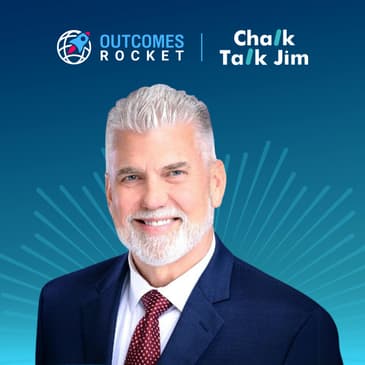
[00:00:29] Welcome to the Chalk Talk Gym podcast, where we explore insights into healthcare that help uncover new opportunities for growth and success. I'm your host, Jim Jordan. Today, I'm excited to welcome John Bright to our show. John is a healthcare technology pioneer with over 20 years of experience in medical claims compliance and electronic medical records.
[00:00:57] As the founder and CEO of Med Claims Compliance Corporation, he's been at the forefront of solving some of the biggest challenges in medical coding, compliance, and interoperability. Now, John's journey started in Silicon Valley, where he developed one of the earliest electronic medical record systems. And over the years, he's pushed the boundaries of AI-driven medical documentation, compliance automation, and point-of-care claims processing.
[00:01:23] His innovations have helped reduce billing rejections, ensured clean claims, and navigate complex Medicare guidelines. In this episode, we dive into the future of AI and medical records, why interoperability remains a challenge, and how to fix compliance issues before they happen. And more importantly, what's next for healthcare technology. John, tell me and the listeners a little bit more about yourself. My name is John Bright. I'm the founder and CEO of Med Claims Compliance Corporation.
[00:01:52] I'm an old EMR guy. I developed an EMR system, Silicon Valley, back in 2002. And so I've been in healthcare technology development and design for 22 years. Sold my EMR company at the beginning of stage one of meaningful use in 2009, right before it happened,
[00:02:15] because I didn't want to be involved in something I knew was going to be very difficult for clinicians to comply with. And then I started working on a solution to solve that problem of that complexity, which is how I came up with our current suite of products at MCC. So tell me about your current suite of products in relation to, and maybe share a little bit of the difference between EMR and EHR and some of that.
[00:02:44] I started R&D, our initial product, which is Remit One, in 2012. So that was quite a while ago, 12 years ago. And I developed it at Cedars-Sinai Medical Center in Beverly Hills, California, in the outpatient clinic with several doctors that were EMR customers of mine back in those days.
[00:03:06] And the idea was to liberate them from the forced utilization of electronic medical records that complied with Medicare's ONC-ATCB certification for utilization for meaningful use, quote unquote. And then more kept going further and further with it.
[00:03:24] So Remit One initially wasn't called anything other than a working title I used in R&D internally to just generate a medical record from an ambient conversation. Technology, AI, ambient generative AI wasn't a phrase back then. I knew it was coming. I knew the technology was coming to do what I had designed using NLP, NLU processing.
[00:03:53] But the tools that are available for us to build this kind of software, all the vendors in the space that came after me, didn't exist yet. But I knew they were coming. And so I started working on them myself and filed my first provisional patent on all of it in 2013, 11 years ago. And so as far as I know, I'm the first guy that ever did this until I find someone that started it before I did.
[00:04:21] But when I filed that patent, I did a global art search worldwide to make sure no one had thought of this before and filed an application on it. No one had. So anyway, it's evolved into a multitude of products now. I think we have six different products now that came from the architecture. I started incorporating medical coding in it in 2014 at the very end of 2014 and then went on to compliance checking, medical necessity checking, coverage determination.
[00:04:50] I was just basically took all of Medicare guidelines and programmed them into the rules engine inside the algorithm. So our final output the doctors saw was a completed usable medical record that was captured from an ambient conversation with multiple speakers between themselves, the patient and family members. And then it was properly coded and code cross-checked and it was compliance checked. And that helped them not submit claims that were going to get rejected.
[00:05:20] That was in 2015 by the time I'd gotten to that point. So correct me if I'm wrong, but I believe an electronic health record and electronic medical record had kind of two differences associated with it, right? The medical record was really about clinical information. And the healthcare record was really about comprehensive, the journey, the payments and this medical information in there too. I don't know. Is that where we are today too, or are they sort of merged?
[00:05:48] Yeah, as far as I can see, yes. Because one of the things about the ONC ATCB certification mandate was an interoperability requirement that all the vendors like me had to comply with. Rather than do a complete rewrite of my software back in 2008, when I saw the mandate coming, I just sold the company and let the people that bought it from me get the certification, which they finally got in 2011.
[00:06:15] And while that wrecked the usability of my system, but with that interoperability requirement, the idea was you had a continuity of care with an electronic health record that could travel everywhere that it needed to based on that patient.
[00:06:31] But the problem that TMS found out about in the early stages of stage one and stage two is that none of the vendors played nice with each other and didn't want to share how they data transferred with each other. And the PQRS fell apart and all of that just didn't quite work out like everyone thought it was going to for that reason. So where would you say we are today in that continuum?
[00:06:57] The last data that I saw on the uploads where all the data elements were supposed to go, including the Medicare's master database on the beneficiaries, there's so many errors from so many vendors that it's not usable. The data is not even usable. So I think we're nowhere with that, with regard to that, frankly. Is it that we have the procedures and the infrastructure to sync?
[00:07:26] It's at the garbage in, garbage out? Is that the scenario we have? Well, it's nothing in. So like in a data upload, in a PQRS upload, there's so many data elements that were required to get the certification that CMS wanted. But if there's nothing in the data field at all, then it errors out because the required field is empty, right?
[00:07:54] That's the garbage scenario. That's a clinical MPI number. Just, I'm not doing this, okay? And so the objective of having the information and being able to have that continuity care and the interoperability just didn't work out. If the end user's not willing to put the information in the field, they're not. And an empty field causes an error in that upload.
[00:08:19] As far as the garbage goes, I appreciate the term more than you know, right? In my mind, physicians should be doctors and not strapped to data element, data entry requirements, which is what led me to create our platform. We teach our doctors how to speak a certain way when our recording device is turned on.
[00:08:44] So they solicit the responses that are needed from their patients in the outpatient setting to really complete the medical record to the level it needs to be. And we teach them to deep dive on time now. I took you off the keyboard. So ask a lot of HPI-related questions about complexity, relieving factors, complicating factors. You can go deep because you have the time now.
[00:09:12] And the more I capture in that conversation, the better your medical record is going to be to support the evaluation and management and services you're about to do. And that works very, very well. You've got to teach them how to talk a certain way for the chart to be where it needs to be. And they take to that pretty quick. There was a group called SNOMED that also connected with electronic health record people, right? Their goal was to create some sort of standard in clinical terminology.
[00:09:42] And my understanding, when ICD-11 comes to the U.S., which is probably going to be last in the globally, the intention is that there's an integration there that's never happened before. What does your system do from a natural language that is on top of SNOMED or addition? Or does it use SNOMED at all? Yeah. Yeah. So SNOMED in medicine, both clinical nomenclatures, right?
[00:10:10] And we use my CTO on my development team, Johan Lee. I meet, I design our stuff and meet with them three or four times a week for several hours in DevOps meetings. And there's a combination of medical vocabularies and clinical nomenclature databases that we license and use inside our algorithm. Which ones and where they're at right now, I leave up to them. But we have worked with SNOMED.
[00:10:40] We have worked with medicine. The PhD engineer that's responsible for that is a woman named Beverly Johnson. And I would have to ask her what combination and where we are today with that so we have the type of matching that we need in the clinical nomenclature and the medical vocabularies. So our output is as good as it is.
[00:11:02] You had mentioned in some of our pre-talk that a very high percentage of billings get rejected, which is costly and time-consuming. And I owned a DME in the day and at the end of a quarter, I would submit bills that get perfectly paid for previously and they would get rejected. And subsequently, I realized that it was because the people paying us ran out of money and were waiting to be refreshed.
[00:11:30] And so they rejected everything, which caused my billing people, if I didn't manage them correctly when I first bought the place, was they would tend to start picking new codes to see what they did wrong, right? As opposed to we had manual books at that point in time. How are you optimizing that for your client? How are you improving the situation over, say, a traditional electronic health record?
[00:11:52] Well, I had, I don't know, Damien and I have had some interesting experiences in the field in the last week or so. And I started this so long ago that I got on Medicare's radar very early with it. 2015 and 2016, California, which is where I started it, California, Nevada.
[00:12:15] What happened was is that the Medicare administrative contractor for that region started seeing certain MPI numbers have a major uptick in their Medicare claims. And that's going to get you flagged in what's called an electronic comparative billing report that they run on the back end through their ACE products, their advanced claim editors.
[00:12:39] So all of a sudden, this one MPI number is adding three Medicare claims a day on average historically, and it continues to go up. The reason that happens is because these ambient scribe tools that came after me. You know, one of the vendors in the market founded their company in 2018.
[00:13:01] And by 2017, I was sole source federally contracted and funded by CMS a year earlier already. The companies that come after me, they're at the first phase that I was at in 2012. I got to be able to create a chart note properly that a doctor can pretty much use out of an ambient conversation. So that was step one.
[00:13:27] When CMS found me, it was because of my doctors and their throughput going way up. It got them reviewed, post-pay audited. And when the auditors from the MAC found their medical records were more comprehensive and complete than they'd ever seen, and their claims were 100% compliant, they were asking them, how in the heck did you guys do this?
[00:13:50] And they waved my iPad at them and said, we're test subjects for this AI tool this guy John Bryce developed and call him. Well, Medicare called me and asked me to come to Washington and show them how what I had built worked.
[00:14:06] And I did that in a very large group setting of multiple senior people with CMS from the Physicians Regulatory Issues Team to the DOJ Civil Fraud Department to the CEOs of some of the MACs themselves, chief medical officers for those MACs. You know, a lot of people in the room all at the same time.
[00:14:30] And they determined, not me, they determined that what I had actually done without realizing it, because I programmed their guidelines into my algorithm. What I'm doing is I'm coding at the point of care and compliance checking at the point of care. And then the providers submit the claims that way. No rejection on front-end scrubs, no denials related to coding.
[00:14:56] And medical necessity all checked out, because I tell a doctor right away on the iPad, you got a problem if you don't have a qualifying diagnosis for this test you ordered. So I taught him something. Well, when I did all that, and then I did the demonstration for CMS up in Washington that year, which was 2016, early in 2016, that was while Obama's administration was still in office. So this was Andy Slavik. That was the administrator at the time.
[00:15:25] The CPI folks that were in the room had determined I had created what they called a point of care clean claims processor. Read name for it. Yeah. Yeah. And then they wanted me to work for them from now on. Can you explain to the audience what a MAC is? Not everyone is. Yeah. A Medicare administrative contractor, basically the private insurers have separate corporations
[00:15:52] that they federally subcontract to the government with to process the claims for Medicare in specific what they call jurisdictions or geographical regions. I think there's six right now, currently. And so that's what a MAC is. So they bring the claims up and they bring the money out too, don't they? Or am I wrong in that? Well, they process the claims for Medicare, federal government.
[00:16:17] And then the payment transaction lock boxes are the funds come from the treasury, of course, for the health and human services budget for the trust fund. That's the Medicare trust fund. Right. Very good. So when you think of personal health records that are stuck, there's been a promise of personal health records for a while, where do you see that fitting into the future in these kinds of systems? Well, you know, what's interesting is when we started making recordings at the point of
[00:16:46] care, which, you know, a lot of different me too's that came along after me are now also doing. The patients have to sign a consent and every state has their own verbiage on having their medical appointments with their licensed doctors in the state recorded. And when they realize that the encounter is going to be recorded, they can request the recording,
[00:17:14] a copy of the recording themselves. Right. So it improves, in my opinion, obviously having a personal health record. If you can take that recording around to multiple positions. You were asking me earlier about how well the EHR itself worked out. And I just met last week with a vice president for an AI and machine learning company in the education space.
[00:17:42] And she was the daughter of one of our doctors. And she described to me a chronic illness that she recently had, a heart condition. And she was very sick, multiple surgeries. And she said, I was literally carrying around printed copies of my own medical records from doctor to doctor. And this is 2024. And I said, yep, I know. And I'm sorry that that's the way it is.
[00:18:09] Yeah, I think that for me, when I think about a personal health record, it's about the concept that our health system by its very nature is generally very acute oriented, not preventative. And that our Apple watches, our scales, our blood pressure cuffs, these kind of things, internet of things. I won't say that the Amazon name, because mine will kick in and start talking to me in the middle of this. But there's lots of information to be had there that can inform clinicians.
[00:18:38] But today, they don't have access to it. And it seems like the challenges who pays for that personal health record software, I think, is the fundamental challenge. But at some point in time, you know, Gardner had talked about this concept of a real-time healthcare system, which has been post-COVID morphed a little bit. But the intention was, I can go all the way from my device to the hospital and public health system and all that, and have this sort of 360 kind of view of patients. Where are we today on that?
[00:19:06] We know better off than we were a decade ago. In my opinion on that, having been a vendor in this space for so long, there's still so much, to be honest, turf war. All the vendors in the space that could work together, in my opinion, to call all of this kind of stuff a reality, just don't. They don't play nice with each other. Everyone's protecting their... I'll give you an example, okay? That just came to mind.
[00:19:35] The type of technology that we developed and have can completely disrupt the electronic medical record industry. I mean, turn it completely upside down. Here's why. Our doctors, I've done thousands of time in motion studies, post-go live videos in the beginning. I don't do them anymore, but other people in my companies still do. But I've seen primary care doctors, for instance, see 32 patients in a day.
[00:20:05] I had never touched EMR keyboard once. Not one time, go to the terminal. They walk around with my iPad in their hands, and they go in and out of examiners, and they see patients, and they know the data's going into that system as the data repository, and they're telling their MAs to order the labs that they want and the medications they want the patient to have. But they're not doing any of this stuff themselves. When I saw that for the first time, of course, I realized I had removed those providers from
[00:20:34] the systems that were built by these multi-billion dollar companies to use. And the first time I saw that same doctor who Damien met for the first time last week out at Cedars-Sinai in LA, came in to me in his own clinic at the end of the day where I was there to do the videos. And he said, hey, John, you know, I just realized something. I don't use the EMR anymore, but my staff still does, and they hate the one that we have.
[00:21:04] What would you recommend that they, they, quote unquote, use? And I didn't even answer the question. I was stunned by the question completely. I said, I just took the intended end user for the EMR industry out of that EMR to where he doesn't care about it anymore. So what is that going to do to the industry itself one day? It's disrupting the heck out of it.
[00:21:33] There's 60 plus and growing vendors that are coming along trying to just do phase one of what we do. But then you start, if you've got something that's component coding and compliance check in two at the point of care, you've made that provider do what they have to do, get paid and correctly, not audited, not prepay reviewed, not post-pay reviewed, not TPE, not RAC audited.
[00:22:01] You've removed all of that from their world. Okay. And you got them to go home at night to have dinner with their families and their kids after they saw their last patient. And they don't work at night at all. They don't work on the weekends either. They don't have to chart. They don't have to code anymore. They're just physicians. I just want to share a story on that. I just lost my primary care physician. She just had a second or third child. I can't remember.
[00:22:28] And she could see her answering on the hospital system app that I have at nine, 10 o'clock at night. Yeah. You know, because I do what I do. I nerd out with her and I went to see her before she left. And it was the paperwork challenge. The other way I've seen this solved is that more and more you see physicians traveling with a nurse or a tech on a computer stand that follows them around, punching all that
[00:22:54] in for them all day long, which is not a terrible idea, except that they are paying someone to do that. And I imagine that the natural language that you're using in your process also helps them sort of like with the checklist of things to check on or to consider, right? Sure. Yeah. Those are templates, yeah, that they know to follow. So do you define yourself as an electronic health worker company?
[00:23:22] No, because I don't store the information our algorithm creates. It bolts on to an electronic. You know, I didn't design it to be an EMR system. I designed it to populate EMR systems with what it generates and billing systems. So we just left a project implementation meeting, we being Damien and I, and we met with the administrators of one of our new sites.
[00:23:49] And the billing department was in the meeting and had a lot of questions about how our system was going to populate their billing screens with all of the codes. And we told them how that works through an interface. Okay. When they saw the initial output of the coding, they immediately said, this is a thousand times better than what the physicians are doing themselves.
[00:24:18] They don't know how to code to save their lives. Okay. It is exactly kind of what they said. And we can trust. We see that we can trust what you're giving us. And so we're comfortable that having it auto-populate our billing screens to send the 837 and then the 1500 will be accurate according to Medicare's guidelines for sure.
[00:24:43] And so all I'm doing is populating those systems, but those systems still need to exist. I've already built an EMR system and a RevCycle product. I don't want to do that again. So you mentioned in your documentation, I love the word human-in-the-loop machine learning. Yeah. Can you explain how that means? Because the definition of machine learning by its very nature is no human-in-the-loop, right? Right.
[00:25:08] So if you know much about AI, machine learning, deep learning, or you research it, the human-in-the-loop machine learning model is the standard for accuracy according to MIT and Stanford and all the experts in the field. All of my development leads and team managers are Stanford and MIT PhDs, okay?
[00:25:35] Generative AIs can hallucinate and can get things wrong if it's allowed to try to be autonomous, right? Look at the IBM Watson experience. So we don't allow that to happen. So my end users contract with me to deliver one thing, a compliant, complete, accurate medical
[00:26:00] record of what happened when the recording was listening, complete coding for that, medical coding for that, that can be used in billing, and compliance checks for that as well. So that's my product. That's what I deliver. So the idea that we partner up with all of these companies ourselves. So our product is white-labeled by other companies that use it as their generative AI tool.
[00:26:29] Well, human-in-the-loop means that before the end user sees that final product, which is what they bought. I bought a medical record. I don't have to audit or edit myself because it didn't hallucinate. Or if it did, it was caught by someone else before I saw it. That's the human-in-the-loop. So we use professional medical auditors to train our machines. And they train them on live sites.
[00:26:58] And a human-in-the-loop deals with what we call anomaly. So I built a dashboard for that human to use on the back end. And those auditors watch the production environment every day. All the doctors out there across the land use it on our platform. Anything the machine generates that's an anomaly gets put into their dashboard for them to deal with? What's an anomaly? Well, you have multiple types.
[00:27:27] We use a certain speech rec engine that's not known for being open source and hallucinating, creating verbiage that wasn't actually on the recording like a lot of the open source ASR engines, automatic speech rec engines do. We use a different one, develop alongside that, and have a rate of accuracy that is automatically really, really good.
[00:27:54] But if I am a doctor and I say the word lymph, L-Y-M-P-H, if I say it like lymph, like I clearly say lymph, even though I meant lymph, the speech rec engine is going to say L-I-M-P. So it'll insert that in a dieterization segment of the recording where the doctor's saying, hey, Damian, you know, I'm feeling your throat right now. Does that hurt?
[00:28:22] And it feels like your lymph nodes are a little swollen on both sides. Okay. So now I've got a second process in the algorithm when it creates the note that analyzes all of the content in the note. So I create a raw transcript of the recording to start with because I'm tagging who's talking so I can structure it the right way, patient, doctor.
[00:28:45] And so when I end up with the final note, the output, L-I-M-P is inserted in that dialogue I just gave you the example of, but it's out of context. Yeah, that's great. So it's flagged. And if it gets flagged, that's an anomaly. So the final analysis didn't put it back in front of the doctor to be the human in the loop. It put it back to the dashboard on the inside to an auditor to be the human in the loop.
[00:29:13] So the auditor now is an anomaly. And then all they have to do is like see two lines above and two lines below. And they're like, this is supposed to be L-Y-M-P-H. Make the correction. That teaches the machine. In this context, don't make this mistake again. Don't even let me see it again. And after three or four times, it stopped showing up as an anomaly. So that's how we use the human in the loop to train the machine.
[00:29:41] So what do you think is going to be the next five years for your company and just insurance in general? Obviously, we've just had a CEO issue here that's, I think, really shown the country who have not maybe been paying attention to things like we do, the energy and the frustration associated with billing. I mean, even telling someone this story this morning, I had wrist surgery several months ago. And they said, you know, if you pay cash, we'll give you this discount.
[00:30:11] So I pay cash. And next thing you know, I get a bill that's double what I paid for in cash. And so you call up and you ask the question, you know, what's going on here? And the woman says, well, you know, we had a different billing code than we got approved. And I said, oh, well, I have billing software. So which major complication code or complication code are we talking about? And she said, well, neither one of those. It's just the wrong code. I said, so you quoted me to buy a car, for example. You agreed on the price. I paid you the price.
[00:30:41] But now you get to continue to bill me. Other scenarios you hear is someone goes to a doctor and they get a radiologist test and they pay the hospital, they pay the local radiologist. And then another bill for 500 comes from some foreign place for some radiologist that read something that you know. So, I mean, this is just completely unacceptable. And I think that's the energy we're seeing now. What do you see from a pragmatic perspective, this event aside?
[00:31:09] I mean, I think the event showed the energy that the average citizen is experiencing with these things. But what do you see as any regulatory solutions or technical solutions that are going to be deployed in the next five years to solve this? Well, when we started the interview or prior to, I told you I was in Washington, D.C. right now. And as Damien and other members on my team will tell you, I spend a lot of time in Washington, D.C.
[00:31:39] And I have members of the House and the Senate asking me the same question. And I'm going to be talking about that later this week about ways to improve it all with legislation, bills that are being introduced in the House with the new administration coming in. And I do have some ideas about how to put some fixes on a few things and we'll see where they end up going. But we have the system that we have in the United States.
[00:32:08] And unfortunately, it's the system that we have in the United States. I travel globally quite a bit, go to a lot of other countries and people in the space in these other countries are asked me very often, you know, how do you manage in the U.S. health care system? Because it's not like theirs. It is what it is.
[00:32:30] I started this to help doctors with something that they didn't see coming that they had to deal with, with the mandate in 2010, with the final deadline for meaningful use. And if you're going to keep your MPI number, you got to use a certified electronic medical record back in 2010. And then it led, you know, I started coding because my doctors wanted help with ICD-10 in October 2014 when they had to transition off a nine.
[00:32:59] They were afraid of the denials because they just didn't know it well enough. And they asked me to start coding for them too. So I'm just trying to help everybody that's involved in the process. And in the meantime, all this other stuff has come out of it. I have the benefit of talking to patients a lot that come out of the clinics where my platform is being used. And they get 100% focus from our providers because they're not burnt out.
[00:33:28] They're not having to chart and code late at night. They're not having to tap on the keyboard. They're not even looking away from the patient. They sit up on a stool, roll it up to the exam table, and the whole time look them straight in the face. And their medical records are coding and their claims are 100% perfect. And when you see what that does to a patient, that is really something for me. When their experience is that much better, they get much more focused care, which means they get better care.
[00:33:58] The satisfaction surveys are way high on the patients that use our platform. And then the doctor's got a better life too. So everybody wins. And then the payers also win because they're not dealing with reject, you know, fraud, waste, abuse, that kind of stuff. Everybody's happy. So as I listen to you, it strikes me that one of the challenges with the personal health record is that how do you validate it?
[00:34:25] And so I also wonder if your solution is actually a bridge to a major piece of information where you could scrub it or at least have some rules associated with it, with the spirit of the human in the loop kind of approach that you're taking. Is that anything you're pursuing at all? I think every day I have a new idea about the potential for where we are now. Like it's created six different products.
[00:34:51] So the algorithm, to give you one quick example, the algorithm is coding and compliance checking. But it's coding and compliance checking a medical record that it created itself on the front end. Well, it doesn't have to be a medical record that was created on the front end by the ambient scribing solution, if you will. It can be any medical record from anywhere.
[00:35:17] And I opened a portal between the first container that does a medical record, structures a medical record, and the second one that does the coding after that. It's like a laundromat with washing machines in there, right? I opened a hole where you can just grab a medical record from anywhere and bring it in and run it through the rest of the washing machines. So now you've got an AI claims auditor that is capable of auditing more, faster, better
[00:35:46] off of the record itself. Most people don't even realize. I don't know too many people that really know this stat. But if you look at Medicare's improper payment rate data every year, then it's public information. If you go look at 2023, the number one cause for claims denials is insufficient documentation. 67% of the improper payment rate last year. The second one is medical necessity.
[00:36:13] But most people don't understand what insufficient documentation means to CMS. It means they can't tell. It's what they call the known unknown. So if an auditor post-pay reviews a chart, if there's not enough information in the medical record to support what was billed by that NPI number, it's an automatic denial. It doesn't mean the doctor did anything wrong, overbilled it or whatever necessarily.
[00:36:41] It just means there's just nothing here that's complete enough for me to make that determination. Auto-deny. The known unknown. 67% of all denials is related to that one thing. If you capture a very, very, very complete medical record at the point of care, you don't have that problem.
[00:37:03] So there was $31.7 billion lost from the trust fund again last year due to improper payments. Well, 67% of them are due to insufficient documentation. And then another 20% are due to medical necessity. You catch both of those up front. You knocked 90% of the improper payment rate out almost.
[00:37:28] So now your $31.7 billion went down to $10 billion and changed. It strikes me too. We were talking about interoperability early. So I'm working with a gentleman who is focusing on a personal health record. Basically, his son expired because he had to take him across the country at a probability of joining a clinical trial that he didn't have the right paperwork with.
[00:37:56] And what strikes me is he can download all the electronic health record details from almost everybody at this point. So what strikes me is where I can't get, I can get a record from, I was talking to someone at Kaiser recently, and they were able to get a record from Canada quicker than they were to get one from Michigan. I'm sorry, Mayo Clinic. So what strikes me is that a personal health record could not only serve at providing pieces
[00:38:23] of information on compliance and other lifestyle things that aren't captured today, but it might have a portability to it that could solve a problem that we have nationally. Jim, may I call you Jim? Please. Okay. Let me ask you a question. Do you know what the MIB is? No. The Medical Information Bureau of the United States. Okay. There is such a thing that you're talking about that a lot of people aren't aware of it.
[00:38:51] The Medical Information Bureau is basically everything about your medical records since you've been born is in one place, and it's in the MIB. And the MIB was an unknown entity until they were forced to disclose their existence several years ago, and you can Google all this. But the MIB was created for the life insurance industry because life insurance fraud was so
[00:39:15] rampant back since day one until the underwriters had a source to go look at information to compare with an applicant's application on their health history to prevent insurance fraud, life insurance fraud. And that's why the MIB was created. Well, it still exists, and unbeknownst to all of us, everything that ever happens to any of us anywhere is uploaded to it at some point.
[00:39:41] So it's interesting you say that because I've heard that the health, I mean, the life insurance industry has more adjudication at risk data and segmentation data on all of us, but for whatever reason, it's not accessible to the health system. Is that still true today? I don't know, but that's why I asked you if you were aware of it yourself, because what you said is accurate.
[00:40:06] But I don't know about the excessive, you know, could I call the MIB up and get my own record from them? I've never tried to do that. That is interesting. I'm actually looking that up as we speak, because I think that's... Yeah. The first time I say the acronym of people, they mean the men in black, and I'm like, no. Well, that was my first thought for sure. I'm not talking about that.
[00:40:28] So it is a non-profit, but they operate predominantly for the insurance industry, the life insurance industry, not necessarily the health insurance industry. Right. And it looks like it has no association at this moment. So that's a great thing to look into. That's great. So what do you read to keep current on all these changes and knowing things like an MIB exists? Everything. Yeah.
[00:40:57] So I've been in the industry a long time. You know, I'm an old Silicon Valley guy from the early 90s. So I rode the tech wave, the dot com. I've got all this silver hair for a reason. I've been around for a while. When I started doing medical EMR software, I made sure, and I still do, you know, I travel all the time, constantly. I flew across the country from Los Angeles to D.C. yesterday.
[00:41:25] And the whole time I was on the plane, I was doing research. I wake up at 435 o'clock in the morning and have my first coffee, grab my phone and keep doing research. I'm up here on the hill all the time. And so when I go into these congressional offices and these Senate offices, I have to know what I'm being asked about and asked to provide input on. So it interests me. So the reason for the question is our audience loves to know, one, how much time.
[00:41:54] So what strikes me, I've done a number of these interviews now, is there's at least an hour to two hours a day folks like you will spend time reading it, and quite often before the day begins. Oh, yeah. And then the second question they're interested in is what specific places can they go to sort of replicate or at least get some sources that you look at that might be unique to them? Are there people you follow or? Yeah, there are innovators in the space I follow.
[00:42:24] But, you know, an interesting thing about my approach is I can read one article like I was reading about, sadly, about the assassination of the CEO of UnitedHealthcare yesterday morning or Saturday morning before I left Beverly Hills. And that led me to links inside the article that were references, right?
[00:42:48] And what I do is I click on those links and go down those rabbit holes really far. And that leads me to these other places where it paints a much bigger picture for me of how all of this stuff, like, for instance, the article was talking about UnitedHealthcare's rate of just denying coverage. And then there's legislation being introduced that was referenced in the article and has
[00:43:14] been introduced to do something about prior authorizations. And that's a fact. I know I'm on my way to Washington on Monday and I'm meeting members of the House in these meetings and their staff. And so I always want to know, am I walking into a meeting with anybody involved in any of this? Because that might be one reason why they want to see me. Okay.
[00:43:37] So I deep dive and then I connect the dots on the agendas that a lot of lawmakers have for their constituents or just the federal government in general and how they're trying to fix it all. And then I get asked by a lot of them before they introduce their bills, you got anything we should add to this before I give it to the speaker? Do you use a certain note technology or just keep it all in your head or keep notes anywhere?
[00:44:05] No, I think my team, I keep it all in my head. So yeah, I mean, I'm making a roadmap of things in my head and it leads me to how I'm going to direct the development of our platforms for one thing and position them in the market. I did this first before anybody else for a reason. And I like to be first at things. Is there anything else you'd like to share with our audience? If any of this has been interesting, if you're in the field, you know, medical care in the
[00:44:33] United States or even worldwide, we're a global company too. Please feel free to reach out to us at our website or follow me on LinkedIn. Very good. And I'll put that information in our show notes. So perfect. Great. Thank you so much. Thank you. Thanks for tuning into the Chalk Talk Gym podcast. For resources, show notes, and ways to get in touch, visit us at chalktalkgym.com.
[00:45:11] This podcast is produced by Outcomes Rocket, your healthcare exclusive digital marketing agency. Outcomes Rocket exists to help healthcare organizations like yours to maximize their impact and accelerate growth. Visit outcomesrocket.com or text us at 312-224-9945.