
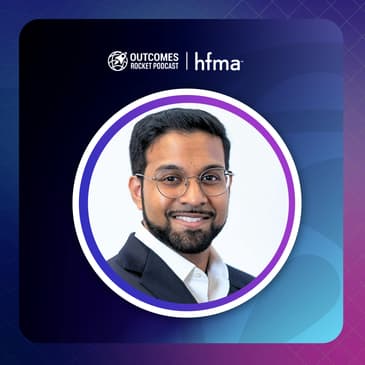
The recent HFMA conference revealed growing confidence in AI's capabilities among healthcare professionals.
In this episode, Malinka Walaliyadde, CEO and co-founder of AKASA, discusses the innovative work of his firm, a technology company leveraging generative AI to enhance healthcare revenue cycles. He explains how their AI tools streamline complex tasks like medical coding and prior authorization, making them more efficient and reliable. Malinka emphasizes the importance of building trust in AI by allowing staff to understand and verify the AI's recommendations, touching on the increasing acceptance of AI in healthcare and the need for real-world examples to demonstrate its effectiveness. He also shares his insights from the recent HFMA conference, noting a shift towards greater confidence in AI's potential and encouraging listeners to explore AKASA’s educational content and reach out for tailored solutions.
Tune in and learn how AI tools like AKASA can address labor challenges in medical coding by making skilled workers more efficient.
Resources:
[00:00:02] [SPEAKER_00]: Hey everybody, welcome back to the Outcomes Rocket HFMA Insights Series. I'm so excited to be here with the outstanding Malinka Walaliyadde. He is the founder and CEO of AKASA. Welcome to the podcast, Malinka. So great to have you back.
[00:00:21] [SPEAKER_00]: Thank you, Saul. It's such a pleasure to be back speaking with you again.
[00:00:24] [SPEAKER_00]: Absolutely. And first of all, I want to thank you for jumping back on. I had a great time meeting you and the team at HFMA. And so let's dive into it. Tell us about your business.
[00:00:34] [SPEAKER_01]: Sure. So AKASA, we are a technology company based outside San Francisco that focuses on leveraging generative AI to support revenue cycle leaders.
[00:00:46] [SPEAKER_01]: And so when you think about revenue cycles, so much of it comes down to deeply understanding the clinical record.
[00:00:52] [SPEAKER_01]: And what we're able to do, what our generative AI is able to do is deeply understand that clinical record and give health system staff workers superpowers in interfacing with that record to get their work done much more comprehensively and efficiently.
[00:01:05] [SPEAKER_00]: Love that. And you know, the advancements in technology are huge and what you could do with Gen AI now is super powerful. What insights and recent news does a company have that you want to share?
[00:01:17] [SPEAKER_01]: Sure. So earlier this year, we launched our first Gen AI assistant in prior authorization. We talked about it back then. But what I'm excited to talk about today is our latest Gen AI assistant in medical coding.
[00:01:30] [SPEAKER_01]: And we've seen just an incredible reception to it in the market. So medical coding, as many folks I'm sure know, is the lifeblood of the revenue cycle rate. Everything goes through coding to get coded and not the door repairs.
[00:01:44] [SPEAKER_01]: It is an incredibly complex task. Coders are some of the most highly skilled workers in the revenue cycle and therefore often the hardest to find and retain.
[00:01:53] [SPEAKER_01]: There are labor challenges. The work itself is quite challenging. It's very complex. Each of these tasks can take an hour or so sometimes to do.
[00:02:01] [SPEAKER_01]: And all of it comes down to deeply understanding the record and figuring out how to code an encounter.
[00:02:07] [SPEAKER_01]: And so what our Gen AI is able to do is read that record, make recommendations to coders on how they should process that encounter.
[00:02:15] [SPEAKER_01]: And what we've seen is it makes people substantially more comprehensive. It helps them get through it more efficiently.
[00:02:21] [SPEAKER_01]: And importantly, I continue to think that the primary way to increase adoption of AI in the enterprise, not just in healthcare, but broadly, is to build trust in the AI.
[00:02:31] [SPEAKER_01]: Enable staff to trust the AI because it doesn't matter how good the AI is if the staff don't trust it.
[00:02:36] [SPEAKER_01]: And so that's why we have deeply invested in mechanisms to build trust in the AI.
[00:02:41] [SPEAKER_01]: So, for example, in encoding, which is our latest Gen AI system, but also in prior authorization that we talked about earlier, what our AI does is beyond making its recommendation, it's able to explain itself, show its work.
[00:02:54] [SPEAKER_01]: Right. So it summarizes, it justifies why it made that recommendation. And then beyond that, it also is able to show you direct quotes from the underlying documents that it used.
[00:03:04] [SPEAKER_01]: And in doing so, it makes it possible for staff to quickly validate to themselves that, hey, I trust the AI because I can follow the AI's train of thought.
[00:03:14] [SPEAKER_01]: And then at some point, they won't need to go into as much detail because they'll start trusting it.
[00:03:19] [SPEAKER_01]: But you have to start by building the trust. And the analogy that I heard someone make, which I think is a great one, is today when you drive a car and it's an automatic, you don't think about what gear you are because you just trust that it's the right gear.
[00:03:31] [SPEAKER_00]: Yeah, yeah, yeah.
[00:03:32] [SPEAKER_01]: Right. But at some point, I'm sure early on, when people are shifting from manual to automatic, they have to continuously check and make sure they felt good about what the car was doing.
[00:03:40] [SPEAKER_01]: We think there'll be a similar transition, but you have to make it possible people are trusted. And once they do, they'll start using it much more efficiently.
[00:03:47] [SPEAKER_00]: Love that. That's a great analogy, right? You sort of just let it go. And even when you become a better driver, you could do other things. Probably you shouldn't. So if you're driving and listening to this, please stay on the road.
[00:04:00] [SPEAKER_00]: Right. Yes.
[00:04:01] [SPEAKER_00]: Yeah, no, I love the analogy, Malinka. And it's exciting to hear that not only are you guys adding value at the front of the rev cycle chain, but now in the middle, because there's so many areas where things get stuck.
[00:04:15] [SPEAKER_00]: And the more options that health systems have to progress and keep their cash flow going, the higher they could stay in business.
[00:04:22] [SPEAKER_00]: So with the conference having just ended HFMA, what can you share with those that couldn't attend an insight that's risen to the top for you?
[00:04:31] [SPEAKER_01]: Sure. I think something that was interesting is there is a higher degree of confidence in AI's capabilities than I've seen before.
[00:04:38] [SPEAKER_01]: Right. Because, you know, the idea of AI in health care has been around for a while, but there's been a decent degree of skepticism in the past.
[00:04:46] [SPEAKER_01]: But I think what I saw this time was people are much more open and welcoming to the idea.
[00:04:53] [SPEAKER_01]: And what they're hungry for is now they believe in it, but they want to see examples of it working.
[00:04:57] [SPEAKER_01]: And that's something where I think given our AI expertise and domain expertise, we were ahead of the curve in terms of investing in building products, truly generative AI native products.
[00:05:07] [SPEAKER_01]: Now that they're out there in the market and doing work for folks, it's been exciting to be ahead of the curve and being able to show some of those results.
[00:05:13] [SPEAKER_01]: But I think people believe now, believe more in the promise than they ever did.
[00:05:17] [SPEAKER_01]: But now the next step is actually showing real products, real use cases, real results.
[00:05:21] [SPEAKER_00]: That's great. That shift in thinking, the acceptance of the technology.
[00:05:25] [SPEAKER_00]: I saw that, too. So I think that's such a great point to make.
[00:05:28] [SPEAKER_00]: Every time you're on the podcast, we learn a ton from you.
[00:05:31] [SPEAKER_00]: We appreciate everything that you and the crew are doing to make revenue cycle easier for health systems.
[00:05:37] [SPEAKER_00]: Give us a call to action and the best place the viewers and listeners can reach out to you and the team.
[00:05:43] [SPEAKER_01]: Of course. We publish a lot of great content, a lot of great educational material about Gen AI and how to evaluate it, how to think about it, how to use it.
[00:05:51] [SPEAKER_01]: We post a lot of that on our website, acosta.com.
[00:05:54] [SPEAKER_01]: We talk about how we use it in prior authorization and coding.
[00:05:57] [SPEAKER_01]: So feel free to go to the website to learn more.
[00:06:00] [SPEAKER_01]: You can also email me, malinka at acosta.com if you want to think about how it can be used for your health system specifically.
[00:06:06] [SPEAKER_01]: But those are some good resources, I think, for people to get to.
[00:06:09] [SPEAKER_00]: Yeah, no, I love it, Malinka.
[00:06:10] [SPEAKER_00]: A lot of people are wrapping their heads around how to use that.
[00:06:14] [SPEAKER_00]: So, folks, take advantage of the work that's already been done by Malinka and his team.
[00:06:19] [SPEAKER_00]: Check out their website.
[00:06:20] [SPEAKER_00]: In the show notes, we'll leave ways to get in touch with Malinka, with the team, with the website.
[00:06:25] [SPEAKER_00]: So you could dig deep, get more thoughtful about it.
[00:06:28] [SPEAKER_00]: And you don't have to go it alone.
[00:06:29] [SPEAKER_00]: Give them a call if you want to engage and have a conversation on anything related to rev cycle automation, making it easier for you.
[00:06:37] [SPEAKER_00]: Malinka, thanks for joining us again on this HFMA series.
[00:06:40] [SPEAKER_00]: This was fun.
[00:06:40] [SPEAKER_00]: Absolutely.
[00:06:41] [SPEAKER_00]: Thanks so much, Saul.
[00:06:41] [SPEAKER_01]: Appreciate it.
[00:06:42] [SPEAKER_01]: Bye.