
This podcast is brought to you by Outcomes Rocket, your exclusive healthcare marketing agency. Learn how to accelerate your growth by going to outcomesrocket.com
AI is revolutionizing healthcare by offering new ways to solve complex problems, emphasizing data-driven solutions over traditional hypothesis-based approaches.
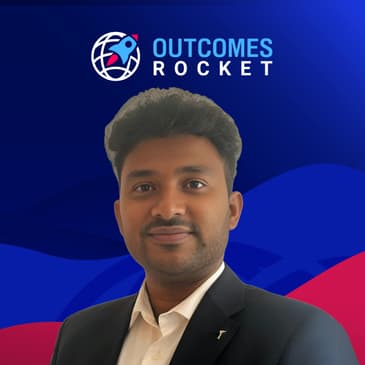
In this episode, Dr. Sam Perli, Chief Scientific Officer and founding member of Thinkhat, discusses how his company is building an AI-powered venture studio to launch innovative healthcare and life sciences companies. Thinkhat serves physicians with its Noki co-pilot for automated tasks, patients with noninvasive monitoring solutions, and pharmaceutical companies with its Encode AI engine for optimizing sequence medicines. Dr. Perli acknowledges skepticism around AI but highlights its potential to solve complex problems like protein folding and neurodegenerative diseases. He encourages openness to AI and suggests cost-effective development strategies, including tapping into global talent pools and leveraging resources in places like Puerto Rico.
Tune in and learn how Thinkhat leverages AI to address previously unsolvable problems in medicine, providing a diverse set of solutions across the healthcare industry!
Resources:
- Connect and follow Dr. Sam Perli on LinkedIn.
- Learn more about Thinkhat on their LinkedIn and website.
- Email Thinkhat directly here.
- Email Sam here.
Fast Track Your Business Growth:
Outcomes Rocket is a full-service marketing agency focused on helping healthcare organizations like yours maximize your impact and accelerate growth. Learn more at outcomesrocket.com
[00:00:01] This podcast is produced by Outcomes Rocket, your healthcare exclusive digital marketing agency. Outcomes Rocket exists to help healthcare organizations like yours to maximize their impact and accelerate growth. Visit outcomesrocket.com or text us at 312-224-9945.
[00:00:29] Hey everyone, and welcome back to the Outcomes Rocket. I'm so excited to have you all back because today we have Dr. Sam Perli on the podcast. He is the Chief Scientific Officer and founding member of Thinkhat. Dr. Perli is a distinguished scientist. He's celebrated for his groundbreaking work in CRISPR technologies and the Yamanaka Lab, earning more than 20 publications and patents.
[00:00:58] As a presidential fellow at MIT, he received his master's in computer science. Later, got his PhD in molecular biology and the CRISPR tech that we were sharing with you guys. I'm excited to cover what they're up to at Thinkhat. And with that, Sam, I want to welcome you to the podcast. Thanks for joining us. Thank you, Saul. Thank you for having me on the podcast. And yes, I'm excited to share some of the exciting things that we are doing at Thinkhat. Well, I love it, man. Well, let's get right into it because it is exciting work.
[00:01:28] Tell us about the company, the business. What do you guys do? How is it different? And why does it matter? Yeah, Saul, we started this company about two years ago. And right at that time, I was doing my postdoctoral research where we were developing a lot of technology for regenerative medicine using stem cells to provide therapeutics for patients. And as you read out, I do have a bachelor in computer science.
[00:01:53] I was working at CSAIL, which is one of the premier artificial intelligence labs at MIT. And I was thinking, how about we not just build biotechnology, but combine artificial intelligence with biology and healthcare. And that was this idea behind what we are doing now at Thinkhat.
[00:02:12] And what we find happening, whether it's chat GPD, agentic AI platforms happening around, we are at an inflection point where AI is truly revolutionizing almost every aspect of our life. Just like computers and the internet has done in the past, AI is changing things. And when we are in this inflection point, instead of starting one company, we were thinking it's better to start a studio that launches multiple companies in the space.
[00:02:41] And so what we are is a full stack venture studio, meaning we have about 120 employees that range from scientists, engineers to business development, to sales and marketing and investment portfolios. And so we have this full stack of people that are available to build companies. So the way we do it is we initiate ideas. Some come internally. Some come from external founders that want to partner with us.
[00:03:07] And we build companies from scratch, not even having incorporated a company, having no IP to start with, get them all the way to series A. And then once they have market traction, we spawn them out and they become independent companies. And we do all of this with a particular focus. And the focus for us is artificial intelligence, revolutionizing healthcare and life sciences. So that's the space we want to play at. That's awesome, man. Really cool.
[00:03:32] Well, you said, man, why just build one when we could build the tech stack and really the resources, the people to build many. And so I love that thought process. And so what end customer do you serve, Sam, in the healthcare ecosystem? Yes. So for us, we have a few different initiatives that serve different sets of customers in the value chain all across life sciences and healthcare. So, for example, we have already launched a physician co-pilot called NoKey.
[00:04:02] And NoKey is short for NoKeyboard. In other words, when a patient walks into the clinic, most often the healthcare provider is busy typing away, taking notes, onboarding and all of that. The idea is that all of that is automated, voice recognition based. And so the physician is actually spending more time with the patient, eliminating possible physician burnout. And so in such a product scenario, our end customer is the physician.
[00:04:26] Our end customer is a healthcare system that has multiple physicians or has clinics where they can automate patient intake. We also have products for patients themselves. Once patient leaves the hospital, we want to do a non-invasive patient monitoring. The patient doesn't want to wear a device. The patient doesn't want cameras in the home, but we have a way to monitor whether they are taking their meds, whether they are sleeping well, whether they had a fall or not. And all of that in the care facility where they might be at, even in a home setting.
[00:04:56] And so there's our end customer is the patient themselves. But then we also have in our life sciences products we are building to enable the pharmaceutical industry to develop better drugs. We have a product called ENCODE, where we are building this AI engine that optimizes sequence medicines, RNA, DNA and proteins and peptides, where the pharmaceutical companies can collaborate with us. They can sign a business license agreement so they can develop their sequence medicine drugs with us.
[00:05:26] And so we are serving quite a bit of spectrum in that space. And every person has a value because AI is touching many different sectors at this point. That's really fascinating. I love the array of customers that you guys serve. And ultimately solving tough to solve problems. That's the promise of AI that we have today. What's one thing most people don't know or appreciate about the problems you solve? Yeah.
[00:05:51] The first is there is still some skepticism in terms of how to use AI and is AI safe? Is AI something to stay away from? I want to give this analogy that what AI does is essentially help us learn in a different fashion. We as humanity have learned things in a particular manner. This goes back all the way to Newton, sitting under the tree and then a fruit falls, possibly an apple.
[00:06:17] And he has this hard experiment that what made this fruit fall is the same thing that makes planets go around in motion. And then he ends up discovering all the laws of motion and things like that. Now, that's how we've always approached the world, science and learning is through doing thought experiments and see if they fall in place with the existing body of knowledge we have. But if you go back to Newton's experiment, there is another way you can actually come up with predicting the motion of the apple.
[00:06:44] And that is by having a camera sitting in front of the apple, taking thousands of pictures, take all of the data, put it in an AI model. And now you ask the AI model, when is the apple going to hit the ground? And it will tell you with 99.99% accuracy when the apple will hit the ground. Now, does the AI model know that force equals mass times acceleration? Not at all, right? But it did figure out that the apple was going to hit at a certain time.
[00:07:11] And so what AI is doing is actually a different way of solving the same problem that uses more data and less hypothesis generation. And so what we are doing now is using that alternative approach of solving problems to solve problems that humanity couldn't solve. Things such as protein folding, things such as Parkinson's, Alzheimer's. And so we are thinking that this alternative method of problem solving could help solve those difficult problems.
[00:07:39] And so one is, I think, be open to adopting a different way of solving problems. That's how we pitch AI across our client database that, hey, don't be afraid of it. It's just a different tool that learns things differently and that we can adopt. And so that's one takeaway I would love to share with our audience here. That's awesome. I love that approach. It's a really just a fundamental way of thinking about it. Exactly. Come on. It's a new way of solving problems.
[00:08:09] I love that. And by the way, if you're not open to it, they will eat your lunch. Like the people that are willing to do it will eat your lunch. So like Dr. Pearlie is being nice about it here. But like the reality is you better adapt it. Otherwise, your future is not looking too bright. Look, Sam, we love learning from successful people. What would you say is your favorite business resource or business hack that you recommend to us and why?
[00:08:37] Yeah, that's a great question, man. Especially with AI booming everywhere. You do want to know how can you differentiate yourself? How could you indeed set yourself up for success? There's lots of money being poured in AI. So many people now building companies around AI. I would say one of the learnings that has been happening in the industry with AI, I think, points to something very interesting.
[00:08:59] You probably all heard Donald Trump announcing this $500 billion initiative to build data centers and build up the AI access. And Donald Trump announced it. And a week later, we have DeepSeek come out from China and developing something at a fraction of the cost and having models as good as what OpenAI has. And so then people began to think, one way we are spending all this money and investing in this architecture.
[00:09:26] But the other approach is not having much of that, but still solving problems, at least in a particular niche. And what China has done or what DeepSeek has done is to show that, well, you can be smart about how you build AI. You could obviously throw a bunch of money at it and build a big infrastructure, etc. But ultimately, open source is the way to go. The way DeepSeek was able to do it is you use open source models, use Lama 3.
[00:09:55] Of course, Microsoft spent a lot of money to build that. But once it's open sourced, several players can come along and build for much cheaper of the cost. Now, at TinCat, we've observed the same to be the case. We, instead of going this route of buying these hundreds of thousands of dollars worth of GPUs and then building a database of millions of compute resources,
[00:10:20] we thought, how about we outsource a lot of this and hire the best talent outside America? So, Fritz, one of the best talent we get for AI is from India. And if you were to now find a good AI software engineer, an AI expert working, say, for Google, and you want to hire them, you're looking at paying north of $500,000 or $750,000 a year to hire one such candidate. But in India, they come from some of the best schools there.
[00:10:48] They are well-equipped, well-trained, and they come for much cheaper of the cost. And so we have quite a few of our amazingly equipped scientists in the AI space doing really hardcore advanced AI building at a fraction of the cost that Americans are doing. And so I would highly encourage the audience to think about where you could do AI for cheaper. Instead of just following suit and throwing a bunch of money at it and hiring all these people who have published some research in AI,
[00:11:18] hey, man, look at places like India or places even like China. They are doing AI at a fraction of the cost. And how could you leverage a market like that? And that's one piece of advice I would share. That's so huge, Sam. I appreciate that advice. I think a lot of entrepreneurs that listen to our podcast will take that home. What about the... I know the one thing that comes up is the risk, right? Like the risk of going outside of the norm. Exactly. What advice would you give them there? Yeah.
[00:11:46] There is also the regulatory landscape as well to add to that risk. Now, especially with our current administration, there is a huge push to bring things back to the American soil. And there is the China. And now the China plus one is becoming a norm in other sense. If you have a business that's using China, you want to have a plus one other than China in case you are forced to leave China and things like that. And so definitely there is that push and you want to bring things back. One of the things that we have done is also... Sol, I know you are based out of Puerto Rico.
[00:12:16] We've actually tried to leverage Puerto Rico quite a bit. In fact, our headquarters for ThinkCat is in Puerto Rico. And the reason is because we do want that to be on American soil. We do want the advantages that the American government gives us to do business in Puerto Rico. And so there are places like these, which are American soil, but still give you the advantages of doing things a little less expensive and leveraging some of the amazing talent in Puerto Rico. So, for example, we have some of the really bright students from University of Puerto Rico
[00:12:45] working for us and building things at a fraction of the cost. And so that's one way to think about it. Yes, come back to American soil. You still want the economies of scale. You still want advantages. Think about places like Puerto Rico and build something really cool from there. Not always companies have to come out of Silicon Valley. So... I love it. I love it, Sam. Well, look, thank you for your time today. This has been an awesome conversation. If people want to learn more about you, about ThinkCat, where can they find out?
[00:13:12] Yes, our website is a one-stop place for everything. You can email info at thinkhat.ai or you can email me at sam.perley, my first and last name, at thinkhat.ai. And that's an easy way to get in touch with us. Outstanding. Ladies and gentlemen, thanks for tuning in to our podcast again today. The privilege of hosting Dr. Sam Perley, Chief Scientific Officer and Founding Member of ThinkHat. Just doing incredible things over there.
[00:13:40] Make sure you check out the show notes to see what they're up to. Reach out if you have an idea that you've been wanting to get up off the ground. They've got the resources and tech to help you do it. Sam, I really appreciate you joining us and look forward to staying in touch. Likewise, Sol. Thank you for the opportunity and all the best.
[00:14:07] This podcast is produced by Outcomes Rocket, your healthcare exclusive digital marketing agency. Outcomes Rocket exists to help healthcare organizations like yours to maximize their impact and accelerate growth. Visit outcomesrocket.com or text us at 312-224-9945.