
The future of spine surgery is increasingly in the outpatient setting.
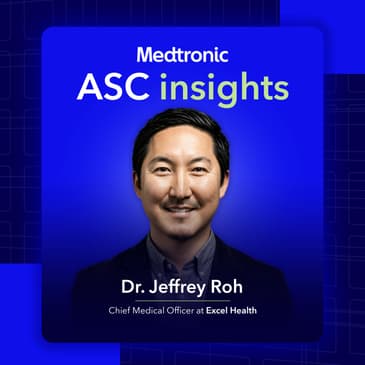
In this episode of ASC Insights, Dr. Jeffrey Roh, orthopedic spine surgeon and Chief Medical Officer at Excel Health, shares how minimally invasive technology is accelerating the shift from inpatient to outpatient spine surgery and transforming the ASC landscape. He discusses the clinical, economic, and patient-experience advantages of ASCs, as well as the evolving role of reimbursement, robotics, and AI in surgical care. Looking ahead, he envisions increasingly autonomous robotic systems, smaller procedures, and a healthcare system where outpatient surgery becomes the default for an expanding range of cases.
Tune in as Dr. Jeffrey Roh explores why the future of spine surgery is moving beyond the hospital, and how minimally invasive technology, AI, and robotics are reshaping what’s possible in the ASC.
Resources:
[00:00:06] Hello everyone, Saul Marquez here and I'm so excited to be introducing an episode of the ASC Insights Series here at ASCA Samba. Excited to be here with Lindsay. Lindsay, thanks for being with us. And happy to be here, Saul. And also Dr. Jeff Norton. How are you doing today? Doing great. Good to see you again. It is a fun time to see you in a while. Yeah, it definitely has been. It's good to be reunited and excited to dig into some really great insights here at ASCA Samba.
[00:00:35] So to kick things off, Jeff, tell us a little bit about you and your background. Sure. My name is Jeffrey Roh. I'm an orthopedic spine surgeon, originally from Seattle, Washington. Did most of my training in the Midwest. Did my orthopedic residency with Dr. Henry Buhlman. Learned a lot from him and then finished off my spine surgery fellowship at the Hospital for Special Surgery. I served as the president of our group in Seattle.
[00:01:04] It was ProLine Surgeons. We had multiple surgery centers. I mean, I think we had at that time at least 20 ASCs spread across Washington State in 40 different locations with clinics, surgery centers and other ancillaries. Then I had this opportunity to join my current practice partner in Honolulu. And that was about two and a half, almost three years ago.
[00:01:31] And then about three months into it, we had this opportunity to acquire a surgery center. And so that's what sort of prompted me to move over to Honolulu. Got it. And develop surgery centers. So now we're in the process of growing the surgery center business in Honolulu. We just acquired another surgery center in Southern California. So our company is called XL Health and I serve as a chief medical officer for XL Health.
[00:01:58] So, you know, there's been a lot of shifts in the ASC space, Dr. Rowe. For sure. So, you know, help us understand today, you know, snapshot of what it is like today compared to two to three years ago. Sure. Sure. And maybe if you wouldn't mind, I'll actually go back even farther. Let's do it. So I think that, you know, the way I think about ambulatory surgery centers, they're essentially ORs outside of the hospital. If you think about it, right? Just because the ORs within a hospital setting, if you don't know this, you probably do.
[00:02:28] But they essentially drive the entire revenue cycle for the hospital for the majority of it, you know. So if you take a look at any major hospital or healthcare system, they will have something blank institute behind it. So that'll typically be an orthopedic institute, a neurosurgical institute, a cardiovascular institute, a cancer institute. Because they, quite frankly, drive the majority of the revenue within the hospital system.
[00:02:58] But what's happened over time, over the course of the last several decades, however, is that we've had this sort of evolution of these ORs coming out of the hospital in order to make it much more efficient for patients, first and foremost. Because, you know, at the end of the day, surgeons always figure out innovative, novel ways to actually do the surgeries less invasively over time.
[00:03:27] And that's happening right now in my own specialty, spine surgery. So over the last two or three years, I would say that there's been a huge transformational shift from inpatient to outpatient. To the extent that CMS and Medicare, they've recognized this shift. And also they've recognized that it's not only economical, but it's also safe. Equivalent to what you would find in a hospital.
[00:03:56] And I would argue that the type of care that you could get in an outpatient setting can almost be even safer than what you'd find in a hospital. Because you don't have the same type of, for instance, nosocomial infections, bacteria that exist in a hospital environment. You don't see that in a surgery center because it's all ambulatory. I love you talking about the safety aspect of it.
[00:04:20] Can you also talk about what that experience is like for patient satisfaction? What that experience is like to be in a surgery center compared to having to go into the hospital for a procedure? I think it's night and day. And I think all you have to do is ask the patients about their experience. Because quite honestly, I think that we in healthcare take that experience for granted.
[00:04:44] Because in most other type of service industries, it's not only important to provide great patient care, but also customer service. Because historically, we've created these ivory towers where patients had to come to us. And we made it so confusing. I mean, just think about your experience of just walking around in a hospital and trying to locate your doctor or a service within that maze.
[00:05:13] It makes no sense, right? I mean, that's not how malls or hotels are built. Casinos kind of. That's true. Because they want you to go through. But in a hospital, I mean, I don't think people think about the convenience of how to get from point A to point B. Whereas in a surgery center, it's much more scaled down.
[00:05:39] It's, you're there for a very specific purpose. And that's to get outpatient surgery on the same day. So I think that's where there's a drastic paradigm shift from hospital-based inpatient surgery to outpatient surgery. Yeah, that's really great. And you alluded to this in sort of your discussion of you're doing more spine surgeries, minimally invasive procedures in the ASC.
[00:06:08] The case complexity clinical evolution. Like, where are you drawing the line right now in case complexity? And how is that line moving? Yeah, that's a great question. And this is how I would answer it. It almost reflects how I was trained as a spine surgeon. So back in the day when I did my residency training with Dr. Bowman and then did my fellowship training at HSS, I did very little minimally invasive. It almost didn't exist.
[00:06:33] I mean, the technology certainly did because Medtronic was really at the forefront of minimally invasive technology such as the metrics tube, minimally invasive percutaneous systems. But it takes a while for us within healthcare and medicine to sort of adopt those technologies. So I think that if you take a look at the evolution of what's happened back then, we made big incisions in order to get to a small area within the spine because we had to.
[00:07:03] Because we had to use our eyes. And then that sort of transformed into smaller incisions because the patients demanded it and the surgeons who were interested in doing that wanted to provide the least invasive type of approach. So then you had loops, which are essentially just microscopes for your eyeballs so you can look down. So you could do many open procedures. And I think it's brilliant.
[00:07:57] And then one of his colleagues then subsequently performed the very first arthroscopic procedure in the knee. So just think about that, right? Like today, if you had a meniscal tear or an ACL rupture and you went to a surgeon, they opened up the knee and then they cut out your entire meniscus or they went in there and tried to repair the ACL through this wide open incision, it would be considered malpractice. Right? Right? But back in the day, it wasn't.
[00:08:25] Because back in the day, that's all we knew. So I think the same sort of evolution has occurred in spine surgery, believe it or not. And I'm hopeful that companies like Medtronic will understand where this is all going because even myself as a minimally invasive spine surgeon, I didn't believe that endoscopic spine surgery was going to take hold. But now I'm a true believer in it. I'm just telling you right now. And this is the reason why.
[00:08:53] Because not only is it the right thing for the patient, but it will lead to better clinical outcomes. There's no question about that. And the barrier to that currently is the fact that not enough surgeons are being trained to learn how to do that less invasively. But that's sort of the evolution of what's happened also from inpatient to outpatient.
[00:09:17] As we develop these technologies and techniques to make smaller and smaller incisions, like we're getting to the point now where we can do the majority of the elective types of procedures on an outpatient basis. So I would say anything that has to do with degenerative conditions of the cervical thoracic lumbar spine can now be done on an outpatient basis.
[00:09:41] Where I would sort of draw the line for now would be multi-level deformity, trauma, tumor, infection. But beyond that, I think that's where it's going to kind of bisect. We're going to see this outpatient being primarily the bread and butter, ACDS, ADRs, lumbar decompressions, but T-less now, right?
[00:10:09] Now that's on the outpatient acceptable types of procedures that we can do. And then inpatient will primarily be those tertiary care type of conditions that require more hospitalization and more specialized expertise. Dr. Rowe, for your peers out there who may be hesitant to go into the ASC setting, specifically around spine, what advice would you give them for why it matters?
[00:10:36] I would say that once you understand and experience what it is to see the types of results that you can get for patients, you'll never go back ever again.
[00:10:50] And I hate to say this, but like early in my career, I spent a lot of time in hospitals and hospitals by design and nature are places where sick patients go to get care.
[00:11:09] But the issue with that model is that currently patients are looking for something different, especially patients that are well-educated and they understand the system.
[00:11:25] Why would you choose to have an open surgery and stay in the hospital for days when you could find a surgeon or a center that could perform the same procedure with an incision the size of a pencil eraser and go home the same day? Like which sane human being would choose option A over option B?
[00:11:50] So what I would say to my colleagues is you better understand what's happening right now because we thought the same thing about minimally invasive MIS procedures through tube-based surgeries 10 or 20 years ago. And even back then, there were the naysayers who said this will never catch on. It's not the standard of care. But that's only because it threatens their way of understanding how to perform these procedures.
[00:12:19] But I would say take time and energy, go to a course, go visit surgeons like me who understand where the market is headed, and learn it. And not for yourself, but learn it for your patients. That's valuable, guys. Yeah, it's a great call to action, Dr. Rowe. And so as these surgeries advance, the technology advances, we also have robotics.
[00:12:47] A question comes up for a lot of ASC owners, large organizations, it's reimbursement, right? So that becomes either a tailwind or a headwind for growth. So talk to us about payer mix pressures and how that's shaping your growth plans. Sure.
[00:13:07] So historically, insurance and third-party payers put a greater value on what you did in the surgery versus – I'm sorry, what you did surgically in a hospital versus what you did in a surgery center. Which makes zero sense. Right.
[00:13:25] Because it's like I, as a surgeon, could do a procedure in a hospital with the same equipment, with the same patient, and do it for a cost that's 2, 3x higher than I could do it in an outpatient setting. Now, how does that even make sense, right? So – but I think that over time, payers like Medicare and private payers are now understanding that look at Dr. Rowe.
[00:13:54] He used to do his procedures in a hospital, and it cost the system 2 to 3 times more than it did when he's doing his procedures now in a surgery center. So that payer mix, just the inequality of the reimbursement will level out at some point. It has to. The system will demand it. Payers will demand it. Patients will demand it.
[00:14:21] When they see their bill coming from a hospital system versus what they might get at a surgery center, it's going to be drastically different. But in the same sense, you talk about robotics, and I do believe in robotics. Robotics is the future. We're not there yet, though. But we need to get there. And the barrier currently is the price point, the capital expense that it takes in order to purchase an expensive robot for your surgery center.
[00:14:51] That price point will go down as technology develops. Just think about the cost of any good or commodity over time. That cost will go down as efficiency is built into that, the production of that product or service. And competition, right? And competition. There's no question.
[00:15:09] But I do believe there is a future in which we, as a surgeon, surgeons will be able to perform surgeries with the assistance of a robot much more efficiently, much more accurately, and almost cost equivalent to what you would be able to do at a hospital. We're not there yet, but we will get there at some point. So kind of going down that path and talking about technology, I'm curious, Dr. Rowe, how do you feel about the role of AI today? And where do you see it going?
[00:15:40] I'm all in on AI. I had a feeling. I love AI. I mean, I'm just telling you. And we do have to be careful, right? Because it's a form of technology that used in a good way will lead to good things, used in a bad way could lead to bad things. But AI is absolutely incredible. It's real. It's transformative. And if you don't stay ahead of it, you're going to get lost to the fray.
[00:16:09] So for us, in our clinics and in our surgery centers, we use AI quite a bit. And we're looking at ways to actually incorporate more AI into what we do. How are you using it? So for instance, we use two or three different AI scribe systems. Oh, for notes? Absolutely. Oh, yeah. So historically, just think about how we used to take notes as doctors, right? Yeah, right.
[00:16:37] But back in the day before EMR was mandated by Congress, right? We took notes on paper. So as a patient would be telling us how they're doing, we would be scribbling notes literally on paper. And that's why doctors have terrible handwriting because they're literally doing this, right?
[00:17:01] But then Congress came and said, come on, let's make this more efficient. Let's make sure we have electronic medical records. And within healthcare and medicine, we said, no, don't force us to do this. But once you adopted that technology, it was painful to actually implement that technology. But now, ask one doctor whether or not they'd go back to paper. They would say, no way in hell. No way.
[00:17:31] Whereas AI is sort of like that technology. And this is why it's important for us to be able to understand how to use it thoughtfully. Because AI is a way for us to be able to process information more efficiently.
[00:17:47] And so, for instance, back in the day when we then had to use EMR, then we had scribes, literal scribes, people, typically pre-meds, who would come into the room with us, with our patient. And the patients are like, who is this person? They know it's like this, right? And there are still doctors who are doing this. I would say that's probably the standard today.
[00:18:15] But that runs into all sorts of different issues, right? Then who is this person that's in the room that's typing away? And why am I sharing details about my healthcare, which are private, with this person that I've never met before, right? It was a necessity. Whereas now we have this capability of implementing AI, where AI listens to the conversation that I have with my patient.
[00:18:44] And the reason why I believe it's better is because it's much more objective. It really takes the information as it is, and it synthesizes it in a manner that's not biased. Whereas for me and or a scribe, you can put a lot of bias into the note. Whereas AI will capture the essence of that note. And obviously, early on, with less data, it's less accurate.
[00:19:12] Over time, it becomes more accurate. So I do believe that the incorporation of AI in the clinical realm is here to stay. And physicians that are more cerebral, they have more of a thinking type of specialty, should be concerned. Because AI is real. And AI can do it much better than we can. It can do it consistently. It can do it without significant bias. And it can do it in a way that's reproducible.
[00:19:42] Now, I do believe that AI and robotics will need to come together. It has to. Because what's happening now is that, let's just be honest here. Robots within spine surgery is just a guide for pedicle screws. That's all it is. Okay? Let's just be honest with ourselves. That needs to change. And I get it. Right now, robots are enabling technologies.
[00:20:08] And it's a very expensive technology for us to be able to put a pedicle screw more accurately, more reproducibly. But it has to get to the point where robots have to allow surgeons to do the entire surgery from point A to point Z. Meaning that it has to be able to help us to do decompressions safely and efficiently.
[00:20:29] It has to be able to let us do instrumentation, pedicle screws, rods, inner body cages, even ACDFs, ADRs. And then it has to be able to allow us to do fusions. So unless the robot gets to that point, it will not be widely adopted.
[00:20:53] But I do believe that once those technologies are built into the robotic platform, surgeons will then utilize robots to train it, to help us almost act as assistants. Because that's essentially what it's doing anyways. But if you take a look at the evolution of what's happening in robotics in other industries, like the automotive industry, for instance. Just think about the car that you currently drive.
[00:21:19] I would say that the majority of your car was built by a robot. And you trust that that car that was built by a robot is going to keep you safe, right? It's got to get to that point where surgeons will teach the robot how to do the procedures. The robot with machine learning over time and AI will learn how to do that procedure just like me.
[00:21:46] But then over time with more repetitions, it'll become better than me. It'll become more efficient than me. And it will not tire like me at the end of the day. In fact, I do envision a future at some point where you could potentially have robots doing surgeries 24-7 and have different shifts like you do in a hospital. But we, as surgeons, would just manage these robots. Well, look, this is fascinating.
[00:22:16] I love this discussion. And I've known you for many years, Dr. Rowe, and you've always been ahead of the curve. So the things that we're talking about now, in a couple of years, folks, you're going to see them happen. So look, as we wrap up today, I'd really like to take a look ahead, you know, three, five years from now. What does success look like for your ASC?
[00:22:39] I would say that success looks like patients being satisfied with the care that we deliver. I think that's first and foremost. I think regardless of where we are and how many surgery centers that we have, we hope to provide a differentiated experience for our patients.
[00:23:06] Meaning that when a patient comes into our doors, we want them to feel as if they're getting the best quality care that they can have anywhere, period. So success for me looks like that we have service centers that deliver the highest level of the most cutting edge technologies and techniques that we can provide to our patients.
[00:23:31] And that there would be no comparison to that delivery of care. And I would say that even companies like Medtronic should take a look at this because that transformation and evolution from inpatient to outpatient is real and it's happening. And you cannot stop it, you know, because it's based on patient and customer demand, both on the patient side, but also on the surgeon side. I can tell you like the question you asked me about my colleagues.
[00:24:01] Once you actually go outpatient only, you'll never go back. Like you'll realize that you were a slave to a hospital system that allowed you to have privileges to take call for them.
[00:24:16] And I'm just telling you that is a thing of the past because true high quality care comes in the form of doctors who are concerned, intently concerned about not only the care of the patient, but the patient and customer experience.
[00:24:36] So I think that back to your question, success looks like that we'll have centers across the United States and that we'll see the continued transformation and evolution of inpatient to outpatient surgeries. And quite honestly, the incision getting smaller and smaller and smaller to the point that at some point that we may be performing needle based spine procedures surgically.
[00:25:04] Once you go outpatient, you never go back. On that note, I think we got the title for this one. It'll go viral. Definitely. No doubt. Well, well, Dr. Roe, I want to thank you so much for spending time with us today. It's always insightful to chat with you. You're welcome. Thanks for spending time with Lindsay and I here. And for everybody out there, thanks for tuning into the series.
[00:25:30] Check out the show notes for all the ways to get in touch with Dr. Roe and to follow the rest of our episodes because there's a ton of good ones straight from Aska and Samba. Thanks for tuning in. And thank you guys for being here. Thank you. Thank you.