
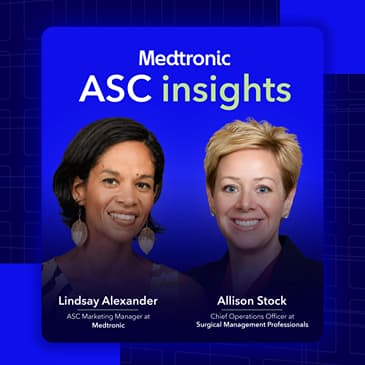
Why the success of an ASC relies on preserving the physician's voice and cultivating a strong, unique culture.
In this episode of ASC Insights, recorded live at ASCA SAMBA 2026, Lindsay Alexander is joined by Allison Stock, Chief Operating Officer at Surgical Management Professionals (SMP). Drawing on 20 years of experience in the ASC space, Allison shares what it takes to build a successful surgery center from the ground up and the importance of keeping independent physicians at the center of clinical decisions. She discusses the evolving challenges of the ASC marketplace, including the impact of private equity, the shift toward higher case complexity, and the pressures of supply chain and reimbursement. Looking ahead, she emphasizes that while innovations like AI and robotics offer new operational efficiencies, human relationships and collaborative teams will always be the true drivers of an ASC’s success.
Tune in as Allison Stock explores why a customized approach to culture and staffing is critical, and how ASC leaders can navigate a rapidly changing landscape while delivering exceptional outpatient care.
Resources:
[00:00:06] [SPEAKER_00] Welcome to ASC Insights. I'm Lindsay with Notronic and today we're recording live from Ask a Samba 2026 where we're excited to be talking to ASC leaders around the Ufalvy marketplace. Today I am here with Allison who we're going to talk a little bit about her experience. Allison, tell me a little bit about in our audience, a little bit about yourself and your background.
[00:00:28] [SPEAKER_01] Allison, Sure. Thanks for having us. Lovely to be here and talk with you today. I'm Allison Stock. I'm a Chief Operating Officer at Surgical Management Professionals or SMP. We are a surgery center management development company. I'm a nurse by background. I've been in the ASC space for 20 years. I've done all things ASC for the last 20 years. I've been a nurse in there. I've been a nursing director. I was an administrator for several years. And I had the privilege of working with multiple surgery centers across the United States.
[00:00:55] [SPEAKER_01] Every day of helping them and their nurse specific ASCs and then also helping new surgery centers from the ground up become fully functioning ASCs in the community.
[00:01:07] [SPEAKER_00] Where do you see the most opportunity for kind of starting a new ASC from the beginning?
[00:01:13] [SPEAKER_01] Sure. The biggest opportunities are with independent physicians. We at SMP really pride ourselves in making sure that those independent physicians still have a voice and a seat at the table. So whether that's a joint venture or they're like a hospital, making sure that their government is set up in a way that those independent providers still feel that they can have a voice and have an opportunity to have an impact on the clinical decisions.
[00:01:35] [SPEAKER_01] Or if it's a completely physician-owned surgery center, we really enjoy that it's a lot of work from picking out where you go from a space, working with the correct architects and contractors to make sure that they have that proper ASC experience and know how to build a surgery center correctly so you're not making corrections on the back end when you get time for that initial survey. Hiring the right staff is super important too in those startups.
[00:02:03] [SPEAKER_01] And then just being successful from a clinical and quality standpoint, making sure you're picking the right cases that you're doing, you're aligning with the right vendors, whether that's anesthesia, whoever you're partnering with. There's a lot of decisions that go into those startups that it takes a village to get you to those first cases and get you across the finish line. But it is so incredibly rewarding. And there's nothing like seeing that first case get done and having the staff and the physicians align and all that come together.
[00:02:33] [SPEAKER_00] That's really great advice for, I think, those startup ASCs. As we're talking about structure and where that goes, where my head goes is thinking about the role of private equity. What are your thoughts on how that impacts an ASC positively and negatively? Sure.
[00:02:52] [SPEAKER_01] I think there's a time and place for private equity. We at SFP do not require equity in any of our ASCs, so that is a differentiator for us. I think, unfortunately, private equity has taken over the space. And I think that while we've seen massive growth, it's been a hindrance on what makes ASCs successful. And what makes ASCs successful is positions voices.
[00:03:14] [SPEAKER_01] And when they no longer feel that they are able to contribute successfully to that ASC, we take away what makes ASC or an ASC. So if we're really in a financial hamster wheel where they can't get off of that and they feel like they have so many financial pressures that they have to meet those metrics and those things, all of a sudden, they don't have that motivation than they did when they were there. And we're really taking care of patients.
[00:03:41] [SPEAKER_01] I think that private equity sometimes can be good. And has really changed the space of ASCs. And we really need to make sure that we're giving those positions the voice so that they continue to be successful in that independent space. Because, again, that is what makes ASCs successful is making sure that they have that ability to contribute and feel like they can talk about supply chain. They can have a voice on what's being used.
[00:04:11] [SPEAKER_01] And if they don't have that voice, they don't want to frame their cases and they don't want to be involved. Yeah, that's a really great play.
[00:04:17] [SPEAKER_00] Speaking of how quickly things are changing, a landscape across the whole is rapidly evolving. What's the biggest difference today from, say, two years ago or even a year ago?
[00:04:29] [SPEAKER_01] I think we're seeing more and more pressures. And that comes in a lot of different ways as from staffing pressures, anesthesia pressures, just the cost of everything rising. But reimbursement is either staying the same or going down. So we're having to be significantly more operationally efficient.
[00:04:50] [SPEAKER_00] Let's talk a little bit about kind of case complexity and that clinical evolution that's happening within ASCs. Where do you see ASCs drawing the line today when it comes to how far they'll go for how complex the casey?
[00:05:04] [SPEAKER_01] I don't think it's really a specific case. I think we really have to look at the big picture. I think you have to look at the system as a full. And I think it's a very individualized conversation. I think you have to be able to say, can we successfully take care of these patients in that outpatient market? Can we have the right support systems? Can the patient successfully recover at home? Can they have the support system at home that they need to be successful and recover?
[00:05:31] [SPEAKER_01] Do you have an anesthesia team that's in alignment with you that can help you navigate those more complex cases? And is reimbursement keeping up? Because as we take and shift these complex cases out, a lot of those come with really expensive implants for supplies. And if reimbursement isn't supporting that, I think that's going to be the differentiator whether these cases can successfully move or not.
[00:05:56] [SPEAKER_00] Right. So kind of towards that lens of the higher acuity patients moving into this space, do you feel like monitoring and safety requirements are keeping up? What in within the current infrastructure today may each change?
[00:06:11] [SPEAKER_01] I do. I think that anesthesia is part of that equation that we need to talk about. There's so much variability with the anesthesia. Depends on who you're working with and what team is at your center.
[00:06:22] [SPEAKER_01] There's so much variability with the anesthesia.
[00:06:52] [SPEAKER_01] We need to do this efficiently and safely and repetitive. And if we can do those things, I think that it's very wide open. We don't think we have to limit ourselves. We just have to be conscious of what we're doing.
[00:07:06] [SPEAKER_00] Got it. We're going to kind of pivot a little bit and talk about like operations and workforce, specifically around staffing. I know it is something that everyone's talking about when it comes to the ASC space. In your opinion, what part of the staffing problem do you feel doesn't get talked about enough?
[00:07:25] [SPEAKER_01] Sure. I mean, I think anytime we talk about staff, right, it's the shortages or those sort of things. I think what we don't talk about enough is culture. Because what makes ASCs really special is that they are their own unique entity. If you've been in an ASC and you go down the street, that ASC is different. Yeah. So they all have a different culture.
[00:07:46] [SPEAKER_01] So I think it's really important from the very first time you interact with an employee, whether it's the interviewer process, that we really explain that culture and what's different about being in an ASC. You could take a really excellent clinician from the hospital and you could draft them into the ASC and they wouldn't be successful, perhaps, because maybe they don't understand that they have to work in a different type of environment. And what I mean by that is the efficiency. We wear a lot of different hats in the ASC. So we have to think differently.
[00:08:16] [SPEAKER_01] And whether you're a really great clinician, that may not be the vibe for you or that may not be how you fit. So I think it's really important that we set those expectations with staff up front and that it can be a really exciting environment to work in, but you have to want to be there.
[00:08:30] [SPEAKER_00] I think that's such a great insight, thinking about culture, because I know that gets overlooked quite a bit when you're thinking more about, oh, what procedures, what cost savings can we make, how are we financially going to step those up? So I love that you went that direction. Speaking of what's different within the ASC space, scheduling, I think, also is different for somebody coming from the hospital side versus an ASC side.
[00:08:56] [SPEAKER_00] What can we see in really work and land in an ASC setting when thinking about scheduling? Are you thinking about scheduling? Sailing to increase OR throughput. Got you, bro.
[00:09:07] [SPEAKER_01] I think the important thing is that it's got to be collaborative, right? Like I think you really think it's got to be everybody's got to be pulling in the same direction for ASC to be successful.
[00:09:18] [SPEAKER_01] So I think you have to think about how can we get the most value out of the time that we have and you want to be efficient for your providers so that they're getting in, getting out because they have other things to do or whether they're gaining extra time to go do personal things or if they can go spend an extra time in the clinic to see more patients. But I think we really have to think about it as a collaborative team.
[00:09:43] [SPEAKER_01] And so when we schedule, I think we have to know how are all of the pieces of the parts having to fit together. So you have to think about how is SPD affected? How is pre-op affected? How is our front office staff affected? And I think we have to look at it from a local picture to make sure that you're hitting all of those things to be the most efficient.
[00:10:03] [SPEAKER_00] I love that. Another question for you is really around supply chain. And the pressure, I'm curious how you think about vendor relationships beyond price. What should ASC leaders be looking for, thinking about when it comes to supply chain?
[00:10:20] [SPEAKER_01] Sure. I think we saw a shift after COVID or when we had some supply chain disruptions, periods, that relationships are more important, sometimes the price. Now, obviously, we're there to make sure that we're being cost conscious and we don't want to be paying double with another vendor that we could maybe be paying, you know, half of that cost. But if you don't have the relationship or the serviceability or that, I think that really does play a factor.
[00:10:47] [SPEAKER_01] We think about that even when we look at capital items, whether we're printing and sterile processing equipment. You know, what is the ability to keep that up and running? If we have something that goes down, what's the response time with that vendor coming in to get that back up and functioning? Because that ability puts us at either out of work for the day or really decreasing our capacity. So I think the shift has gone into that relationship that we have to think of them as a partner.
[00:11:15] [SPEAKER_01] They're not, we have to pay them a lot of money and we like to think of them as a pain point. But if we can partner with them and they want to help us look for opportunities as well, I think that's where we find the wins.
[00:11:27] [SPEAKER_00] I love that relationships matter and it makes them more human element of you've got to think for than just your bottom line. Okay. Let's talk a little bit about kind of growth and where the market is going. So when you think about kind of that reimbursement and payment mix pressure, how does that shape ASC's growth plans?
[00:11:49] [SPEAKER_01] I think the big thing, and I hit on it a little bit earlier, is really where the implants come in. I mean, we have to be strategic about it, but I think ASCs have to be looked at as not just the best value, but like how can we do this successfully? And so I think implants are really going to be the turning point for ASCs because a lot of payers won't reimburse for implants or it's difficult to get that reimbursed.
[00:12:15] [SPEAKER_01] Maybe there's new technology that comes out and it's not FDA approved, so they don't want to pay for it, right? And so for ASCs to keep growing and capturing those two things, payers have to keep up with us. And if they don't, just like cardiovascular, like we see that being a push coming into the space. But if payers aren't recognizing that ASCs are taking on these cases and reversing them appropriately, that's going to stunt the growth.
[00:12:41] [SPEAKER_01] So I do think it's really payer specific that we have to keep them and educating them on why they have to adjust to us.
[00:12:48] [SPEAKER_00] Do you have any specific advice for, say, an ASC on how to approach those payer conversations?
[00:12:54] [SPEAKER_01] I think it's data. And that's hard because if you don't want to put your toe in the water because you know you can make that. But it's quality. I think you have to just keep coming back to showing that ASCs are a true quality choice. Those are the ways to have those conversations with peers and then just show them like you are paying X to take your patients here.
[00:13:16] [SPEAKER_01] When you could pay us Y, we're not asking for the same as us, but we're just asking you to meet us somewhere in the middle so that we can do this successful.
[00:13:25] [SPEAKER_00] That's great advice. We're going to kind of pivot a little bit and talk about technology and innovation in the ASC space. We can't talk about technology without kind of dancing around AI.
[00:13:36] [SPEAKER_01] I think we're going to be laughing at ourselves for sure, because I think we don't have any true understanding of what the customer is seeing coming forward. But from an AI standpoint, I think we really need to be digging in on ways to help with efficiencies. What I mean by that is taking away that administrative burden. So things like scheduling, looking at that utilization, helping with some of those front end things, prior authorizations and those types of things.
[00:14:02] [SPEAKER_01] Where I hear AI talked about, too, is, oh, it's going to take away operations. They can come in and do all of the things. It's never going to take away a person. It's never going to take away a human being. A lot of what ASC leaders deal with every day is relationships, physician upsets, staffing challenges. So that's never going to go away. And I don't believe that AI is ever going to come into that space and take that away. But I do think we need to be tapping into AI and making sure that we're accessing it where it makes sense.
[00:14:32] [SPEAKER_00] I think that's phenomenal advice for everyone who's listening and tuning in today. And kind of going down the path of talking about technology, when you think about the large investment that can come along with capital equipment, what advice do you have around how to approach that? What are the non-negotiables that you think that ASC leaders should be thinking about when they're in that purchasing cycle?
[00:14:58] [SPEAKER_01] Sure. I think one of the big topics is, you know, robotics or whatever it is from a capital standpoint. Really understanding it's not just that initial investment, right? You have to really be thinking about it globally. And what is it going to cost me six months from now, a year from now? They have hefty service contracts that come with them to keep them up and running. And truly understanding, is it needed in your ASC? And what I mean by that is, do you have enough need for it to support it? Can you really fund it?
[00:15:27] [SPEAKER_01] Are you going to utilize it enough that it makes sense to put it? Sometimes it does. It doesn't always. But you have to think about all of the things that come with it, whether it's a robot or not. But what does it take to maintain that piece of equipment, that piece of capital that you're placing in your ASC? Because it's not just a one-time purchase.
[00:15:46] [SPEAKER_00] Because of your experience, deep experience in ASC is having 20 years, I want to kind of pivot to talk about leadership and vision. Let's think three years into the future. What do you think success will look like for an ASC? And if you could be as specific as possible.
[00:16:02] [SPEAKER_01] I think success will be ASCs that are continuing to push the envelope a little bit or being smart about it, right? We have to continue to keep pushing the industry forward. We have to be thinking about ways of doing things better, looking for those opportunities, exploring the new types of technology that are coming in, but being smart about it. If we jump full into things and they aren't successful, that could, hey, well, did ASC or put them out of business.
[00:16:31] [SPEAKER_01] So it's always fun to be the first to the table, but sometimes it's not maybe the smartest in the ASC space. So I think success means continuing to look for those opportunities of growth, whether that's expanding into new service lines, whether that's keeping with what you're doing, which is doing it better. I had a mentor tell me a long time ago, if you're doing something you were doing three years ago, you're probably not doing it right because it's already advanced so much. So we have to keep moving that ball forward.
[00:16:58] [SPEAKER_01] We have to be looking for more ways, whether that's AI, whether that's new staffing things, if it's just all those innovations that we can bring to the table. I think that's how we'll be successful.
[00:17:12] [SPEAKER_00] That's great advice for success in an ASC. If you could change one thing the way that hospital administrators, peers, policymakers think about the ASC, what would it be?
[00:17:25] [SPEAKER_01] I think it would be that we're just we can't do all of the things and we can. We are we are very much capable. And I think they think of us as just kind of a discounted version of whatever they are. But we are we are giving such great quality care that I think that gets overlooked. And I think it's CSS competition, whether it's the hospital systems.
[00:17:50] [SPEAKER_01] Right. And if they could really look at how can we collaborate and how can we do this successfully? And then from a policy standpoint, really just understanding who we are. I still think there's a really big gap of really understanding what ASCs bring to the table, what value we add, how we can save dollars to help care in general.
[00:18:11] [SPEAKER_01] Really just educating them and continue to be an advocate to them of who we are and what we bring and how we successfully care for the patients in this in their communities.
[00:18:22] [SPEAKER_00] And the value of the ASCs is the thing that stands out to me there. So we kind of look to the future. I want to have you reflect back for a little bit and think about where you were three years ago. And if there's somebody who may be in the same boat as you did for years ago, what advice would you give to yourself next?
[00:18:40] [SPEAKER_01] I would tell you to keep building those relationships. I think relationships are truly where success is. The ASC world is a very, very small community. We're here with thousands of people at this conference. But there's people that I've known for 20 years because they come into this conference. They may be across the United States. I think that that is so important. And I think when you have those relationships, whether it's in that supply chain.
[00:19:03] [SPEAKER_01] So when you do have a crisis or a situation that you don't know how to navigate through, you can pick up the phone and call those support people to help you navigate. While we are being innovative and we're doing lots of youth things, a lot of times it's nearly not that new. Somebody may have already experienced it. So if you can tap into those resources, those networked contacts that you have to help you navigate some of those tougher situations. I think that is the best advice I can give is to just continue to grow and build those relationships.
[00:19:35] [SPEAKER_00] Allison, I can't thank you enough for sharing your insight on the importance of the relationships you have, those resources that you could tap into. I feel like ASC leaders are going to find that incredibly valuable. Thank you for being here today. And thank you guys for tuning in to the ASC Insights series. Stay to care. Thanks.