
This podcast is brought to you by Outcomes Rocket, your exclusive healthcare marketing agency. Learn how to accelerate your growth by going to outcomesrocket.com
Integrating behavioral health into OB practices and utilizing telehealth is critical to addressing the maternal mental health crisis and improving outcomes for families.
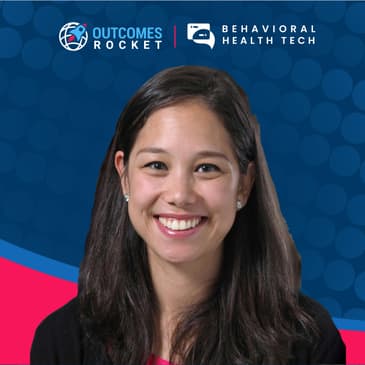
In this episode, Dr. Jessica Gaulton, CEO of Family Well, discusses the intersection of perinatal mental health and technology, focusing on collaborative care. She discusses how innovative care models are addressing critical gaps in maternal mental health services. Dr. Gaulton talks about embedding behavioral health support into OB practices. She also mentions how leveraging telehealth helps scale access to specialized care for new mothers and families.
Tune in to learn how innovative care models and tech-driven solutions are reshaping the future of maternal mental health!
Resources:
- Connect with and follow Dr. Jessica Gaulton on LinkedIn.
- Follow Family Well on LinkedIn and discover their website.
Fast Track Your Business Growth:
Outcomes Rocket is a full service marketing agency focused on helping healthcare organizations like yours maximize your impact and accelerate growth. Learn more at outcomesrocket.com
[00:00:01] This podcast is produced by Outcomes Rocket, your healthcare exclusive digital marketing agency. Outcomes Rocket exists to help healthcare organizations like yours to maximize their impact and accelerate growth. Visit outcomesrocket.com or text us at 312-224-9945.
[00:00:25] Hey everyone, welcome back to the Expanding Access podcast recorded live here at Behavioral Health Tech in the amazing Biltmore in Arizona. I'm excited to be with Dr. Jessica Gaulton today. She is the CEO of Family Well. Dr. Gaulton, thanks for joining us. Thank you for having me.
[00:00:53] Of course. This isn't your first time here. Why did you decide to come back to the conference? Last year, I just had the most incredible experience. So I was a founder fundraising last year and met my investors here. And they actually told me after we closed our seed round that one of the reasons they invested was because we met in person here and got to know each other.
[00:01:17] And so that was pretty magical because a year ago I was a founder fundraising and now we are a venture-backed company. We're in four states and it's just, it's pretty cool to be back. Amazing. Well, congratulations on that successful moment, but also the journey and the success you've had thus far. Yeah, it's been a difficult ride with fundraising, but really great outcome for us.
[00:01:44] We have great investors and are able to fulfill like our mission to solve the perinatal mental health crisis. Well, a very important topic. Tell us a little bit about you and your experience. Yeah. So I'm a mom of two and I had postpartum depression after I had both of my babies, actually. I'm a physician, I'm a neonatologist and I work with babies and families all the time and I missed my own symptoms.
[00:02:10] So doctors like myself, obstetricians on the front lines, we don't get any training in mood disorders in this really specific time in your life. Yes. And so I missed my own symptoms. It was six months after my second was born that I just realized there's something wrong. Yeah. And I hit a wall. I was practicing neonatology and on call every four nights. Which is so challenging. High stress. High stress. Yeah.
[00:02:40] In a new city with young kids feeling very isolated and very stigmatized. But what I needed was a female physician colleague of mine that had gone through the same thing a year prior turned to me and said, Jess, are you okay? And no, I was not. But what I realized was that was like the gate opening for me to realize, okay, I do need help. I can't go on like this.
[00:03:07] And then that started this whole path of like eventually me starting FamilyWell, but lots of steps in between. Wow. Well, I'm glad your colleague asked you. Mm-hmm. Mm-hmm.
[00:03:18] Mm-hmm.
[00:03:45] And say, if you don't have intrusive thoughts as a new parent, there's something wrong with you. You should worry. You should have these thoughts pop into your head. But what's happening to me in rare cases, they can be so intrusive that they prevent you from functioning. And it's because I didn't know what they were. I was having panic attacks. I was having, I never had thoughts of harming myself or my baby. But I often felt like it'd be so much easier if I just weren't here. Oh, my gosh.
[00:04:14] And it happens to so many women out there. Well, that's challenging. Tell us about how you're helping me expand access to mental health and substance abuse care. Yeah. So basically through my own experience, I was able to get help. It was very difficult to find specialized care. I didn't end up finding it. It was pre-COVID. And I just, I found a therapist, a generalist. She did help a lot.
[00:04:39] But after starting FamilyWell, realizing that women who struggle during pregnancy or postpartum, they need specialized care. And so what we did at FamilyWell was developed a comprehensive care model. So basically the care model includes a care manager. So basically like your advocate who walks you through the program, coach, therapist, and psych, psychiatrist or psych provider if needed. And then we embed all of that into OB practices.
[00:05:08] So our mission is to make behavioral health and traditional OB care one so that it's just fully embedded. And so we work with obstetric practices to provide that integrated care in their practice. So great. I think that's brilliant. And so tell us about virtual versus in-person delivery. Yeah. So I think the way to go in health care is to have a tech-enabled service, right?
[00:05:38] Like we can't replace everything with technology. We can't replace all humans with technology. Maybe someday when AI takes over the world. But we can use technology to help basically make services accessible in your own home because behavioral health is very stigmatizing. You don't really want to be telling your OB in the clinic all about your mental health concerns. And so using technology to enable the comfort in your own home.
[00:06:06] And we use telehealth for our one-on-one sessions. And then using technology to scale. So we've built a digital platform to enable us this clinical model that we're developing that's unique to be able to scale. And so technology is important, but then that like in-person, face-to-face partnership with the OB practice and with patients to get them into the program is also very important. I love that. Yeah. I love that. Thanks for sharing that. Of course.
[00:06:33] And just think one of the key things that has come up here at the conference is reimbursement and making sure that these types of programs get paid for. We're seeing a lot of advancements at both federal and state levels, but tell us more about how that could potentially be tailwinds or headwinds for you guys. Yeah. Great question. So what I was really passionate about is we have to develop a model that we can get paid for right away. We're not going to create new CPT codes.
[00:07:01] We're not going to go directly to the payer. We wanted to start, you know, embedding ourselves in practices and getting the practices to benefit financially. Yes. So I learned about collaborative care two years ago. Okay. Collaborative care is pretty much, I would say, the standard of care in primary care, right? It's like integrated behavioral health. There are CPT codes that have existed since 2017. Yeah. 32 state Medicaid plans accept these codes.
[00:07:28] So I said, why are we not doing this in OB, right? We're doing this in primary care. We're integrating care. PCPs are able to bill for these codes and benefit financially. Why can't OBs? And so basically we are the first to bring collaborative care specifically niche into perinatal mental health. I love it. And we're able to get the practices paid. So they're benefiting financially, clinically for their patients. And then they pay us.
[00:07:56] And we also bill for therapy and site codes. And although insurance-based models are not ideal, the rates are not ideal. We are able to get it paid for. It's covered by commercial insurance and Medicaid. Outstanding. That's music to my ears. And I'm sure music to a lot of the practices out there that are watching this. Penetration-wise, where's the industry at? Yeah. In terms of reimbursements?
[00:08:23] Well, actually more so OB practices adopting the solution you offer. They are desperate for it. Are they? They are desperate for it. Because what is happening in OB obstetrics as a profession is that OB-GYN providers, so that includes MDs, midwives, nurse practitioners, they are on the front lines, right? Taking care of patients when they're pregnant and postpartum. They're expected to screen for these disorders. Depression, anxiety.
[00:08:52] They're supposed to rule out bipolar disorder. This is all coming from ACOG, which is the American College of Obstetrics and Gynecology. They're like professional body. And so they're expected to screen during pregnancy, postpartum, but they literally have nowhere to send their patients. Wow. And that's why I started Family Well is because they, without access to treatment, you can't screen. Providers are hesitant, scared to screen, really. They don't want to know because they literally have nowhere to send them.
[00:09:20] And I experienced that to myself as a neonatologist taking care of families in the NICU. Wow. Well, the opportunity is huge. I'm so excited to be helping share your message with everybody watching and listening. Thank you so much. Thank you for sharing your personal experience. And so as you think about how we leave our audience today with a closing thought, what would you leave them with? And where can they reach out to you and your team to learn more? Yeah.
[00:09:49] So there are probably a lot of innovators, investors, a lot of stakeholders across healthcare listening to this. And I would just say that don't accept the status quo. The only way that we're going to make the system better is by challenging it and finding creative ways to fill gaps. And that's what we've done at Family Well. And I got impatient and I said, you know what? I'm not going to wait. I'm not going to do this within the health system.
[00:10:13] I'm going to start a company and then slowly bring these services back into the healthcare system. And so far it's working. I would just say don't accept the status quo. Always ask why we're doing this and figure out ways that we can do it better. Amazing. I love that so much. I heard what somebody say last week to me. Let's stop saying that's unfortunate and start saying that's unacceptable. Yes. Yes. And you're living that sentence to the T. Yep.
[00:10:42] So thank you for what you do, Dr. Gossel. It's a big service for all of us. And for everybody listening and watching, thanks for tuning in with the amazing Dr. Jessica Galton, CEO of Family Well. Check out the show notes for ways to get in touch with her and the program that she and her team are leading to transform psych and mental health care for really the OB population, right? Yep. So thank you all for tuning in. And Dr. Galton, thanks for having us. Thank you so much.
[00:11:10] This podcast is produced by Outcomes Rocket, your health care exclusive digital marketing agency. Outcomes Rocket exists to help health care organizations like yours to maximize their impact and accelerate growth.
[00:11:39] Visit outcomesrocket.com or text us at 312-224-9945. Thank you.