
Finding heart failure earlier gives patients a better chance to begin treatment before the disease progresses.
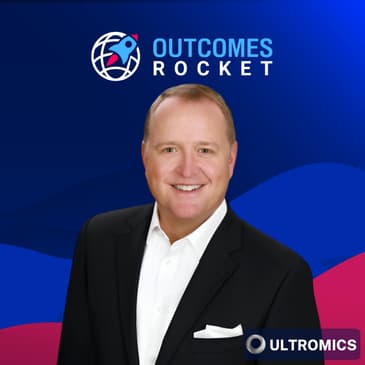
In this episode, Roger Owens, Chief Commercial Officer at Ultromics, discusses how AI-powered echocardiography can improve the early detection of HFpEF and cardiac amyloidosis. He explains how EchoGo integrates seamlessly into existing hospital workflows, enabling physicians to identify signs of heart failure from standard echocardiograms. Roger also explores the operational, reimbursement, and implementation challenges healthcare organizations face when adopting AI in clinical practice. He emphasizes that advances in treatment options make earlier diagnosis increasingly important for improving patient outcomes.
Tune in to discover how AI-powered cardiac diagnostics can support earlier intervention and better patient outcomes!
Resources:
[00:00:02] Hello everyone and welcome back to the Outcomes Rocket. I'm excited to be hosting Roger Owens on today's podcast. He's the Chief Commercial Officer at Ultromics. They're doing some fascinating work in cardiac diagnostics specific for heart failure. He's going to be the one that better tells us about what specifically they do and I'm excited to learn here with you as we dig in. So Roger, thank you so much for joining us today.
[00:00:31] Thanks for having me, Saul. Looking forward to chatting. Absolutely. You know, you have quite the history in MedDevices. You've been with some of the early stage companies that became the big players like the Bostons and the Abbots of the world. Talk to us about what inspires your work in the business, Roger, and what you're doing with Ultromics.
[00:00:51] Yeah, Saul, it's gone by in a blink. But I would say through undergrad and grad school, I was always really fascinated by the heart. That's what led to my graduate work. And then coming out, I was lucky enough to get into cardiac rhythm management. And I really had no idea what I was getting into at the time.
[00:01:09] But it was such a meaningful time in cardiology with medical devices and things like that because everything that was happening at that time was really revolutionary. It's really when defibrillators kind of exploded and then re-synchronization therapy. And then we had all kinds of novel and new things going on.
[00:01:26] But we also had a great group of people and really a wonderful footprint and guidance of leadership that have kind of proliferated throughout the medical device, in particular cardiology, to kind of lead a lot of different companies and bring to light a lot of new therapies and diagnostics. So it's been a lot of fun. That's kind of what inspired it. And the fascination in the heart, the, you know, we're not building bombs.
[00:01:52] So we're helping people day in, day out. And then while we're going through that, it's really kind of inspiring to work with so many different customers, physicians, healthcare practitioners, who also share that same passion of kind of bringing therapies and diagnostics to light that weren't there before.
[00:02:09] And it's easy to come up with novel things. It's hard to implement them and then work on the business of medicine. You need a lot of people kind of with the right intent. And it's been a lot of fun, but it's been inspiring. And that old adage of you never work a day if you're doing what you love kind of falls into play here. So it's been a lot of fun. That's great, Roger. I could feel your passion for cardiac, for the business, for devices. Talk to us about Ultromics. What are you guys doing that's different?
[00:02:37] Ultromics, similarly, was founded by two people out of the University of Oxford and some of our investors with Oxford Ventures. Really passionate about echocardiography. Really passionate about cardiology in general and finding different ways to diagnose heart failure earlier. As you know, it's a ticking clock and the earlier you find these patients, the better.
[00:03:00] So really, the company's based out of the UK, our offices in Oxford, I'm located in Dallas, but really launched EchoGo Heart Failure. And that's really to find and diagnose heart failure earlier in patients utilizing just a standard four-chamber apical echo. And then subsequently released a module to also evaluate amyloids. So we're trying to find patients who have HF-PF and amyloid earlier in their disease progression.
[00:03:28] And now there's actually things that you can do as far as therapies and pharmacologic care pathways that those patients can go down. But it's really heavily underdiagnosed. It's underdiagnosed 64% of the time for HF-PF, around the same for amyloid. So the earlier that you find them in a meaningful and scalable way, the sooner they get on care pathways. And that's really what Ultramix has been doing. We're going to continue to work on additional phenotypes and other infiltrative disease like hypertrophic cardiomyopathy.
[00:03:58] But that's really, in a nutshell, what we do. That's great. And how does it work? Basically, we work really closely with the hospitals across the country, close to you, hospitals like UCSD and other hospitals up in Orange County, like Hoag and Eisenhower and some others that we've been working with. But what we'll do is we'll work with the echo physicians as well as the heart failure physicians and then their IT teams to implement EchoGo into their workflow.
[00:04:25] So it's one thing about the product and finding their patients, but it's another thing about how do you create an application for this that is usable and so that it's not disrupting the care workflow within the hospital. So we'll integrate with the IT and then basically ingest their echoes and then those echoes will be run through EchoGo. And then we return the results to the reading physician from after the sonographers have completed the studies.
[00:04:51] And that's really, we deliver a DICOM image back to the PACS system to alert and detect for patients with HFpEF and amyloid. Well, that's fascinating and interesting. Yeah, it's a mouthful for sure. No, but you're fully integrating into the workflow. You're essentially, I hate using analogies for stuff like this because I'm probably wrong, but like, is it kind of like a co-pilot? Tell me, like, use the analogy that's right for me. Yeah, it's like a co-pilot, if you will.
[00:05:20] But Saul, I would think of it as the model EchoGo has been trained with an AI model, and that's really the secret sauce for the black box, if you will. But I think what makes it really different than the other things is you hear AI has almost desensitized so many people. You hear about it so many times, about so many different things. And I think it's one thing about how the model was developed and how that was trained and validated and then tested.
[00:05:47] I think what differentiates it is we've got a lot of clinical data in peer-reviewed journals like European Heart Journal and Jack Bances and others. But the actual operationalizing and using it in the application, I think that's what so many people are struggling with in healthcare right now. It's like, this sounds great from an AI standpoint, but how do we apply it so that it can be integrated into every day-to-day workflow? That has proven to be a very difficult problem.
[00:06:17] That's where I think we've differentiated ourselves. We've got a great team in the UK. We've got a great team in the States that really worked to implement it into the workflow so that physicians can care for their patients. I love that. Thanks, Roger. And as you talk to physicians out there and you're implementing systems across the country, what's the one thing that you feel is the biggest difference?
[00:06:40] I think the biggest difference that we've come across is we've had to overcome a lot and we're still learning and we're learning more from our customers while we're learning as much from our customers as I think they're learning from us. But I think the biggest difference is the actual implementation to operationalize it. There's a lot of really good models out there and we're okay with that because that kind of, you know, rising tide floats all boats.
[00:07:06] But when we take a look at how people are either early adopting, they're implementing and they're working out the operational portion of implementing AI into their healthcare practice. I think that's the main difference that we have. There's other people that are waiting to see. They're on the fence post right now because they appreciate the test. They don't question the data, but they don't know how to put it into play. How does this work in my hospital?
[00:07:34] And also, there's only so much time in the day and they're already busy and slammed with different things from caring for the patients to working on the economics, building healthcare challenges that are out there. But I think the real big difference is we've actually been able to operationalize it. We're live in top centers in the United States since August of 24. So we've learned a lot in that time.
[00:07:57] It's almost been two years since some of the first hospitals in Cleveland and nationally in City of Hope up in LA since we started working with them. Yeah, I saw the City of Hope case study on the website. You guys are doing some really great work. So as you sort of think about the lay of the land, you've got a lot of new SAMD, self-resistant medical device coming up. Yeah. There's a lot to overcome.
[00:08:21] In your view, what's been one of the biggest challenges and how have you guys overcome that and learned from it? I think one of the biggest challenges, Saul, is once we got through the operational things, and again, it all starts with the model, the EchoGo, the training, validating, testing. But then once we got through the workflow piece, we've really had to operationalize because the Echoes are relatively high volume.
[00:08:45] We've really had to operationalize an auto billing so that the economics work because hospitals are really struggling with the budgetary challenges that all the hospitals have come across throughout the country, making sure that the billing, the utilization, and the economics work on their end. And that takes a lot of communication with payers because they're trying to deal with this in a new and novel way as well because some AI models do not have any reimbursement at all.
[00:09:15] With EchoGo, we actually worked with CMS to go through HICS-PICS to Category 3. And so we have reimbursements specifically for EchoGo. And that sounds great, but then you have to work with everybody to make sure that the payers are aware and the education's there, the training and best practices are kind of put in place. That's probably been the challenge after the implementation. That's really great to know, Roger.
[00:09:38] Are you finding that you're running into like the need for prior auth for this or is it pretty seamless and people could go and do it if they want it? Yeah, it's a really good question, Saul. Just from a workflow standpoint, we're not looking for patients who are not already indicated for an Echo. That's where a lot of prior auths come in. So they're already going in for an Echo. You're just an overlay. We're just an overlay.
[00:10:03] So think of it as when you're not thinking about a heart failure, we're giving you a buoy in the bay. It doesn't necessarily mean a tsunami is there, but it's a detection device that alerts the physician who ultimately makes the clinical diagnosis of heart failure. But we're saying, based on what we've been training, this Echo looks like a half-pef heart or this Echo looks like an amyloid heart. And that's where I think we haven't had to have the prior auth. Got it. That makes a lot of sense. Thanks for walking me through that.
[00:10:33] Super useful. And these types of technologies are changing the game. So it's really exciting to hear about what you guys are up to. If you are thinking about any technology or trend that you're seeing out there that's going to change healthcare as we know it, what would you say that is? Yeah. Saul, you think about this daily, right? And I've been in cardiology a long time. So I've been fortunate enough to see some of the signals. And I'm more sensitive to them now.
[00:11:01] So hopefully I'm continuing to be educated. But Saul, what's really cool right now in heart failure is people weren't looking for it meaningfully every single day because there weren't therapies available for Hefpef, for example, until SGLT2Is came out. And then for amyloid, people weren't actively looking for it because you couldn't really do anything about it until Pfizer came out with their amyloid drugs about six years ago at Tephemidis.
[00:11:31] And then recently other companies have come out. Alnylam and then BridgeBio have come out with theirs. So all of these drugs and therapies, they kind of freeze the heart failure in place. What's really exciting in the future, and so time is of the essence. So the earlier we find the patients, the better chance they can live a full life with managing their disease.
[00:11:52] The really cool thing, though, as we take a look in the future is there's some not only silencers and stabilizers, but some of the drugs have promised to potentially reverse the disease progression. And if that happens, it really could be a kind of a life-changing event.
[00:12:09] I don't use that shyly on that because if you find the patients before they get too far along in this kind of sweet spot, you can not only stop the disease progression, but some of the pharmacologic therapies promise an opportunity to reverse. Those aren't out yet, so they're not there, but it's a really kind of exciting thing as we continue to kind of venture into the heart failure space. I really appreciate that context, Roger.
[00:12:34] And it's sort of like therapeutic advancement has opened up the door to now placing value on understanding where a patient is with regard to HF-PEF and amyloid. And you guys are able to serve that up for folks, which ultimately becomes a meaningful therapy delivered. Yeah, and that's really our goal. And the timing of when that meaningful therapy is delivered is really pretty critical right now with the current offerings that are out there. I love that, Roger.
[00:13:02] Well, look, I'd love to dig in further. Maybe we do a part two here, but as we close today's podcast, I'd love to have you give our folks best ways to get in touch with you as well as the company to learn more. Yeah, so we've just updated our website for Ultromics.com. And if you wanted to... It looks great, by the way. I was spending a little time on that. It looks really good. But yeah, and Sarah Jackson and Talabinam, they deserve all the credit for that.
[00:13:29] They are a part of our marketing team and really the brains behind our organization, at least commercially. But Ultramix.com, it's a real simple link. If you want to have a conversation, you can click that and get in touch with us. Also on LinkedIn, we have an Ultramix page on that and then my own personal LinkedIn as well. So any of those mechanisms are probably the best way to get a hold of us. So if you have any questions or want to learn more about Echo Go and Ultramix in general. That's fantastic, Roger. And I'm glad you gave your marketing team a shout out.
[00:13:57] So kudos to you guys, unsung heroes. You have been sung for. The light has been shown. They, along with Gracie McGill, have done an outstanding job. And it's a great team that we work with. That's great. That's great. Kudos, guys. Awesome job on the site and brilliant job on the technology that you and your crew are bringing to market, Roger. As you guys know, in the show notes, you'll find all the ways that Roger just shared to get in touch. So reach out to him.
[00:14:24] Share this with a friend if you feel like it's something that they could benefit from. Ultimately, that's how we spread the word and improve outcomes. We are the outcomes rocket and we want to be true to that. So thank you all for tuning in. And Roger, thanks for being with us. Thanks for having me, Saul. Appreciate it.