
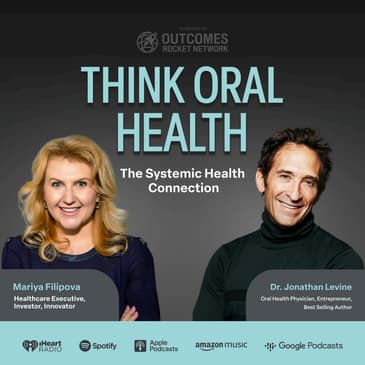
Pivotal advancements in dental practices, from early detection to non-invasive treatments, pave the way for leaps in oral-systemic health.
In this episode, Kyle Guerin delves into Henry Schein's commitment to health equity initiatives and its authentic culture, lauding CEO Stanley Bergman for fostering innovation. He also discusses efforts to improve oral healthcare for individuals with special needs and expresses optimism about future oral-systemic health initiatives, highlighting the importance of technology and collaboration.
Stay tuned as Kyle shares his vision for advancing oral-systemic health initiatives and harnessing the power of technology and collaboration for positive change!
Resources:
[00:00:00] Welcome to Think Oral,
[00:00:06] where we connect the unconnected between oral and physical health.
[00:00:10] I'm your host, Dr. Jonathan Levine.
[00:00:12] And I'm your host, Maria Filippova.
[00:00:14] Let's get at it.
[00:00:16] Another episode of Think Oral Health
[00:00:25] and another sneak preview of why we are excited about talking to our guest today.
[00:00:31] Jonathan, why are you excited about talking to Kyle Guerra today?
[00:00:35] Well, I am excited to talk to Kyle.
[00:00:38] Kyle heads up CSR at Henry Schein.
[00:00:40] And Henry Schein has been a tremendous partner for our GLO-GOOD Foundation,
[00:00:46] where we do these missions, these oral health and overall health missions
[00:00:52] into underserved areas to really create the equality.
[00:00:55] And we've been focused on Lutheran, the Bahamas.
[00:00:57] We are in partnership with Let Love Rule with Lenny Kravitz.
[00:01:00] And we've had Lenny on the show with us.
[00:01:03] So Kyle has come down to the mission.
[00:01:05] We've had amazing experiences together,
[00:01:07] and we've evolved to where we are because of the partnership
[00:01:11] and their support and their help.
[00:01:14] But Kyle is a very special guy, very warm, very considerate and kind person.
[00:01:19] So I'm excited to have him on the show.
[00:01:22] I love the energy that he brings in.
[00:01:24] I love the commitment to the mission that we will hear about again.
[00:01:29] And I love that who knows, maybe it would be another opportunity
[00:01:32] for you and I to disperse a couple of myths about oral health and overall health.
[00:01:37] Stay tuned, we'll find out.
[00:01:38] That would be amazing.
[00:01:40] Awesome. Let's get to it.
[00:01:41] Okay.
[00:01:42] Hi everyone, and welcome to the Think Oral Health podcast.
[00:01:46] I'm Maria Filippova, and I'm joined by Dr. Jonathan Levine,
[00:01:50] my favorite podcast co-host, and may or may not be biased.
[00:01:54] And I know we're not allowed to have favorite guests.
[00:01:57] Are we allowed to have favorite guests, Jonathan?
[00:01:58] I don't know. Maybe we, maybe, but we definitely have a top list of guests.
[00:02:04] And I think today is one of those situations where we have a dear friend,
[00:02:08] a visionary, a fellow troublemaker, Kyle Garrett.
[00:02:12] So Kyle is joining us as the director of corporate social responsibility at Henry Schein.
[00:02:17] What does that mean? You might ask.
[00:02:19] He is leading a number of high priority initiatives around health equity,
[00:02:25] initiatives that help health happen. We'll ask him about that.
[00:02:29] He supports Henry Schein and his vision and commitment to fulfill responsibilities
[00:02:33] as a global corporate citizen with five pillars around empowering teams,
[00:02:39] trying to reach their full potential, advancing health equity and expanding access,
[00:02:44] accelerating environmental sustainability, and strengthening
[00:02:47] and diversifying supply chain practices that Henry Schein uses.
[00:02:52] So not a small plate of initiatives.
[00:02:56] And most importantly, Jonathan and I have been talking about doing well by doing good.
[00:03:01] Kyle has made that his full-time job.
[00:03:03] He also happens to be a veteran in the industry.
[00:03:07] I know he looks, he doesn't look the age, but he has over 15 experience
[00:03:11] in healthcare and corporate social responsibility work.
[00:03:14] And he comes from the land of DSOs, having led initiatives
[00:03:20] and work at Pacific Dental previously.
[00:03:22] So with that, Jonathan, how excited are we to have one of our top guests
[00:03:28] and favorite guests today, Kyle, welcome to the podcast.
[00:03:32] Kyle, so great to have you here.
[00:03:34] Oh, it's my pleasure. I was honored to be here.
[00:03:37] Thank you so much. So let's start it off with, I have a burning,
[00:03:40] yearning question and maybe even a question that some of our listeners are thinking about,
[00:03:47] which is CSR, corporate social responsibility.
[00:03:52] How do you at Henry Schein, or has Henry Schein, think about those three letters
[00:03:57] and how important is it organizationally?
[00:04:00] Jonathan, it really is at the core of who we are.
[00:04:03] And it started 90 years ago when Henry and Esther Schein created this organization.
[00:04:10] And it was the way that they treated their customers at the time, employees or team members,
[00:04:17] or as now as we like to call them team Schein members.
[00:04:20] It was instilled there.
[00:04:22] And so it began just with simply the way we do business is important.
[00:04:26] And I love you already used our phrase doing well by doing good.
[00:04:30] So there was a intentional business effort as part of that.
[00:04:34] But it really started about we can't, if we don't take care of our people,
[00:04:39] how are they going to be able to take care of our customers?
[00:04:41] And that has grown to now when we talk about CSR and there's a lot of different discussion of the word.
[00:04:47] But ultimately, from my perspective, it's like, how do we just make the world a better place?
[00:04:52] And how do we like the word healthier people for a healthier planet?
[00:04:56] It needs to be simpler than it gets so political now with ESG and CSR.
[00:05:02] So I like that. We like to just say we're helping health happen every day.
[00:05:06] I love it. I love that.
[00:05:08] And call for you in Henry Schein.
[00:05:11] What of all the things that you're involved with?
[00:05:16] What gets you personally most excited?
[00:05:19] I'd be lying if on this podcast, if I'd say it's the work that we get to do in Eleuthera, Bahamas.
[00:05:26] And the let love rule.
[00:05:29] Why is it five minutes in and I'm working in a lot of wild nighters.
[00:05:33] In my career, we're going right away to the rock top moment of my dental career.
[00:05:39] But I was actually being all seriousness.
[00:05:41] I think one of the things that I shared with you while we were in the Bahamas is one of my personal mantras or life versus is learning from Coach John Wooden.
[00:05:51] And that's the help is to make each day your masterpiece.
[00:05:54] And I think one of the things that Henry Schein that I get to do at Henry Schein and that we get to do as an organization is we get to support those doing incredible things.
[00:06:04] And that's somebody has an ideal like you, Dr. Lugolino.
[00:06:08] You know what? I need to change the way oral health is done in the Eleuthera, Bahamas.
[00:06:12] And it starts and we have to come alongside.
[00:06:15] Yeah, let's do it.
[00:06:16] How do we bring in cool people and smart people?
[00:06:18] How do we bring in the right technology?
[00:06:20] How do we bring in innovation?
[00:06:22] I'm not a dentist, but I get to support them around the world.
[00:06:26] And I think that it's like picking a favorite kid.
[00:06:29] We don't have a favorite kid, honestly.
[00:06:32] But we the things we get to do are inspiring every day.
[00:06:36] Yeah, it's truly amazing.
[00:06:38] And it also doesn't it reflect Maria?
[00:06:40] It doesn't reflect Henry Schein as a culture because we've had some firsthand experience.
[00:06:46] Right. And we've had at the Glarglo Good Foundation that started out in a partnership with Lenny Kravitz.
[00:06:54] And we started on the lawn chairs and portable units.
[00:06:58] And seven years later, four universities into the schools, 100 people, freestanding 14 chair clinic.
[00:07:06] And we couldn't do that without our partners.
[00:07:08] And Henry Schein is such an amazing collaborative partner.
[00:07:12] So the old expression comes to mind that it does take a village.
[00:07:16] And he does. How would you describe the Henry Schein culture, the culture that you live in,
[00:07:24] that your teammates live in, your senior management team lives at?
[00:07:27] How would you describe it and how would you differentiate it from maybe some other experiences that you've had or other companies that you know, you're friends working in?
[00:07:37] Dr. Levine, I sat not literally your chair, but I was in a similar role as you at Pacific Dental Services as a previous customer.
[00:07:45] And I looked to Henry Schein as my solution.
[00:07:48] I told this story earlier today where for the very first time I didn't I wasn't a little boy growing up in Michigan and said someday I'm going to be the director of corporate social responsibility at Henry Schein.
[00:08:00] I didn't even know I knew what dentistry was.
[00:08:03] I'd been to the dentist, but I didn't know all the things of dentistry.
[00:08:06] When I was at Pacific Dental and I was literally in Ethiopia and we were in McKellar University in northern Ethiopia, in Tigray, and we're walking through this dental school and they didn't have anything.
[00:08:17] They didn't have they didn't have chairs.
[00:08:19] They didn't have hand pieces.
[00:08:21] They didn't have supplies.
[00:08:22] And for my former CEO, Steve Thorne and Steve and Marie, you both do.
[00:08:27] And Steve's the speaker of this podcast.
[00:08:29] Yeah.
[00:08:30] The listeners know Steve Thorne.
[00:08:31] And he's we're going to make something happen.
[00:08:33] And so we turn to Henry Schein and as a DSO and as a customer, we're like, we need it tomorrow.
[00:08:39] We need it right now.
[00:08:40] We don't you got to make it happen.
[00:08:42] And Henry Schein, they didn't do business in Ethiopia.
[00:08:45] They didn't have the supply chain, but they made it happen and they made it seem so easy and they made it.
[00:08:52] And by the end of the time I was doing it was serving Ethiopia.
[00:08:55] We had delivered chairs.
[00:08:57] We did different professors.
[00:08:58] We had we were we had connected them with a local distributor.
[00:09:01] We had provided supplies and all this work had been done.
[00:09:05] And I had this just Henry Schein, everybody I met at Henry Schein was so helpful and so kind.
[00:09:10] And I was like, this culture is fantastic.
[00:09:12] And then when I had an opportunity to join the organization, I was almost a little nervous because.
[00:09:18] All right, now I'm going to pull back the curtain.
[00:09:20] Now I'm going to be on the other side.
[00:09:22] Are they who they say they are?
[00:09:24] Are they is the culture real when you I joke because I've only been there a year.
[00:09:29] So I'm like this little baby team shine member because you see the longevity of 30 years, 20 years.
[00:09:35] We just Steve Kess just retired.
[00:09:37] He's 80 years old.
[00:09:38] He's been there for 40 years and it's he still is in calls.
[00:09:42] It's he lives this value that becomes of who you are and the beauty of it.
[00:09:46] It's all real.
[00:09:48] The authenticity, the genuineness, the ability to care that the opportunity to just go above and beyond.
[00:09:54] It's all real.
[00:09:55] And that's the part that is just so inspiring and exciting to you to be a part of this organization.
[00:10:02] Yeah.
[00:10:03] Tell me energy.
[00:10:04] We could feel ill.
[00:10:05] Oh, I got a bit of a burning question because I knew Henry Schein from maybe a decade and a half ago.
[00:10:12] And I know Henry Schein today.
[00:10:16] And the ability for companies to reinvent themselves, to reimagine a future, to have leadership at the top like you had that won't accept the mediocrity will only accept.
[00:10:31] How do we become the best?
[00:10:33] And how do we also help people along the way?
[00:10:36] Can you talk a little bit about some of that new energy and the new blood, the new people like yourself who have joined and reshine and how that has impacted public company like Henry Schein?
[00:10:48] Obviously, you both know it starts at the top.
[00:10:50] And Stanley Bergman is a legend, right?
[00:10:53] He's inspiring in the industry.
[00:10:55] He's never taking no.
[00:10:57] He never said no.
[00:10:58] You know what I'm saying?
[00:10:59] He always is willing to help.
[00:11:01] He always is pushing the envelope, finding the best solutions, finding the newest technology, finding how can we do better?
[00:11:07] How can we reinvent our business?
[00:11:09] How can we?
[00:11:10] And he has brought it there.
[00:11:11] There is but a little changing of the guard when you're a 90 year old company.
[00:11:16] There is a let's be honest.
[00:11:18] There is always sometimes of a need to bring in new energy to keep it fresh.
[00:11:22] And it was funny when and my one of the biggest reason I came to Henry Schein was another one of your amazing guests, David Kotschman, who David and I had spent time in Ethiopia.
[00:11:33] He was instrumental in the work that I did at Pacific.
[00:11:36] He was just I was so drawn to David and his energy and his thought leadership and just how he made things happen and how he became a mentor to me.
[00:11:46] And then the opportunity to join his team where it was like it was a no brainer.
[00:11:53] And I think David has those same values of Stan and has those same that that same drive and that same desire to it always goes back to doing well by doing good.
[00:12:04] But you're right, actually. I showed up at Henry Schein.
[00:12:06] I was at New York corporate corporate.
[00:12:09] I was West Coast.
[00:12:12] I'm wearing Jordans with my suit coat.
[00:12:15] Sometimes it's flashy.
[00:12:16] I'm not wearing a tie.
[00:12:18] And they weren't like, hey, man, go over there and put your lumpers on.
[00:12:22] It was like you to you and let's go out and do some great things.
[00:12:28] It has been exciting to see some of the transition that just keeps us.
[00:12:32] The dental industry is continuing to get younger.
[00:12:35] Dentists are getting younger.
[00:12:36] Health care is getting younger.
[00:12:38] And again, I'm not getting any younger, but I can try to relate to a little bit of that next generation.
[00:12:45] And this is great because for those of our listeners who have not heard the episode with David Kuchman, please tune in.
[00:12:51] The episode is out.
[00:12:52] And we also have even more special surprise.
[00:12:55] We've got Dan Berkman, the CEO of Henry Schein coming up on one of our next episodes.
[00:13:00] So please stay tuned.
[00:13:02] As I said, I at the very beginning, we wanted to bring you in, Kyle, because there's a lot of good work that you're doing that feeds into something that is a favorite thing of Jonathan and mine to do.
[00:13:12] I love this podcast because it's a great opportunity to disperse myths.
[00:13:16] And there's so many myths about dental.
[00:13:19] Just in our prior conversation with Maria Ryan from Colgate, we dispersed the myth that you don't really have to do anything about your oral health until you feel pain or discomfort.
[00:13:29] By the time you feel pain and discomfort in oral health, it's too late.
[00:13:32] Another myth we like to talk about and disperse is the fact that the oral health conversation is a dental benefits conversation and it lives in the clinical side.
[00:13:41] And with the heads of benefits, it is not a business C-suite level conversation.
[00:13:45] And so in the spirit of those myths that are bursting, I love having you here because one of the myths that you would help us burst is the myth that there is a very niche, small market that has to do with meeting the needs of patients with intellectual and developmental disabilities.
[00:14:05] So talk to us a little bit about this niche market of the 20% of the population who actually do have special needs.
[00:14:13] And what are you doing about this and why do you care?
[00:14:16] Yeah, I appreciate you bringing that up.
[00:14:19] There's 60 million Americans with a disability and one of their largest, their single biggest challenge is access to oral health care.
[00:14:30] And if you have a, and this is something not that people don't care about.
[00:14:35] It's just not on their radar, right?
[00:14:37] If you don't have a loved one or you don't have a somebody in your life that has this challenge, you're not even thinking about it.
[00:14:47] And I was really, I have a 15 year old son who's high functioning autism spectrum disorder.
[00:14:53] And with my son, you don't know unless, and there are certain markers and things and set like the oral health thing isn't a problem for us.
[00:15:01] He started at an early age.
[00:15:02] One of my best friends is a pediatric dentist in Arizona, Dr. Eric Ellis.
[00:15:08] And I would, we literally would drive to Arizona to see Dr. Ellis just one because it was super fun and we got to hang out.
[00:15:13] But he was just such a great clinician.
[00:15:15] And so as we were getting older, like it was always, it was second nature.
[00:15:19] But for so many families and so many patients, let's just talk United States here because the world is a whole nother problem.
[00:15:27] But here in the United States, it is such a challenge to find access to care.
[00:15:32] And from a dental perspective, I don't always blame the dentist.
[00:15:36] And because one, how very few of them received any training in dental school.
[00:15:41] Maybe it was some educational book type part or they got something.
[00:15:45] In some schools they did.
[00:15:46] They got 80 stills in Arizona is an amazing one.
[00:15:49] But so many of them didn't get, they didn't get the training.
[00:15:52] And let's be honest for some of this patient population, it takes time.
[00:15:56] It takes more time to be able to see this patient.
[00:15:58] And also the last one is just the reimbursement.
[00:16:01] And we don't want to get into all that.
[00:16:03] That's all another, that's probably a whole other show.
[00:16:05] But I think what I've had the privilege to do both at Pacific Dental Services and the PDS Foundation and then here at Henry Schein is to be a voice for this population is to be out there on great podcasts like this or at dental meetings.
[00:16:19] I got to be honest when you're speaking at the greater New York and you're speaking about intellectual or developmental disabilities, your session is not as well attended as insert new product or here's a new way to do a BNC.
[00:16:35] It's not as sexy, but the opportunity is so great.
[00:16:39] And what we've seen is that so many of the of these patients.
[00:16:43] And again, this is a whole another can be seen without sedation.
[00:16:46] It just takes a little more education.
[00:16:48] It takes a little more time.
[00:16:49] And we're out here and championing so many other people are out here really trying to move this needle in this area that is so needed.
[00:16:56] I love that.
[00:16:57] And is there maybe part of what you're describing is we need to be more aware of folks around us who may have.
[00:17:05] And I don't like to call it special needs.
[00:17:07] I like to call it personalized care.
[00:17:09] Yeah, I also have special needs.
[00:17:12] I like to go to the dentist at the end of the day after I'm done with work.
[00:17:15] So I also require some form of accommodation, extended hours.
[00:17:19] Right. And so whether or not somebody might have phobia from needles or like sensitivity to noise or light, all of these are way in the ways in which we personalize care.
[00:17:29] Walk us through from obviously you looking into this topic.
[00:17:33] What are examples of clinics, programs on the academic side, on the business side who are doing it well that we could look to as examples?
[00:17:42] And number two, are there any resources for our listeners who want to get involved, who want to get better educated about this?
[00:17:49] What could they do?
[00:17:50] Yeah. To be right now, Dr. Mark Wolfe is the dean at Penn.
[00:17:55] He is just doing a fantastic job of advancing this from their persons with disabilities center that they've just opened on the campus to they literally for dentists who are interested are offering and partnering with Delta Dental Foundation of Michigan and Indiana.
[00:18:11] I think Ohio, Holly Seabury is doing amazing work in that area.
[00:18:15] But they offer 16 free CEs that dentists can go into to just learn more about this area and to just get their feet wet in this topic.
[00:18:24] There's a number of amazing clinicians that are just that have become friends.
[00:18:29] Dr. Jacob Dent, who is a PDS supported dentist in Louisiana.
[00:18:33] Dr. Taryn Sedillo, who's in Colorado.
[00:18:37] And I think she's she may I think she may be moved or Nebraska.
[00:18:40] Dr. Brooke, who is in Idaho, who is out speaking and doing incredible work.
[00:18:45] I have to say a little bit about the clinic that previously I'd opened PDS Foundation Clinic in Phoenix, Arizona, that is doing incredible work seeing patients of this area.
[00:18:55] Dr. David Jiropshi, who is a friend of mine in Arizona, pediatric dentist.
[00:18:59] There are dentists are interested joining the AADMD, the American Academy of Developmental Medicine and Dentistry, the Special Care Dentist Association.
[00:19:09] It's Dr. Alan Wong is just a legend in the space.
[00:19:13] But you can start even in your local neighborhood with go volunteer at a healthy athlete special smiles event with Special Olympics.
[00:19:22] This is the easiest way.
[00:19:24] That's all it takes to just dip your toe.
[00:19:26] And once you do that, you realize that this is something you can bring into your practice.
[00:19:31] And this is if you take off the charity hat and you put on the business hat.
[00:19:35] So many of these families are desperate to find care.
[00:19:38] So as a marketing kind of again from a business owner, if you're willing and able to see this loved one, guess what?
[00:19:46] They're going to tell all their family, whole family now comes to your practice and they're going to tell all your friends.
[00:19:51] These can become your best marketing advocates for your office and they can do all the marketing for you when you can just be a place that is open and safe and accommodating.
[00:20:01] I promise you if you build it, they will come.
[00:20:04] Boy, that speaks to the heartbeat of doing well by doing good.
[00:20:08] And that is just such a great message.
[00:20:11] It's a great message.
[00:20:12] And I do have a question for you, Dr.
[00:20:14] Jonathan Levine, because we were describing here what Kyle is describing here is the business side, people side, the admin side of care delivery.
[00:20:25] And it's clear, at least in my view, that the practice of dentistry, the clinical practice of dentistry also needs to evolve.
[00:20:33] Some of the treatments are so invasive.
[00:20:37] And so how are we deploying innovation, cutting edge technologies and advances in science to make dentistry less invasive and more preventative and more proactive?
[00:20:49] And I have something very specific in mind.
[00:20:51] Again, I go back to my one of the myths that I talked about periodontal disease.
[00:20:56] As I say jokingly, if we really want to advance treatment and of periodontal disease, we should just make periodontal disease more painful.
[00:21:03] Right. Because by the time you start experiencing the symptoms, it's too late.
[00:21:08] And the treatment of periodontal disease is not a walk in the park.
[00:21:12] Right. It's just treatment sometimes is worse than the symptoms.
[00:21:17] And so talk to us, Dr. Levine, about where do you see hope in that innovation set of new solutions, especially on the preventative care side?
[00:21:27] Right. Do I need a filling or do I need a product like Hurodon, especially when it comes to solution for patient populations with special needs?
[00:21:37] Yeah.
[00:21:38] What do you think?
[00:21:39] What reminds me and what I've learned is innovation happens at every level.
[00:21:44] And the idea is that you look at all of health care, we got to go upstream with our thinking and with our mindset.
[00:21:50] So our mindset needs new way of thinking.
[00:21:53] We can't embrace a sickness model.
[00:21:57] We have to embrace a wellness model.
[00:22:00] And what does that mean?
[00:22:01] Oral diseases, the decay of periodontal disease and even early detection of cancers.
[00:22:06] Everything is preventable if you catch it early enough.
[00:22:10] So what do we have to do?
[00:22:11] We have to develop behavior and habits that become ritualized.
[00:22:16] We have to be able to educate people about the importance.
[00:22:20] At our Glow Good Foundation, what we have learned in this microcosm of a town called Eleuthera in partnership with Lenny Kravitz,
[00:22:27] our foundation has realized that when we go into the schools and educate the children that have never been educated before,
[00:22:34] educate the teachers so that we can basically teach the trader model where we go into the community and provide services
[00:22:43] and take people out of pain and give them their self-respect, their dignity, and their function back.
[00:22:48] We can change a community.
[00:22:51] And now the children are thinking about how to, are educated about how to be prevented.
[00:22:57] You couple that with new innovation that you were talking about with a company that embraces new technology like Eturidad,
[00:23:06] like a number of these companies that are looking at what are the new actives?
[00:23:10] What are the new peptides?
[00:23:11] What are the new remineralization agents?
[00:23:13] Or what can we do in addition to fluoride to decrease decay?
[00:23:18] How do we educate people so that you don't develop inflammation in the mouth?
[00:23:22] Because we know that systemic inflammatory diseases, everyone we could name are connected to inflammation of the mouth
[00:23:30] because inflammation of the mouth creates these foreign invaders in the rest of the body as it hits every one of our organs.
[00:23:36] Upstream thinking, changing mindset, innovation in our thinking, innovation in our products and our services coupled together, embracing it.
[00:23:46] And having companies and also having insurance companies that will reimburse providers
[00:23:53] and understand how many billions of dollars we can save downstream by thinking about this greater wellness model
[00:24:02] will go a long way to create efficiencies and effectiveness for people's health.
[00:24:08] I couldn't agree more.
[00:24:10] And I would love to, again, in the spirit of making this as practical as possible,
[00:24:14] behavior change takes time, patience, discipline.
[00:24:18] And today there are opportunities that you even as a patient could do.
[00:24:24] When you go to your dentist, ask what are the non-invasive options for this?
[00:24:29] Ask your dentist, what do they think about oral systemic health?
[00:24:32] If they look at you weirdly, then you probably need a different dentist.
[00:24:36] That's my opinion.
[00:24:37] And so as a patient, it does start with taking the time and the responsibility to get a little bit more educated because they are new.
[00:24:46] And again, I go back to that example.
[00:24:47] There are new technologies that are coming up.
[00:24:49] We were just on a conversation with Maria Ryans from Colgate and we're talking about Arginine,
[00:24:56] like a new soon to be on the market opportunity or technology that is improving to be significantly more effective than fluoride alone.
[00:25:06] And so what are those technologies?
[00:25:08] What are those preventative enamel regenerating solutions like Curidon that could be used instead of a filling for an early lesion?
[00:25:17] So ask about them when you go to your doctor.
[00:25:20] And that's probably where I would put it because as an activated patient, we have to take responsibility for our own health as well.
[00:25:28] Activated patient.
[00:25:29] Maria, I love when you use that expression.
[00:25:31] Maria, explain to everybody what you mean by that.
[00:25:34] An activated patient is a patient who uses a curious mindset and humility to overcome this.
[00:25:45] Jonathan, I don't know if you've experienced it because you do have, you are the doctor.
[00:25:48] But when I go to an office, a dental office or medical office, the white coat syndrome is real.
[00:25:55] There's such a hierarchical energy and there's also disinformation, right?
[00:26:01] I'm a patient.
[00:26:02] I did not go years in medical school.
[00:26:05] A lot of the times you're in your most stressful, painful state of mind and then all kinds of scary terms are thrown your way.
[00:26:14] And an activated patient simply uses their curious mind to say, what do you mean by that?
[00:26:20] What are the other alternatives?
[00:26:22] Help me understand this.
[00:26:24] Because what a novel idea that you have to understand what your diagnosis and what your treatment options are so you could be an active participant in it.
[00:26:33] Why is that important?
[00:26:34] Because when you know what you're in for, when you were part of that decision making, you're probably more likely to stick to your treatment plan.
[00:26:42] Yes.
[00:26:43] And so to me, being an active, it also means that you are responsible for your health outcome.
[00:26:48] Exactly.
[00:26:49] And that's really what it comes down to.
[00:26:51] We take a ship to our health, this whole concept of self-health.
[00:26:56] We really have to become educated ourselves.
[00:26:58] We have to really adopt that curiosity mindset for sure.
[00:27:03] So let's get back to Kyle.
[00:27:04] Kyle, questions for you.
[00:27:06] As you look at CSR, you look at Henry Schein, you look at 2024, what's on the top of the agenda?
[00:27:12] What are you hoping for to accomplish this year?
[00:27:15] And maybe even as you look a little bit down the road, what gets you excited?
[00:27:20] I love that conversation.
[00:27:22] Just to put a bow on it, what you're talking about, of that education for a patient of really understanding it.
[00:27:28] Because when we go to the dentist, let's be honest, do I want to get four quads of scaling and root plating or do I want to buy these New Jordans?
[00:27:36] Unless I really understand how it's going to make me healthier and understanding from the heart to diabetes and to all those other things, I'm not going to do it.
[00:27:45] Honestly, what excites me, and this is this, you are seeing, you guys talked to Steve, Steve is, he is all in on oral systemic health.
[00:27:54] And you're seeing more and more dentistry.
[00:27:57] So I think what we're seeing at Henry Schein is one, volunteerism is back.
[00:28:03] COVID really did a number on individuals either going on trips or missions or all those things.
[00:28:09] And so we have gotten more requests than probably ever.
[00:28:12] We are to request levels, pre-pandemic request level.
[00:28:15] People are back doing trips, doing health fairs, screenings, all those things.
[00:28:20] But what else is exciting is back to the special needs.
[00:28:23] There's a number of universities that we're seeing that are now launching special healthcare projects.
[00:28:30] They're launching those operatories geared towards this patient population.
[00:28:33] We're seeing that the curriculum get developed, the universal curriculum with AADMD has been working on.
[00:28:39] So you're really seeing a light being shined on these different issues.
[00:28:44] You're seeing, I'd say, that compassion of individuals like yourself, Dr. Levy, that are like, you know what, this starts in our backyard, but it's also across the world that we can make this impact.
[00:28:55] And you're seeing it's not just one of the things that I absolutely fell in love the first time I got to go on the trip was the idea that we're just showing up into these areas.
[00:29:07] We're doing as many extractions as possible, and we're going home, patting ourselves on the back and snapping pictures to share on Instagram.
[00:29:16] What you were able to accomplish and through our great partners, 3Shape and SprintRay, to be able to literally change the smiles of people and placing dentures and partials and completely new smiles.
[00:29:32] That was such a game changer to where you're like, gosh, I think they're out of pain.
[00:29:38] We pulled the tooth.
[00:29:40] The poor girl no longer has eight or nine.
[00:29:42] Gosh, we hope for the best.
[00:29:44] And yet seeing the transformation.
[00:29:46] So I think as we're seeing that technology is making this easier, there is an opportunity to provide that better health outcome to those patients beyond that it doesn't just have to be.
[00:29:58] There is still a place with remote medicine and dental that you have to get out of pain and you have to get rid of the infection.
[00:30:04] It is necessary.
[00:30:05] I'm not knocking that at all because not everyone has the opportunity that you do in the environment that you're able to do it.
[00:30:12] But it is so exciting to see that there is this just strong desire to create sustainable solutions around the world, bringing in the local populations to bringing in not just coming in and saving the world, but building a sustainable method that for years to come that can really be that health access beyond a trip.
[00:30:35] Yeah, no, it really does.
[00:30:37] Look, it takes a village because of the collaboration, your company of the Sprint Rays, of all the people that have come on this mission.
[00:30:46] We've been able to evolve where we started, to where we are and where we want to go using technologies that you would not expect.
[00:30:54] Yeah, places like Lutheran Bahamas and Gregory Town with 3D printing dentures and prostheses we're designing on computers where have baseline vital health with nurse practitioners.
[00:31:08] We combine oral systemic medicine.
[00:31:10] In other words, we look at how oral health and overall health need to work together and to improve better outcomes.
[00:31:17] We figured out how to go into the schools and change young people's behaviors so they don't develop these diseases.
[00:31:23] There's so many learnings that come out of a mission like that.
[00:31:27] And what do we always say?
[00:31:29] We always say that we get more out of it than the people we're treating because we really figure out why we do what we do.
[00:31:35] And the collaboration of people coming together from all aspects of an industry is extremely powerful.
[00:31:42] I think that's what we've seen on these missions.
[00:31:45] And like we all like to say, we're just getting started.
[00:31:48] Yeah, I got to tell a funny story, Dr. Levine, that piggybacks exactly what you said.
[00:31:52] We did that amazing video the year before and we chronicled the three women that were, that had gotten this treatment.
[00:31:59] And we met, I think her name was Edith.
[00:32:01] And Edith's daughter was getting married and she had waited for us to give the smile.
[00:32:06] And it was just incredible story, right?
[00:32:09] Now she's going to get married and Edith is going to smile in all the pictures.
[00:32:13] And so then this year we brought Edith back and we're like, how's your life?
[00:32:18] And she's like, I didn't get married.
[00:32:19] They decided to buy a house instead.
[00:32:22] And life's good.
[00:32:23] My smile's great.
[00:32:24] I'm eating what I want.
[00:32:25] But it was funny because we expected this moment.
[00:32:28] But the beauty of it was last year was the designer, the doctor that's married to Julia, I think her name is.
[00:32:35] And last year he was in Brazil designing the prosthesis.
[00:32:42] And he was like, in some of these, he was learning on the fly and it inspired him to take all these classes and to be a better dentist.
[00:32:51] And so then this year he comes on the trip.
[00:32:54] He's designing.
[00:32:55] He meets Edith.
[00:32:57] They're talking and hugging.
[00:32:59] He's weeping, like weeping, crying because he was so touched by the opportunity he had.
[00:33:07] And like you just said, the impact so often is not as we see it, not as we think it's going to be.
[00:33:14] And I've told a million people this story because it was so touching to see at the end of the day, it's these human interactions that inspire us to do amazing things.
[00:33:24] And we never know where these paths are going to take us.
[00:33:27] But it's fun being on the ride.
[00:33:29] And so I just love the things that you're doing and the things that we get to be a part of.
[00:33:35] Yeah, we do it.
[00:33:36] We all do it together.
[00:33:37] It's very powerful when you're in an industry and you find your purpose, whatever you're doing to really figure out why we do what we do and how do we help and serve each other and become better humans at the same time.
[00:33:51] It's so great for me, Kyle, just to talk about these wonderful things.
[00:33:57] We could have five episodes of stories of wives that are being touched with the mission and the work that you do, Kyle, and your organization supports and the mission that you have folded and embedded into your life, Jonathan.
[00:34:12] So that's actually why we created the podcast, right?
[00:34:16] More to come and I can't wait to continue the conversation.
[00:34:20] And we will include links to some of the resources that you mentioned, Kyle, in the description of this episode.
[00:34:25] So for those of you who wanted to volunteer, get connected, check out the description of this episode as well.
[00:34:32] With that, thank you for joining us.
[00:34:34] Thank you, Kyle, so much.
[00:34:36] My pleasure.
[00:34:37] As you said, you guys are two of the best and I'm just honored to be here.
[00:34:40] And what's the best part of this whole thing we get to do?
[00:34:42] It's just making new friends.
[00:34:44] Let's be honest.
[00:34:45] We're all people and we love hugging and just seeing each other.
[00:34:48] So if nothing else, it's great making new friends.
[00:34:51] You're bringing that joy.
[00:34:53] Thanks, Kyle.
[00:34:54] Thank you so much, Maria.
[00:34:55] Always a pleasure to have some fun with you on the podcast.
[00:34:57] Always.
[00:35:04] Thanks for listening to the Think Oral podcast.
[00:35:07] For the show notes and resources from today's podcast, visit us at www.outcomesrocket.health.com or start a conversation with us on social media.
[00:35:20] Until then, keep smiling and connecting care.