
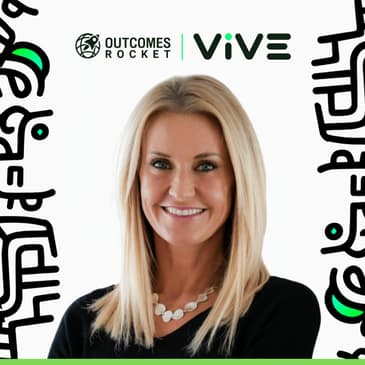
Bridging the gaps in care through secure communication.
In this episode, Therasa Bell, President and Co-founder of Kno2, talks about connecting the entire continuum of healthcare providers, including overlooked groups such as post-acute and behavioral health. She discusses building a national healthcare infrastructure and developing a Trust Accord that goes beyond baseline regulatory requirements. Finally, Therasa explains their provider's first business model, designed to ensure that the last stop for care is protected and integrated. This episode explores the mission of democratizing healthcare communication by building a secure and scalable national infrastructure rooted in a unique trust model.
Tune in to break down the barriers of healthcare communication!
Resources:
[00:00:08] Hello everyone and welcome back to the Outcomes Rocket recorded live here in Los Angeles for Vive. I am so excited to have Therasa Bell with us today. She is the President and Co-Founder of Kno2. Therasa, welcome to the podcast. Therasa Bell Thank you for having me, Saul. This is exciting. Therasa So let us know a little bit about you and your company before we get into the questions. Therasa Bell Absolutely. Well, as you said, I'm the President and Founder of the organization. Started it now. We're 13 years old.
[00:00:38] Therasa Bell Serving a real, I'd say one of the most difficult challenges that's yet unsolved in healthcare, but is really about connecting the entire continuum of providers so that they can exchange information at scale. So we've been hard at work for about 13 years building infrastructure. So we've been laying the pipes for the information to flow at scale, patient's information to flow at scale for that long.
[00:01:02] Therasa Bell And also very focused to connecting the parts of the continuum that have been overlooked for years. So very much focused to post-acute providers, to behavioral health, to vision, dental, emergency medical services, all these groups that actually perform more care than we see in the hospitals every day, but are never talked about. So those two have been our mission. And today we serve as the largest communication infrastructure in the United States. Therasa Bell Super cool. And what is it that got you into this?
[00:01:31] Therasa Bell Like 13 years ago, what was the thing or things that led to keep getting into this? Therasa Bell Well, my whole career was based upon software engineering. Therasa Bell So I'm a software engineer by trade. Therasa Bell I spent all my time in healthcare and I got to sit in multiple care settings and then in multiple personas. Therasa Bell So I sat in the hospital setting. Therasa Bell I've been in a physician office setting. Therasa Bell I also worked on the insurance side. Therasa Bell And I've seen kind of all the inefficiencies that were in healthcare.
[00:01:58] Therasa Bell And then I worked for a company where we were building technology for healthcare, Therasa Bell Specifically to capture clinical information at the point of care in either structured or unstructured format. Therasa Bell And based upon some happenings at that company, Therasa Bell I was able to go out on my own and pursue a passion that I absolutely believed in Therasa Bell And being able to break down the barriers of communication. Therasa Bell And that's what started it. Therasa Bell And I always say I was waitressing by day and engineering at night and doing the work. Therasa Bell And I loved it, loved what I do.
[00:02:28] Therasa Bell And today, again, we've really accomplished a lot as a company. Therasa Bell That's great. Therasa Bell Thanks for the story. Therasa Bell And there's something to be said when you get to sit in those different seats. Therasa Bell You see the problems, right, from the different- Therasa Bell Oh, 100%, yes. Therasa Bell And it's unbelievable because people say healthcare, they use the word healthcare, and I say which part? Therasa Bell Because healthcare for most people represents a doctor, represents a hospital,
[00:02:56] and that's what I would say the typical consumer thinks about when they think about healthcare. Therasa Bell And then I said, do you understand how wide healthcare is? Therasa Bell I mean, healthcare is everything from that acute care setting to a skilled nursing, to a home health agency, to physical therapy. Therasa Bell And now we're seeing healthcare take on new forms of innovation and care models and telehealth and remote patient monitoring. Therasa Bell And healthcare's word is always expanding, but with every expansion, it is really,
[00:03:25] really difficult to start connecting now that part because the data is so big. Therasa Bell The data sets are so big. Therasa Bell So I actually get kind of dismayed when people compare healthcare to, they always use the banking industry. Therasa Bell It's like, oh, we've connected every ATM in the United States. Therasa Bell It must be that easy. Therasa Bell Like, do you understand that they're working with a data set of zero to nine? Therasa Bell That's all they have to worry about is zero to nine. Therasa Bell And in healthcare, data is exploding.
[00:03:50] Therasa Bell And what a physical therapist cares about versus what a behavioral health provider cares about versus a emergency med doc, very, very different versus a dentist, very different information. Therasa Bell So health information exchange is not easy. Therasa Bell It is not, it's a difficult equation to solve at scale. Therasa Bell And that's what drove my passion. Therasa Bell I love it. Therasa Bell Every day I wake up with more passion than I did the day before. Therasa Bell That's so great. Therasa Bell Well, you picked the right problem to solve. Therasa Bell Yes. Therasa Bell I may not see it before I'm dead, but yeah, this will be fun.
[00:04:19] Therasa Bell Hey, 13 years in, this is a good run. Therasa Bell So talk to us about how No2 is using digital health and technology today to drive meaningful change in healthcare. Therasa Bell Yes, we are enabling it. Therasa Bell So we have just under 300 technology partners and growing every day that have integrated to our infrastructure. Therasa Bell So when I say that, we have an API that they connect to.
[00:05:11] Therasa Bell
[00:05:42] Therasa Bell Therasa Bell So we don't leave, we say we leave no technology provider left behind, no electronic health record left behind, no matter if they have incentive to connect or not. Therasa Bell Wherever they're at with their technology stack, they can adapt to our API and get connected and not have to make a huge overhaul of their technology. Therasa Bell That's great. Therasa Bell What's the most important innovation your team is focused on right now? Therasa Bell And what problem is it designed to solve?
[00:06:06] Therasa Bell Yeah, so we're focused, one, we're part of the national healthcare infrastructure that the federal government put forward with TEFCA. Therasa Bell Yeah, it's up. Therasa Bell And so we're very focused to TEFCA and to the CMS initiative under CMS Align Networks to making sure that our network supports those requirements. Therasa Bell And they're constantly changing right now. Therasa Bell It's a very dynamic industry. Therasa Bell So anytime a regulation comes down or we get a new standard operating procedure, we're embedding about that.
[00:06:33] Therasa Bell I mean, people don't often think about it, but if you think about in the communications industry early on, especially with T-Mobile and Verizon and the constant sharing of data standards that they were having to go to to build the infrastructure that we have today with 5G, right? Therasa Bell And then now we're going to Starlink and everything else. Therasa Bell That's what we're doing in healthcare and building that kind of national infrastructure. Therasa Bell That's our number one focus is making sure we meet the regulatory and all those expectations.
[00:07:00] Therasa Bell Second to that, we're really about going beyond just what we consider to be baseline with the national infrastructure. Therasa Bell So how do we drive communication that's meaningful? Therasa Bell You'll notice I don't use the word interoperability very often because to us interoperability is a two-part equation. Therasa Bell So not only the technology vendor like the remote patient monitoring platform that connects to us and us, it takes both to drive interoperability.
[00:07:25] Therasa Bell We're focused to how do we make sure we build communication, meaningful communication, so that when somebody connects to us, it's smart. Therasa Bell It knows, hey, you're going to need this information or, hey, this patient needs to transition here. Therasa Bell And we're constantly pushing that envelope with our infrastructure. Therasa Bell What's one thing that most people don't know about what you do? Therasa Bell Art it is.
[00:07:48] Therasa Bell I would go back to the question on, it's the analogies of, hey, the ATMs are connected, how hard can it be? Therasa Bell And it's really hard. Therasa Bell So not only the technology side of it, but also the, as you can imagine, the trust aspect of healthcare. Therasa Bell People always say, well, you know, we've got HIPAA, we've got cybersecurity, we've got encryption, isn't that cover the need? Therasa Bell And that's like, that's baseline. Therasa Bell Getting to national, let me pose the problem.
[00:08:18] Therasa Bell So in HIPAA, that was defined in 1995, 96 time period where the provider was responsible. Therasa Bell So as a patient, I go see my provider and I just trusted that they were managing my information and protecting it and only releasing it to who they needed to, right? Therasa Bell That's what I signed my consent saying, you can release it to other providers, you can release it to payers when it's needed. Therasa Bell Very basic. Therasa Bell But the provider made the decision every time to push it out.
[00:08:47] Therasa Bell So they would fax it out or they'd mail it out, right? Therasa Bell That was the old world. Therasa Bell Now we've inverted that problem, right? Therasa Bell So now we have all of these different networks coming up where we've agreed as networks that we're going to be able to query and pull information from any system at any given time when I need it. Therasa Bell So now you have unfederated exchange and pull of patients' information.
[00:09:09] Therasa Bell So the trust equation has flipped where I trusted you as my provider to send my information on before. Therasa Bell Now I'm trusting you as my provider to make sure that you're putting the mechanisms in place that say when somebody comes and queries, comes in the back door and knocks on for that information, that scale, that my information is protected going out the door. Therasa Bell And that's our job as a network. Therasa Bell So when I say it's not, it's hard. Therasa Bell This is hard, right? Therasa Bell Because it's not just technology. Therasa Bell It's privacy. Therasa Bell It's regulation. Therasa Bell But it's innovation too.
[00:09:39] Therasa Bell It's pushing up against innovation and making sure that we're not standing in the way of innovation, but we're not letting our patients' information just fly out, you know, in cyberspace and be used by who knows what. Therasa Bell So it's a constantly evolving situation that we're working through. Therasa Bell Yeah, that trust piece is key. Therasa Bell It's key. Therasa Bell And, you know, you hear a lot about, you know, cyber vulnerabilities and risks.
[00:10:08] Therasa Bell And this is what we're talking about, right? Therasa Bell Like setting things up, having the right governance. Therasa Bell Talk to us about how organizations can prepare for something like that. Therasa Bell Yeah, it's, I'm going to actually flip your question a little bit. Therasa Bell So the first question is, is how are the networks ensuring trust? Therasa Bell And we're, we have a TEFCA governing body. Therasa Bell So ASTP, which is part of the federal government, right, is providing kind of a core operating framework that says, you guys are going to trust each other. Therasa Bell Here's what you have.
[00:10:37] Therasa Bell Here's the standard operating procedures between each other. Therasa Bell And then trust really moves now to the networks themselves. Therasa Bell How do I know that? Therasa Bell How does a technology partner that's, I'm going to go back to that remote patient monitoring platform. Therasa Bell How do they know when they choose no to, that no to is doing the right thing beyond just baseline requirements, like beyond HIPAA, beyond cybersecurity. Therasa Bell Those are givens, right? Therasa Bell You, you better be meeting high trust. Therasa Bell You better be meeting HIPAA. Therasa Bell How do I know then your ethics are appropriate?
[00:11:06] Therasa Bell How do I know that you're operating at a different level? Therasa Bell And we're actually the first network that we're coming out with what we're calling the trust accord. Therasa Bell So if you're familiar with Anthropic, and most people are, right, Claude. Therasa Bell If you go to Claude's website, do you know they have a constitution? Therasa Bell And if you go there, it's very interesting. Therasa Bell Oh, that's right. Therasa Bell And they were the first AI model to come out with a constitution. Therasa Bell And the constitution, it's a very technical document. Therasa Bell But the intent of the constitution is to say, this is how we're training our learning models.
[00:11:35] Therasa Bell And they're using external sources, like they're taking the United Nations Bill of Rights and saying, this is the Human Bill of Rights. Our learning models read that Bill of Rights. Therasa Bell And they were building against that Bill of Rights. Therasa Bell So it's not Anthropic saying, here's the Bill of Rights. Therasa Bell They put their own, of course, in there. Therasa Bell Oh, okay. Therasa Bell They're saying, nope, I went higher than that. Therasa Bell I went to the United Nations Bill of Rights and my learning model. Therasa Bell So no two looked at that and said, we probably need something similar.
[00:12:03] Therasa Bell That as a network, we're coming out with the trust accord. Therasa Bell And this is actually being published actively to say, Therasa Bell We're going beyond HIPAA. Therasa Bell We're going beyond high trust. Therasa Bell That's a given. Therasa Bell You should expect that as a provider, as a patient. Therasa Bell And we're moving to a set of 107 operating principles that says, Therasa Bell These are dynamic and we're going to continue to make sure that we're making ethical decisions that are not commercially driven, that are for the provider, that are for the patient. Therasa Bell And we're pushing forward on that.
[00:12:30] Therasa Bell So to me, that's how trust has to be established in layers. Therasa Bell Because at the end of the day, trust is a prediction. Therasa Bell I always say, trust is a prediction of behavior. Therasa Bell That based on what you've done, based on things that you've said, I'm predicting you're going to behave this way and that you'll continue to behave this way. Therasa Bell I like that. Therasa Bell That's a fresh approach to trust. Therasa Bell We hope so. Therasa Bell I love that. Therasa Bell And what's the business model? Therasa Bell Yeah, that's a for us without going into too much detail, but it's a really good
[00:12:58] question because from the beginning, when I say we went after the overlooked audiences, so we went after post-acute behavioral. Therasa Bell By going after those markets, they couldn't spell the word interoperability, not to be offensive to them. I love them dearly. Therasa Bell They couldn't spell the word. Therasa Bell But they also didn't have any kind of economic incentive that was given to them. Therasa Bell Unlike what Meaningful Use drove, $30 billion for hospitals and physician offices, they got zero. Therasa Bell They've gotten zero to build this infrastructure.
[00:13:24] Therasa Bell So we had to build an economic model that I always say could scale between the physical therapist that worked part-time in the strip mall and could pay $15 a month to be on the network to an acute care facility or to a payer, totally different economic. But we built to democratize healthcare communications, and so our economic models follow that everybody, nobody's left behind.
[00:13:49] Therasa Bell Everybody, every provider can participate and afford it and share the information that they need and be able to exchange information that they need. Therasa Bell Great. Therasa Bell That's really interesting how you did that. Therasa Bell So, yeah. Therasa Bell Love that. Therasa Bell So we talked about the health information exchange trust issues. Therasa Bell What are you doing differently, right? Therasa Bell Because you also mentioned there's other networks. Therasa Bell So what are you doing differently that would lead people to choose you? Therasa Bell I think it.
[00:14:19] Therasa Bell It goes back to that trust accord. Therasa Bell That's what we're doing differently. Therasa Bell Nobody else is publishing a trust accord. Therasa Bell I would say we also, unlike what you hear in the media, so I'm going to say something that could be seen as contentious. Therasa Bell Okay. Therasa Bell The patient is at the center of everything right now, right? Therasa Bell Patient-centered, we hear it. Therasa Bell It is overused. Therasa Bell It is under-delivered for sure. Therasa Bell And we absolutely believe the patient is at the center of things. Therasa Bell But we fundamentally have built a business model that's for providers,
[00:14:49] first. Therasa Bell So our network, even though we believe patients
[00:15:19] we've flipped that paradigm to say, yeah, patient-centered is a little overdone. Therasa Bell It's provider for us. Therasa Bell And patients win, payers win, everybody wins if the providers protect it. Therasa Bell They're the gate, right? Therasa Bell They're the gatekeeper. Therasa Bell That's right. Therasa Bell Make sure that they're taken care of. Therasa Bell That makes sense. Therasa Bell The model makes a lot of sense. Therasa Bell Where do you see the biggest opportunity for your company to make an impact over the next year or two? Therasa Bell Oh, it's a great question. Therasa Bell So we have a very specific plan for the next 18 months.
[00:15:48] Therasa Bell We're about two months into it. Therasa Bell By contract, we have close to 200,000 provider organizations that we're bringing live on the network. Therasa Bell These are the organizations that we targeted, right? Therasa Bell So again, post-Q behavioral. Therasa Bell Their EHR vendors have taken a long path in these technology vendors to integrate to our API, get their technology ready to be on the national networks, and now they're at the starting line to launch.
[00:16:15] So our team is very focused to building out the health information network from a part of the continuum that's never been online before. So I say we're putting 200,000 provider organizations on the internet in a secure way to share information for patients. Where hospitals and Epic and Oracle and all those groups have been there for two decades, these groups have not, and now they're going to be. So for me, this touches me dearly because my dad's 85 with Parkinson's.
[00:16:41] And when I bring him to a skilled nursing facility and I see that his records didn't make it over, I hold that as a personal burden that I got to fix. And that's what we're doing in the next 18 months. It's a very scripted plan. Therasa Bell I think it's fantastic. And are there any policy timelines tied to when this has to go off? Or is it more so aligned with your initiatives? Therasa Bell Yeah, there's multiple policy. Well, policy from both a, I'd say a regulatory perspective and more a commitment.
[00:17:07] So one, there is regulation that says that people need to be online and certain provider groups need to be online. But we also have the CMS Aligned Network Initiative. I don't know if you're familiar with what in July of this last year, I went to the White House. Therasa Bell You mentioned that. Therasa Bell Yeah. Therasa Bell So there's a group of like, Therasa Bell You were at the White House? Therasa Bell Yeah. Therasa Bell I was sitting in the East Wing of the White House. Therasa Bell It was super fun. Therasa Bell So I was sitting in the East Wing of the White House and we took, there was a handful of companies that took a pledge with CMS
[00:17:35] in the room, with Donald Trump in the room, and saying, we're going to fix healthcare. We're going to make healthcare technology great again. And that pledge is sitting near and dear to us in terms of what we pledged for. So this next year, July 4th, the 250th anniversary of this country is when we've pledged to bring forward providers online, when we've pledged to meet some of the expectation of CMS and CMS has a lot of levers to pull.
[00:18:02] Payment is tied to it. So we have every reason to believe in the next 12 to 24 months that they're going to start tying participating in national exchange as a requirement for anybody that takes a Medicare dollar or Medicaid dollar. Oh, that's exciting. Finally, some financial push. Our backs are against the wall. So I guess that's what it took as an industry. But here we are. And it's moving fast.
[00:18:24] Well, Therasa Bell, fascinating business. Incredible work by you and your team. The differentiator around your, what did you call them again? Your rules for engagement? The no to trust accord. The trust accord. The no to trust accord. If people want to learn more, where can they reach out? To you or the organization?
[00:18:45] Yeah. So just info at Kno2 dot com, sales at Kno2 dot com, either one of them. And feel free to reach out to me on LinkedIn. I'm very active. I love engagement with the public. I encourage it and would love to have the discussions. Outstanding.
[00:18:58] Well, there you have it, ladies and gentlemen, Trace, a bell, president and co founder of no to here at Vive recording on the beat. Check out the show notes all the ways you could get in touch with her and her team on the work that they're doing to make our information network stronger and more accessible. Thank you all for tuning in. And Trace, thanks for being with us. So excited.