
Orthopedic procedures are increasingly moving to ambulatory surgery centers, but many navigation technologies remain too expensive, complex, or inefficient for that setting.
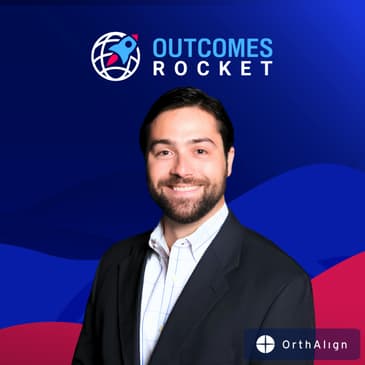
In this episode, Nic Aldrich, Vice President of Marketing at OrthAlign, discusses how handheld navigation technology is making precision orthopedic care more accessible. He explains how OrthAlign helps surgeons reduce variability, execute patient-specific plans, and bring advanced technology into total hip, knee, partial knee, and revision procedures.
Nic also shares how the newly cleared Lantern ASC system was designed specifically for surgery centers, balancing accuracy with cost, speed, and ease of use.
Tune in to learn how smaller, more efficient technologies are helping expand access to precision orthopedic care.
Resources:
[00:00:04] Hello, everyone. Welcome back to the Outcomes Rocket. So excited you tuned in to another episode. Today, I have the privilege of hosting Alexis Anderson on the podcast. He is the Vice President of Marketing at Orthalign. They're doing some impressive work and wanted to share it with you guys. So, Nick, thank you so much for being with us today. Hey, Saul. Thanks for having me.
[00:00:26] Yeah. Listen, it's my pleasure. And to kick things off, Nick, tell us a little bit about you and tell us a little bit about the work that Orthalign does in the business. Sure. Yeah. I've been in healthcare for my entire career, spent some time on the finance side, now more in the marketing and product management space.
[00:00:45] And really, I was drawn to healthcare right out of college. When you get the opportunity to work on technologies or products that can help people and help improve their quality of life on a day-to-day basis is something that hits me deep.
[00:01:00] Unfortunately, being here at Orthalign, a guy that's had a couple of knee problems myself and will one day need a knee replacement, exciting to be working on game-changing technologies that really bring quality of life, bring better outcomes and more precision to surgeons that are delivering care to their patients.
[00:01:17] That's great, Nick. That's so cool. You got right into healthcare. I personally have a love for orthopedics. My first gig out of college was not in healthcare. I wanted to get in, but because I was a history major, they didn't want to hire me.
[00:01:35] So, so I got a sales gig and I worked at Striker as a trauma rep and then I got into spine. So very familiar. I was never like a full recon hip and knee guy, but I definitely was periphery kind of hip fractures, tibial fractures. So I definitely know the space very well and I have a love for it.
[00:01:58] So talk to us about what Orthalign does. How do you guys add value to the orthopedic surgeons, to the hospitals? Yeah. Tell us more about the product and the platform. Yeah. So Orthalign provides handheld navigation technologies for total hip, total knee, partial knee, and ligament balancing in the revision space. So we're helping surgeons reduce outliers and make sure that as they go out and develop patient-specific plans, they can go out and actually execute those plans.
[00:02:26] When you look at the orthopedic space historically, manual instrumentation, it's very rudimentary, right? You're using the equivalent of protractors and rulers to try to align implants in 3D space. So bringing technology to that space, that's easy to use, accurate, efficient, and cost-effective is really what we're after.
[00:02:46] When I joined Orthalign five or six years ago, and we rewrote our mission statement. At Orthalign, we're driven by that belief that everybody deserves exceptional healthcare, and we're committed to making the empowering technologies accessible to all.
[00:02:59] And the accessibility piece is really what we're focused on. So we can ultimately help drive the market to a standard of care where every patient, no matter who's operating, what implant systems, who the payer is, or where you're getting that procedure, that you have the access to top-tier technologies so that the surgeons can really execute their plans to perfection.
[00:03:50] That's great, Nick. I love that you focused on accessibility with these procedures. There's a lot of care moving into the ASC. Is it that accessible? Or is this still a technology that's made for the OR? Oh, absolutely. And we actually, just a couple of days ago, we got FDA clearance for our Lantern ASC system, which is a purpose-built system. Yeah, it's great. We're really excited about it. Team's been working on it for quite some time. And it's a purpose-built system.
[00:04:20] Thank you. We're pumped. Now the hard work starts, right? Getting it into the market and driving adoption. But when we set out to develop this system, we were heavily focused on the ASC market, right? All the Medicare policy is moving more and more procedures, particularly hips and knees, into the surgery centers.
[00:04:40] And when you think about that rapid pace of movement to the surgery centers and where technology sits today, there's definitely a gap, right? The market is moving faster than the products are innovating. So having a product that's specifically designed for the ASC to meet the needs of every stakeholder, not just a surgeon. It meets the needs of the patient, meets the needs of the surgeons and the administrator and economics of the system.
[00:05:05] So that's really what we designed it for. And we're really excited to get that into the market now and start to see some rapid adoption. Dude, that is huge. Man, I did not expect that. And that's really fantastic.
[00:05:16] I was actually just at ASCA Samba and National Harbor a couple of weeks ago, having a conversation with actually a spine surgeon, orthopedic spine surgeon, talking about how important it is that the patient experience, like nobody wants to be operated in a hospital, man. Let's be honest, right?
[00:05:38] Yeah. And the fact that you guys are so in tune with what's happening and now have a product to answer the needs to decrease variability in the ASC is exciting. You'll have to share a link with me that I could put in the show notes so that people could learn more about that. Absolutely. We'll do that. Yeah. And, you know, when I think and thinking more about the orthopedic technology space, right, I've never seen an industry where technology enters and leads.
[00:06:07] We've had robotics in the space for over 10 years now, and they've done a phenomenal job of advancing care and getting more precision and accuracy for surgeons in their implant placement. But it introduced a couple additional problems, right? It introduced some economic issues, potentially some time and throughput challenges. And it's those types of challenges that are magnified in the ambulatory surgery centers that we're trying to solve with our product, right?
[00:06:33] Trying to figure out how we make these technologies that provide that simplicity and that efficiency that those centers demand while also providing the precision that the surgeons and patients need. Oh, yeah. Like spot on, man. It's a it's such a big issue. And it's that quadruple aim that we're after. And cost is a big thing. So, man, as you guys have been building, Nick, talk to us about a setback that you've run into that has become a key learning for you guys.
[00:07:03] Yeah. One of our biggest challenges is our size, right? We're a small company around 130 employees. And when you think about the total joint space and the relationship driven nature of the sales process, which you understand from the trauma days. Oh, yeah. How do we take a product and scale it quickly in the marketplace and take advantage of that? These multiple trends going on. We've got move into technology. We've got move into the surgery centers. The question isn't, am I going to use technology from a surgeon?
[00:07:32] It's what technology am I going to use? Right. So if surgeons are out there seeking that, scaling our organization and our organizational footprint in a way that allows us to still be a profitable organization and be able to have that infrastructure to go out and sell in that one to one sort of selling environment has probably been the biggest challenge for us. You know, we operate through distribution. A lot of times our distributors are carrying other robots or other technologies in their bag.
[00:08:01] So how do we grab the mind share from the sales force or how do we drive the pull from the consumer, the surgeons in this case, to really want the product and ask be pushing their distributors or their reps to bring that product in? And I think that's been probably one of the biggest challenges for us looking at how do we deploy a sales force that can be there on that one to one basis, but also pull themselves back and multiply themselves through distribution.
[00:08:57] Yeah, yeah, for sure, man. That's fantastic. Yeah, yeah. You know, mission aligned. It seems like you guys are very mission aligned. So finding more mission aligned people to get with the cause to kind of move in the same direction. Yeah. And it works, you know, both with the internal folks. It works through our distribution networks and also at the surgeon level. You know, when you look at a lot of our customers, they deeply believe in this mission as well.
[00:09:22] So having those mission aligned customers create really strong champions that help in the peer to peer sale process. When you think about multiple surgeons operating in a facility, you know, everyone's always checking in on their peers saying, hey, what are you using? How are you doing this? What's your technique for that? Are you doing measured resection?
[00:09:40] Are you gut balancing, kinematic alignment, all these different techniques out there and having strong champions that believe in the mission, believe in the product and are getting the outcomes that they that they want is really helping us continue to expand our market. Yeah, man, I think that's great. And you cannot manage what you cannot measure. And so the opportunity with what you guys are doing is big. Talk to us about what you see as a health care trend or technology that's going to change the game.
[00:10:10] Yeah. So, I mean, I mentioned our Lantern ASC system, which recently launched into the marketplace. You know, we're really excited about that product specifically because the biggest challenge today in orthopedics is getting technology out there in a in a way. That is economically viable for facilities, for the payers and for our health care economic system as a whole. Right. When you think about the technologies that pioneered in this space, you're talking about big box navigation or robotics.
[00:10:41] And these things often come with a, you know, multi hundred thousand dollar, half million dollar price tag. And as procedures continue to move to these surgery centers and surgeons are operating in multiple facilities, the concept of having these large capital equipment purchases or even just having capital placements in these settings makes it difficult. So when we think about the type of technology that we're bringing to the space, it's about democratizing the access to technology.
[00:11:08] It's providing a single use format or a cost effective and efficient technology that works with any implant system so that no matter who the surgeon is, no matter what implant they're using, no matter what technique or approach to the knee or hip they have, they have access to a technology that can help them get the outcomes that they are planning for. So when I think about the space and how it's continuing to evolve, you can see it with a lot of innovation coming out of a bunch of our competitors, right?
[00:11:36] Everyone's trying to get smaller, more cost effective and really sort of chase the market that we've held for quite some time. You know, we're the leader in handheld orthopedic technologies. We've completed over 450,000 procedures globally since inception. So a product that's got great data and great market staying power is how do we continue to innovate on that to make it more accessible, whether that be the simplicity side, the efficiency front, or even the price point. And those are the things that we've really focused on.
[00:12:05] So as I see the market continue to evolve and trying to drive to the standard of care where every patient and every total joint procedure gets some kind of technology, it's really those other metrics. It's not just the accuracy and simplicity, right? That's somewhat table stakes nowadays. We talk about the clinical value equation, right? It's outcomes over cost. Well, I think as an industry, we've done really well on the outcomes front.
[00:12:34] But now it's really about those other factors. It's about the time. It's about the cost. It's about the efficiency. And how do we change the denominator to make these technologies more clinically valuable in the space? And that's really what at Orthalign we're most focused on. Let's crush that denominator.
[00:12:54] Let's get the cost lower, man, because it's definitely expensive for our nation as we think about even global competitiveness and the cost of health care for employers. You know, it's definitely impacting us at the global scale. So, yeah, man, the root of the problem is right there. Glad you guys are aiming to crush it.
[00:13:18] If people want to learn more about the work that you guys are doing, they're curious about your product in the OR or in the ASC, where can they reach out, Nick? Info at orthline.com. That's the easiest way to get connected to somebody. We've got a lot of great information on our website, www.orthline.com. And then we're pretty active on LinkedIn, always sharing customer success stories, new product launches, informational videos on how to use the product.
[00:13:45] And then, again, I said we've got a pretty big Salesforce out there that are ready to do some demos, get some product in your hands. And being that we are a very accessible technology, whether you're doing one case or 100 cases, this is the kind of technology that scales with you. So you can go and try it for one with, you know, a lot of these other bigger systems. You can't just do that. Right. So we're here for you. We're here for the market and excited and hopeful to have some good inbound. That's awesome.
[00:14:12] Well, Nick, thank you so much for spending time with us and for everybody joining us today. Thank you for spending a little bit of your time today hearing about this technology that Orthline's brought to market from Nick Aldrich, the VP of marketing over there. In the show notes, you'll find all the ways to get in touch with the company, with Nick.
[00:14:32] And if something today resonated with you, whether it's the affordability or the decreased variability and outcomes, like forward this to a friend, because that's ultimately how these things get discovered and how you two can make a difference in care outcomes and also total cost of care. So thank you all for tuning in. Nick, thanks for being with us. So thank you for having me.