
This podcast is brought to you by Outcomes Rocket, your exclusive healthcare marketing agency. Learn how to accelerate your growth by going to outcomesrocket.com
A resilient and efficient healthcare supply chain is critical for ensuring patients receive timely and appropriate care.
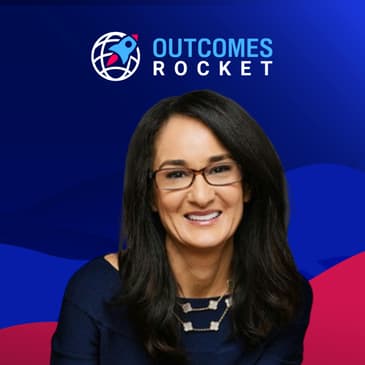
In this episode, Tina Vatanka Murphy, President and CEO of GHX, shares how her company uses technology and data to strengthen fragile healthcare supply chains and prevent disruptions that can delay or cancel care. She explains that GHX serves all stakeholders, from manufacturers to hospitals, by anticipating issues before they affect patients. Tina challenges the misconception that procurement is only about cost, emphasizing that value-based care focuses on the best outcomes at the lowest total cost. She also underscores the importance of data, real-time feedback, and courageous leadership grounded in purpose, authenticity, and continuous growth.
Tune in and learn how technology is revolutionizing the healthcare supply chain!
Resources:
[00:00:01] This podcast is produced by Outcomes Rocket, your healthcare exclusive digital marketing agency. Outcomes Rocket exists to help healthcare organizations like yours to maximize their impact and accelerate growth. Visit outcomesrocket.com or text us at 312-224-9945.
[00:00:25] Hey everyone, Saul Marquez here and welcome back to the Outcomes Rocket podcast. I'm so excited to be with an extraordinary guest today. Her name is Tina Vatanka Murphy. She is the president and CEO of GHX and she's leading a bold transformation of one of the world's most complex and consequential industries. You know it, it's healthcare, we're all playing in it. And at the helm of a technology company, connecting into the world's most complex and consequential industries.
[00:00:58] And with an extensive network of health systems and suppliers, Tina is driving the next era of innovation by infusing the healthcare supply chain with AI, automation, and actionable intelligence. Tina, I'm so excited that you're joining us today to tell us about what you guys are up to. Welcome. I'm thrilled to be here. Thanks for inviting me, Saul. It's my pleasure, Tina. And look, to kick things off, tell us a little bit about you and tell us about the business.
[00:01:27] What is it that you guys do? Why is it different? And why does it matter? Great. So I'll use that. We're all playing in this healthcare system. And so imagine you have a procedure tomorrow and you show up at the hospital and you're a little nervous, maybe a little bit anxious. You've called all your friends and family and told them it's happening and you get to the hospital and it's canceled. And it's not canceled because the surgeon couldn't show up.
[00:01:56] It's not canceled because the hospital had an issue. It's canceled because there was a supply disruption. And what that means is the product needed in your care that day weren't where they need to be, when they need to be there to get the care that you need. So I start with that story because I think a lot of people don't really understand just how important a resilient supply chain is to patient care.
[00:02:26] You know what at GHX we do? It's our mission. We wake up every day and what we fight for is a more resilient, more efficient, more intelligent supply chain. And you know what? We've been doing it for 25 years. And so today we're healthcare's leading supply chain platform.
[00:02:50] I love it, Tina. Such an important role. I mean, just recently, right? The things that happen with the IV bags, with COVID, all the challenges that happen with that. We're always getting surprised by things, it seems like. I love how you ask that because you know what? We shouldn't be surprised because these aren't one-offs. There is a pattern. There is a pattern. And the pattern is because we are facing a fragility crisis.
[00:03:19] And what a fragility crisis means is that the supply chain is too vulnerable. There is too much risk in the supply chain. So if there is a natural disaster, a hurricane, a bridge collapse, striking dock workers, all of these disruptions lead to, at best, care delay, at worst, cancellation of care.
[00:03:47] And so it is a crisis. It's a fragility crisis. But you know what? There's actually good news. And the good news is that the technology has caught up to the needs of the day. In fact, at GHX, we're leveraging our platform, our data, our trusted data, and AI to deliver a more resilient supply chain.
[00:04:14] And what's cool about being able to leverage the technology of AI today is that we now can anticipate disruption and prepare for it before it impacts a patient life. That's pretty cool. It's very cool. It's very meaningful, Tina.
[00:04:39] And so let's dig into a couple of maybe use cases and specifically like your end customer. Who's your end customer in the healthcare ecosystem? So really, any stakeholder that's involved in getting the products where they need to be. So it's the manufacturer, it's the distributor, it's the hospital, it's also the GPO.
[00:05:02] So all of these stakeholders that come together to make sure that a patient can get the care they need, all of those stakeholders are our customers. That's fantastic.
[00:05:43] He or she is delivering patient care, not running around and looking for supplies. Or a patient shows up and they're able to get the care they need versus having to reschedule. So I think what a lot of people don't understand is all that has to happen behind the scenes are all the data to make the right patient-centered decision.
[00:06:07] So Saul, an example would be, I think a lot of people think that supplies, when procurement is working on supplies, they're just focusing on the lowest cost supply. But you know what? That's actually not the case. In a value-based care model, they're thinking about the lowest price solution with the best clinical outcomes. So what that means, it's not the cheapest tip.
[00:06:33] It's the hip that will make sure there's not an infection, that will make sure you're not readmitted. Because it's in fact when we do all of that that we actually have the lowest cost to care. So I would say all those little invisible things we do behind the scenes to improve the quality of care and lower the cost to deliver it. I think that's fantastic. And yeah, oftentimes we don't think about that invisible force because when everything is where it needs to be, you don't feel it.
[00:07:03] But when it's not. Very well said. Very well said. Tina, I'm fascinated by your story. We had a chance to connect before our interview and we like to learn from successful people. Just tell us about your story and then in that, your career, a favorite business resource or hack that you would recommend to other aspiring leaders. Yeah. I started at GHX 25 years ago, right? I got married.
[00:07:32] I went on my honeymoon and I started here. And there have been, and we've always been a very mission-driven company. So I just showed up every day thinking about what can we do in service to our customers. I didn't show up every day thinking about what do I do to move to this job or this job. That was never part of my calculus ever. Just wasn't in my nature. It's always about how do we do really good work?
[00:08:01] How do I get exceptional at what I do? And then the opportunities surface. And when you asked what are an important lesson, there have been countless lessons. But if I had to pick one, I would say that I think growth is critical, right?
[00:08:22] And the most important lesson that I think is foundational to growth is the power of what we call a GHX RTF, which stands for real-time feedback. And the importance of this, gosh, it must have been 15 years ago. I had a 360 done and my coach interviewed about 15 of my colleagues.
[00:08:50] And the feedback came back. You know what? The feedback wasn't actually what bothered me. What bothered me was that they hadn't just given me the feedback directly. It was so hurt because either they didn't trust me to be able to handle it or they didn't have the courage. And you know what? But neither one of those things felt very good to me.
[00:09:18] And so I carried that lesson. I carried that lesson with me. And then, like, there was this profound moment where I gave feedback to someone who was really hard feedback. And, of course, it was someone I cared about. And I was really scared and nervous. Because I was scared, like, at best, I hurt their feelings. I damage our relationship. I got it worst. I clipped their wings. And so I was really nervous.
[00:09:48] But I prepared. And I gave the feedback. And I was shocked. At the end of the feedback, he stood up. He gave me this giant bear hug. And it was because, like, he knew my motivation was pure. He knew my motivation was to build him up, not tear him down.
[00:10:14] And he saw the courage it took to ultimately help him be better. And to this day, when I actually talked to him about that moment, he has said it was the moment in time that our relationship went to that next level.
[00:10:36] And so it was this remarkable lesson about the bonding power of feedback. Who knew? It doesn't break down relationships. When your motivations are pure and you do it with respect, there's actually a tremendous bond that is built. And so at GHX, not only do we leave space for that, but we invite it. And I think it makes all the difference to our culture.
[00:11:06] I think that's beautiful, Tina. RTF, real-time feedback. Yeah. It's so critical. And I've had moments, too, right? Whether it's with my team or on someone else's leadership team in the past. Oftentimes when you share that real and actually, like, real, right? In real-time feedback. Like that real feedback from a pure place. It's transformative. Absolutely. Absolutely.
[00:11:34] And what a gift, right? Because those are all blind spots that we live with. And how painful to think we're walking around with those blind spots and no one cares enough to tell us. I love that, Tina. So, gosh, 25 years focused on adding value to customers, giving this transformative feedback. Leading the company is critical. Any messages out there for leaders seeking to do a better job?
[00:12:02] Saul, I think these are unprecedented times. And my message to everyone from individual contributors to CEOs of multi-billion dollar corporation is that now is the time for courageous leadership. And to us, courageous leadership is three things. Number one, it's purpose-driven.
[00:12:26] Purpose-driven, which means with we fight for a mission that matters and we fight with integrity and heart. Number two, courageous leadership is authentic. Right? We leave space for people to show up as their authentic self. It's when, in fact, we are at our best and we can shine. And don't worry. Like, as leaders, don't worry about being perfect. Just be present.
[00:12:56] Just be present. Number three, courageous leadership is growth-minded. There is so much exciting things going on. So lean into the greatest problems of the world and skin your knees and fail again and again and learn and get up and fight to leverage today's technology to create a better future.
[00:13:20] I want us all to be able to look back at this moment in time and know that our decisions allowed us to rise to the occasion. Makes all the difference. That's a phenomenal framework, Tina. I would rewind that, folks. Make sure you get that. Take that home with you because courageous leadership is so needed today.
[00:13:45] There's a lot of challenges and that is the type of leadership that's going to get us the outcomes we need in healthcare, get us the business results that we need, get us the culture that we're all looking for. And on the point of leadership, Tina, gosh, this Gardner report on supply chain, out of all of them, you guys, nine out of 10 are your customers. You have a meeting coming up. A lot of exciting things. What do you want to share with the listeners about all that? I'd love for you to join us.
[00:14:13] Our annual summit is May 13th to 16th in Atlanta. And it's an amazing time to come together with supply chains, thought leaders, providers, suppliers to come together and collaborate and envision a better future for the healthcare supply chain. And Saul, you're going to be there. I am. You're an amazing panel. I cannot wait. I'm so excited for it.
[00:14:41] You guys are doing extraordinary things, Tina, you and the team. I want to give you kudos. Thanks for the invite to come and participate in the meeting. I'm thrilled. And for all of you listening, if you're looking to get insights on supply chain, understand this fragility that Tina was speaking about. How can we counteract that with technology, with process? This is the meeting to go to. I'll link it up in the show notes so you can check it out. Make sure you check it out if you're interested and come see us.
[00:15:10] Tina, I just want to thank you for really everything that you do, the team that you lead, the company that you lead, and for joining us today on the podcast. This podcast is produced by Outcomes Rocket, your healthcare exclusive digital marketing agency.
[00:15:37] Outcomes Rocket exists to help healthcare organizations like yours to maximize their impact and accelerate growth. Visit OutcomesRocket.com or text us at 312-224-9945. Outcomes Rocket. Out respondents. Outcomes Rocket.