
Breakthroughs in healthcare technology over the past ten years are painting a promising picture for the future of medicine.
In this episode, Stanley Bergman, Chairman and CEO of Henry Schein, shares his leadership journey and highlights the transformative power of healthcare technology, particularly in dentistry. He emphasizes collaboration, trust, and patient access, advocating for a future where dentistry and medicine work together to improve overall health through prevention and education.
Tune in and learn about the evolving landscape of healthcare and dentistry, the role of technology, and the importance of collaborative efforts to improve health outcomes.
Resources:
- Connect with and follow Stanley Bergman on LinkedIn.
- Follow the Henry Schein company on LinkedIn and discover their website!
- Watch the entire episode on YouTube and get more details at Think Oral Health.
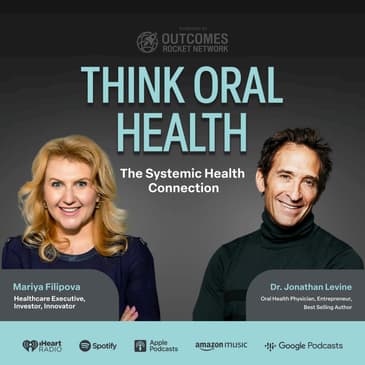
[00:00:00] Think Oral Welcome to Think Oral, where we connect the unconnected between oral and physical health. I'm your host, Dr. Jonathan Levine. And I'm your host, Maria Filippova. Let's get at it. Hi everyone, and welcome to another edition of the Think Oral Health Podcast, where we
[00:00:25] connect the dots between silos and disciplines in overall health. As usual, I am joined here by my partner in crime and co-host, Dr. Jonathan Levine. And today we have a very exciting trailblazer innovator and executive in oral health, Stanley
[00:00:47] Bergman, who serves as the chairman of the board and the CEO of Henry Schein. And I'm so excited to welcome Stanley to the podcast. Hello, Stanley, and hi, Jonathan. Thank you, Maria. It's absolutely a pleasure to have you, Stanley.
[00:01:03] A little introduction, Stanley, if I had to really go through your bio, we wouldn't be able to get through the podcast, but you're amazingly accomplished. You've been the CEO since 1989. You've been able to build this incredible company, one that I know personally from a
[00:01:21] standpoint of the people that you have in this company. It almost feels like a small entrepreneurial company, yet it's this very large public company. And I know firsthand how you've built an amazing culture.
[00:01:35] But you're on the board of many of the universities at the same time as the CEO and chairman of Henry Schein, University of Pennsylvania, Columbia University, Hebrew University, Tel Aviv University, Wittwaterstrand Fund, World Economic Health Care Governors, the board
[00:01:53] of that, the business council, and I can go on and on. But amazingly accomplished, one of the great thought leaders of business, of our profession. It's such an honor to have you here. And thank you for joining Maria and I on our Think Oral Health podcast. Sure.
[00:02:08] Thank you, Maria. Thank you, Jonathan. I love the introduction. I'm going to start believing it. Well, we do. We definitely do. You must be doing something right to have deserved all these honors.
[00:02:22] We always like to ask our guests to share with us a fun fact that's not in the bio. And so we wouldn't want to deprive you of the opportunity to do that.
[00:02:31] So what else can you share with us that's not in the bio, that's specific for our listeners of the Think Oral Health podcast? So Maria, I don't know how much fun there is, but what is interesting is when I joined Henry Schein, I had no exposure to opera.
[00:02:47] I, of course, had appreciation for classical music. My parents listened to it at home, but not the opera. And Henry and Esther had season tickets for the opera on Friday nights. My partner, Jim Breslovsky, and I, Jimmy and I have been partners for 48 years.
[00:03:04] We were asked to drive Henry and Esther to the opera. One week would be Jimmy, one week would be me. And eventually we got, there were no CDs in those days, tapes of the opera before we went and we listened.
[00:03:16] And now we're heavily into the opera, my wife and I. At the same time, Jay Schein was into skiing. And in the 80s, he would take the entire company skiing to Hunter Mountain.
[00:03:28] There were a few hundred people in the company, but it was several buses and we'd go skiing. And eventually I said to my wife, we've got to take some lessons, we might as well enjoy this. So today we're into the opera, we're into skiing.
[00:03:42] One the result of Henry and the other one, the result of Jay. So I'm too shy. Family members got us skiing and going to the opera. What a beautiful story. Yeah, Jonathan and I both share the appreciation for the skis and especially today in today's
[00:03:56] world where everybody's so quick to put their face in front of a screen and stay home and decompress with a screen in front of them. It's so rare to be able to go out and being in the mountain or be exposed to art. So great reminder.
[00:04:11] I've had the number of ski accidents. Obviously, the more you ski, the bigger chances are. One knee was taken out by my youngest son's best friend when he was 16 and the other one by a partner of our son about nine years ago. So I've had two knee replacements.
[00:04:29] And if anybody's thinking about a knee replacement, the new technology is absolutely amazing. My knee procedure, the last one I did was done, the second knee was done six or seven weeks ago at NYU with a robot.
[00:04:43] I was out of the hospital the same day on the bike the next day. And the recovery has been amazing. The technology that exists today in health care is off the charts compared to what it was even 10 years ago. Impressive. So true.
[00:04:58] And it's actually come into dentistry in the last 15 years. Stanley, we'll talk a little about that because you're one of the key influencers for that. I'd love to start us off with this question, Maria.
[00:05:11] And for Stanley, it reminds me of the expression, where you began is not where you end up. And when you first started with Henry Schein, what is it? 28, 29 years ago? I started in 1980. Oh, geez. What is that? 20, 40... Some more coffee for you, Jonathan.
[00:05:28] You can't do math that early in the morning. I became a CEO 29 years ago. CEO for about that long. Yeah. I started out when the company was about $40 million in sales and Henry worked in the warehouse and Esther ran the books with a Waterman pen. Wow.
[00:05:44] And it was my job to replace Esther with a computer that cost us about $5 million and a lot of people. And my partner, Jim Breslowski, of 40 plus years, he was the one that convinced Esther to give up the Waterman pen for a computer.
[00:06:00] Let's go from when you first took over as CEO and the vision of the company that you had back then compared to the vision that you have today, when we look over those three decades. So the vision, Jonathan, has always been to help healthcare practitioners in the alternate
[00:06:21] care side. That's dentists, physicians, dental laboratories included, and physicians, for example, in oncology sites and renal sites and ambulatory surgical centers. All of these locations outside of the hospital, helping these practitioners operate a more efficient business so that they can provide better clinical care.
[00:06:46] Because at the end of the day, our customers are in the free market system and if they don't run a good business, they're not going to be around to provide better clinical care. So the balance between operations and clinical care has been at the heart of Henry Schein's
[00:07:01] success since Henry and Esther opened the door 90 plus years ago. I always like the back and forth. It's interesting because we told Stanley how Jonathan and I interrupt each other and finish each other's sentences.
[00:07:15] And honestly, in our how many year worth of episodes so far, we've rarely been so awestruck and speechless where both of us are like, no, please. You're witnessing a rare moment here, Stanley, where both Jonathan and I are saying, wow.
[00:07:32] All right, Maria, I'm happy to do a follow up because I talked about this a little bit in the intro and I really believe Henry Schein has this incredible culture and the people are amazing.
[00:07:42] Stanley, tell us a little bit about what you've been able to build in the Henry Schein organization from a standpoint of the people side of the equation and the culture. The late Jay Schein, who was the CEO for nine years from 1980 to 1989 when he tragically passed away, tragic.
[00:08:01] Now we can talk about it was a long time ago. He came up with a phrase, it's all about the people and it's all about the results. And at the end of the day, that's at the heart of the success of every business. It's all about people.
[00:08:17] And that connection, there was a gentleman by the name of Edward B. Schills. Ed was the founder of the Wharton Entrepreneurial Center. He was the chair of the Department of Management at Wharton, but also was the executive director of the dental manufacturers and dental distributors in America.
[00:08:34] He did that in his part time as a part time role. And Ed coined the phrase of intrapreneurship. Entrepreneurship in a large company. And if you combine the two philosophies of it's all about people and it's all about results
[00:08:51] with the notion that companies can be broken down into small entities where you have entrepreneurs running that part of the company. If you look at that, you will see that is what we've practiced at Henry Schein.
[00:09:07] We have about 350 different businesses in Henry Schein, all focused on the same goals that we discussed early on, but all run by intrapreneurs. That's entrepreneurs in a large company. Of course, there are common systems, common infrastructures and rules and ethics that
[00:09:29] govern a public company that have to be complied with. But in the essence, at the essence of this success story has been intrapreneurship. Is this what you believe is also going to be the key to success in the future?
[00:09:45] I mean, we're seeing overall when you started the company versus today, a lot of folks are experiencing change happens faster. We are generating data much faster than before. We have technologies coming up, new technologies coming up, being adopted faster. Consumers are now educated patients.
[00:10:07] So in that whirlwind of change that Henry Schein is operating today, do you think that those core principles, people, results, entrepreneurship is what's going to carry you for the next couple of decades forward? Yes, very much Maria.
[00:10:25] At the end of the day, at Henry Schein, we have certain values which drive our behavior and those values revolve around the notion of the importance of individuals. There are five key principles around them.
[00:10:40] One is the people that give us the products, whether it's our suppliers or our factories. These people, these institutions are really important. We have to make them successful. On the other side is our customers.
[00:10:55] We want to help our customers operate in more efficient practice and to provide better clinical care. If we do that right, they'll give us more business. Between the two, bringing the two together is team Schein.
[00:11:05] This is the notion of everyone is important as the next and everyone plays a key role. Then we, of course, we have as the fourth constituency, our investors. For our investors, we are very clear.
[00:11:16] They're one of the five constituents that make up the Henry Schein mosaic of success, but one of five. Our responsibility to our investors is to provide a consistent growing return on investment, driving the income. The company doesn't exist for our investors. It's one of the five constituents.
[00:11:38] The fifth, which is I think the secret sauce to our success, is our commitment to making the world a better place, our commitment to social responsibility. Take all of that together and it creates trust, a common feeling of trust.
[00:11:54] By having that trust amongst all the constituents, you can drive change. Henry Schein has been a change leader in our industry for 90 plus years. So long as we keep those values in place, we will succeed. Of course, the culture has to change.
[00:12:12] First of all, we can't have the same culture exactly that we had with Henry and Esther with 100 people as we have today with 25,000 people in a world that is not any longer a world where people necessarily work out of an office.
[00:12:28] This discussion we're having today, five years ago would have had to take place in person. The world is a hybrid world today where people can operate in an office or in a hybrid environment and the culture has to be different. Culture has to be different.
[00:12:45] The culture that Jimmy and I experienced when we joined Henry Schein 40 plus years ago and we put in the first fax machine. The cultures are different, but the values are consistent and those values are what
[00:12:57] results in trust and results in the ability to introduce change amongst the constituents, including our customers, and that will be there forever. Yeah. I'd love to, maybe I'll pick up on this notion around trust and a culture that embraces differences in perspectives.
[00:13:15] One of the reasons I believe our partnership for this podcast has worked so well is because we have Dr. Jonathan Levine bringing the scientific rigor of a clinician and oral health physician with my business background and opportunity to look at technology and payment models differently.
[00:13:32] Talk a little bit about the ability, as you build your culture and build the teams across those 350 businesses in Henry Schein, talk about your ability to marry business perspectives with clinical perspectives and stay true to what's important for the end customer, the patient.
[00:13:51] I had the opportunity to meet your lovely wife, Miriam, who is trained, a trained physician in one of the conferences recently. And so I know for a fact that you have wise counsel of a physician at home, but you also
[00:14:02] surround yourself as a company with brilliant minds from different perspectives. So how hard is it to do that and how important is it for your success as a company over the years? That's a very good question.
[00:14:16] I think firstly, you need the foundation of values and you need a culture that subscribes to values. But the way you really manage, I think, through any environment of change, and my God, we're going, I think Jonathan mentioned it earlier, massive change right now and in society, of
[00:14:36] course, in dentistry. And the way you manage through that is, of course, with the trust, but you have to have diverse opinion. So diversity is really important. People from all walks of life, different backgrounds, different ways of thinking.
[00:14:53] And the success is very much based on the alignment amongst the diverse constituents to make sure you come up with a common role, a common vision and a common strategy to execute on. So it's about trust and it's about diversity of opinions.
[00:15:15] I want to stay on that theme. So we have this incredibly changing environment we're talking about and in dentistry, with the organized approach to dentistry through the dental service organizations, the idea of one dentist, one assistant, one hygienist being 70 percent of the industry years ago
[00:15:37] now is forever changing into more multi-specialty or multi-doc offices. In addition to the DSOs now at about, I think they call it 22, 23 percent of all revenue. Feli, how do you think about this rapidly changing business model in dentistry and how is Henry
[00:15:56] Schein going to meet these changes today and really the next 12, 24 months? So Jonathan, there'll be room in dentistry for the very largest DSOs, but at the same time there's going to be lots of room for smaller practices, nimble practices that
[00:16:16] adopt the greatest in technology all the way to mid-sized practices, to regional DSOs, to national DSOs. The demand for dentistry will grow. There's a direct correlation between good oral care and good health care and I believe
[00:16:33] that payers of health care, whether it's the government or whether it's private industry, companies, all understand this notion. It's just a matter of time before it gets to be more important. That will create a demand for dentistry and the question is how do we scale up dentistry
[00:16:53] for the future? And I think all these models will work, but there'll be a heavy dose of technology to be able to deliver on the needs of the public. Yeah, I see it first hand as a clinician and we have seven docs for hygienists, we have
[00:17:09] large multi-specialty practice that I've been able to build over the last three decades and scanners and mill machines and all, and CVCTs, hundreds of thousands of dollars of investment. How does the individual clinician handle that?
[00:17:27] And then the ability to manage a larger team and manage all these processes and wear these multiple hats. Yeah, the trending definitely says to survive and then to thrive, you have to come together.
[00:17:41] I like to say, Stanley, I don't know if you've heard me ever say this, but what I heard, life is a team sport and so is dentistry. And where I think we're moving is really into that team approach, just like any industry
[00:17:55] and just like any company, it's all about building what you've done at Henry Scheiner, collaborative culture. And for us- That's what it's all about. You have to have a collaborative culture in your practice.
[00:18:08] One of the dentists I think has to be the CEO and needs to get the team aligned. I think that's very important. The big DSOs, they don't necessarily have a dentist as the CEO, but the chief dental officer is very highly-
[00:18:24] So whether it's the CEO that's non-healthcare professional or it's the chief dental officer, at the end of the day, these practices that are going to be successful will have to be collaborative, will have to have the technology and have to therefore be people driven to
[00:18:41] execute on that technology. Yeah, that's right. And it's interesting about the piece on our technology because Henry Schein does serve both medical and dental practices. You're able to see how technology, and again, from my point of view, I spent earlier parts of my career in healthcare.
[00:18:58] And so being able to, I went into healthcare knowing that healthcare lags other industries at least by a decade in adopting technologies. Now with the benefit of multiple years in dentistry, I understand that dental lacks healthcare by a couple of years in adopting technologies.
[00:19:16] To some extent, that is true. But I also think that there are times when dentistry has been ahead of the game. I believe dentistry was significantly ahead of the game in introducing the digital electronic medical record way before physicians and hospitals.
[00:19:33] And the notion of having a digital scanner, digital imaging, AI being used in dentistry, all of these dentistry can advance. But not all dentists are using this technology. So where technology is being used in the practice, I think dentistry is up there with the other parts of healthcare.
[00:19:52] What do you think is going to drive adoption, Stanley, in this? Because not all dental offices are using it. Is it still a barrier at cost? Is it education, just the fear of trying new things?
[00:20:06] What do you think is going to be the unlock for dentists and majority of dental practices to be more comfortable with those things? I think it's two things, Maria. The first is the public. If you've had an impression that's manual and you've also had an impression that's a
[00:20:21] dental digital scan impression, I doubt you'll go back to a practitioner that's not going to use a scanner. If you go into a dental office and you see a digital image machine or you see a wet chemistry
[00:20:39] machine, you may not go back to that office where you've seen the wet machine. So I think the public will drive that. But behind the scenes, dental practices are going to have to adopt this technology as we discussed. Reimbursement pressures will be there, but the volume will increase.
[00:21:01] So you balance all of that, you need technology. There's only one way out and it's no different to any business. At Henry Schein, we put a computer in to service our accounts receivable. Why? Because we couldn't continue to have people having cards in tubs.
[00:21:19] It just didn't make sense. So technology is driven by supply and demand and there's going to be a demand for dentistry and dentists will not be able to satisfy that demand unless they use technology. That's right. That's right.
[00:21:33] We're dealing with the smart consumers, Maria, that you were talking about before. The consumers who listen to the Think Oral Health podcast, where they created all these amazing new things. And many other places. And the dentists find out about this and it's a competitive environment.
[00:21:47] And they need to have this, a little bit of faux model, a fear of missing out, but also to raise their own game to that next level. CBCD's code beams will become very soon a standard of care in the dental office. Intraoral scanners, a standard of care.
[00:22:04] If you look at scanners that have been around for 30 plus years and you look at the percentage of adoption, it's only very recently that it's really starting to take off. I think that's true. What is interesting is that we just launched a Google search engine.
[00:22:20] So you can go to Google and find me a dentist who has this insurance, who is available between this time and this time. I can book an appointment online. And at the same time, I can look at the ratings of that dentist online.
[00:22:39] So of course, this is a new technology, not a new application, but I'm sure that in two or three years' time, if you don't have this kind of application, you may not get new patients.
[00:22:52] So at the end of the day, that's going to drive technology because you can't just get that Google application if it's not tied into electronic medical record, which is tied into a scheduler.
[00:23:04] And in order to do that, you have to have a digital office and you have to be able to run your digital office efficiently. So technology is going to be driven by the consumer and by necessity.
[00:23:17] Is this where you see then the opportunity to, if you were starting a new company now and if you weren't starting it as an entrepreneur in Henry Schein, but as an entrepreneur outside of Henry Schein, what would be the problem you would go after as a startup today?
[00:23:35] I call Henry Schein to find out how I could be helpful. Of course. But I would go, I would focus on applications that can drive clinical efficiency and quality of care at the same time. Drilling and filling is not the future. It's prevention and wellness.
[00:23:56] In fact, in all of healthcare, we have almost 70% of our budget, 18% of the GDP spent on areas where non-communicable diseases are being treated. These could all be treated preventatively. Dentistry plays a key role. So at the end of the day, it's applications that drive prevention and wellness, including
[00:24:22] dentistry that will drive the future of healthcare. Let's stay right there, Maria, because we love to talk about oral systemic health and we like to talk about breaking down the walls between dentistry and medicine.
[00:24:35] We know the old story about the 1840s when they knocked on the door of the first medical school and the dentists were rebuked about coming into the medical school. And from back then to today, a lot has not changed when it comes to the ability for
[00:24:53] dentistry to be a tip of the spear. You go to the dentist and the hygienist, more you go to your physician. We can play such an important role in the diagnostics of inflammatory diseases and getting
[00:25:04] ahead of obesity and diabetes and pre-diabetics that are such a propensity in this country. Stanley, you have this company that has dentistry and medicine. How can we potentially break down these walls? What are the things that you think about for our future for this to start happening?
[00:25:24] It's education. I think we need to work with the dental profession on educating the dental profession on the importance of prevention and wellness. And I believe that dentists that are graduating from dental school today understand this, that it's not only about procedures.
[00:25:48] I believe that medical practitioners that are coming out of medical school today understand that it's about prevention and wellness. And also to a large extent, medical professionals are understanding that systemic health is important and oral care is part of systemic health.
[00:26:07] So it's about educating the young practitioners and it's about educating those that pay for healthcare to understand that treating sick people with 18% of the GDP is not going to do it. We need to make sure in the wealthiest country in the world, everyone has access to a dentist
[00:26:30] because at the end of the day, dentistry will prevent you from getting sick in the first place. So it's better to be preventative driven than sick care driven. You need a balance, of course, but dentistry played its role.
[00:26:47] And the importance of going to who is putting the bill at the end, right? Education around understanding that there is no such thing as a free lunch or free healthcare, right? CMS, Medicare, Medicaid covers the bill on the medical side.
[00:27:02] But people don't appreciate that about a third of total healthcare cost is actually borne by private insurers and specifically self-insured employers. And so if you are a small business or even a large business, Howard Schultz famously
[00:27:17] said that Starbucks spends more money on healthcare benefits for their employees than coffee beans. If you're a large employer, healthcare is a big part of your bottom line and your expenses, operating budgets. And there's huge inflation in healthcare.
[00:27:35] The only way we're going to deal with this healthcare cost, which is 80% of the GDP, is to reduce the amount of money spent on these non-communicable diseases to prevention and wellness. Cardiovascular disease, $1 billion a day.
[00:27:53] If we do what Stanley's talking about and we go upstream and we can diagnose early these type of cardiovascular disease, but actually adopt a wellness model, not a sickness model, and the dentist become more than just fix my teeth and becomes more of this oral physician,
[00:28:13] which the mouth has to go back into the body, as people like to say, it would create some radical change. Yeah, I think that's critical. I think the younger generation of dentists understand this.
[00:28:27] I think the big challenge, of course, is to ensure that everyone has access to a dentist. Healthcare reform resulted in people having access to a primary care physician. No one is debating that. The big debate is who pays for it and how is it managed?
[00:28:43] But at the end of the day, every American should have access to a dentist. Hopefully that's going to happen. In the 60s when Medicare legislation was passed, it was very controversial. No one would say today, remove Medicare.
[00:28:58] Everyone would debate whether it's properly administered, but we need to ensure that everyone gets access to a dentist in the wealthiest country in the world, because by accessing a dentist, you prevent caries and other dental issues. And the net result is people live a healthier and longer life.
[00:29:17] Absolutely a lot. And Maria, with that in mind, Stanley, let's talk about, before we let you go, let's talk about your philosophy, what you were talking about before of the inequality that exists in healthcare. Henry Schein is an amazing supporter.
[00:29:34] Foundations and these areas where people are underserved, they don't have access to care, the poor areas unfortunately where people don't have the resources and the capital to take care of themselves. Personally, I know this to be very true as you, Henry Schein has been an amazing supporter
[00:29:54] for our Glow Good Foundation. Tell us about how you have integrated and inculcated this philosophy into Henry Schein and your own personal thinking from a leadership perspective that really is in every level of Henry Schein. Yeah, Jonathan, I think people intuitively want to do the right thing.
[00:30:14] We need to give the vehicle to do that. And for our team and our customers, I think we've done very well in creating alignment, and our alignment relates to access to care, medical care, general medical care, oral care, and responsiveness to emergencies.
[00:30:36] Then of course, it also entails a bit of emergency response that we've been very active in. But the bottom line is, the key part of Henry Schein's goal is to help with advancing access to care.
[00:30:51] And that is of course done through our customers, but also through our philanthropy, where we believe doing well by doing good in the end is good for business and good for society and the team involved from a business point of view. Amazing. Doing well by doing good.
[00:31:08] And I think that's the theme that carries through whether you're a business that has an eye towards your impact on the community or an oral health physician that is looking to have an impact on the overall health of their patients.
[00:31:23] That connectivity and that longer term perspective is really what I think the future of healthcare would be about. It's got a unique concept. Benjamin Franklin came up with the notion of enlightened self-interest over 200 years ago where he said, business and society have to be aligned.
[00:31:43] And it's good for business and it's good for society in the case of access to oral care. What a great way to end this. What a fantastic way to end the conversation. Thank you for being part of this community now, the Think Oral Health podcast community.
[00:31:58] And thank you for reinforcing the importance of bringing those two disciplines together and actually also walking the talk, not only talking the talk. Yes. Thank you, Maria, for what you do. Thank you, Jonathan, for what you do both in your professional practices, in the work
[00:32:18] you're doing Maria as well in the public health arena and your work as well, Jonathan, in your community service activities. You're both doing great work and we're happy to work with you. Very honored, in fact. Thank you. Thank you, Stanley, so much for being on our podcast.
[00:32:35] Much appreciated. Thanks for listening to the Think Oral podcast. For the show notes and resources from today's podcast, visit us at www.outcomesrocket.health.com or start a conversation with us on social media. Until then, keep smiling and connecting care.