
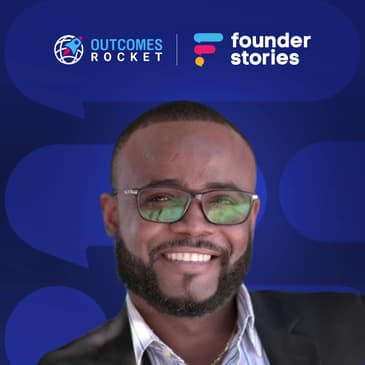
From tragedy to triumph, discover how a personal loss sparked an inspiring mission to restore hope and dignity to others.
In this episode of Founder Stories, Graviel Nuel Jacobo, founder and CEO of Centro de Prótesis y Terapia Física (Prosthetics and Physical Therapy Center) in the Dominican Republic, shares his inspiring journey from a tragic accident at age six that resulted in the loss of his leg to his mission of helping others in similar situations. He discusses the founding of his nonprofit organization, the challenges faced in building it, and the profound impact of providing prosthetics to those in need, restoring their hope and dignity.
Tune in to be inspired by how a personal tragedy became a mission to restore hope and dignity to others through his nonprofit, which provides prosthetics!
Resources:
[00:00:02] Hey everyone, welcome back to the Outcomes Rocket. I'm so pumped to have you all tuned back in for another episode of Founder Stories. A couple weeks ago, I had the privilege of going to the SOAR 2024 meeting in Atlanta, Georgia. Rebecca Woods, just an amazing person, helping women leaders succeed in health IT and IT. During that meeting, there was incredible speakers. One of those speakers was Graviel Nuel Jacobo, who's with me today.
[00:00:32] He is the founder and CEO of Centro de Prótesis y Terapia Física, that's the Center for Prosthesis and Physical Therapy. He's based in the Dominican Republic. He's got an incredible story. He was born and raised in a humble sugarcane village there, and at age six, his life took a tragic turn. He's going to tell us about it and what that has turned into.
[00:01:01] So, Graviel, thanks so much for joining us. It's such a privilege to have you here.
[00:01:06] Well, thank you so much, Saul. It is truly an honor to be here, and I'm excited about sharing my story and the impact that we are doing in the Dominican Republic.
[00:01:17] First of all, I was born and raised in a village in the Dominican Republic. Villages are communities within the sugarcane fields where Haitians and their descendants live.
[00:01:26] And basically, the limitations that you have in those villages are, for example, no electricity, no running water, and you have to walk a long distance to get to the school.
[00:01:38] So, I come from a big family. We are 10 siblings in total. So, basically, at the age of six. And the other thing is, those people live in some of those villages.
[00:01:49] They can barely have one meal a day. And that was the situation of my family back then. So, one day I went to the school. I was only six years old.
[00:01:58] And when I went back home as a kid, you know, I was hungry. And I asked my mom for some food, but she didn't even have any food to give me.
[00:02:06] But as a kid, you don't understand that. So, I went to the train station to get some sugarcane.
[00:02:12] I took some sugarcane and I fell onto the railroad tracks. I'm able to move. I was run over by the train car.
[00:02:18] And that changed my whole life. And just imagine you're born with your feet and you wake up in a hospital with only one leg. It's just frustrated.
[00:02:29] And so, it was really hard for me to get back.
[00:02:32] How old were you when that happened?
[00:02:34] I was six years old when I had the accident.
[00:02:37] Yeah.
[00:02:38] Wow.
[00:02:38] So, life was really hard for me. And going back to school, it was even more complicated. And I remember that I used to use crutches to walk.
[00:02:48] And at some point, I didn't even want to go to the school because, you know, things change.
[00:02:54] And you have to fight the fact that you are without a limb. And also, you have to fight with society because they make you understand that you are different.
[00:03:04] So, I spent 10 years sending letters to politicians, organizations, and asking people to help me to get a prosthetic leg.
[00:03:15] And I never received a response until I went to do social work for a hospital that was being built for missionaries, American missionaries in the Dominican.
[00:03:25] And so, there I met a lot of people and with the collective support of many of them, I was able to come to the U.S. at the age of 16.
[00:03:35] And I was fitted with my first artificial leg. We changed my whole life.
[00:03:40] Wow.
[00:03:40] So, when I went back home and I had to come back to the U.S. many times to do maintenance, to change parts.
[00:03:48] And also, I went to Omaha for an internship in accounting and management.
[00:03:52] So, I went back home again and I was working for one of the biggest hotels in the Dominican as the reservation supervisor.
[00:03:59] But at the same time, I realized that there were a lot of people going through the same situation.
[00:04:04] People that perhaps they didn't have the opportunity that I had.
[00:04:08] They didn't have the connection that I had to come to the U.S. and get my prosthetic because we don't have a prosthetic center in the Dominican.
[00:04:16] So, I decided to fund it.
[00:04:19] The first non-profit prosthetic and physical therapy center of the Dominican Republic, which is Centro del Prótesis y Terapia Física.
[00:04:26] So, in 2017, 2018, with the support of the Portland Club, we were able to hold our first prosthetic clinic back then.
[00:04:37] And we helped 45 people with prosthetic.
[00:04:40] It was really exciting being able to help people, give them hope back.
[00:04:46] So, we decided to do another clinic in 2019 and 107 people were served.
[00:04:53] The number was just going up and up, you know?
[00:04:55] So, if you drive in the Dominican, you're not going to see amputees like in the street or walking.
[00:05:02] But if you say that you're going to hold a clinic somewhere, hundreds of people show up.
[00:05:06] So, besides providing prosthetic leg and prosthetic arm to amputees, we also help with the counseling support to amputees with traumatic amputation.
[00:05:16] And we serve special needs kids with physical therapy.
[00:05:20] So, since our nation to the present day, we have served over 500 people.
[00:05:27] And as of now, we have 750 people in our waiting list.
[00:05:33] Wow.
[00:05:34] And our organization is not only helping people from the Dominican Republic, but also we have extended our service to many other places such as Bolivia, Venezuela, Guatemala.
[00:05:47] And it has been really exciting being able to help people, not only from my home country, but also from different places.
[00:05:55] And this is basically what we are doing as a non-Francic organization in the Dominican Republic.
[00:06:00] And we are in the process of building our center in La Romana, in a land that was donated by one of the mayor of La Romana.
[00:06:09] Awesome.
[00:06:09] And a month ago, we were able to put the roof on.
[00:06:12] So, we're going to work hard to prepare two rooms so we can start operating.
[00:06:16] But as of now, we do mobile clinic.
[00:06:19] We move across the country with volunteers from the Dominican and also from the United States.
[00:06:24] And it's been a wonderful trip.
[00:06:27] It's been a wonderful journey of changing and transforming the lives of those that needed the most in the Caribbean.
[00:06:34] Yeah, I really appreciate that, Graviel.
[00:06:36] I mean, that's huge.
[00:06:37] 500 people, a waiting list of 750, going from mobile clinics to now having a physical clinic.
[00:06:45] This thing is growing.
[00:06:46] It is.
[00:06:46] You could have simply gotten your leg and had a nice job at the hotel and just lived a productive life.
[00:06:55] But you decided to do this instead.
[00:06:58] What happened?
[00:06:58] Like, what inspired you to do this for people?
[00:07:03] Well, I spent over 10 years trying to find somebody to help me.
[00:07:09] Yeah.
[00:07:09] And it was really hard for me.
[00:07:11] It was really hard for my family and to get back on my feet and have a normal life.
[00:07:16] So, it was the collective support of people from the United States that helped me to get the prosthetic.
[00:07:24] And at the same time, you know, I was like, if it wasn't because of these people, maybe I wouldn't be able to get my prosthetic.
[00:07:33] And I decided once I was able to get this lesson through these people, I decided to pay it forward to do the same for others and change life.
[00:07:43] Because the impact of getting a prosthetic is amazing.
[00:07:47] It gives you hold back and it gives you the opportunity to be included in society.
[00:07:53] And that was one of the main reasons that motivated me to help others going through the same situation.
[00:08:01] That's great.
[00:08:01] That's inspiring, Graviel.
[00:08:03] So, how many years have you been building this clinic now?
[00:08:06] Well, we have been working in the building for four years.
[00:08:10] We don't have a lot of people, donors, donating for construction because usually people like to see their money in action.
[00:08:19] Yeah.
[00:08:19] So, people usually donate to purchase prosthetic limb and do the feeding and they can see the patients walking.
[00:08:26] But we have quite a few people helping with the construction and that's why it has taken too long.
[00:08:33] But I believe that we have come a long way.
[00:08:35] And I think we will be able to have the building up and running soon once people understand how important the building is in doing the maintenance, in helping people with the feeding process.
[00:08:48] And, you know, it will be a hold for amputees.
[00:08:50] So, I know the process is not going to be easy.
[00:08:53] It's going to be a long process.
[00:08:55] But we're still moving forward.
[00:08:56] And that's the best part.
[00:08:58] That's great.
[00:08:59] Noah, that's fantastic.
[00:09:00] And as you've built the nonprofit from the vans to now the building, what's been one of the most difficult things you've run into?
[00:09:08] So, you know, on our podcast Founder Stories, a lot of it is about navigating challenge because when you build something from scratch, there's challenge.
[00:09:17] So, what rises up to the top for you as something that's been challenging but that you tackled it and it's made you guys that much better?
[00:09:24] Well, when we started this organization, first of all, it's the first of its kind in the Dominican.
[00:09:31] So, it was really hard to come from the Dominican to the U.S., present the organization to many people.
[00:09:40] Sometime I used to take a flight from home to the U.S. with only $2 in my pocket.
[00:09:45] But I had faith that somebody would connect, engage with the mission.
[00:09:51] And it was a big challenge for me personally to drive across this country without knowing any, you know, people and connecting with people.
[00:10:01] And I didn't know they would engage, they would connect with the mission.
[00:10:04] And it was really a big challenge.
[00:10:07] And the other thing is, as you might know, prosthetic limb are really expensive.
[00:10:12] So, we didn't know people would donate prosthetic part.
[00:10:15] We didn't know people would donate money to purchase prosthetic to help people from another country.
[00:10:20] But at the same time, I had a group of people that believed in the mission.
[00:10:25] I had a group of people extending with our mission.
[00:10:27] And that was one of the things that helped me, you know, move forward despite the challenges that I had in front of me.
[00:10:35] And we still have challenges ahead of us.
[00:10:38] We still have challenges.
[00:10:39] But you have to keep believing the mission that you have in your hand.
[00:10:42] You have to have faith that, you know, it's not going to be easy.
[00:10:46] But if you push forward and if you fall down, just keep your head out, you know, and keep moving forward.
[00:10:53] Because the mission of when you fight and when you work hard to help somebody, it's worthy.
[00:11:02] And at the end, you can say mission accomplished.
[00:11:04] So, the challenge of connecting with people, the challenge of leaving my country, the challenge of trying to find funding for something that nobody knew about it.
[00:11:13] It was really hard.
[00:11:15] But we still standing after seven years and we still helping people, right?
[00:11:19] That's amazing.
[00:11:20] Well, look, it's inspiring.
[00:11:21] And folks, you're listening to Graviel's story.
[00:11:25] You know, maybe you're at a prosthetic manufacturer.
[00:11:28] And this is a chance for you to raise your hand and contribute.
[00:11:32] Maybe you're just looking for ways to find impact.
[00:11:35] And this is a chance to contribute.
[00:11:38] Because I'll tell you, when I was in the crowd and I heard Graviel's speech, it captured my spirit, my heart, and just inspired me that I had to grab Graviel afterwards and say,
[00:11:51] Dude, we got to share your message to the people, you know?
[00:11:55] Because that's how you get outcomes.
[00:11:57] And this is the outcomes rocket.
[00:11:59] So, my invitation to everybody listening is if Graviel said something to you and you want to share it, man, share it.
[00:12:07] And if it's not money, make it social media.
[00:12:09] Let's let people know that Graviel is doing what he's doing to help all these people.
[00:12:15] If it's money, hey, bring in the money because they're building the building and they need help.
[00:12:19] If it's prosthetics, there's opportunities here.
[00:12:22] So, Graviel, if people want to learn more, possibly even contribute, where can they find you and how can they learn more?
[00:12:31] Well, they can visit our website, www.centraldeprothesis.org.
[00:12:37] And also, Centro de Prothesis and Facebook.
[00:12:41] They can find us and learn more about the work we have been doing for the past seven years.
[00:12:47] But also, I want to share something with the audience.
[00:12:50] Many of us might take for granted the ease with which we walk, hold things, or even embrace our loved ones.
[00:13:00] But for someone who has lost a limb, these everyday actions can feel like, I would say, insurmountable challenges.
[00:13:09] And that's where the real power of what we do comes into play.
[00:13:14] So, when someone receives a prosthetic limb, we are not just given a physical tool.
[00:13:20] We are giving them back their hope.
[00:13:23] We are giving them back their dignity and independence.
[00:13:26] We are restoring, basically, the ability to move freely, to engage in life's activity without being defined by, let's say, the limits of their body.
[00:13:36] For many, it's a second chance at life.
[00:13:40] Well said.
[00:13:41] Couldn't agree with you more, Graviel.
[00:13:43] Let's work on these second chances of life for the people that you're working to serve.
[00:13:48] I can't thank you enough for sharing your story with us.
[00:13:51] Folks, go to the show notes.
[00:13:52] In the show notes, we'll add the website for Graviel's organization, as well as the Facebook page, so that you could engage with them, find out more, and find ways to get involved.
[00:14:02] Graviel, appreciate you so much.
[00:14:04] Thanks for what you do, and thanks for being with us.
[00:14:06] Thank you so much.
[00:14:07] Thank you for having me.
[00:14:08] Have a great day.
[00:14:09] You too.
[00:14:10] Thank you.