
Medical technology is evolving faster than many manufacturers can adapt to, and falling behind can now happen in months rather than years.
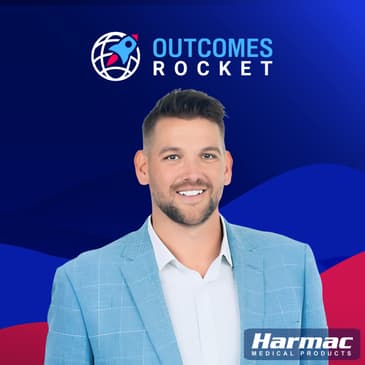
In this episode, Seth Rowan, Director of Business Development at Harmac Medical Products, discusses how AI, data integration, and digital transformation are reshaping medical device manufacturing. He explains why clean data is essential for successful AI adoption, how manufacturers can identify bottlenecks before they grow, and why companies need scalable manufacturing partnerships to bring single-use medical devices from design through commercialization.
Tune in to learn how manufacturers can turn rapidly changing technology into practical solutions without losing sight of execution, quality, and scale.
Resources:
- Connect with and follow Seth Rowan on LinkedIn.
- Follow Harmac Medical Products on LinkedIn and explore their website!
[00:00:03] Hello everyone and welcome back to the Outcomes Rocket coming live to you from Device Talks Boston. I'm excited to be here with the outstanding Seth Rowan. He's with Harmac Medical. Seth, thanks for joining us today. Thank you for having me. I love that introduction. I think the fantastic Seth Rowan, it works, right? Ready, Seth, go. That's right. Ready, Seth, go. Thanks for having me. I appreciate it.
[00:00:26] Seth, it's great to have you, man. Talk to us about you, your role, and what your company does in the industry. Yeah. So Harmac Medical, my name is Seth Rowan, Business Development. So I'm Director of Business Development in North America as I help kind of grow within that scale. Harmac Medical is a single-use medical device manufacturer within the plastics. Our focus is going to be more on the fluidics track and we've been around for almost 30 plus years.
[00:00:51] So tons of history there. But, you know, some of our focuses are just making sure we can help the customer figure out some of their design issues. But we ourselves don't own the IP. We build it out for them. We help them scale it to the point where they can commercialize. So it's one of our skill sets. We're based out of Buffalo. We have two locations in Tijuana and then we also have a location in Ireland. So, yeah. So we're growing and things are going well.
[00:01:16] That's fantastic, Seth. I really appreciate that. So single-use equipment, you do the design as well as the manufacturer. Yeah. So we don't do a carry, full carry for the design. But what we like to do is make sure that if someone comes in and needs some help, we have an engineering team that can provide some assistance on that regard. But, yes, we can help them design from the beginning to the end. We specialize within the polymer space.
[00:01:40] So fluidic tracks, anything involving that. So, yes, design to pretty much finish product is something that we do. And so, yeah. Very useful. Very useful. Yeah. So as you think about medtech, what's the biggest shift that you're seeing in medtech this year? As being business development, I think this is going to be the common question for everyone. What's the biggest medtech shift? AI. AI is going to give you metadata. It's going to be able to sift through information a lot faster.
[00:02:07] So from a manufacturer to being able to read the logistics of being able to just understand what your customer needs or understanding where you're going. So from a business development standpoint, seeing the medtech space is how do you get in front of someone down to the line of how do you make sure that you get the product to them on time in the right way? And being able to figure out how to make AI make sense within your organization. And so in the medtech space, you're seeing a lot of changes, but those changes are not necessarily understood until later down the line when all of the information comes out.
[00:02:36] So it's tough to make a decision, but you kind of take a leap and just say, I hope AI takes off. Yeah, for sure. And what would you say is a watch out there, Seth? Like, you know, AI is so useful, but it could also create problems. Yeah. Like, well, what to watch out? I mean, it's just company-wide.
[00:02:52] The adoptions, you know, one of the larger ones and just being able to utilize the formats appropriately, being able to get it integrated into your systems, being able to understand that and being to have the conversation within the system to be able to catch the problems before they happen. So you have a lot of moving parts. You have a lot of moving companies. You have, you know, logistics down the line. So you think about the individual companies being able to understand how the product gets down the line and if there's any complications as you're trying to figure that out.
[00:03:21] You're also looking at the bottlenecks that potentially could be made worse because AI comes along and doesn't actually solve the problem for you. If you don't have clean data, right? Clean data in, clean data out. If you don't clean data in, it's going to cause some issues down the line. So as you're understanding this, not everyone's a tech guru, not everyone's a software engineer. So to be able to understand how to utilize it within your space of your industry is very, very difficult.
[00:03:45] But I think that come time when things are more smoothed out, companies will have more solutions to those problems. I love it. And Seth, you know, a lot of people come to device talks and other conferences to figure out some of their biggest challenges. So what's one of the biggest roadblocks that's on your radar right now? So right now, I think when it comes down to it, I think everybody has the same thing. They just want to meet someone that's going to have a need and be able to solve that problem for you. I think that there's twofold in these.
[00:04:13] It's from a business development standpoint. You want to meet someone along the way that potentially is going to have a design need, is going to have a manufacturing need. Maybe they haven't been able to solve a problem. So being able to support and provide help to those members. The other side of it is what exists? What's the newest? What's the latest? Because technology used to move, you know, in decades. It used to move in months. Now it's moving in almost days where you have the latest releases of Claw, the latest releases of GPT, which are models that are used.
[00:04:43] But then within your own systems, you have software solutions like here at, you know, Device Socks. The software solutions, the robotic solutions that are out there change every single day. And the best options are going to change from year to year, from day to day sometimes. So being here is just staying with the latest, understanding the latest, and being able to actually implement that within your company to make the most change so that you're not left behind. With what used to be a 10-year gap is now sometimes almost a monthly gap. So it's a big decision. Yeah, for sure.
[00:05:12] So you've been exposed to a lot of things here. And walking the halls, checking out the speaking sessions, the panels. What's one of the things you're most excited about and betting on here moving forward? I really think it has to come down to whoever gets to solutions from an AI adoption rate. And that this might not make a lot of sense within this space from a robotics. But I think that when everybody is starting to look at the 10, 15-year-go conversation, it was people didn't understand that it was all about the data.
[00:05:41] It was all about understanding or being able to grab the data, being able to access the data. Now you have the data, and it's being able to understand and integrate and make it searchable, right? So these silos that exist. And I think that whoever gets to the point where they are able to solve that problem for the majority from a manufacturing standpoint, specifically in my case, I think you're going to start to see people take off on that level. So I don't know if that's going to make a lot of sense up front, but I think we're still at the very forefront of this.
[00:06:10] So there's a lot going on. There's a lot of moving pieces, but I really think that there's this underlying current. And that's where I think being able to access that and then utilize it in the best way is the kind of spaces we're moving forward on. Totally, man. No, I love that. And I think you made some really good cause. I mean, at the end of the day, robots' devices are paired with software. And if that software is moving fast, you're able to make changes to your devices and your robot.
[00:06:39] So you've got to stay with it. And that's why we're here, folks. If people wanted to learn more about you and your company, where can they get in touch? Yeah, so you can go to Harmack Medical, right? So harmack.com or the best place to find me is Satoran on LinkedIn. Reach out anytime if you have any questions about the CDMO space or anything just talking about AI. It's something that I love. And being able to see everything that's going on here today, especially from a robotic standpoint, it's phenomenal. Some of the things that I saw was actually a little robot that jumped back and forth.
[00:07:09] And we're not far. We are not far. What was the robot doing? So it was actually able to jump, stand around. You would actually push it, pull it back. And it was able to go sideways, left ways. So you're actually watching a robot in real time adjust to its environment. And that doesn't exist without the current software. That doesn't exist without the current data being able to be practiced within its own environment. So, yeah. That's pretty cool. I'm excited. Well, that and more here from Device Talks.
[00:07:37] Seth Broen with Harmack Medical with us today. Check out the show notes for all the ways to get in touch with him, as well as all the ways to get in touch with this company. And to get more from Device Talks and our podcast series we're doing with them. Thanks for tuning in. And Seth, thanks for being with us. Thank you for having me.