
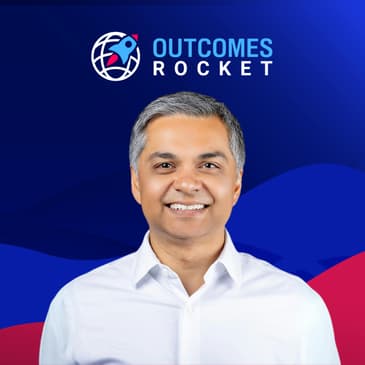
This podcast is brought to you by Outcomes Rocket, your exclusive healthcare marketing agency. Learn how to accelerate your growth by going to outcomesrocket.com
The key to improving patient outcomes and lowering healthcare costs lies in effectively integrating genomic insights into clinical decision-making.
In this episode, Surya Singh, CEO of InformedDNA, discusses how his company uses technology and genetic information to enhance population health. He shares the recent acquisition of Coriell Life Sciences, a pharmacogenomics company, to expand its proactive healthcare capabilities. With a background as a physician and healthcare strategist, Surya emphasizes the importance of shifting from reactive to preventive care. He also highlights the launch of DNA Impact, a population health platform designed to identify and support at-risk individuals by streamlining the genetic testing process and addressing the underutilization of validated genetic assessments.
Tune in and learn how genomic solutions can revolutionize healthcare and improve patient outcomes!
Resources:
- Connect and follow Surya Singh on LinkedIn.
- Learn more about InformedDNA on their LinkedIn and website.
- Discover more about DNA Impact here.
- Buy Good to Great by Jim Collins here.
- Grab a copy of Turning the Flywheel by Jim Collins here.
- Get the book Accelerating Growth by Vern Davenport here.
Fast Track Your Business Growth:
Outcomes Rocket is a full-service marketing agency focused on helping healthcare organizations like yours maximize your impact and accelerate growth. Learn more at outcomesrocket.com
[00:00:01] This podcast is produced by Outcomes Rocket, your healthcare exclusive digital marketing agency. Outcomes Rocket exists to help healthcare organizations like yours to maximize their impact and accelerate growth. Visit outcomesrocket.com or text us at 312-224-9945.
[00:00:29] Hello, everyone, and welcome back to the podcast. So excited you tuned in because today I've got Surya Singh on the podcast. He is the CEO of InformedDNA. They're a leading tech-enabled genomic solutions provider. And under his leadership, InformedDNA integrates genetic insights into healthcare to improve patient outcomes, optimize clinical decision making, and reduce costs.
[00:00:57] I'm really excited for this conversation with him and Surya, just want to give you a warm welcome. Thanks for joining us. Thank you so much. Very excited to be here. Yeah, it's great to have you here. And so the year's off to the races. We're almost done with Q1. How's the year gone for you? Very well. We actually last week closed on a acquisition that we've been working on for about nine months. So that was big news for us. A press release on it goes out tomorrow, in fact. Congratulations. Congratulations. Care to share?
[00:01:25] You're firing all sponsors. Yeah, very excited. That's awesome. Do you want to tell us about it? Yeah, we are in the process right now of going through the phases of integration with Coriel Life Sciences, a pharmacogenomics company that's been in the market over a dozen years, and is incredibly synergistic with what we've been doing with the population health platform called DNA Impact.
[00:01:47] That essentially aims to use a variety of different digital tools and technology to expand the practical application of genomics and population health. So couldn't be more excited about it. I see pharmacogenomics and had for a very long time in my 20 to 25 years in healthcare as a field that has a ton of evidence where the medical establishment has not quite caught up to the use of that evidence.
[00:02:11] And trying to make patient care better and driving all the things that you said in the outset, you know, better outcomes at a lower cost are achievable through use of validated genomic markers. Drug metabolism is one of the important categories for that, which is what this acquisition is. Well, that's fantastic. Congratulations to you and the team for that acquisition. That's exciting. Thank you. Yeah. So let's dig in, Surya. Tell us about your business. What do you guys do? How is it different? Why does it matter?
[00:02:36] So I'll start with a tiny bit of background about me because I think it'll provide the context for the company and where we're going and what we do that's different. So I'm a physician, I'm an internist and hospitalist. I practiced here in Boston at the Brigham Williams Hospital as a hospitalist for a number of years, full-time first and on a part-time basis.
[00:02:57] And so, you know, I had the chance to see firsthand a lot of the end results in a tertiary or quaternary care referral center of a lack of prevention, lack of proactive preventive care.
[00:03:11] And I come from a medical background, medical family, came into medicine, being, you know, quite familiar with a lot of the issues that have emerged over the last half century of healthcare, things that you've covered well on this podcast and the episodes that I've listened to at least. You know, just the disorganization and chaos and fractured care that we have.
[00:03:31] A recurring theme that you and many others have had amongst your guests is the need for us to move away from a reactive system that takes care of people when they're sick rather than a well-care system that is more proactive, right? And we all talk about that for 20 years consistently. And just to kind of give the quick thumbnail sketch, I spent time as a strategy consultant when I left practice full-time at McKinsey.
[00:03:56] And there was a series of small companies, including a company that did in those days in the mid-2000s, large data risk analytics before we really called it predictive analytics as a field called D2 Hawkeye. And I really cut my teeth here thinking about how can we use the data that's available in order to do what we're doing now, and I'll get to metanformed DNA, just better population level stratification and drilling into individuals to really understand risk profiles.
[00:04:26] Population strata and kind of what we now call precision medicine, what we formerly would call personalized medicine, are really just good medicine and good population stratification and being able to apply better and more precise interventions to stratified pieces of the population so that we can be more effective and more cost-effective. And in those days, our tools were a little more blunt, but the concept was the same.
[00:04:50] And we were trying to use claims analysis in order to drive drilling into the diabetic portion of the population and see which end organs were the ones that were lighting up and giving a problem earliest so that we could apply better interventions. And fast forward, I ended up through a series of different career moves at CVS for a stint as the chief medical officer of the specialty pharmacy business.
[00:05:12] Since we got very deep into thinking about medication adherence for those at greatest risk and quite vulnerable populations according to their disease profile, both socioeconomically but also based on having a diagnosis of a rare disorder or severe disorder. And also very deep in the world of cancer therapeutics and went through about three cycles of different companies trying to manage risk in a capitated way for cancer patients, both at the practice level and working with health plans and so on.
[00:05:40] So I got very interested based on way prior to that, which I won't go into research background in genetics and molecular biology to the practical application of tools and largely it's better risk stratification through advanced diagnostics and biomarkers to be able to provide patients ultimately.
[00:06:02] But let's just say those who are managing populations, largely plan sponsors, employers, self-funded employers, health plans and so on with tools to be able to stratify their population so we can get better interventions to the appropriate parts of those populations. Simplistically, who are the people that are going to cost a lot of money and be sickest and how can we get to them earlier? How we can predict who they are. And I left CVS.
[00:06:27] It was clear to me after I was there through the acquisition merger with Aetna that there was going to be a lot of roll up the sleeves work in the integration period. And I really wanted to work more in innovation. I built an innovation team at CVS and so on. So I was interested in getting out and kind of re-putting on the entrepreneur hat and thinking about how to get to spend more time in precision medicine.
[00:06:50] And after about a year of serving on advisory boards and boards and things and doing a portfolio of activities, I started a company with a co-founder, colleague, close colleague of mine in genomics aimed at creating technology that can normalize the input and take essentially the results of genetic and genomic testing, put them into a database after that normalization and then apply a rules engine to them to produce reports.
[00:07:14] In the process of going out to the market and talking about licensing that to different entities, we had a conversation with Informed DNA. Informed DNA decided to acquire that company and I came in as CEO in 2023. And we've been on a journey since then, which brings me all the way back to your question about what do we do that's different?
[00:07:32] This company's background and its three phases that it's been through, it's been around 18 years now, so it's not a brand new company by any means, have really kind of given it, I think, a really important set of expertise and experience from which to create the best models for implementing precision health at scale.
[00:07:52] First thing was an outsourced genetic counseling company and that business is alive and well, agreements with about 70 health systems around the country that refer us patients for genetic counseling, either as a supplement because they're understaffed in genetic counseling and their cancer center or their reproductive health practices or as a full replacement. So that was the first kind of genesis of it.
[00:08:13] They went out and did the hard work of getting in network for providing genetic counseling across the country, originally for about 100 to 120 million lives and now it's 150 million lives of payer coverage. And then after the payers that they got in network with saw that they had this deep genetics expertise, they said, can you help us with writing our policies, with our utilization management criteria, with our claims edits and so on? So in the second phase of the company, they built a business doing all those things.
[00:08:38] The third phase, which we're in now and really is the, you know, sort of the passion that I have for doing this work is to build a population health platform and deploy it, implement it on the behalf of plan sponsors to fix what has become as big of a problem as the overutilization and misinterpretation problem in genetics. And that is underutilization of heavily validated genetic and genomic assessments. So we've introduced a platform to do that DNA impact.
[00:09:07] I mentioned one of the acquisitions. There have been a couple that we've done now to more rapidly accelerate its development. And I think the thing that we do that's different on that up front is take a broad lens so that we're not looking at just cancer alone or just cardiac alone. We're looking across different therapeutic areas. So it's not a point solution, just single therapeutic area platform.
[00:09:29] And then secondly, we go all the way to the end of the earth of trying to make the process of getting people through that funnel, deciding whether or not testing is right for them, getting the testing done, interpreting the testing, talking with the patient and their provider so that the test is interpreted correctly and issuing a report. So there's a really kind of full cycle service as opposed to just doing very transactionally issuing a lab report.
[00:09:57] So obviously a lot of depth on any of those pieces, but there's your long winded answer. No, that's fantastic, sir. Yeah, look, it's very clear. I love your passion for this. I think the way that the companies come together has really kind of been like an orchestra, right? Different innovators doing different pieces of the puzzle ultimately to help the clinicians deliver the best care that they can with a data set that's underutilized. Look, we like to learn from successful people.
[00:10:24] What's your favorite business resource or hack that you recommend to our listeners and why? So I don't know if I would quite characterize it as a hack, but I am a big consumer of different classic business tools and so on. And so one of our investors has published a book on a management system called Accelerating Growth. And it's really been pretty informative and helpful to us in having a rigorous approach to running our business.
[00:10:51] And through an operating committee that I and my COO co-run, we've really had an efficient build, I think, towards the model that we're in now of running this company. And I'll just share with you the resource that I asked my team to read over the holidays, which was the flywheel monograph that was a fault. Oh, okay. It could be great. Which, you know, is an old and classic one, but I still believe in.
[00:11:14] And I think when you find that part of the market that you're able to get the flywheel to really start to turn and propagate, catching on to that and focusing has been something that the half dozen times when I've had products that I've been a part, you know, been fortunate to be a part of introducing into the market at different stops along the way. You don't drop everything, but you certainly focus as much as you can on getting that flywheel really going. And I think we're doing that here and I'm excited to be back in that phase of the company. That's exciting, Surya.
[00:11:42] And so it is the Accelerating Growth System. You also called out the Flywheel Monograph and Good to Great. All such great resources. Folks, we'll link them up to the show notes so you too can get your surge of business intel. And so, Surya, if people, if the plans and the employers listening to this episode want to reach out to you because they're curious and they want to learn more, where can they reach out to you and the company?
[00:12:10] So, definitely on our website, informdna.com would be the primary place. I'm available on LinkedIn and over email. I personally review my email and can't say I'll be as rapid response as I heard anecdotally Mark Cuban was before Cost Plus Trust started. Sorry to read that was a cold email that started that, but I am very quick to respond over email, which is also published on my LinkedIn profile.
[00:12:36] So, you can reach us any of those ways and we're active on the other social media platforms also, including Instagram. So, I think any of those places you can find our company and find me. That's outstanding. Thank you so much for that. And folks, in the show notes, we'll leave all the ways to get in touch with Dr. Surya Singh. He's the CEO of Informed DNA. They're leading the way in tech-enabled genomic solutions for plans and employer sponsors.
[00:13:04] Tune in to stay in touch with him. And Surya, I really appreciate you joining us. This was a really great episode. Thanks so much, Saul. Much appreciated. This podcast is produced by Outcomes Rocket, your healthcare-exclusive digital marketing agency.
[00:13:32] Outcomes Rocket exists to help healthcare organizations like yours to maximize their impact and accelerate growth. Visit outcomesrocket.com or text us at 312-224-9945.