
AI technology in healthcare is revolutionizing documentation processes, saving time for physicians, and improving efficiency.
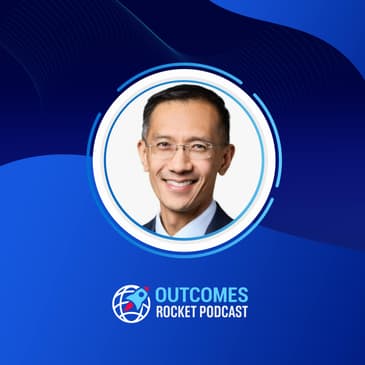
In this episode, Dr. Ed Lee, Chief Medical Officer at Nabla and a practicing primary care physician, discusses Nabla's AI documentation application, Nabla Copilot, which significantly reduces clinicians' documentation burden by listening to patient-clinician conversations and generating detailed notes. Throughout this interview, he emphasizes Nabla's customizable features and its integration options with electronic health records. Dr. Lee addresses setbacks as opportunities for improvement and advocates for thoughtful adoption of AI, envisioning its potential to enhance patient care, mitigate challenges, and lower healthcare costs. He also underscores the importance of deploying technology in alignment with patient care goals.
Tune in and learn how innovative technologies like AI can revolutionize healthcare documentation and improve patient outcomes!
Resources:
[00:00:02] Hey everybody, welcome back to the Outcomes Rocket. So excited that you tuned back in today. I have the privilege of hosting Dr. Ed Lee with us. He is the chief medical officer at NABLA and is a primary care
[00:00:18] Physician currently practicing as well with over two decades of health care technology expertise I'm so excited to host him here on the Outcomes Rocket. Dr. Lee. Thanks for joining us. So thanks for having me
[00:00:29] It's our pleasure and look really excited to unpack the work you guys do at NABLA But also wanted to learn more about you. So tell us a little bit about you and what inspired your work in health care
[00:00:40] Yeah, absolutely. So as you mentioned, I'm a practicing primary care physician I trained in internal medicine at UC Davis Medical Center in Sacramento and Following my training. I joined Kaiser Permanente in the Permanente medical group where I spent basically the next 20 years spearheading
[00:00:58] various transformative initiatives around informatics or health care technology and innovation and Enjoyed my time there, but recently as you mentioned joined NABLA as their chief medical officer There are so many things that drive me to do the work that I do
[00:01:14] Health care technology is fun. It's exciting. It's often cutting-edge. Although Sometimes quite honestly, it's not sometimes it's about using older technology and developing or improving processes that
[00:01:26] Whether technology will make the biggest difference and that's sort of the fun part and you can think of it as sort of a Puzzle that requires imagination and creativity and knowledge and expertise to solve but those are all more personal fulfilling reasons
[00:01:40] The bigger picture the more meaningful and true inspiration around my work has always been for our patients Delivering high quality care which all our patients want and they deserve. That's really at the center of it all and sometimes it's
[00:01:56] Creating technologies that patients will directly interface with and other times it's developing tools that our physicians will use I always say that when you help our patients you help our physicians
[00:02:08] but when you help the physicians, you also help the patients and there's a lot that ails the American health system and Including things like physician and nurse shortages and rising cost of care inadequate resources physician burnout. There's a lot to fix
[00:02:23] But I'm a firm believer that technology and more importantly Optimized technology is one of the key levers that will assist us in mitigating many of these problems that I just mentioned Yeah, no for sure and I love the way you put it. Dr
[00:02:35] Lee if you help a patient help a physician and vice versa if you have a Physician you help a patient talk to us about nabla. What are you guys doing to add value to the health care ecosystem? Yeah
[00:02:50] NABLA is the developer of nabla copilot, which is the leading AI documentation application in the industry More clinicians use nabla than any other similar product out there which speaks to the value that nabla is bringing to health care
[00:03:06] it's no secret that physicians and other clinicians have an overwhelming amount of work that needs to be done and Unfortunately a lot of what they do now is administrative in nature Studies have shown that for every hour of direct patient care
[00:03:21] there's two hours of work that needs to be done in electronic health record and One of the tasks that takes the most time is writing notes documenting the patient interaction the EHR so what ends up happening is that a physician will see a patient during the day and
[00:03:38] It'll be 8 10 or 12 hour day of patient care and the documentation work starts after the traditional workday ends Often extending well into the evening hours What nabla does is that it dramatically and significantly reduces the documentation burden that clinicians face by
[00:03:57] listening to the conversation between the patient and the clinician and using AI through proprietary develops large language models to produce documentation for the clinician It works in dozens of specialties both in ambulatory and inpatient space multiple languages with interpreters
[00:04:15] when there are multiple people in the room speaking such as when you have a pediatric patient with parents and siblings all part of the conversation and Not only does it create the consultation or the progress note
[00:04:27] It also writes patient instructions which can create summaries that's written in patient-friendly language without the medical jargon that the patient can review after visit and In addition nabla can suggest ICD-10 codes for the visit and soon it also recommend HTC's and CPT codes, you know
[00:04:47] Someone using nabla can easily save two hours a day and that's not theoretical I've seen it happen in real life I've had colleagues tell me that nabla is a game changer for them and I've seen testimonials saying it's Saved their medical practice. They were
[00:05:04] considering retiring early but because The work was unsustainable before but now suddenly is sustainable with the use of nabla. That's fantastic and certainly leveraging large language models big play today with Gen AI and so talk to us about
[00:05:21] How it's different or better than other options out there today We have a product that does all the basics of which you'd expect out of an AI scribe solution Create a beautifully written note organized note that contains all the pertinent facts from the patient physician interaction
[00:05:37] But what I think we do especially well is that we understand that writing a clinical note is personal We all have our own way of documenting and so with nabla We give our users the freedom to customize the note in the way that they want to
[00:05:52] We've got numerous different templates that can shape the note in how the clinician wants their note to be shaped We have this concept of verbal dot phrases where you can say keywords during the visit and The nabla will expand those keywords into a block of text
[00:06:10] we have the ability to regenerate the note if you want more detail in one section or less detail in another and I think what that all boils down to is the fact that we're super customer focus
[00:06:22] We understand that there are unique needs and we want to shape the product so that it will exceed your expectations And so these customizations all also happen at a pace at what you want Meaning you don't have to wait months or years for upgrades and technology to happen
[00:06:40] They're literally happening all the time and I'll often Have a suggestion of a new feature and the next thing, you know next day next week It'll be available for me to use already. It's really great. Yeah, that speed that's that innovative speed is key
[00:06:55] Especially with with these types of tools that personal element I've definitely heard of it before dr. Lee the sort of the ownership of the note and I've never been a physician But certainly have heard it before so sounds like a very valuable
[00:07:10] Customization suite that you guys offer from my perspective. This is a hot topic, right? Chatting with my wife about it and then she's like so does it integrate into the EMR? So does it then does it do it automatically?
[00:07:25] Yeah, so there are different versions out there where you can have it a standalone outside in a web-based application and there is an ability to integrate the node directly into the EHR where you're using the tool and You click done and the next thing you know
[00:07:42] It shows up in the EHR and so there are pros and cons of each with the former you can get that out Deployed right away. There's nothing that needs to be done. You everyone has access to a web browser and a microphone and You can use it today
[00:07:58] With the integrated piece, you've got the convenience of having the node show up there But you do have to put work in on the health system side to build that integration into the workflow
[00:08:09] So there's pros and cons. Sure. Yeah a heavy lift maybe up front, but then you get the benefits on the back end For the integrated one. Yeah. No fantastic. Thanks for sharing that. I'll be sure to share it with her later today
[00:08:22] And of course our listeners or everybody you could get it as an app a web browser or it could be integrated as well With the creation of these types of tools, dr. Lee. It doesn't happen without
[00:08:35] Issues or setbacks what's been one of the biggest ones that's come up and a key learning that has made you guys better as a result Setbacks happen all the time in life and work in general and
[00:08:47] I'm part of the slack novel slack and I see the different reports that come in and the thing that's striking to me about what I see is that when something comes in it gets fixed quickly and
[00:09:01] That's the last time I ever see anything mentioned about that particular issue I think part of it is that the speed to execution part and being quick and nimble, but the other thing is that Using setbacks as opportunities to take steps forward learning from them
[00:09:19] understanding what went wrong making changes to prevent it from happening it again and Knowing that the setbacks aren't necessarily what define you but how you respond to them does How you exhibit resilience and the strength that you have to overcome any setback that you have and problems?
[00:09:38] I see I never hear him again because The solutions are done rapidly but in a thoughtful way that solves the problem now and into the future Yeah, for sure. It's not what happens to you
[00:09:51] But how you respond and I think it's great to know that you guys do respond fast And and how about look we're talking about a technology that is innovative It is a trend. There's tons of buzz, right?
[00:10:04] So this question that I have for you is like basically what we've been talking about is tech or trends in healthcare, but maybe the other angle we could look at this one at is is
[00:10:15] Maybe how do how can people think how can leaders think about these technologies differently? What are you seeing and how could they be thinking about them differently as they seek to adopt these types of technologies? AI is such a big thing right now
[00:10:30] And I'm not saying that just because it's a buzzword or because of all the hype that's around it I'm saying because I've worked with the underlying technology. I've deployed AI systems
[00:10:42] I've seen what it can do when it's deployed in a large scale and how much value we can bring But it needs to be done in a systematic organized and thoughtful way
[00:10:52] You know, that's how you can extract the most value out of AI and when I say AI I'm not just talking about the generative AI space in which Nobla is in but AI in general and I subscribe to the term
[00:11:04] augmented intelligence rather than just plain artificial intelligence because I think it emphasizes that AI Is not a standalone product at least not in the clinical healthcare space at least not yet So using AI as a tool to assist and to complement the expertise of physicians and other clinicians
[00:11:22] It's really actually how we're gonna make the biggest difference. I see in making improvements in quality of care elevating patient experiences mitigating access challenges and physician shortages Decreasing overall cost of care because patients will be able to get care sooner
[00:11:38] Which means their health conditions are less likely to progress to more advanced stages That means less morbidity, less mortality, less suffering, lower costs. In addition to the generative AI space large language model space I think computer vision where AI can detect visual patterns and sometimes
[00:11:58] can be difficult for the human eye to detect and predictive analytics where AI can look at millions or if not billions of data points and Find patterns through there so we can understand what's more likely to happen in the future and again intervene earlier
[00:12:13] Thank you so much for that. Dr. Lee very insightful frame of thought around AI and how we should be thinking about it So folks something to think about as you approach these opportunities in your particular health system
[00:12:27] Or if you're a technology seeking to to help health systems or payers for that matter It's certainly important the thought that you put to it and the frame of thought that dr
[00:12:38] Lee shared is a really great one and this has been an incredible opportunity to chat with you really just Appreciate your passion for the work that you guys do there And and so if you were to leave us all with the closing thought what would that be?
[00:12:51] And what's the best place the listeners and viewers could learn more about you and nabla? Yes, so first of all, thanks so much for having me on the podcast. You're at a great time
[00:13:01] I think the future of what we'll be doing with AI scribe technology and AI in general It's only gonna be limited by our imagination You know The potential is massive but only if we deploy and employ technology in the right place at the right time
[00:13:18] And I'm confident that's gonna happen There are a lot of smart people out there in health tech with The goals and the visions that are aligned with I think what is what I think is most important which is again Getting our patients the best care possible
[00:13:32] And the best way you reach me probably on LinkedIn. You can find me at ed Lee MD MPH amazing Thank you Ed really appreciate that folks in the show notes. You'll find links to ways to get in touch with. Dr
[00:13:44] Lee as well as learn more about nabla and dr. Lee want to thank you for being with us today. It's a pleasure Thanks all