
Did you know that dentists have one of the highest rates of burnout and mental health challenges?
In this episode, Dr. Kyle Stanley discusses the pressures in dentistry and the importance of mindset, emphasizing how financial stress, business management, and professional identity struggles contribute to mental health challenges. He introduces his "ripple framework," which focuses on self-awareness and well-being, while the conversation also explores AI's role in standardizing diagnoses and the shift toward preventive dentistry.
Tune in to uncover the hidden struggles in dentistry and how mindset, AI, and preventive care are shaping a healthier future for both professionals and patients!
Resources:
- Connect with and follow Dr. Kyle Stanley on LinkedIn and Instagram, visit his website, or reach out to him at info@drkylestanley.com.
- Check out Dr. Kyle Stanley’s podcasts!
- Discover the Light Side Dentistry website!
- Enroll for Dr. Stanley’s next live course here!
- Follow Pearl AI on LinkedIn and explore their website!
- Watch the entire episode on YouTube and get more details at Think Oral Health.
- Mariya Filipova - https://filipova.health/
- Systemic Health Investor - https://www.4100dx.com/
- Care Convergence Thought Leader: Dental Economics
- Forbes Technology Council Member
- Jonathan Levine - www.drjonathanlevine.com
- Founder - JBL New York City www.jblnyc.com
- Founder - GLO Science LLC www.gloscience.com
- Co-Founder - GLO GOOD Foundation www.glogoodfoundation.org
[00:00:01] This podcast is produced by Outcomes Rocket, your healthcare exclusive digital marketing agency. Outcomes Rocket exists to help healthcare organizations like yours to maximize their impact and accelerate growth. Visit outcomesrocket.com or text us at 312-224-9945.
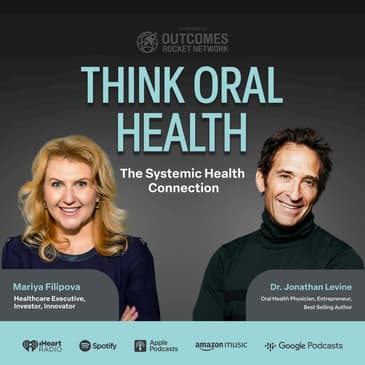
[00:00:31] Welcome to Think Oral. Where we connect the unconnected between oral and physical health. I'm your host, Dr. Jonathan Levine. And I'm your host, Maria Filipova. Let's get at it. Hi everyone, and welcome to another episode of Think Oral Health podcast. As usual, I'm joined by Dr. Jonathan Levine.
[00:00:56] And today we're privileged to have another doctor as a conversation partner at our podcast today. Without further ado, I will ask Jonathan to introduce us to our guest. Jonathan, who are we having a conversation with today? Thank you, Maria. I am super excited to have Dr. Kyle Stanley, colleague, friend. He is absolutely a trailblazer in dentistry ever since he hit this industry. Called this next generation of aesthetic dentists.
[00:01:24] I don't like the word cosmetic, but aesthetic, which means structure, function, and biology as part of the aesthetic milieu. He's very involved as top educator. Seattle Study Club. Lectured in name of the continent. He's lectured in the last 10, 15 years. He's spearheaded some groundbreaking technology with Pearl AI. He's now evolved into really helping dentists elevate their mindset, their thinking, and understand,
[00:01:54] how do I have this optimistic, positive thinking around our profession? It's a profession that is complicated. It is a profession, unfortunately, riddled with a certain level of mental illness because of the kind of profession it is. And I think all of healthcare could fall into that category. He's now very focused on this, and he's really an advocate for mental health within dentistry. Super excited. He's got an amazing podcast.
[00:02:21] That is this happy podcast with Christian Coachman and Ingrid Mira. And it's really a fantastic podcast. And I've asked him to please join you and me on our podcast because he's really a voice that this profession needs to hear. So thank you, Kyle, for joining us and taking the time out today. Thanks for having me. Nice to be here. Welcome. Welcome to the podcast. Thank you.
[00:02:45] Well, Maria, let me start it off because having been in this industry for, and I like to say three and a half decades, but it's really not true. It's really a little bit more. And understanding the way this industry has evolved over the last three, four decades, the industry today has such a difference in technology. There's so much more kind of basic science research and knowledge that we have.
[00:03:11] But the pressure has never been greater, really, when you think about this profession, because of the competition, because of a lot of this trending that's happening in dentistry. So let me throw that question out to Kyle. Kyle, what do you think are the elements that have created this profession that maybe I could call complicated, pressurized, and one that needs your voice of mental health within the profession? What are those trends? What's causing all of that?
[00:03:40] You know, I would actually say that I don't know if it's much worse than it was back when my dad graduated in the 70s. I just think that there's more awareness now. There's things that have changed, like you said the competition or maybe the financial component. When you look at insurance reimbursement, for example, it stayed the same since my dad graduated in 76. It's been the same.
[00:04:07] There were doctors that I knew that told me in the 70s they were making $150,000 and a house was $70,000. Now you make $150,000 and a house is $700,000. It's a little bit different. But I think in general, the main pressures of dentistry are still there, which is aligning your purpose with your profession, aligning your identity with your clinical work, the pressure of running a business and working in the business.
[00:04:35] Jonathan, you and I know a lot of people that are very successful. Let's say they, like I know this guy who, through a friend, who makes the orange buckets for Home Depot. Okay? The guy's got Ferraris. He's got mansions. He's got all this stuff. You think he's in the factory making the buckets? No. He's just working on the business.
[00:04:56] However, dentists and other doctors as well, specific doctors, are working in the business and on the business at the same time in a very challenging area of the mouth, a very unpredictable area of the body. And so I don't think much has changed besides maybe the competition, the awareness. Also, you add in a little bit of social media, that professional jealousy. So I think it's been there for decades. Yeah. Yeah.
[00:05:24] And if you thought about this is an issue that's been longstanding and we've learned more today, what are the elements that you like to talk about, you lecture about, and you're really exposing the dental profession too that can help dentistry and dentists really have a more fulfilling, purposeful life? What is that? Yeah. Yeah. So I'll bring you through my ripple framework, which will summarize everything really.
[00:05:53] Number one is the R for ripple. That is realized. It's self-awareness. It's realizing something has changed. It's realizing that maybe you're not in the best physical health anymore. Maybe you have back pain. Maybe you're more reactive with your team or with your spouse or with your kids. So that's the number one step of, or almost step zero of solving any problem, right? Having the awareness. One of my jujitsu professors says a problem understood is a problem half solved. And I completely understand that. You have to understand the problem.
[00:06:22] The next stage in the ripple theory is I. That's for identify. You have to go through and identify all your triggers. What triggers you in dentistry? Is it when a patient sits down and says, I hate the dentist. I hate being here. Is it when your hygienist shows up 10 minutes late every day? Is it paying your student loans? Is it the difficulty of trying to work on a back molar and the patient won't go back in the chair anymore?
[00:06:51] They say, no, you can't put me back anymore. So you have to identify those. Next is purpose and perspective. Probably one of the most important steps in the process, which is separating your purpose and your identity and life from your profession. Now, this is challenging for us because we've been funneled in for 8, 10, 12 years, depending on how many residencies we did to thinking that our entire self-worth is in our clinical work.
[00:07:17] So that's probably one of the most difficult steps, but one of the most important steps. Next step is really the learn phase. And this is where we need to learn daily habits outside of the practice. I have something called the dream sequence, which is diet, relationships, exercise, appreciation, meditation, and sleep. As you guys both know, they're all research backed. There's a ton of research on this. The last step is the elevate step.
[00:07:43] And that is really learning how to manage your practice for your mental health. So most people talk about running a business for making money. I talk about running a business for your mental health. Now, the side effect is most of the time you make money and you're happier, but you need to learn all these soft skills that really not just dentists, but no doctor learned. Communication skills, how to have difficult conversations, how to set expectations, how to have boundaries with people.
[00:08:13] I learned that was where I suffered. I was a pretty good dentist, but I suffered in these soft skills. So that's a long-winded answer of where I think it needs to go. Fantastic. He's incorporated that thinking that is so important with so many people that have spent their life thinking about across industries of how do you create personal mastery, personal
[00:08:38] growth so that you can be an amazing leader and servant leader and elevate yourself and your people around you. I've been at it now for such a length of time and have done many different things within the profession. And you can find out what is going to really give the purpose, right? Maria Simon-Sinek, I know you, why you're doing that. And Maria, you come from a business executive standpoint, you're a different background. I mean, it really resonates.
[00:09:08] I have five minutes to put insurance under the bus. So this is great. It's a great conversation. I'm a recovering healthcare insurance exec. So that's what Jonathan is hinting at fairly, very gently there. But yeah. Yeah, I don't blame the insurances. I actually blame the dentists because dentists, I'm not in insurance in my practice. I don't think Jonathan is either. And a lot of dentists love to blame insurances. And then I say, well, why don't you go off of insurance?
[00:09:37] Oh, well, I can't do that. No, no. I mean, everybody will leave. And I say, how true is that? How true is that that everybody will leave? And they say, well, what if I lose 30% of my practice? Yeah. But what if you do 30% of your work and you make the same amount of money? I don't think people understand the business. It's just been ingrained into our profession for so long that people assume that they need to accept dental insurance. Yeah. Yeah. I think you got to realize what business you're in, right?
[00:10:04] And if you're providing services in a certain segment of the population and you're providing services that are differentiated, people who are willing to pay for quality. If you are in the business of, you know, going to dental deserts where the patient population can't afford much and you are in a Medicaid contract, that's a very different business. That's right. Soft skills are equally important in both businesses.
[00:10:30] You just need to know what business you're in and realize that you can't be all things to all people. Yeah. You can't run the same business in a different... So that's, I think that's really powerful, Kyle. It's true now, as it was back in the seventies, as you said, is there anything about the business of dentistry and the practice of dentistry today that you think is different? I'm purposefully probably leading you down the path of dentists as oral health physicians, as Jonathan calls them.
[00:10:59] And so even within your career as from graduating dental school after your residency to the day, do you see differences in the way patients getting engaged with their oral health physicians? Physicians are more open to talking to patients about nutrition counseling. What happens after you leave my dental chair and what impact it has on your smile and your overall health? Is that a... Do you see that happening as a trend or is that something that Jonathan and I just passionately
[00:11:28] want to talk about on the podcast? And that's where it ends. Well, I think that mine and Jonathan's friends who tend to be in that upper echelon of dentistry, I wouldn't even consider myself in that group, but we know a lot of people that are really forward thinkers in this are definitely thinking about that. But when you think about the 99.9% of dentists, if you said oral physician to them, they have no idea what you're talking about.
[00:11:54] But I think this is where we will differentiate because patients are going to be the ones that will drive this. Patients are going to be the ones that are listening to podcasts like this and reading books and following people on Instagram that are talking about the oral health connection. So I think it's going to really separate people. The people that take this on, grab it by the tail and say, I'm going to be this oral physician,
[00:12:23] they will absolutely gain the trust of their patients. They will probably make more money. I think the challenging thing, and it's funny, we just had a discussion about this exact topic yesterday on my podcast was how do we incentivize doctors to do this? Because in general, most type of doctors, but especially dentists, we do reactive dentistry. We wait until the caries is there and then we get paid to fix it.
[00:12:51] So how can we incentivize doctors to make their patients healthier? How can we, I think it all, it really comes down to educating patients that they should pay for a doctor to keep them healthy, not pay for a doctor to solve their problems that they already have. And that actually things like a filling should be more expensive than a crown because it's less invasive. It's saving you potentially from losing that tooth in the future.
[00:13:19] So it's like the earlier we can catch it, the more value it should have. Yeah. Unfortunately, insurance has driven it the other way where if it's only one surface, it's less money. But if it's two surfaces, it's more money. And if it's three surfaces, it's even more money. And if it's all the surfaces. Yeah. And that's why we have such a trust deficit in dentistry is because we have financially
[00:13:49] driven diagnosis. That's good. And that's bad, right? That's good for dentists. The more we find, the more we make. It's bad for dentists because the more we find, the less trust we have. And it goes back to the lack of education that patients come in with. I'm a car guy. Jonathan knows this. We talk about old cars. And I'm a car guy, but I can't build a motor by myself. So if I go, I drive 45 minutes.
[00:14:14] I drive past probably hundreds of mechanics to get to a mechanic that my family has been using for 30 years. Why? Because of trust. Yeah. He's more expensive. He takes longer time. But when I go there, I know that if he says you need a new timing belt, he could show me the timing belt. I'm not going to know what I'm looking at. So I just have blind trust and say, okay.
[00:14:39] But in dentistry, it's the same way as an auto mechanic in that there has to be that you have to build that trust. And there's definitely a trust deficit because just like the mechanic, I know the more he finds, the more money he makes. I love that line of thinking. So let's pull on the thread a little bit, right? A set of x-rays. I have two dentists here. If I ask you to diagnose and put a treatment plan together, likely even the two of you will have differences.
[00:15:07] We actually did two studies on this at Pearl. I don't know if you're familiar with this, but we took one of my patients. We took their full mouth set of x-rays. We asked 136 doctors to diagnose and treatment plan the case. And there was a vast difference in discrepancy. So for example, on one tooth, it was like a 50-50 split if the patient saw decay.
[00:15:31] Now what surprised me even more was the entire mouth treatment plan ranged from $300 to $36,000. So that's like the patient comes to me and I say, you need a filling, it's $300. Then they go to my brother who's a dentist and he says, oh, you need some root canals or some crowns we have to do. You need some scaling and root planing. Okay, it's $10,000. And they go, I don't know.
[00:15:59] And then they go to my dad who's also a dentist and he says, you need everything redone, $36,000. But isn't that at the crux of the trust issue that you're talking about, right? Is there an opportunity for dentistry as a community, a profession to have a certain level of quality standards of what good looks like? Well, I think this is where AI comes in. Right. AI is non-bias.
[00:16:24] AI doesn't make any money or gain status by finding something on an x-ray or an image. So when we created Pearl, that was one of the things that we wanted to do was build a non-biased second opinion, which is what one of the products is called, so that doctors and patients could have this non-biased second opinion. Now, it's not always right. It's not always perfect, but neither are humans. But it is non-biased.
[00:16:52] It has nothing to gain from this, which is a nice little separation for both the patient and the doctor. Sure. This is one of the biggest issues in dentistry, is treatment planning and diagnosis. It really is. And there's a trend where specialists are all under one roof and you have multiple eyes where you have like grand rounds of medicine, you have grand rounds of dentistry. And I've been fortunate. I'm an overnight success in 30 plus years. And that's what I have in my practice. We have all the specialists. We all put the data up on Friday morning.
[00:17:21] We put up our case. But it's hard to have that. But still, with technology, you can still get multiple sets of eyes. AI plus the eyeballs of multiple docs, just like they have in grand rounds in medicine, would be a terrific trend. And Pearl and AI and these other AI companies are showing us the way, using technology to create that democratized and standardized approach.
[00:17:49] That's a fascinating study. Yeah. Kyle, if we stick with that idea for a second, right? AI is the ability to help us be consistent in diagnosing and treating and transparent in many ways. So I think consistency is key here, right? Yeah. Consistency is number one. Consistency is what AI is good at. So AI will be consistent no matter what you do, unless you retrain it.
[00:18:15] So there's also been studies done, and we did one of this at Pearl a long time ago, was we asked dentists to diagnose and treatment plan, and then we waited six months and asked them to diagnose and treatment plan the same images. Dentists only agree with themselves 70% of the time. But AI is consistent. So if you show it that image, it will give you that every single day at any time of the day, unless it's retrained.
[00:18:43] Now, if that's right, it'll be consistently right. If it's wrong, it'll be consistently wrong. So it has to be trained inherently well. But that is one of the best things about AI, is that it is consistent. But you still compensate dentists based on production, right? So inevitably what happens is being used to upsell, somebody could say, right? Playing devil's advocate, right?
[00:19:05] And a lot of companies, AI companies, promote and advertise the fact that you could discover so many more early lesions that you could treat. And you could discover periodontal disease, and the patient will accept the treatment plan and look at your production increase, right? So there's a fine line between consistency and just another tool to optimize production. In your mind, is there a way to deploy AI to show the outcomes of prevention?
[00:19:34] Yeah, for sure. I mean, first of all, to respond to what you just said, any tool can be used, good or bad. Yeah. So I hear this argument all the time. Well, won't there be people that will use AI to compel patients to have treatment? For sure. But there will also be people that use AI to compel patients to have treatment that they really need, that they wouldn't usually do. And then they would wait until the tooth fell out or something.
[00:20:00] So, but to really answer your question, how can we do it for more prevention? That has to do with the ability of AI. For example, if you look at an x-ray, x-rays are done in black and white. Now, our human eyes can see 50 shades of gray. The AI can see about 750 to maybe 850 shades of gray. So what happens is it's able to detect things earlier.
[00:20:23] Now, why that's great in dentistry is because we now have technology like peptides and starch molecules that we can remineralize teeth earlier. Now, you can't remineralize teeth if they've gone past a certain step. So unless you can detect it early, you can't remineralize it early. So I think that's one of the areas where AI can have early detection of prevention.
[00:20:47] Also, too, when you get into predictive analytics with AI, this is something in the dental world will probably be coming out this year. I know Pearl's been working on it for many years. There's other companies working on it as well. And that is predicting what's going to happen to this patient based on hundreds of thousands of patients just like them. So you have a 43-year-old female that comes in. She's 120 pounds. She's Caucasian. She eats a vegetarian diet. She has a O-positive blood type. She has three crowns, whatever.
[00:21:17] We have all the data. We have all her medical data, too. And we can say, based on patients just like you, this is what we predict is going to happen. So for you, most people may need two cleanings a year. You may need three. Now, if you do that, then we can prevent this from happening in the future. Or you may need one cleaning, actually. Maybe it goes the opposite way. You have the genetic predisposition to be, you don't build harder, maybe. So maybe you only need one cleaning.
[00:21:46] We can save them time, save them money. It's interesting. Dentistry lags medicine. It's about 17 years of adoption dentistry. And a little long, actually. But if we look at medicine and healthcare, and you look at what AI has done in medicine, which has really preceded dentistry. You talk about flack and light. One of the great breakthroughs in cardiovascular diagnostics is clearly where it takes these scans in color. And you can see, actually, the lumens of the coronary arteries.
[00:22:15] You can see the breakdown of hard and soft plaque. You can see the breakdown of the soft plaque, the one that really breaks off. It's absolutely phenomenal. But this is what's happening in dentistry. We have a complete digital workflow now. We have these diagnostics with AI tools that's changing our game. So using this technology really makes us more efficient, more effective. However, let's go back to the original conversation.
[00:22:40] I want to go back to what Kyle likes to talk about today, if I can, which is a lot about the mindset. One thing, Kyle, that I personally learned, I don't want to get you to be honest, when we started this foundation, and we started it our own 10 years ago, and we're on our eighth mission, we were off for two years, but to a person, and we take down 75 people per mission, sometimes about 100, 120 if you do two missions in a row. The people talk about finding their why.
[00:23:10] They talk about the same people always want to come back, and then we're constantly expanding this because we want to build greater awareness to what happens to our mindset because we're helping people, and we're helping people in a way is why we went into the profession in the first place. And this is a place where there are wonderful people who have zero access to care, as Maria likes to say, the dental desert, with a rock star like Lenny Kravitz. But we live in this just amazing environment.
[00:23:40] So finding your why. Yeah. So when you're talking to Dennis, and this is such an important focus for you educationally to really expand people's knowledge around it, how do you help people do that? What do you talk about, and how do you bring that out in people? Or how can they experience it? Because I know personally, my happiest moment, and I do a bunch of things in the industry over the years, my happiest moment is sitting in my foundation mission.
[00:24:09] It's 14 chairs, the place is jamming, the music's going high, I got all my friends, I got my family, and everybody's working for one purpose, which is to help these people, except that we get more out of it than they do. Right. Because of the joy that it brings in our heart, it fills our soul. And Maria's come on in with us, and she knows, and she's, well, you had a sterilization for a number of days. I was in the sterilization department. You were amazing. So clearly, it tells you that upskill,
[00:24:36] the quick upskilling that happens on the job training. From Harvard MBA to working and doing sterilization. You know, all hands on deck, that's right. But it does give you a whole different perspective. Oh, what a perspective. A whole different perspective. I want you to think about that, and we love to say, you know, when you're doing good, it leads to doing well. You've alluded to that before, about helping each other and being a servant leader. But tell us a little bit about, you know, how you feel about that. Yeah. So I usually bring this up by talking about my grandparents.
[00:25:06] And I ask people to think about great people in their family or friends. And I say, some of my grandparents have been dead for 20 years. But we talk about them at Christmas and at Easter and at water polo games. And they're just legends in our family. And we never talk about what they did for work. We never say, wow, Grandpap was such an amazing steel worker. I mean, the I-beams that he made were just perfect. And they were so dense, right?
[00:25:36] We don't say, gosh, Nanny was just the most amazing bank teller. Gosh, she handled it. No. We say, hey, remember when Grandpap would have us over at the pool party and he'd go around and ask everybody how they wanted their burger. And then he would just burn them all. We talk about how he made us feel. And I think there's so many of us in the dental world that believe that our entire self-worth
[00:26:02] is in our 50 micron margins or our zero bone loss implants. And so I encourage people to, I always say, I hope when you pass, your kids and your grandkids don't say, wow, Grandma or Grandpa was the most amazing dentist. Because that wouldn't be a life worth living for me. So that's how I bring it up. I didn't like to talk about your identity in life as an investment portfolio.
[00:26:32] So let's say you were an investor in 2005 and you invested 100% in real estate. Then in 2008, you had nothing, right? Everything went to crap and you had nothing. But if you were invested in stocks and if you had gold and if you had crypto and if you had bonds, then everything would be cooled out. And that's the same way we have to think about our identity. We can't put our whole identity within our profession. So dentistry is part of my profession.
[00:27:02] But being a dad is part of my profession. Being a jujitsu practitioner is part of my profession. Being a surfer, working with charities, helping children. So that if one part of my identity goes away, let's say I get disabled and I can't do something with my hand, I can still be a great dad with one hand, right? I can't be a great dentist, but I can be a great dad. I can still help charities. I can still work on other aspects of my life.
[00:27:31] So that's how I like to think about it. Yeah, I love that. I love that. It's really so true. He says, you know, I got there because I like doing a lot of different things. And so does Maria. And I always say, you know, the dots connect. But I came out of, and Maria has heard this story too many times. I'm so sorry, Maria. But I came out of college, ran this amazing coach, amazing players. And we were this team that didn't win our sophomore year, junior year.
[00:28:01] But in lacrosse, we were national champs our senior year. But what happened is it set me, because when I went into the profession, Kyle, it was such a solo sport. One dentist, one assistant. Everybody was collegial, but there was too much, a little bit of jealousy and envy, a little bit too much. And I said to myself, life is a team sport. That's what I know. Well, so is dentistry. And so is everything we do, because we are the company we keep and who we surround ourselves with and how we build teams.
[00:28:30] And I think that focus lends itself to doing all the things that you're talking about, which is to do multiple things that bring the joy for us, how we feel, what makes us excited. And I think it's such an important conversation. Like Kyle, I have started off in aesthetic reconstruction, prosthodontic lecturing. Then today, as full professor of NYU, I talk about entrepreneurship, leadership, culture building,
[00:28:58] because that's what makes me happy to talk about. And that took me decades to learn. I'm a slow learner. Kyle, he figured it out in short order. That brings his joy, but it's very similar. I just went through burnout earlier, maybe. Well, we probably should also preface that if you try to balance it all in one day or one week, that might cause you a burnout, right? Because it's a balanced portfolio over a period of time.
[00:29:26] Doesn't mean that in a 10, 12 hour day, you should be everything, right? A mom, a parent, a dentist, volunteer. That doesn't all happen in one single day. But over a period of time, that's a portfolio in its balance. Because if you try to do it all at once, that's where those unrealistic expectations come in. The other thing is doing none of them at the same time.
[00:29:54] So for example, if you're a doctor and you're at your practice, you're a doctor right now, you're not a dad then. You're not a mom then. So you have to have boundaries with yourself. But just vice versa, when you're back at home, you're not a doctor anymore. You're just a mom or dad now. And that was my hard thing was I was trying, I would be working on my practice and talking with my wife about something or concern. And I was never present where I was. Yeah. You got to be all in.
[00:30:23] You got to be all in what you're doing. Wherever your feet are standing, that's where you need to be. That's it. It's such a great conversation. Kyle, I'm so happy that you're talking about this. I love what you're doing on LinkedIn. I love that you're really the podcast stands for this. It's so important within the profession to avoid the burnout, to have a balanced mindset and really to bring the joy for yourself in life. Are there any tips or resources? Obviously, you have a podcast.
[00:30:50] Our listeners could absolutely join you on the Happy Dentist podcast. We'll share details on that. But what are some of the hard-earned truths and tips that you still rely on to get yourself into that happy, healthy mindset? Yeah. Identity is probably the biggest one. But other than that, a lot of it are things that are not related to dentistry. A lot of it, I boiled everything down that I did wrong to three things, which was expectations,
[00:31:21] boundaries, and communication. Those are the things that I suffered in. And now, once I learned it in dentistry, I realized, oh my God, this is just a life skill. It has nothing to do with dentistry. Boundaries, expectation, and communication. I use my wife. I use my kids. I use my neighbors. I use my business partners, random strangers that I meet on the street. That was, I think, where people can focus. There's a lot of people in the world, especially in dentistry,
[00:31:48] that think the only skills are with your hands, not if it's between your ears or comes out of your mouth. And so learning that everything is a skill, like setting a boundary is a skill. Setting expectations is a skill. Communication is a huge skill. And once you put time and effort and money into learning anything, you get better at it. And you create less stress in your life.
[00:32:14] I have to ask you about our favorite question here, because Jonathan and I talk a lot about the future of dentistry, where dentistry is going, the profession, the medical profession, the dental profession. And for better or for worse, all of that requires a certain level of change and adapting to change. And that's a scary word. And so even what you're describing, right? Even if you recognize your R from Ripple, that you are going down a not so healthy path,
[00:32:42] you have to be willing to change. That's right. To do that very scary thing. So how are you, and again, that doesn't happen overnight. You don't flip a switch and say, from now on, I know how to set boundaries, right? So tell us a little bit about that process of change and how can it become, in your experience, less intimidating for some people who are really panicked about doing things differently and because they, again, maybe expect results overnight.
[00:33:09] Well, I struggle with this because I wish people would change before they have to, but usually that's not the case. For me, it was change or get out of dentistry. That was my option. I came home and told my wife that I was going to quit. And it was a rough time in my life. And unfortunately, what I see with most of the people that take my courses and are in my masterminds, they usually don't change until they have to. So I think it's a human condition.
[00:33:39] I wish that people could learn from my mistakes, learn from mistakes that Jonathan and Maria have made and we've all made. Many times, you just have to learn from your own mistakes, unfortunately. Yeah, you got to live it. My son started a company similar to what my wife and I started 20-something years ago. We started a company, Go Smile, and they started twice. Yeah. And I was trying to coach them up. I didn't want to be heavy-handed. Dad, you got to do this. You got to do that.
[00:34:07] But I would kind of like, you want to keep raising money? You're not going to be heavy. And I would tell them what I learned about being cash flow positive. They had to learn on their own. And then finally, Julian says to me, Dad, you got to be cash flow positive. Otherwise, you're spending your life raising money. And you finally learned about raising money. So it's true. You got it. You do a lot. It's human nature. You got it. Experience. Once in a while, we do listen to other people. Yeah. It's really true. It's so true.
[00:34:35] Well, this is pretty amazing. Kyle, love the conversation. It's great to see you and hear what you're doing and what you're up to. And I think it's just such an important voice. To hear from you. Do you, where can they find you? I know you're on LinkedIn. But again, I'm trying to make this as practical as we can. Yeah. The easiest place for me is Instagram. It's just at Dr. Kyle Stanley, D-R Kyle Stanley. I'm on LinkedIn. My website is drkylestanley.com. Everything's on there.
[00:35:04] So I'm pretty easy to find. And you have a live coming up in May so people could follow you and join the live. Yeah. We have a live course at Glidewell in Irvine, California, which is pretty cool that we have one of the largest private companies in dentistry that is supporting mental health and bringing us in. So really cool. We have Stephanie Goddard here. Oh, she's great. Yeah. She's great. And we talked with... She's a good friend.
[00:35:31] I might have a surprise to you, but we talked to her about innovation and entrepreneurship and change. And so all these foreign topics to all of us. Yeah. We should say hi to her from us. And Jonathan, we might have to invite her again to come back on a podcast. Yeah. She's awesome. Because we did not talk with her about mental health. So that's something we should definitely circle back on. Yeah. She started a great women's group that we're talking about now, incorporating what we teach into their women's group.
[00:35:58] So we're excited about that because we've actually done live courses only with female doctors before. And it was really rewarding. Is there... I know we're trying to wrap up, but I have to pick up on this topic a little bit. Maybe you'll have to come back and tell us. Do you see... I'm sure scientifically there's some data. Do you see women and men going through the burn, the cycles of burnout differently? Okay. Some data on this, I relate a lot of it back to the suicide data that we have, unfortunately,
[00:36:28] which is men tend to take their lives more. However, there is some studies showing that female specialists take their lives more. Oh. Now, I'm publishing some new data with a group in the Netherlands where we do see some sex differences. Women tend to be more open to looking at mental health tactics and resources. But yeah, it's definitely a topic that we could probably have a whole 45-minute discussion
[00:36:57] on because 70% of dentists are going to be women in the next five years around the world. Absolutely. Yeah. I would love to have you back on that, especially when the data is out and published so we can discuss that. Yeah, it should be later this year that we should have that published. That would be awesome. Fantastic. Thank you for having us, for joining us, for having to come being part of your journey and of your evolution as a dentist and a teacher and a jujitsu practitioner.
[00:37:27] I like that you need all of my identities now. I feel very hurt. I know. This is it. In all your... We like bringing people on board who are the podcasts who have taken the non-traditional path, raising their own path. So thank you for having us, for again, sharing your path with us. And then we'll see you next time. Sounds good. Thanks a lot. Thanks for listening to the Think Oral podcast.
[00:37:53] For the show notes and resources from today's podcast, visit us at www.outcomesrocket.health slash think oral. Or start a conversation with us on social media. Until then, keep smiling. And connecting care.
[00:38:19] This podcast is produced by Outcomes Rocket, your healthcare exclusive digital marketing agency. Outcomes Rocket exists to help healthcare organizations like yours to maximize their impact and accelerate growth. Visit outcomesrocket.com or text us at 312-224-9945.