
Did you know that your saliva could hold the key to detecting not just dental issues but also serious health conditions like diabetes and heart disease?
In this episode, Dr. Tina Saw discusses how salivary diagnostics can connect dentistry and overall health, offering rapid, affordable chairside testing that analyzes biomarkers for various diseases. She advocates for making salivary testing a standard of care to shift dentistry to a preventive model, potentially reducing healthcare costs and improving patient outcomes.
Tune in to learn how cutting-edge salivary diagnostics are transforming dentistry into a powerful tool for preventive healthcare!
Watch the entire episode on YouTube and get more details at Think Oral Health.
Resources:
- Connect with and follow Dr. Tina Saw on LinkedIn.
- Follow Oral Genome on LinkedIn and discover their website!
- Follow Harmony Health on LinkedIn and explore their website!
- Check out Dr. Saw’s previous Think Oral Health episode!
- Watch the entire episode on YouTube and get more details at Think Oral Health.
- Mariya Filipova - https://filipova.health/
- Systemic Health Investor - https://www.4100dx.com/
- Care Convergence Thought Leader: Dental Economics
- Forbes Technology Council Member
- Jonathan Levine - www.drjonathanlevine.com
- Founder - JBL New York City www.jblnyc.com
- Founder - GLO Science LLC www.gloscience.com
- Co-Founder - GLO GOOD Foundation www.glogoodfoundation.org
[00:00:01] This podcast is produced by Outcomes Rocket, your healthcare-exclusive digital marketing agency. Outcomes Rocket exists to help healthcare organizations like yours to maximize their impact and accelerate growth. Visit outcomesrocket.com or text us at 312-224-9945.
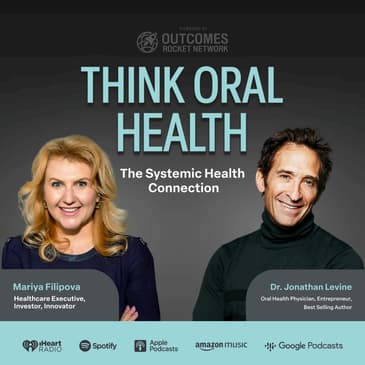
[00:00:31] Welcome to Think Oral. Where we connect the unconnected between oral and physical health. I'm your host, Dr. Jonathan Levine. And I'm your host, Maria Filipova. Let's get at it. Hello everyone, and welcome to another episode of the Think Oral Health Podcast,
[00:00:59] where as usual, I'm joined by my co-host and partner in troublemaking for good, Dr. Jonathan Levine. And today we have a really special treat for you. Due to popular demand, we are double-clicking on a topic that we started a couple of episodes ago. And today we're bringing one of our guests as a return, repeat attendance and a conversation partner. And so I'm very excited to let Jonathan introduce our guest for today.
[00:01:30] Fantastic. Maria, great to be here with you. And super excited to have Tina Saw, who is the CEO of Oral Genome. This Oral Genome company is incredibly innovative, and it's quite amazing that Tina Saw, who is really young to the profession, and would be so inspirational for young dentists, that really if you have a dream, you surround yourself with the right people, everything is possible.
[00:01:57] She has this complete commitment to dental-medical integration, and we're going to dig in a lot into what does Salivary Diagnostics, and what it entails to really get this out to the industry. She's the founder of Oral Genome. She's leading this charge here with Salivary Diagnostics, and using this new technology as an amazing screening tool, so that dentistry can be the tip of the spear for overall health.
[00:02:26] And we believe that it leads to overall health. And yes, we are troublemakers when it comes to care convergence. Welcome you here, Tina. Tina, welcome to the show again for a second time. Thank you for having me. I'm glad you invited me again. You're joining a very select group of people who've been on our podcast twice. So no pressure. But again, as I said, we've generated really good interest in the topic with our first conversation.
[00:02:53] And let's start with something that Jonathan shared. He called you young to the industry, young to dentistry. I don't know if I'm young to dentistry, but I'm definitely a dental transplant. I came from healthcare as well. And so I'm probably following that category for better or for worse. So Tina, tell us a little bit about your origin story, your personal why, and how did you find yourself in this place at this time making change and transforming an industry?
[00:03:23] Yeah, thank you. So I appreciate you calling me young in the industry because I don't feel that way. But I'll just put it out there. I have been a dentist for 11 years. I graduated in 2014. But the thing is, I went to dental school and I remember they asked me during my interview, why do you want to be a dentist? And I went there and I chose Loma Linda University and their whole model is make man whole.
[00:03:53] And I said, I want holistic care. I want to make man whole. I want to help with prevention. I want to have everybody have healthy smiles. All these things that I wanted to really do for people in my community. And so as I started going through dental school, you get into private practice. And then I was like, wait, we fix people's teeth, which is my job and we are trained. But why are we not putting prevention back into dentistry?
[00:04:23] And so that's been my story. I did a lot of oral systemic research while I was in college. It just always just piqued my interest. And as I started practicing, I started realizing too that we didn't really connect as much to physicians. The only time we connected with physicians was when they were asking for a clearance because the person had to go for cancer treatment or something or chemotherapy.
[00:04:49] That's when I talked to them or they needed antibiotic because they had something going on. Or at that time, I know it's changed, but knee replacements and having to talk to the physician and getting a consult. And so I was like, we aren't really bridging that much. And there's been a lot of those like big news and research about oral systemic health, how many diseases started in the mouth. But I was like, why can't we connect this all?
[00:05:14] And so hence that kind of journey towards how can we make that happen versus just talking about it? I love that you're just talking about it. Did you hear that? My favorite conversation. Right, Maria? That's right. What are we doing about all these great connections? Let's get into a little bit of what can dentists do today to enhance those connections? And that question is both to you and Jonathan, to both of you as clinicians on the phone.
[00:05:42] Well, the big follow to that really is there are other salivary diagnostic companies out there. And one of them's been around probably 10, 15 years. And it's a really terrific company that looks at oral DNA that looks at different microbiology of the microbiome and understanding all the way from bacteria to fungi to all of the invaders
[00:06:10] that are living healthy in the mouth, but are also pathogenic. But TEMA has done something very unique. And that's where we go to point of care. Because what does happen is that if we're getting reports that take up to two weeks or even more to get an answer, it's a little late. Because if you understand the flow in dentistry, you need, and also in medicine, you need that information as quick as possible. So then the question over to Tina is, Tina, how did you figure that out?
[00:06:39] So many people were trying, but you cracked the code on this. Tell us how you did that. So for me, it's not only the two week time, but also the biggest complaint I knew while in practice when I tried to get salivary testing done was affordability of it. And so I think that the way that we do things at Oral Genome is having an affordable test that
[00:07:05] can be done point of care, chair site, anywhere, and give you that information within 15 minutes. It fits within the workflow and it makes the patient happy. Thanks to Amazon, we actually want information and things now. And, but the way I would say we cracked the code is I love looking as an entrepreneur into other industries. How are they doing things? How are they better providing their patient care?
[00:07:33] And my story too is actually, I have two children. One, they've both been to the doctor, been sick. And I would witness all these chair site tests that could diagnose my child with flu, strep, a UTI, anything within that hour visit. And it was great because I walked back home to the pharmacy or knowing exactly what I needed to do at home for my child.
[00:08:01] And so in dentistry, I was like, why are we not doing this? Why are we not having point of care testing? I started looking at what are those technologies that they're doing? And then I started going, okay, let's bring that into dentistry. The technology we utilize here at Oral Genome is not a new thing that we built. Everything, our IP and everything we built, like the type of technology out there, but
[00:08:26] everything we focus our markers just on dentistry and developed the IP of our tests behind all those dental markers. A little bit about how the information you're getting from the salivary test informs treatment planning or decisions that dentists or oral health physicians or other members of the care team would make because of that information in their fingertips. Yeah.
[00:08:52] So the way I see dentistry right now, we've traditionally had the patient go in, take the x-rays into oral photos. Then you're going to do the perio charting and then checking all the, what I would say, like the carious lesions by putting your Explorer. Does it sink? Is it sticky? All that stuff. We're looking at that. But how we inform patients actually is we will look at different things like MMP8 levels. You have high MMP8 levels.
[00:09:19] There's a high chance that you have perio disease depending on the amount of MMP8 that you have. So we're using all this, we're pairing our test. So we're semi-quantifying how much of something like MMP8 you have. We have the clinician then pair it with the perio charting, with the x-rays, the bone loss, and we can actually help with that diagnosis of mild, moderate, severe periodontitis.
[00:09:44] And even having the clinician or the hygienist, dentist determine what else do we want to do to help this patient? Well, to prevent them from going from gingivitis to mild or moderate, whatever that severity is. And then we're also able to check if they've done treatment, has those bacterial levels gone down? Has those inflammatory enzymes gone down? All of those things. So that's what our test does.
[00:10:10] It provides progress and also checks and helps with that prevention and where you are on that scale. It is an objective tool that is going to help patients. And also there's something about patients seeing this on the tests. And we say it's optimal, poor, high. We try to really help with that terminology so a patient understands. And they're actually very motivated to do treatment because when I, for example, I get a lab test
[00:10:39] that's a blood test and I see, oh, this is elevated. I do have, you know, this type of condition and I need to go do something about it. So it's a very motivating tool for patients to see. And the dentist kind of brings it home and be like, yeah, we see all these things in your mouth also. And what it does, what's so interesting, Tina, please comment on the fact that not only MMP8, which is the salivary protein, which does indicate a certain level of inflammation in the mouth
[00:11:07] or in the body, but the genome, the bacteria propensity for decay, perio, take us through that. Also potentially high blood glucose levels, which then you can go to the next level of testing. So tell us a little bit about that because it's quite robust of what they're testing right away. That takes all about kind of 18 to 20 minutes to get results. Yeah, I know. MMP8 is one of those big talked about markers right now. There's lots of publications.
[00:11:35] We just got a publication last week about why MMP8, but we're looking at carries. So we're looking at pH, buffering capacity. We're looking at the level of proteins, your nitric oxide, your MMP8, your P gingivalis levels. And on top of that, we bring this outside of dentistry by doing glucose screening, because there's a lot of studies that are showing glucose in your saliva is very highly related to diabetes.
[00:12:00] And this is why a lot of the medical payers really like us is because we're able to catch these things really early. And if they're pre-diabetic, we can get them into early treatment and verify the diagnosis, all that stuff. And so what I'm going at is this kind of goes back to the oral systemic connections. It's not just about our job is talking about carries and perio, but we're just closing that loop and helping physicians also by referring our patients over to them.
[00:12:28] And what's interesting is we've seen a lot of the practices that do those referrals because they've done our testing. They actually get physicians referring back to their office new patients because they are doing this medical demo integration. There you go. There you go. So we deeply believe medicine and dentistry needs to have this connectivity. This is a new innovative tool to drive that because if you can get upstream in prevention,
[00:12:56] if we can get to, let's say, a high glucose level that's just starting and maybe pre-diabetic, then the physician or the dental office could be doing A1C testing to really understand, well, what really is, what are those levels? And all of a sudden, dentistry becomes part of the healthcare solution for us to be preventative. So Maria, what an amazing, amazing technology that's evolving. Yeah. And I appreciate the conversation because we talk a lot about what care convergence is,
[00:13:25] but we also don't talk about what care convergence isn't. And offering one new solution or a new supplement or a new service in your dental practice by itself is not care convergence. Unless you connect the dots back to the overall health of that patient and you're able to track progress and how the patient is responding to the treatment, right?
[00:13:48] And your example with pre-diabetics, unless you actually are able to then refer that patient to a program or give them resources about what to do, then you haven't really closed the loop. And I know that's actually the most frustrating and hardest part in the way we're set up as a care system today. But I know that I am dedicated my life and my career now in building and supporting solutions that make those transitions one click easy, as they call them, right? Yeah.
[00:14:16] And so that's what I love about the conversation because we're teasing out that next step of closing the loop at how important it is. But let's stay on that next step. Let's unpack that a little bit. So diabetes, right? The flow, if they go to a dental office and they have a high risk of potential pre-diabetic or diabetic, that has to go to the physician. It goes to the physician. And I have a diabetes patient.
[00:14:39] I want to make sure that they're having multiple cleanings because we understand the level of inflammatory disease and taking the immune response off its game because it gets overwhelmed because you have inflammation not only all over the body. Now you have an additional one for your mouth. So you need to have a healthy mouth. Same thing with pregnancy, gingivitis. So all of a sudden, the physician is starting to say, oh, we have to work with our dental colleagues. And the dental colleagues are saying we have to work with our medical colleagues.
[00:15:09] And together, we're going to have better outcomes, go upstream at diagnostics before they develop the systemic inflammatory, these very expensive diseases to treat. And we talk about this so much. So tell us a little bit, Tina, where do you want to see this go? What would be success where you're having an impact in the industry, where this is starting to become pervasive in a majority of the dental offices,
[00:15:38] whether it's insurance-based, whether it's fee-for-service? What would it look like for success for this profession of ours? I would say that I really believe salivary testing should be a standard of care. I think it's similar to how we are seeing CBCTs as something that needs to be routinely done prior to placement of every endo or every implant that's being done. This is one of those things that we should be doing.
[00:16:08] Just like I always, I said, I look at other industries, medicine. They're doing an annual blood testing on everybody. Why are we not doing this? Why are we catching everything after it happens? Like, we shouldn't be a reactive profession. We need to be a preventive profession. I know we've been trying so hard as a profession to connect with physicians and physicians want to connect with us. But here we are. We actually have something to connect about because now we know,
[00:16:39] okay, we're flagged with high PG, which is actually also in this systemic condition. And we know where to do a referral. We can't just have the patient call their physician and be like, oh, my doctor didn't just sell something in the mouth. She thinks or he thinks and maybe this. We actually have a test that's actually connecting those dots. And we have something that the physician knows then what to test for
[00:17:06] to go to the next level and get them better to whatever that whole care is. And I think in the perfect world, I want us to, we're a first world country. I want us to be one of the healthiest populations ever. I think there's a lot of advanced technology out there that can really get us there. And I'd really like to see the decrease of costs in overall long-term care overall for our U.S. Right, exactly.
[00:17:32] And it's with all of the innovation that we have in this country and all the money we spend from a standpoint of health care being 20% of our GDP of this country, it's overwhelming. So to be proactive and to get upstream with diagnostics through our dental professional offices, we always talk about this, Tina. We say that people go to the dental office more than they go to their primary care physician. That's absolute fact. So you're right. If it's a standard of care, we now can work collaboratively.
[00:18:00] And we know how many of these systemic inflammatory diseases oftentimes either are exacerbated, what's happening in the mouth or start in the mouth as we find the biggest pathogen, P. gingivalis, in the carotid artery or cardiovascular disease, pancreas or pancreatic cancers, interstitial cells of leaky gut, amyloid plaque on Alzheimer's, on cognitive function, on and on.
[00:18:26] So as you are moving this forward, there's some great trends. Maria, you know so much about this, American Dental Associations, insurance companies, thinking about how do we take these new technologies to the industry? What would you like to see happen? And tell us a little bit of what's been breaking for your company just of recent. Yeah, let's do a quick call to action, invitation. As Jonathan called them, we don't call them call to action. It's an invitation.
[00:18:52] What invitation would you like to extend to benefits managers, providers, patients? What is your invitation for them? I think the least expensive thing actually out there is prevention. And so I try to tell people, you spend under $100 per patient. Actually, to be honest, our test is about $55 to $65 right now. You spend that much upfront.
[00:19:21] You look at the long-term savings. So the call to action is really think ahead of the curve. Like what are upfront ways to help people get them to have better managed care? And just in general, just be like healthier people. And we're just moving in this all together. We really got to think, I say, outside of the box because what we've been doing for years and years is not working.
[00:19:49] It's time to shift and adopt and utilize technologies like ours out there to really help more people get to a healthy state. I mean, that's spot on. I'll probably join you in the invitation to keep connecting dots because I don't think there's shortage of solutions. But to Jonathan's example about the diabetic patients, and we spend hundreds of billions of dollars on diabetes alone in this country.
[00:20:17] And so if all we do is find those diabetic patients or high-risk pre-diabetic patients and focus on maximizing their dental, they just need to get to the dentist. Don't do anything different. I would love to give them extra cleanings. That would be customization and personalization. But at minimum, let's focus on getting them to a dentist because vast majority of them don't even go to max out their dental benefits that they have available.
[00:20:43] And so that would be my invitation to even continue to, you know, drum that same drumbeat of the connections. And we see that A1Cs do go down when patients make it to the dental office, all else equal. So if you don't want to get on the treadmill or cut down on your sugar, go to the dentist. You heard it here first. Well, and Marie, it makes just such a great point.
[00:21:09] We diagnose, and then based on that diagnosis, now we have this enhanced tool, right? Whether it's the patient had too much decay, gum inflammation, they're on their way to be potentially pre-diabetic. Their nutrition is not great. All of a sudden, we have a test. You're at high risk for a few of these things. Amazing. Then we put our solutions into place, whether it's our periodontal type therapy, our soft tissue management. Maybe we discovered the glucose problem.
[00:21:39] You made the referral to the physician and things are getting under control. And now you're testing again. Inflammatory markers are down. Your bacteria profile looks so much healthier. So here we have this technology that really can be enhancing our ability to not only diagnose, but to treat. And really, underneath that line, we have oral health lead to overall health. And we really believe that. So, Tina, you got to keep going.
[00:22:05] And companies like yours are going to be leading the charge of new technology. But if I could, Maria, can I do this? Can I switch gears for a second? You could. If you could do it in 30 seconds. This is a bite-sized. Okay. Here's my big... But I think for everybody listening. Yes. Tina saw... And I'm sorry. I'm 10 years in dentistry. In my world as a young dentist. And I mean young as incredible compliment to you.
[00:22:31] But the great compliment is you're balancing career, family, children, husband, all of it. Two children. Tell the listeners, how are you doing it, Tina? Because you're starting a company. It's taking off. There's so much to do. You got to build your team. It's like every day is a new whatever. 10 things. Tell us how you're doing it. Multiple time jobs all at once. Yes.
[00:22:58] It's actually coming down to the right team of people who firmly believe in the product. It's your team and your advisors and the support system who are willing to work hard because they believe in the mission that you're after. And I would feel like... I know I've come a long way and I have to say I don't like to pat myself on the back, but I recently just had to step aside and be like,
[00:23:25] okay, we actually made this product actually happen, made an affordable screener. But what really got me there was really, truly the scientists, the engineers, and also the passionate dental team that was wanting to move this forward. I'm also really excited that the American Dental Association has really supported us through
[00:23:49] our mission into what we're doing to really build, bring this into multiple places and bring value-based care, helping underserved communities with this affordable type of screening. And I just really think that the reason why I've come is not because I've did it alone. It's really the support of the people behind everything. A team at home and a team at the office, right? You need to help. That's it.
[00:24:16] It's how we surround, who we surround ourselves with and the who on that equation. Good for you and amazing kudos for setting a North Star for your team of this is where we're going. We want to make this a standard of care in dentistry. That is a great vision and really connecting the dots of our profession. So, Maria, there it is. There it is. Well, I'm grateful for surrounding myself with the two of you today, this afternoon,
[00:24:43] because that's very telling on, I think, where the industry is going to go. Tina, we will share with our listeners ways they could get in touch with you and ways patients could ask their doctors about salivary diagnostics or screenings. And dentists looking to be leaders in that field could get in touch and give it a try, too. So that's our bite-sized episode for today. And we can't wait to see what you do next. Sounds good.
[00:25:12] Thank you so much for having me. Thank you, Tina. And thank you, Maria. Thanks for listening to the Think Oral podcast. For the show notes and resources from today's podcast, visit us at www.outcomesrocket.health slash think oral. Or start a conversation with us on social media.
[00:25:41] Until then, keep smiling. And connecting care. This podcast is produced by Outcomes Rocket, your healthcare-exclusive digital marketing agency. Outcomes Rocket exists to help healthcare organizations like yours to maximize their impact and accelerate growth.
[00:26:09] Visit outcomesrocket.com or text us at 312-224-9945.