
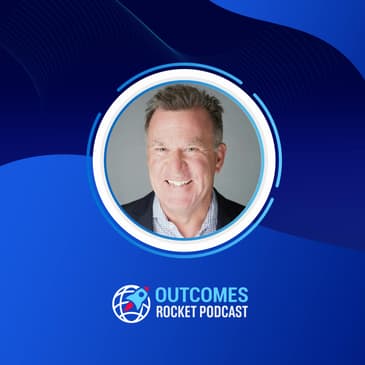
Curae's financial solutions and technology tackle patient debt and enhance healthcare satisfaction.
In this episode, we meet Gary Johnson, Chief Growth Officer of Curae, who shares his extensive experience in healthcare marketing and revenue cycle management. He discusses the challenges of patient bad debt and uncompensated care, highlighting how Curae's innovative financial solutions help healthcare providers and patients navigate the complexities of healthcare costs. Gary also emphasizes the importance of technology in improving revenue cycle processes and encourages healthcare providers to strive for better financial outcomes and patient satisfaction.
Tune in to discover how Curae’s innovative financial solutions are transforming healthcare costs and improving patient satisfaction!
Resources:
[00:00:02] Hey everybody, welcome back to the Outcomes Rocket. So excited you tuned in to another episode of our podcast. Today I have the privilege of hosting the amazing Gary Johnson. I've known Gary for a few years now. Just to introduce him to you all, he's a sales and marketing executive focused on driving growth within the healthcare space on the B2B, B2C, software as a service side.
[00:00:29] He is serving as the Chief Growth Officer of Curae. They're a company that's focused on financial solutions that help patients and providers improve access and also health. So with that, I'm super excited to have you on the podcast, Gary, and I'm so glad that you could join us.
[00:00:51] Thank you. Thanks for that intro. Very kind and not deserved, but looking forward to our chat today.
[00:00:58] Yeah, likewise, Gary. And look, you had quite the experience in healthcare, serving in different companies, and you have a really unique perspective. So talk to us about what got you into the business of healthcare and why you do what you do.
[00:01:15] Yeah. Well, I've been in marketing, leadership, product management, brand management, starting right out of school with Kimberly Clark.
[00:01:26] It was consumer packaged goods. So big brands like Kleenex and Huggies diapers and Kotex and launch dependent continents products and then worked in a lot of different consumer packaged goods,
[00:01:41] OTCs and pharmaceuticals, and then I came back to Kimberly Clark.
[00:01:48] And then I came back to Kimberly Clark and Kimberly Clark also had a very large healthcare division, medical devices, protective apparel, basically everything that the professionals are wearing in a cath lab or an operating room, head to toe, and some other things.
[00:02:03] And I just, I loved healthcare. And then I moved into more of the business side of healthcare, revenue cycle management, supply chain.
[00:02:12] And that's when I really became jazzed about, there's a whole another side of healthcare that there's the clinical side, of course, is incredibly important.
[00:02:21] But then there's a business side in the U.S. healthcare system where it's just hard for patients to afford care.
[00:02:29] You're going to have insurance and healthcare providers to get paid accurately and timely and to collect payments from patients.
[00:02:36] And I just, I enjoy being in that space now because it's almost like, it feels like giving back in helping solve these problems for patients and providers.
[00:02:46] I love that. Yeah. And it's always interesting how people end up in healthcare for you.
[00:02:51] You were with the consumer company, but as we all know, healthcare is not a vertical, it's a horizontal.
[00:02:59] And so you definitely got introduced to it, got the bug and have had an amazing career in it.
[00:03:06] So talk to us a little bit about what you're up to at Curate.
[00:03:11] We had a chance to meet at the HFMA conference. That was a lot of fun.
[00:03:14] Talk to us about what you guys are doing there.
[00:03:17] Yeah. One of the big issues in healthcare is that the patient, people like you and I,
[00:03:24] we are now the third largest source of revenue for healthcare providers.
[00:03:30] And in some cases, some health systems were the second largest.
[00:03:34] And so you've got commercial payers and you've got government with Medicare and Medicaid,
[00:03:39] but because of, we shifted to high deductible health plans, started that a number of years ago, right?
[00:03:45] And that moved a lot more of the cost of healthcare onto the shoulders of employees through commercial insurance,
[00:03:52] their employer-sponsored insurance, or even ACA plans.
[00:03:56] But what that did is it meant that a lot of people have, let's say for a family of four,
[00:04:02] they have health insurance, high deductible plan.
[00:04:05] This year, their deductible could be over $16,000 before they've used healthcare.
[00:04:11] And they've already been paying $1,000 a month in gross dollars in monthly insurance premiums.
[00:04:18] And they haven't used healthcare yet.
[00:04:19] And then they have an unplanned event, as many healthcare events are.
[00:04:25] They're not planned. It's a bit of a surprise.
[00:04:28] And so, oh, by the way, you have a patient responsibility of $5,000, $8,000, or even larger.
[00:04:36] And so, what we do at Curate, we help healthcare providers begin to take on that problem of the escalating patient bad debt or uncompensated care.
[00:04:49] And as we know, healthcare providers, specifically not-for-profit tax status, they have charity care.
[00:04:56] It's part of their responsibility and their community benefit each year.
[00:05:00] They file a Form 990. But over and above that, they have all this other care they're providing that's not charity care.
[00:05:08] It doesn't count towards a community benefit because they've already met it.
[00:05:11] And it's just, it's like running a restaurant and randomly you choose tables each night and you go,
[00:05:18] these ones don't need to pay. And we'll try to figure it out later.
[00:05:22] Well, that's not a good approach.
[00:05:23] So what we do, we help attack patient bad debt really through three things.
[00:05:28] One is we do insurance discovery with new technology that's just way beyond anything else in the market.
[00:05:35] And so when you go for an appointment and you're scheduled, often they ask for ID and they ask for an insurance card.
[00:05:41] And the person is literally logging into a clearinghouse to confirm, yep, you have ABC health insurance.
[00:05:48] It's a PPO and you have a deductible of X that you've met and the copay today is Y dollars.
[00:05:56] Often though, when they go through that clearinghouse, that software on the other side by a vendor is yesterday's technology.
[00:06:02] It'll miss the insurance that's available actually in place at the time of service.
[00:06:06] So we will rerun all those so-called self-pay patients that they couldn't find insurance.
[00:06:13] We'll find 20 to 30 percent of them actually had insurance at time of service and you can refile it before it goes off timely filing.
[00:06:22] Second thing is that task that I just explained also enables us to identify patients that are actually eligible for Medicaid and will hold their hand and get them enrolled.
[00:06:34] Also, it identifies patients eligible for ACA plans, subsidized plans, and we'll get them enrolled.
[00:06:41] We'll hold their hand.
[00:06:41] We'll even provide funding to the patient to help support their monthly premiums.
[00:06:46] Totally up to the patient to choose which health care provider and which plan.
[00:06:51] But often they go with who they're already a patient or record.
[00:06:54] And then the third and final, even after someone has a so-called rich employer-sponsored insurance plan, they still have balances after the fact.
[00:07:05] And most people, studies are showing most households don't have $600 of free cash sitting around for an unexpected event.
[00:07:14] How would they ever pay for $3,000, $4,000, $5,000?
[00:07:18] And that's where we come in with 0% interest line of credit for the patient.
[00:07:23] It's underwritten for the individual patient.
[00:07:26] It's a revolving line of credit.
[00:07:28] It's 0% interest.
[00:07:30] We pay the provider off in full in 48 hours.
[00:07:33] The patient doesn't pay interest.
[00:07:36] They don't pay fees.
[00:07:37] There's no balloon payments.
[00:07:38] We don't sell their debt.
[00:07:40] And it's non-recourse.
[00:07:41] So those are basically the three major components to our platform.
[00:07:46] And that will greatly reduce health systems, patient bad debt by typically 20% by the end of the first year.
[00:07:53] We'll double their collections from patients at the time of scheduling over current rate.
[00:07:58] And we see net promoter scores jumping by 20 to 30 points.
[00:08:04] Patients love it.
[00:08:05] It's more Amazon-like.
[00:08:06] It's consumer-like.
[00:08:08] And offer financing.
[00:08:09] The reason we're able to do this, we're taking technology and practices used in the retail industry, Home Depot, rooms to go, car dealerships.
[00:08:20] And we're able to use that technology to run algorithms to set the right funding and underwriting fee for 95% plus of patients that apply.
[00:08:31] And we're applying it to the healthcare space.
[00:08:33] And that in a nutshell is what we do.
[00:08:36] And clients are very happy.
[00:08:37] Patients are happy.
[00:08:38] Well, that's fantastic, Gary.
[00:08:41] And so on the one hand, helping providers identify missed insurance plans so they could cover that.
[00:08:51] So you help the patient and the provider in that instance.
[00:08:54] On the other hand, helping people that could get coverage, get the coverage they need, like Medicare, Medicaid, ACA plans.
[00:09:04] And then finally, when there's that gap, you're helping them fund with 0% interest.
[00:09:10] That pretty much covers it all.
[00:09:13] It does.
[00:09:13] And when you dig into the data, here's what's alarming.
[00:09:16] I was just at a conference a couple weeks ago.
[00:09:18] And there was about 200 health systems represented.
[00:09:22] Where'd you go?
[00:09:23] Which one was it?
[00:09:24] It was the PN Conference in Miami.
[00:09:26] Oh, okay.
[00:09:27] Healthcare Partnership Network.
[00:09:28] Oh, yeah, yeah.
[00:09:29] It was their second year running.
[00:09:31] Great conference.
[00:09:32] A lot of impressive leaders.
[00:09:33] Not just in revenue cycle or finance.
[00:09:36] They had folks from that area, but they also had chief medical officers, chief nursing officers, COOs, heads of emergency medicine.
[00:09:44] Check that one out.
[00:09:45] But they were one of the issues, and we got to do a presentation, a case study around what our clients are doing, is that these health systems are recognizing this is a trend line that's very uncomfortable.
[00:09:58] The size of patient bad debt that they're carrying on their books is increasing at a double digit rate year over year.
[00:10:05] They don't seem to have a means of controlling it and slowing it.
[00:10:10] If you look at the stats, patients with balances of $7,500 is up 300% versus a year ago.
[00:10:20] So at this conference, you know, you got the cross section of these leaders of different functional departments.
[00:10:25] But one is they're hearing from all their frontline clinical staff, as well as patient financial navigators, people who do the check-in at the front desk.
[00:10:36] Are you here for your appointment?
[00:10:37] Let me check.
[00:10:38] They're hearing from patients the anxiety that they're unprepared to pay for whatever is their portion.
[00:10:45] And as a result, clinicians are saying, basically, I got patients that have chronic diseases.
[00:10:52] I need to see them every month, every two months.
[00:10:55] They're not coming in.
[00:10:56] They're disengaging.
[00:10:57] They are abandoning care.
[00:10:59] And that's a problem, right?
[00:11:01] That's a problem.
[00:11:01] The second thing is it's occurring is that patients at the time that they are being diagnosed, you know, often let's say it's in oncology because there was one health system there that spoke very boldly about oncology care and infusion centers.
[00:11:18] So they said that basically, hey, the best care in many cases involves pharmaceuticals.
[00:11:26] They've been approved by FDA, but they're new.
[00:11:29] And commercial health insurance may not have approved it.
[00:11:32] They may deem it as medically unnecessary.
[00:11:35] Use the drug that was popular in the past.
[00:11:38] And yet the cost of this new drug, it may be $50,000, $70,000, $80,000.
[00:11:45] And when patients are faced with that, especially with something like oncology, they may choose to walk away from care.
[00:11:54] They don't want to spend their kids' inheritance.
[00:11:56] And so you've got to find ways to fund it.
[00:12:00] And that's what we do.
[00:12:01] We tap into philanthropic organizations as well.
[00:12:04] So drug charities, most of the pharmaceutical companies have foundations.
[00:12:09] They'll subsidize the cost of the drugs.
[00:12:11] They'll cover other out-of-pocket expenses.
[00:12:14] So that's also a big part of what we do.
[00:12:17] That's great, Gary.
[00:12:18] That's awesome.
[00:12:19] And when people are in that tough time and their insurance plan refuses to pay, that's a terrible situation.
[00:12:28] And it's nice to know that you guys are making an impact and some inroads for people to have options instead of just being stuck with, like you said, choosing between their savings, kids' inheritance, and their life.
[00:12:42] Like what a terrible choice they have to make.
[00:12:45] So I think that's really great.
[00:12:47] And there's a lot of firms out there offering different things in the rep cycle space.
[00:12:53] What would you say differentiates you guys?
[00:12:55] I think two things.
[00:12:57] One is technology.
[00:12:59] Technology is constantly evolving, whether you're looking at the power of semiconductors and that law where it multiplies by 10 every so many years or whatever.
[00:13:09] Technology is constantly improving, replacing yesterday's technology.
[00:13:13] I mean, look at what we have today in imaging.
[00:13:15] We can detect cancer cells at a point in time far earlier than what we could five years ago, 10 years ago, and then begin therapies.
[00:13:24] Well, this is the same thing.
[00:13:26] So we have new technology, very sophisticated.
[00:13:29] This is why we do the insurance discovery in a superior way versus others.
[00:13:33] We also provide our technology to the workflows that we work in working with health systems.
[00:13:41] Think about your Six Sigma philosophy and approach to workflows, right?
[00:13:49] An error on the front end at the very early front end will multiply by 10, 100, or 1,000 through to the back end in magnifying the impact of that mistake.
[00:13:59] Well, if you miss insurance on the front end, at the very front end, and you accidentally assign a patient to the self-pay category, self-pay, uninsured, they're going to be treated differently.
[00:14:12] And the bill is going to be treated differently.
[00:14:14] And maybe even the path of care could be treated differently, depending on where they go.
[00:14:19] And look at the extra effort that you have to go through when, in fact, oh, you find that they do have insurance maybe halfway through the revenue cycle process.
[00:14:26] Now you go back and you've got to rebuild, refile to the insurance carrier.
[00:14:31] And it's always going to be complicated.
[00:14:33] So you've added much more cost and time to the overall piece.
[00:14:37] So by reengineering the workflow processes, it's textbook workflow improvement, reducing errors on the front end.
[00:14:45] And as part of that is bringing the know-how.
[00:14:48] Because I got to tell you, our parent company is one of the largest consumer credit processors in the United States.
[00:14:54] And they manage and run the consumer credit program for one of the biggest big box retailers.
[00:15:04] And when that retailer says, I would like every consumer that walks through the door to qualify for financing, whether they want to buy $8,000 worth of appliances or building supplies, can you make that happen?
[00:15:17] And they figured out how.
[00:15:20] It's in the underwriting.
[00:15:21] It's an insurance pool model.
[00:15:23] You got to have a lot of consumers going through it.
[00:15:26] And we applied that same model so that you could get 95% plus of people that apply.
[00:15:32] They do, in fact, qualify.
[00:15:35] You change the underwriting fee because obviously the risk is different and the risk that we take is different.
[00:15:40] But at the end of the day, the patient gets a means to afford care.
[00:15:45] And the health care provider gets paid for the portion that the patient is responsible for.
[00:15:50] Less an underwriting fee.
[00:15:51] But their alternative is often get paid zero.
[00:15:55] And as one of our clients always reminds me, he says, zero is not a good multiplier.
[00:15:59] So I'd rather have a large portion of that.
[00:16:02] I think we could all agree on that one, Gary, for sure.
[00:16:06] And I appreciate your perspective on the matter.
[00:16:10] Building companies, growing them, it's not easy.
[00:16:14] So one of the things that we like to cover on the podcast is challenges and setbacks.
[00:16:21] So if you had to think of a setback you had with the company or the companies had, what is it?
[00:16:29] And what's been a big forward step that you've been able to take as a result of overcoming it?
[00:16:34] Yeah.
[00:16:36] No, it's a good question.
[00:16:38] And this is not necessarily a setback, but it's definitely an obstacle.
[00:16:42] And it's a reality in health care space today.
[00:16:45] So let's say we meet with a senior executive over finance and revenue cycle.
[00:16:52] And we pull their data, both the public data.
[00:16:56] They also get a data spec.
[00:16:58] We run a file on all their self-pay today and their payer mix.
[00:17:03] And also we project to they have a payment program.
[00:17:07] Most health systems have some kind of a homegrown payment program that they're trying to manage as well.
[00:17:11] They're trying to be in the banking business.
[00:17:13] We'll run all of that.
[00:17:14] And if there are, let's say there are health care system of four to five billion dollars a year in net patient revenue,
[00:17:21] which is about a medium to large.
[00:17:24] There are many that are much larger and many more in the three to five.
[00:17:28] But let's say there are four to five billion.
[00:17:30] Their net improvement of which we would project, and it's very conservative.
[00:17:34] And we have data that we reverse engineered into building this model.
[00:17:39] We used our actual clients data and their results because we have many that are several years in.
[00:17:44] That net improvement of new revenue will be in the range of 50 to 100 million dollars per year.
[00:17:53] That's a large number because their bottom line may only be 50 million to 80 million a year.
[00:18:00] So it's an effect could double if they let it flow through to the bottom line.
[00:18:03] But they need cash.
[00:18:05] To answer your question, the setback, we're shocked that many times the person in charge will say,
[00:18:10] I can't show that number to my leadership group.
[00:18:14] Why not?
[00:18:15] Because they think we've been incompetent and been running a bad ship inside revenue sector.
[00:18:21] And it's a surprising reaction.
[00:18:24] But people have told me revenue cycle is a tough space to be in.
[00:18:28] And you're putting out a lot of fires and issues and claims are denied and it's hard to solve things.
[00:18:34] So people are a little bit on the defense.
[00:18:36] Yeah.
[00:18:36] So what we've had to do, we coach people.
[00:18:38] We say, Liz, you're going to have to narrate the story that this isn't about finding errors or incompetency.
[00:18:46] This is about new technology, new workflows and approaches that you couldn't possibly have identified these opportunities.
[00:18:55] And these are new and over and above opportunities over whatever you're working on today.
[00:19:01] And it's real.
[00:19:02] It's real in terms of the dollars.
[00:19:05] And here's our list of references you can speak to.
[00:19:07] But we've had to help them and coach that because on one hand, they're afraid that they're afraid to bring it forward.
[00:19:14] Yet we've had others who are brave, particularly if they're in the role less than a year and they were brought in to make change.
[00:19:22] And they seem to have more of a political license in the organization to say, here's what I found.
[00:19:27] And we're all overhauling this.
[00:19:29] And here's the new improvement.
[00:19:30] They're gung ho and they're going 100 miles an hour.
[00:19:32] So we've had to learn how to help our champions and some of the influencers to navigate this recommendation.
[00:19:42] Sometimes we help them put together their own business case.
[00:19:45] And it's how to do it in a way that's safe.
[00:19:48] And yet they get the benefit.
[00:19:50] They get the financial benefit right away in the first year.
[00:19:53] That's great, Gary.
[00:19:54] And it reminds me of a quote that yesterday's systems won't serve you today or in the future.
[00:20:01] And today's systems won't serve you in the future.
[00:20:04] And this is just a really great paradigm to look at it through.
[00:20:10] It's what we have had in the past didn't allow us.
[00:20:15] And now what we have today, we can do it.
[00:20:18] So I think that's a really great paradigm.
[00:20:20] It's great that you're partnering with organizations the way you guys are, even helping them put together their cases.
[00:20:26] I want to give you and the team kudos for the approach.
[00:20:29] I think it's a very seasoned one and one that is much needed.
[00:20:34] So kudos there.
[00:20:35] A lot of the things that we chat about on the podcast can make a huge difference for organizations listening and watching.
[00:20:42] What call to action would you leave people with as we close up here?
[00:20:46] And then where's the best place that they could reach out to you and the curate team?
[00:20:51] I would say the call to action specifically about patient bad debt, uncompensated care.
[00:20:57] Because I've heard this directly when I've asked folks and I've told data.
[00:21:01] We run a model basically on their data in their form 990.
[00:21:05] It's enough information and some payer mix.
[00:21:08] We can run a model and we say, hey, we can reduce your patient bad debt from its current number and bring in 50 million, 80 million.
[00:21:17] And I got a lot of problems.
[00:21:19] And I guess this is as good as it gets for patient bad debt and uncompensated care.
[00:21:24] And I would say the call to action is no, it isn't.
[00:21:27] Actually, you're in the lower half.
[00:21:30] If we're ranking health care providers and we're actually building a model right now, we will be ranking health care systems based on revenue cycle size and patient bad debt, uncompensated care.
[00:21:41] So people can score themselves versus the other health systems that are truly leading in using technology and leaning into this patient bad debt problem.
[00:21:52] You're not doing great.
[00:21:54] You can do far better and you're going to have happier patients.
[00:21:58] You're going to be the brand of choice in your market.
[00:22:00] You're going to be more consumer like and friendly.
[00:22:03] And that's great for market share.
[00:22:05] But that's what I would give as the call to action is don't be satisfied with patient bad debt of three, four, five, six percent of net patient revenue.
[00:22:13] Don't be satisfied.
[00:22:15] That's terrible.
[00:22:16] And a capital reinvestable business that eats capital every year.
[00:22:20] You just can't afford to do that.
[00:22:22] And the way to get connected, LinkedIn is probably the best way.
[00:22:26] I'm routinely posting and reposting other people's content and weighing in on things, but people can get in touch with me that way.
[00:22:33] But we would love to help people.
[00:22:35] Multi-hospital systems.
[00:22:37] It doesn't matter if you're in an expansion state or non-expansion state.
[00:22:41] We can help you all the same.
[00:22:43] And wherever your performance level is today, we can make it even better.
[00:22:48] Gary, that's fantastic.
[00:22:49] Really appreciate that close.
[00:22:51] Let's not accept what we're getting today.
[00:22:54] Let's expect more.
[00:22:57] Because it's possible.
[00:22:59] And as Gary shared, with the technology that Curie has, what was not possible yesterday is possible today.
[00:23:06] So take advantage of his call to action.
[00:23:08] In the show notes, we're going to leave his LinkedIn profile so you can get in touch with them, as well as links to Curie and ways to get in touch with the team over there.
[00:23:18] So appreciate everybody tuning in.
[00:23:20] The best way you make use of today's information is by taking action.
[00:23:25] So I encourage you guys to take action on what Gary has here.
[00:23:29] And Gary, thanks for spending time with us.
[00:23:32] This has been a true pleasure.
[00:23:34] Thank you, Saul.
[00:23:35] It's terrific.
[00:23:37] Love your podcast.
[00:23:37] Love your podcast.
[00:23:37] Love your podcast.
[00:23:37] Love your podcast.