
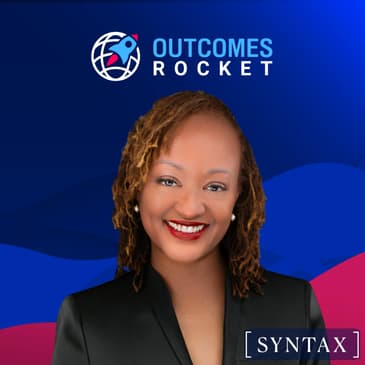
Value-based care works best when payers and providers have the transparency, data, and shared understanding needed to succeed together.
In this episode, Rachael Jones, Founder and CEO of Syntax Health, now part of Lightbeam Health Solutions, talks about simplifying the financial complexities of value-based care. Rachael explains how Syntax combines contract modeling, performance analysis, and actuarial science to help healthcare organizations understand risk and determine their true earning potential. She also discusses why community health centers deserve a stronger position in value-based care conversations, how clearer information can improve payer-provider collaboration, and why every additional dollar earned can help these organizations better serve their communities.
Tune in to learn how actuarial intelligence and greater transparency can help community health centers maximize value-based care opportunities!
Resources:
[00:00:03] Hello everyone and welcome back to the Outcomes Rocket, reporting live here from CHI 26 in Las Vegas. I have the pleasure of hosting Rachael Jones with us today. She is the Founder and CEO at Syntax. They are a Lightbeam company. We're going to share with you guys all about Syntax, Lightbeam, the whole relationship there and community health is the focus. So Rachael, thank you so much for joining us.
[00:00:28] Yeah, my pleasure. I'm super excited to be here. Yeah, so we were chatting a little bit before a hidden record, just kind of like the history, but tell us a little bit about you. Yeah. What got you into healthcare? What keeps you in healthcare? Don't we have enough time for all of that. I've been in healthcare my entire career. I was actually pre-med and decided to go to grad school. Oh, you were? Okay.
[00:00:58] Oh, wow. And then got pulled into the dark side, as they say, the healthcare payer side and spent my entire career between healthcare organizations and vendor organizations. So working at a scale, I'm obsessed with solving problems at a system level. So working for software companies like Lightbeam now and in the past, Cotivity and other places allowed me to see how you can solve problems at scale. But I also have a really practical need to see the application of those solutions.
[00:01:24] So I've been drawn back to the health plan and provider side to see how those solutions hit boots on the ground, right? That's great. And having that mix of real world experience and also innovation and technology has kind of been the thread through my career. Yeah. And being close to how the work gets done. When the action happens, was it was from Hamilton in the room where it happens, right? That's right. That's right. I think so much. I love that, by the way. Yeah. I took my nine-year-old to it. We saw it too. Oh my gosh. Incredible. It's literally on our playlist.
[00:01:53] I was just going to say every now and then driving, it'll pop up. Sophia. So good. I love it. But you asked about why healthcare. There's few industries that day-to-day, it changes, right? Day-to-day, what you're worried about, what is happening, what is the policy. There's never a dull moment. You will not get bored in healthcare because there's always new problems to tackle.
[00:02:21] And innovation is happening at the speed of light. As soon as you think you have the answer, something else changes and you have to respond to that. So I think for someone who is fascinated by problems and how to impact and make a positive impact at scale, there's no better place to do that than in healthcare. Oh, I'm with you. A hundred percent of the way there. And so share a little bit more with me about syntax. Yeah. Yes. As part of my career journey, I spent about 15 years focused specifically on value-based care.
[00:02:51] I had the pleasure of leading Anthem, now Elevance's value-based care analytics organization. Oh, I did not know that. That's super cool. Thank you. I also led the risk analytics team to Health First in New York. Wow. And so I had this experience supporting payers and providers and trying to come together in a risk-based, value-based care agreement and setting. And I saw firsthand how difficult it was. Value-based care is a very different kind of reimbursement model, as you know. You're looking backwards at historical data to understand what might happen in the future.
[00:03:21] And then you're having a handshake agreement on, if you hit these benchmarks, here is how much of the incentive I might share with you as the payer. There's so much that goes into that. And if you don't have the right data, if you don't have the right understanding of the terms, it's not transparent. If it's not collaborative versus friction-based, it can be a disaster.
[00:03:40] And so about three and a half years ago, almost four years ago now, a company called Redesign Health, which is a venture studio that starts and incubates new innovation, reached out to me and said, hey, we have an idea about starting a company that's going to do something a little different in the value-based care space and fill the gap of infrastructure and tooling. If you know anything about value-based care, you know that the folks on the financial side are basically living off of spreadsheets and prayers. It's back of the envelope math.
[00:04:09] It's death by a thousand cuts and version control nightmares and Excel spreadsheets to try to figure out this complex math. And the thought process was, could there be a better way? Could you create software that could automate the modeling process, the performance analysis process for folks who are in value-based care deals? And could you do it in a way that infused actuarial science? Because the whole process of value-based care arrangements is sharing risk. Yeah. And that's an actuary's job. It's an actuary's job.
[00:04:39] Project out what is the likelihood of this risk profile given the membership mix, the timing, all these different things. So my first call was to my co-founder, Emily Walker, Johns Emily, who worked with me at Anthem. And I said, hey, I think I want to do this thing. I think we should try to see if we can solve this problem and build the thing we always wanted. Wow. So Syntax came out of our desire to build something that we wish we had when we had a responsibility for these big jobs of managing these programs.
[00:05:06] And we built a platform from the ground up and started to work with community health center clients as one of our first client profiles and was just blown away with how much we could add value for this particular provider segment. Because CHCs are at the heart of value-based care. They live and breathe primary care models by design. But unfortunately, they're usually the last to be considered. They get the crumbs in the value-based care conversation, right?
[00:05:35] The large medical groups, the large systems command most of that attention to the payer because of who they are, the brand name, the market share. What you think about what CHCs are doing, that's really where care is happening. It's in those communities with the underserved, with the most vulnerable, with moms and with babies.
[00:05:53] And so for us to be able to help CHCs understand their own earning potential, understand the power they have based on their quality performance and their contribution to the payer's overall profile, it's been a rewarding experience. And so we got started with that about three and a half years ago and continued to grow with a number of provider clients, CHC clients. And then in December of last year, we were approached by Lightbeam. And the partnership made so much sense.
[00:06:19] If you don't know Lightbeam, Lightbeam focuses on population health, analytics, data, quality, clinical gaps, closure, risk. And it was such a perfect complement as we focused on the financial and actuarial side. They focused on the population health side together to get that end-to-end. Correct. Yeah. So it's been a great experience. And I'm most intrigued by the actuarial layer. Yeah.
[00:06:43] Just because that does, in my view, but you'll correct me if I'm wrong, it adds that rigor, that mathematical rigor that is better for all parties involved. I don't know if I paid you to say that, Sarah. That is 100,000% true. It just makes sense. How many times we've sat with both payers and providers who make these assumptions that one plus one equals two. And that's not always the case in value-based care.
[00:07:10] Because so much can change between when you thought you had this model design versus what's actually happening now, nine months into a measurement period. And you're always having to re-up and refresh and reproject what truth looks like now, given the different factors at play. That's one piece. The other piece is that we love to say in one of our taglines was order of operations matters, right? The math matters.
[00:07:35] Because in the value-based care setting, how the dollars flow really depends on how that contract is set up. It starts with attribution, with the belly buttons that you have responsibility for. But then so many different... By the way, if I can, and that in itself is a challenge. Oh, my God. With provider data quality, like... Pay on just attribution alone. Yeah. Yeah. So number one, can I get the attribution right? First and foremost. Are my members? And do I have the right mix? Do I have adverse selection going on?
[00:08:04] Do I have the right people on the bus that I have responsibility for? Then what is the order of operations as dictated by that contract term? So many people don't even read their contracts, or they read that one exhibit, but don't read all the paragraphs behind it. So a big part of what we did in Syntax was to automate all of that math, right? All of those different terms and paragraphs of policy have impact on how that contract is priced. What comes first? First dollar, second dollar stop law.
[00:08:34] What's excluded? What's included? What actually gets billed back to medical costs versus carved out for admin? All those pieces ultimately impact how much that provider can even earn. So a lot of times we'll have a conversation with a provider that says, yeah, the payer told you that on paper you can earn up to a million. But after you hit all these carve outs and all of the things that sort of impact you as a provider, your true earnings potential is more like $70,000.
[00:09:02] Now, $70,000 is not something to throw away. If I gave you $7,000, you wouldn't go, okay, thank you, right? Right. But the difference between a million and yourself, though. Exactly. Am I going to invest all this work and clinical staff and administrative burden on $70,000? I may not. I might make other choices. So a big part of what we believe in, and I'm old school, and we might remember this from the 1980s, knowledge is power, right? Yeah. Like P.I. Joe, the more you know.
[00:09:26] So a big part of what we do is just educate folks on what truly is possible, and then let's go after what's possible. Let's leave no dollar behind, but let's have very clear eyes about what you can actually achieve. So I love that. And so if somebody is currently sitting with a renewal or a new contract, is that the point to call you? We like to be called no matter where you are in the process.
[00:09:52] Because it really can be, I don't think there's any such thing as too late or too early. Okay. That's fair. So you could be a payer or a provider that is trying to understand how to maybe scale or optimize your value-based care contracts. Maybe you've got a handful. And if you know the sort of HCP land spectrum of simple to complex, right?
[00:10:14] You've got your P4P, kind of your baby value-based care contracts all the way up to your capitated, much more complex, much more inclusive. Anywhere on that spectrum, you may want to evolve and you may want to improve your programs, right? And so that's a great place to reach out to us. You might be thinking, hey, I'm in all these different contracts. Am I getting what I should be getting? Am I maximizing my earning potential? Great time to call us. You could be a payer and say, hey, how do I get more provider engagement?
[00:10:43] I have these contracts, but these providers I'm working with are kind of just like doing the bare minimum. How do I get them more excited about their opportunities to earn? Great time to call us. You might be now coming off of a measurement period where you maybe got a bad news. Maybe you thought you were going to get a million and you got 70K. How can I improve for next time? How can I look at my contract terms and my program design to put me in a better position for next time? Great time to call us.
[00:11:09] So it really doesn't matter where you are, whether you're starting, you're in, or you're at the tail end. If you're in value-based care at all, we want to have a conversation with you. That's clear. That's clear. And you sit on both sides of the equation, payer and provider. By design. I think that, unfortunately, we've kind of created this oil and vinegar, Hatfield-McCoy, doing sides. And I understand there's a lot of tension and a lot of friction when margins are tight and people think, I've got to figure out how to keep my size to the pie.
[00:11:39] We like to think in value-based care, you get to expand the pie. It's less about how much you get and how much I get. Let's create a bigger pie. Because you create a bigger pie by having healthier communities, by reducing unnecessary waste, by reducing unnecessary spend. So if we can use that data and those insights to expand the pie, then everybody wins. Rise or rising tide lifts all boats. So if you're able to now be a vendor that can support both sides, you can bring perspective to the conversation.
[00:12:06] There's not really a bad actor. It's bad information. It's bad incentives, perhaps. Maybe it's not clear what winning looks like. And so what we find ourselves doing is being a translator. Speaking health planees. Providers, yeah. To help them understand, hey, this is what this term actually is trying to do. This is what this health plan is actually trying to incentivize you to do with this design.
[00:12:32] And for a payer, we're saying, hey, these providers are saying that there is too many quality metrics. It doesn't make sense. They have different sort of shades of gray on the same thing. Can we simplify it? Can we make it more streamlined to get more providers involved? So I do think it's important if you are a vendor working in value-based care to offer something that can work on both sides of the aisle. I love that. Yeah. It makes so much sense. Yeah. I think so.
[00:13:00] And I also think ultimately, if you are truly in the spirit of value-based care for the right reasons, it should be about partnership and collaboration. It shouldn't be about putting two sides against each other. I agree. And that's an old school mentality. Yeah. I think about that Bezos quote, your margin is my opportunity. I think about in this light. Yeah. This waste. Yeah. There's a lot of it. Oh, my God. That's the opportunity. It is. And that's how you make the pie grow. That's exactly right. Yes.
[00:13:27] This waste, it's also missed opportunity in catching things early. A huge part of healthcare. And worse outcomes. A huge part of healthcare is prevention. I know there's an old school saying, a pound of prevention is worth a pound of cure or whatever. An ounce of prevention is a pound of cure. But it's true. Yeah. If you can, and that's, again, I'm going to bring it back to community health center. This is why community health centers are so effective. It's the relationships that they build. I've talked to centers who've been seeing families since the babies were in the womb.
[00:13:57] Wow. And now they're teenagers, right? And then they bring their, and when they get older, they bring their families. And so you have generations going to community health centers who can really pour in and get to know these families and then hopefully get them on a preventative path, get their screenings, get their checkups every year and catch things before they become catastrophic, right? And I think at the same time, we have a lot of waste. We have a lot of missed opportunity too. I love that. That's a good catch. Yeah. Yeah, for sure.
[00:14:26] I love that catch. Yeah. What brings you to CHI this year? Or, you know, any highlights so far? Yeah. This is, I think, my third or fourth CHI. You say CHI. I say CHI. So is it like, correct me because this is my first time. I don't know. Some people call it, like, it's like health, right? People say HLT. Yeah, that's so true. I've always thought about it as CHI. All right. But it could be CHI. I can do CHI. All right. We're going to do a poll. Yeah, we're going to do a poll here. This is my fourth and then my third or fourth one. And I love it.
[00:14:57] I am a kind of veteran. Yeah. I think I like this particular conference because of the fact that it's all about innovation. They should have the heart of it. We were actually, when we started Syntax, we were the inaugural class of the Innovation X. Oh, really? I can flex on that a little bit. That's cool. That's cool. I love that. And we won. Congratulations. Thank you so much. But I think because the heart of it is innovation, it pulls me back every year because, one,
[00:15:25] it's so encouraging to see that community health centers are embracing innovation. Yes. That's the way to survive, I believe, is constantly innovate. Yes. But also, I think when you come and you're here with the CHI community, what I see here is you get leadership. A lot of trade shows you go, it's like the third in level at the management level. It doesn't come, right? Because they're so busy. The CEOs, the C-suite, they invest in this conference. They come. They want to learn. They'll tell you about what they're dealing with.
[00:15:54] So it's a great opportunity to listen and to hear what's top of mind. And I also think it's really cool to see what's happening in the sort of moment. Yeah. A couple of years ago, and we were waiting to see what was going to happen on the Hill with policy. And now it's here. And now we're seeing the impacts of that rollout. So like, okay, now what are we doing? What's the strategy now? So it's nice to hear what the different health center partners are up to, too, like the PCAs, HCCNs, how are they partnering with CHIs?
[00:16:23] And the other thing I love is the regionality of CHIs. Like you talk to one that's from Arizona, they might have a different issue than one that's in Maine, right? So you're hearing how community health centers are being impacted geographically as well as nationally and rural health and all those different things are coming out. So it's really interesting to just listen and learn and see what's happening real time. Yeah, that's great. Yeah. And you never know, right? I mean, policy could be different at the state level at different states. Oh my God. Maybe it'll give you some foresight, right?
[00:16:53] And so potentially it's something you could do or it's a thing. And to your point earlier, too, I think because we're here, we can listen about what is happening for them and then try to see where our solutions can meet the moment, right? And because a company like Lightbeam has so much, we focus on the actuarial lane, but there's so much that we can offer. So it can be sometimes overwhelming to a community health center to say, look at all our things. I know that you're worried right now about member engagement.
[00:17:24] Here is this remote patient monitoring tool that we offer. If you're worried about how do I get providers to close care gaps, here is this ribbon that we offer to plug into your EMR. So it allows us to be, I think sometimes solution companies can try to be all things to all people. And I think that's the wrong way to do it. I think you want to think about what's tailored and what is that need today and how can I help you with your need right now? Totally. Yeah. I had a friend whose mom, I always admired her as a kid.
[00:17:51] She had a business and I always wanted to start my own business. And you did. And I did. And Cheryl, Zahora, shout out to Cheryl. She says the best way to succeed in business is go to the conferences and hear what people are going through and help them with what they need help with. Does it get simpler? No, that's a lifetime philosophy. And I was certified in pragmatic marketing a long time ago when I started my product management career.
[00:18:18] The number one thing a product manager does is learn that products solve problems. Novel concept, right? We should probably solve problems. We should probably solve problems. If you're going to solve something. And if you have built something that does not have a problem and that no one's buying it, you do not have a product. There you go, folks. There is the takeaway today. There you go. Make sure you're adding value. There's too many tech for tech's sake solutions out there. What's the phrase? Service to money leads to greatness. Amen. That's the best way to make it.
[00:18:48] It's to serve a lot of people. I love that. I love that. Yeah. Rachel, what's shifting right now? What are those tectonic shifts that community health leaders need to be paying attention to? There is a lot. It's a lot going on. And if you think about it, there's a lot on every layer. So let's start with the regulatory layer. In the last six months, a year to six months, we've had a sea change from a regulatory perspective
[00:19:13] with the one big, beautiful bill where that really impacted reimbursement for centers in a very meaningful way, not only from just top line, but in terms of impacting Medicaid eligibility. Eligibility. Right? CHC serve one in 10 Americans and one in seven in some communities. And a lot of those members are going to be coming off the rolls because of work requirements, because of just having to recertify every six months, having to just understand these new ways of working.
[00:19:41] And if you don't have systems that are optimized to reach out into the community to get those members in to understand their eligibility, you're going to lose members. You're going to fall through the cracks. You are. And that's going to impact centers. Right? And then you have all the different changes happening on the pharmacy side. Right? With really expensive drugs and GLPs, which we know have positive indications. Right? Improving diabetes, improving risk outcomes from an obesity standpoint. But they're really expensive.
[00:20:08] And if you don't have the right reimbursement programs, so 340B and others, you might have a issue there. And then you layer that with sort of what's happening locally with state programs and state funding. So as states get cut, they pass those cuts down. And then you layer that with workforce challenges. How does CHCs continue to attract the best and the brightest and get a pipeline from medical
[00:20:33] school into the community when you have administrative burnout and workflow shortages and you can't pay competitive salaries and you're in a rural area, perhaps, that you can't attract folks to come to your center. So you kind of have this mounting pressure. Right? But I'll tell you the thing I most admire about CHCs is the resilience. CHCs and the leadership of these folks have some of the most resilient and fighting spirit
[00:21:00] that no matter what we've been through it, we're going to get through this too. Yeah. They've been here, they've seen the different changes and there's this attitude of, okay, whatever you got to throw at us, you got it. Let's do it. And I've seen some really cool things too. Like I went into a session yesterday with the D9. I don't know if you know what the D9 is. Okay. No. The Vine Line is an organization, it's a, basically, it represents all of the traditionally African-American Greek organizations, right? Greek letter organizations. Oh. So I'm a Zeta. Oh, cool. Everybody's already incorporated.
[00:21:30] Shout out to Zetas out there. Shout out. And yesterday they had a session with the D9 and Community Health Center partnership. So these are national organizations that have local chapters. And the whole conversation was, how can these organizations partner Community Health Centers to, if we're having a fair, let's make it a step show. Let's have a health fair and get folks registered and screened if you're going to have, giving out turkeys, right?
[00:21:55] So it's like, how can you meet the community and have community action that also partners with healthcare? So I think things like that will always be a way to make up for some of the shortages that you're seeing. And it's that kind of innovative spirit and mindset that allows, I think, Community Health Center to continue to thrive, no matter what's happening. I love it. I love it. Well, you certainly have called out a lot of the challenges. Yeah. But the spirit and resilience is still there. Yes. I'm going to have to look at the D9 works. It's fascinating.
[00:22:25] Maybe we need to cover them. You should. On the podcast. You should. Absolutely. I think that the talk about history and heritage, right? African-American Greek letter organizations were started out of necessity where they couldn't get, they weren't invited to other organizations, right? And they started their own. And I think what is different and unique about the D9 is that each of these organizations have such rich history and legacy, but they are rooted in service. Every one of us has service as a core principle.
[00:22:55] And that service often looks like healthcare service. Cool. So my organization, we have a partnership with Stork's Nest. Oh, okay. And if you know Stork's Nest, that's focused on prenatal care. Oh, cool. It's a national organization of March of Dimes. So March of Dimes is the body that focuses on maternal child health and moms and babies. In our Stork's Nest program, we partner with March of Dimes as a national partner. The right service. And we do training on healthy pregnancies, giving like basic kits for the moms.
[00:23:24] And that's just one example. Each of these organizations have their own sort of service thrust. And a lot of that looks like healthcare. Thanks for the D9 reference. Sure. We'll definitely have to cover that. As we get to the end here of our discussion, what call to action would you leave our listeners and viewers with? And where can they find you and the LightBeam, the Syntax and LightBeam? Yeah. Yeah. Well, you will find Syntax as part of LightBeam. So if you go to LightBeam's website, www.lightbeamhealth.com, you will find us in there. And definitely reach out to me. I'm also on LinkedIn.
[00:23:54] So you can be very active on LinkedIn. You can reach me on LinkedIn. I think the call to action, especially for now, you know, as we're in CHI and we're with community health centers is really understand that the conversation has shifted from should I be in value-based care to how do I optimize in value-based care? At this point, if you're not in value-based care, you are being left behind. And you're leaving opportunity for your center on the table. And you have to appreciate that for every dollar you can have as a center, it goes right
[00:24:23] back into the community, right? And if there's no margin, there's no mission. Amen to that. And so for us, it's, you know, we see the call to action as get into action, get yourself at the table and be a part of these value-based care conversations and ask the right questions, be empowered to ask about data, to ask about the contract, to ask about benchmarks, to understand how you, the contribution value of your center, that's typically highest than many other providers.
[00:24:52] We've seen some of the highest quality results come from centers that we work with. How is that contribution value helping the health plan achieve their goals? And then what is your incentive to continue? I love that, Rachel. Know your worth and add tax. Yes. I love that. Exactly. I love that. And my takeaway here, folks, from our chat with Rachel is it doesn't have to be a black box. No. Like, it can actually be very clear. Yes.
[00:25:21] And with the right analytics and the right partners. That's right. And the right actuarial overlays. Yes. There's an opportunity for you to understand what the true value at hand is. Yeah. So super excited that we had a chance to connect with Rachel Jones, founder and CEO of Syntax, now part of Lightbeam. Mm-hmm. To explore this opportunity for everyone, check out the show notes. You're going to find ways to get in touch with her, her team, the Lightbeam team. Now's the time.
[00:25:48] And if we talked about when the right time, it's always the right time. Always the right time to talk about value-based care. Always the right time. And if you're not doing it, you're getting left behind, just like with AI. So take a look at what they have to offer. Rachel, this has been an incredible opportunity. Likewise. Thank you so much. It's a pleasure. Appreciate it, so. Yeah. Yeah.