
Imagine a platform in healthcare that connects consumers and care providers digitally, ultimately improving outcomes and reducing inefficiencies.
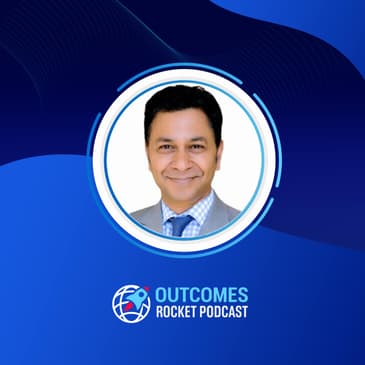
In today’s episode, Rajeev Ronanki, the CEO of Lyric, shares his vision for the future of healthcare at his company focusing on utilizing AI, blockchain, and machine learning to simplify the business of healthcare. He emphasizes the importance of creating a platform in healthcare that connects consumers and care providers digitally, ultimately leading to a more seamless and efficient healthcare experience for all stakeholders. Rajeev also discusses the concept of payment integrity and how it extends beyond serving health plan clients to impacting providers, employers, and consumers. He delves into the potential for technology to minimize the noise and friction in healthcare transactions, allowing stakeholders to focus on improving health outcomes and creating a delightful experience for consumers.
Tune in to gain valuable insights and learn more about Rajeev and Lyric's impactful initiatives.
Resources:
[00:00:00] Hey everybody, welcome back to the Outcomes Rocket. Today I have the privilege of hosting Raj
[00:00:07] Varnanke on the podcast again and his new role as chief executive officer. Raj has over 25 years
[00:00:15] of experience in innovation driven industry and also social change across healthcare and
[00:00:20] technology. As Lyric CEO, his vision is to invigorate Lyric's technology and utilize AI,
[00:00:28] blockchain and machine learning while building best in market strategic partnerships. Before joining
[00:00:34] Lyric, Raj led the transformation at Elevance, formerly Anthem from a traditional insurance company
[00:00:40] to a digital platform as the president of Keralon. So Raj, tell me what inspires your work in
[00:00:46] healthcare? Thanks for having me, so I'm good to see you. So I love the fact that healthcare
[00:00:50] creates such an impact whether it's bringing delightful solutions to consumers, simplifying
[00:00:55] the provider experience, simplifying the myriad transactions that are comprised of healthcare
[00:01:00] that contribute to the nearly trillion dollars to spend that I believe is not value and ultimately
[00:01:05] the patient or the provider experience. You put all that together for the country that has as
[00:01:10] much innovation as we do in healthcare and as many advances that we make in healthcare,
[00:01:16] there's still a lot more to be done whether it's creating more access to care,
[00:01:20] making care more equitable, removing bias from medical care, reducing medical errors,
[00:01:26] improving the quality of care, moving more to align outcomes between providers and insurance companies,
[00:01:33] making consumers more, I guess, make consumers better educated, more informed about the care
[00:01:38] they're receiving. There's an endless series of problems and opportunities in healthcare
[00:01:43] and me personally, I feel that technology can have a dramatic impact on the future of health in our
[00:01:50] country. And I'm excited that at Lyric, I have a platform on which to do that along with hundreds
[00:01:57] of talented colleagues that all share the same purpose, which is ultimately to simplify the
[00:02:01] business of healthcare. That's great. Yeah, and you've always had such an innovative
[00:02:06] approach in the work that you do, Raj. So I've been a fan of what you do. And at Lyric,
[00:02:12] the focus is payment integrity, right? And so serving health plan clients, do you see
[00:02:17] payment integrity, especially through innovation and technology growing to
[00:02:21] touch and impact other stakeholders? And if so, how? Yeah, great question, Sol. So the history
[00:02:28] of the company, the legacy of the company has been in serving health plan clients and that's been
[00:02:32] done for the better part of 30 years now with great distinction. The customers that we do have
[00:02:38] the retention rate is incredibly high. We have to have a single voluntary customer
[00:02:43] and sort of attrition event, if you will. So that speaks to the stickiness of the product and
[00:02:47] at the core of what we deliver in terms of value to our health plan customers.
[00:02:52] But beyond that, I think we also have an opportunity to serve providers by better
[00:02:56] educating them on submitting transactions that are clean and pristine to begin with so that
[00:03:01] we can start to minimize the noise and the friction that exists between providers and
[00:03:08] payers on this transactional flow between the two and allow both of them to ultimately focus
[00:03:14] on what matters, which is creating a delightful experience with consumers, improving their health
[00:03:19] and outcomes for them. And then enabling doctors and clinicians to focus on the things
[00:03:25] that they enjoy, which is ultimately care and care related matters as opposed to
[00:03:30] administrative and transactional overhead that we've created in the system. So
[00:03:35] I see Lyric as down the road being able to serve not only providers, employers, consumers,
[00:03:41] and obviously continuing to serve health plans with distinction.
[00:03:44] That's really great. Thank you for that. And you've done a lot of thought leadership work
[00:03:48] around AI. And in particular last year, you talked at TED AI where you shared your thoughts
[00:03:54] around organizational structure and AI. Can you share a little bit more about that and how
[00:03:59] you see it impacting and perhaps catalyzing healthcare company leaders and laggards?
[00:04:05] Yeah. So the genesis behind that was there is I think a tendency when it comes to AI to start
[00:04:13] building capabilities, to buy a software solution or hire a team in-house and start
[00:04:20] creating new capabilities and new solutions or exploring any one of the platform point
[00:04:25] solutions that are available that seem to crop up by the hour by the day.
[00:04:29] The question is where does this all integrate into and what's the organizational design that
[00:04:36] leverages these capabilities to the utmost and ultimately create better ROI for customers
[00:04:41] in an improved experience for all the stakeholders out here. So what's I think missing from the
[00:04:46] equation is how should companies be organized to take advantage of these capabilities?
[00:04:52] In my TED talk in last October in San Francisco, I
[00:04:56] drawn an analogy between what happened in the original industrial revolution back in
[00:05:00] late 1700s and early 1800s where as that revolution started to move from steam to electricity,
[00:05:08] it gave factories an opportunity to redesign the factory floors on electric motors. So now you
[00:05:14] could take electric motors and put them to where the work is create sort of the notion of a
[00:05:19] modern assembly line and make factory floors more open, more airy, more worker-friendly.
[00:05:27] And whereas if you just try to kind of put in an electric motor and in the place of a steam
[00:05:31] shaft and organize factory floors vertically then you really wouldn't have taken advantage
[00:05:36] of electricity and all the innovation that it brought to the table for factories.
[00:05:40] I think nearly 200 years later I think we're in a similar spot with AI which is
[00:05:45] for the most part companies are organized by departments and those departments probably have
[00:05:51] their roots in paper-based workloads. So we had an underwriting department, we had a customer service
[00:05:57] department, we had a claims department, we had a grievance department and back in the day you
[00:06:01] could imagine people with inter-office mail floating around supplying inputs and outputs to
[00:06:06] those different departments and they all kind of work together that way. With the advent
[00:06:11] of tech in the 80s and 90s I think a lot of that was automated but the departmental structure
[00:06:17] was still retained. And ultimately now with AI you still have the same structures that you saw
[00:06:23] in the 50s and 60s and companies to this day. The question is should they exist in that way
[00:06:29] or could they be reimagined with AI organized around different sort of purposes of an
[00:06:35] enterprise. So if one department's goal is to serve customers with satisfaction and with distinction
[00:06:43] then why not organize the entire supply chain that constitutes that under one structure.
[00:06:49] And if there's another department whose goal is to minimize friction between stakeholders
[00:06:54] and make sure that transactions are settled with no errors and with straight through processing
[00:07:00] then let's think about how to organize that along those lines versus in the way that
[00:07:04] they're currently organized which is based on honestly the 50s and 60s architecture. So in modernizing
[00:07:10] the operating design of the company, the organizational structure of the company
[00:07:14] and then marry the capabilities into it then I think you have a better chance of success
[00:07:18] than I think simply chasing the next new widget or next new capability without
[00:07:24] thinking about the largest structure into which all that kind of comes together.
[00:07:27] I really love your perspective on that Raj and it speaks to peeling back the layers
[00:07:32] don't get tactical, get strategic and start with the organization right and the results could be
[00:07:37] transformational from what you're telling me. Yeah and I think conversely if you're only chasing
[00:07:43] down capabilities and solutions and initiatives I'll think ultimately I think one will feel
[00:07:48] disappointed with the results because it's really not giving you the total impact that
[00:07:53] it could have without changing all of the surrounding structures around it.
[00:07:57] I love that and so all of these things you've had years of experience implementing at various
[00:08:04] organizations none of this comes without lessons learned. So I love if you could share with all
[00:08:10] the innovators listening maybe one of the biggest setbacks you've faced and a key learning that
[00:08:15] came from that. Far too many to counsel and that's a failure as very instructive and that
[00:08:21] keep keep teaching you the things that you have to remember probably more so than the
[00:08:25] successes you've had did not avoid I guess to making them again. So to me it's I'll maybe
[00:08:31] paint an abstract view of all the different lessons over time of the things that that haven't
[00:08:35] worked so one is clearly that like with my engineering background early on in my career
[00:08:40] I had a great degree of focus on building initiatives, building capabilities, building
[00:08:45] solutions without all the surrounding things that need to be accounted for for making something
[00:08:50] successful. So that's organizational upskilling, it's change management, it's understanding the
[00:08:56] motivations of change and the resistors to those change and systematically creating an
[00:09:01] organizational design an organizational change management plan to make sure that
[00:09:05] ultimately the solution and the products create the ROI and the impact that you would
[00:09:09] expect it to have and then working backwards from the outcome sometimes I think we tend
[00:09:14] to start with what's easy and then you get a third of the way and or a half of the way
[00:09:19] on your trajectory to your destination only to realize that the last half, the last third,
[00:09:25] the last mile is incredibly hard and costs a lot more and takes a lot more time to to pull off
[00:09:33] whereas knowing that upfront I think would change the priorities and the sequence in which you
[00:09:39] would go after it and in retrospect for me now what I start with when taking on anything new is
[00:09:45] understanding all that could go wrong, all the dimensions of risk whether it's people or its
[00:09:52] talent or its structure or its capability or its platform business model what have you
[00:09:57] looking at all the variables that have that create the most amount of uncertainty
[00:10:02] and then starting with a plan to reduce uncertainty so as you get closer to the
[00:10:06] finish line then the amount of variances and uncertainties you have is much smaller than
[00:10:11] when you start in whereas typically I think when startups get launched or when new product gets built
[00:10:17] or new business models get invented I think we tend to move the uncertainty to the right
[00:10:22] and then discover surprises later in the game which I've had a fair share of that over time
[00:10:27] my career and based on all of that those are all the things that I'm doing differently.
[00:10:31] That's great Raji, yeah it's a planning for the the inevitable surprises the inevitable things that
[00:10:37] will come up is key and minimizing uncertainty right is the name of the game. Exactly right.
[00:10:44] So you've spoken about the importance to simplify the business of care what does that mean
[00:10:50] and how do organizations and individuals get to that place? Yeah to me I think so the
[00:10:57] healthcare is missing the notion of a platform so if you think of Amazon and the work they've done
[00:11:03] in retail it's probably the most advanced piece of technology that connects consumers to the
[00:11:09] things that they buy and transact on that through a platform that's very easy to use
[00:11:16] with hardly any issues and things that could go wrong with it and if and when they do go
[00:11:20] wrong something does go wrong then there's excellent customer service to come back around and
[00:11:25] fix it so no one ever leaves that experience with or very few people would let's say leave
[00:11:30] that experience with any amount of dissatisfaction but if you look at healthcare that is probably
[00:11:36] the opposite even when I'd say someone has a pretty serious illness they get the best care in the
[00:11:42] world and they come out of it healthy and with equal with the right outcomes even then
[00:11:47] even when you interview all the stakeholders involved in that process there's usually something
[00:11:52] that they're not happy about either the financial transactions that's around that or the process by
[00:11:58] which they got the care or some element of care that could have been better let's say the lag work
[00:12:04] being better coordinated with the clinical work with genetic work all those things tend to be
[00:12:08] in silos so to me the entire system if you were to step back and look at it is a series of silos
[00:12:14] with very little communication and collaboration between the stakeholders
[00:12:18] and as a result incredible amount of waste incredible amount of rework and ultimately the
[00:12:24] consumer experience is very subpar so then if you think about like if we put those two thoughts
[00:12:31] together what does a platform look like in healthcare so that we can have a scaled view
[00:12:36] into which we can introduce innovations that means that you and I as consumers need to have
[00:12:42] a common set of front door capabilities and experiences that we could use to start our healthcare
[00:12:49] journey finding a doctor making an appointment making our information available to whomever needs
[00:12:54] it in a secure and friendly manner and having all of the specialists and the primary care docs
[00:13:01] and every other stakeholder that might be involved in care having a common understanding of one's
[00:13:08] medical profile then comes the supply side of it the providers all need to be connected so that
[00:13:16] the electronic medical records could be integrated in with administrative systems
[00:13:20] and that's who's available at for what price point and what outcomes will be created all
[00:13:24] becomes readily available so that we can think of healthcare as a supply demand problem with
[00:13:30] the care that consumers need with the clinicians providing the care to the consumers that need
[00:13:36] and connecting it digitally so that we can have global instrumentation around it
[00:13:40] once we have that and only a few big companies can do that that have access to providers at scale
[00:13:47] and have access to consumers at scale but there are tech companies like Lyric that can provide
[00:13:52] the enabling capabilities to do that so once you have those that end the bookend of consumers
[00:13:57] and care providers connecting in digitally then we can start to take all these transactions
[00:14:03] of healthcare and reimagine them whether it's prior authorization or claim submissions or risk
[00:14:10] adjustment processes or its heaters and quality measures all of these things which are essentially
[00:14:16] measuring what happens between consumers and the care they need and adjudicating the outcome
[00:14:22] of that what should be risk adjusted what should be paid what's considered out of
[00:14:26] network what's your cost here all those things are just outcomes of an event that's happened
[00:14:31] between a consumer and a care provider and because every one of those things happens in a silo
[00:14:36] we have the system in the country that we do but I think we can reimagine that by systematically
[00:14:42] creating sort of these platforms for connecting care and care providers and then digitizing all
[00:14:47] the things that happen at the intersection of that great examples of that across the country
[00:14:52] including at my former company Elements and the work we're doing now at Lyric and which
[00:14:56] kind of gives me you know reasons to be optimistic about what we can do in the future
[00:15:01] Morage I appreciate the vision for what healthcare could be I guess putting the Lyric and the
[00:15:07] alignment in in healthcare it leaves us with with really kind of something to look forward to
[00:15:13] as consumers and even as providers right seeking to make the experience that much better for
[00:15:18] consumers look excited for you and what the team are building there what closing thought would
[00:15:24] you leave us with and what's the best place for listeners to learn more about you and the work
[00:15:29] that you're up to at Lyric yeah so thank you for having me always a pleasure to connect with you
[00:15:36] I always enjoy our discussions we have the most insightful questions that always gets the
[00:15:40] mind going you can find us at Lyric.ai that's our company website where we usually have the
[00:15:46] latest and greatest information about our products or initiatives or points of view on
[00:15:50] various topics I'm active on on LinkedIn at you know Rajiv Ranaki or on X at Rajiv Ranaki on X
[00:15:58] as well as Lyric has a presence both on Twitter as well as on LinkedIn as Lyric Clarity and Notion
[00:16:04] and we typically if you follow us there we'll keep you abreast of all that's happening in AI with
[00:16:09] our company as well as anything that may be related and again thanks for having me and
[00:16:13] look forward to our continued collaboration likewise Rajiv and and we'll be sure to
[00:16:18] leave all of the links that you mentioned in the show notes for everybody listening to stay
[00:16:22] in touch with you as well as Lyric thank you so much for spending the time with us thank you