
This podcast is brought to you by Outcomes Rocket, your exclusive healthcare marketing agency. Learn how to accelerate your growth by going to outcomesrocket.com
Textiles offer an unprecedented opportunity to bridge the gap between humans, AI, and healthcare by creating a seamless, continuous data stream for proactive prevention.
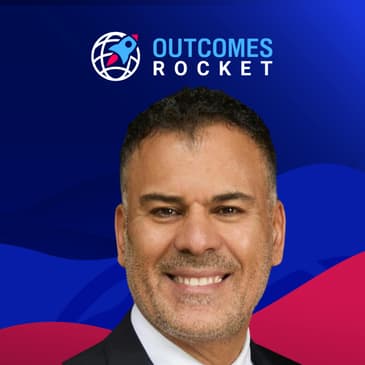
In this episode, Dr. Tony Chahine, CEO and founder of Myant, shares his mission to transform healthcare through textile computing. Inspired by his father's dementia, he developed sensor-embedded clothing that passively monitors vital signs like EKG, core body temperature, and breathing rate, transmitting real-time data to care teams for remote monitoring and more accurate diagnoses. Myant's initial focus is on cardiology clinics, offering an alternative to Holter monitors for patients with cardiovascular disease while also consolidating multiple health devices into a single wearable garment. Dr. Chahine envisions a future where AI models trained on this data can predict health events before they occur, emphasizing the need for perseverance and long-term vision in pioneering innovation.
Tune in and learn how textiles are poised to revolutionize preventive healthcare!
Resources:
- Connect and follow Tony Chahine on LinkedIn.
- Learn more about Myant on their LinkedIn and website.
- Discover more about Myant’s manufacturing division here.
Fast Track Your Business Growth:
Outcomes Rocket is a full-service marketing agency focused on helping healthcare organizations like yours maximize your impact and accelerate growth. Learn more at outcomesrocket.com
[00:00:01] This podcast is produced by Outcomes Rocket, your healthcare exclusive digital marketing agency. Outcomes Rocket exists to help healthcare organizations like yours to maximize their impact and accelerate growth. Visit outcomesrocket.com or text us at 312-224-9945.
[00:00:30] Hello everyone and welcome back to the Outcomes Rocket. I'm so excited to be joined by an outstanding leader in the space. His name is Dr. Tony Chahine. He's the CEO and founder of Myant. They're a revolutionary company anchored in deep tech innovation, advanced materials, textile computing, technology research and advanced manufacturing. He's on a mission, he and his company are on a mission to enable a future society where humans, animals,
[00:00:59] and the planet coexist in harmony. I don't know about you guys, but I want that too. Tony, welcome to the podcast. So great to have you with us. Thank you very, very much. Hey, look, so let's get into it, Tony. You're doing some fascinating things with your firm. Talk to us about what you do, why you do it and why it matters. We're building a new relationship between humans, AI and their care team with a high focus on healthcare.
[00:01:28] That's our first deployment of our technology. We started sometime in 2010 and the challenge was for me, I wanted to do something for my dad. He had developed a severe dementia at a very young age and I wanted to stay connected with my dad. And someone with dementia can't learn new habits. So it forced me to think about a new medium.
[00:01:47] And the solution I found since my dad wore textile top to bottom across time, that gave me the idea of why not use the textile as a medium where we can put sensors and actuators and create a closed loop solution and then deliver a continuum of care for someone like my dad. That idea started, as I mentioned, by 2015, we decided to make it a solid business and we grew.
[00:02:15] And now with like over 200 staff with pretty advanced end-to-end facility, enabling people who are living today with cardiovascular disease, heart failure, people with cognitive disorder, to really take advantage of technology by preventing the onset of disease as early as possible. So our vision is for people to live younger and longer is really what we're after.
[00:02:42] And you can only do that if you develop a passive-type relationship between humans and their healthcare. This idea of using a device only when you're sick is a reactive idea. And often people ignore early tells or some tells are silent. So the whole idea, we wanted to have this natural, continuous relationship between humans and their care system and their care provider.
[00:03:07] And textiles, since everyone, as I mentioned, is wearing it, could enable unprecedented type of data. And as a result, you can leverage AI and really be in the business of prevention with a high level of precision. You know, I love that. And we've had a lot of conversations about wearables, nearables. The reality is clothes, textiles are on us every single day. So why not integrate these devices?
[00:03:35] Virtual care, a lot of people say it's a Zoom. Until you bring in the vitals and until you bring in the data. And I love that this is where you're focused, Tony. Really thinking about the opportunities at hand. Talk to us really around like your end customer. Who is buying from you and who do you serve in the healthcare ecosystem? Yeah, we started deploying our product last year after 14 years of research and development. We needed to develop new advanced polymer. Extrude that polymer into yarn.
[00:04:05] Then knit and weave that yarn into finished textile that you can wash and dry. This is not a textile that has wires and some patches glued to it. This is a textile as we're used to textile. The yarn itself is the sensor. It took us very, very long time to get regulatory approval in Canada. We got that sometime in 2024. And we started deploying shortly after a number of cardiovascular disease clinics.
[00:04:32] The patients who are using our product and benefiting from our product are patients who are told to wear a halter monitor. You know, a patch. They have to shave the patient. They prepare the skin. And then they have to put these adhesive patches. And they ask the patient to go away home and then keep this device on them between 1 to 14 or longer days. So often, patients can't tolerate this adhesive. They develop skin allergy.
[00:04:59] And as a result, the data becomes sometimes highly inaccurate because the leads are off. And the patient can't keep it on a long time, etc. So we use a bra or a chest band or a polo or a tank top or an underwear, which we develop. You just wear it in the same way you wear textile.
[00:05:18] You wash it and dry it in the same way, except the data is transmitting multi-lead EKG, core body temperature, breathing rate, breathing volume, all continuously, as well as your inertia and posture data and actigraphy. So as a result, you now, the same patient who is wearing our product has dozens of modalities. Data modalities are transmitted real-time between the patient and through their app, to their care circle, also to their cardiologist, if the cardiologist is looking at it.
[00:05:48] It's a very different experience. Every time the patient is dealing with some symptoms, the symptoms are either logged automatically or manually. But then it allows the patient, it allows the doctor, which is something really unique on our platform, to replay an event. So often when we have a tell or some event, we have to remember that event and then call the doctor and say, doctor, I had this two weeks ago.
[00:06:12] And then the doctor will issue something in the future, hoping to catch in some report in the future what happened in the past. The beauty of our platform, if you're wearing this product, it transmits that data continuously, the doctor can go back. So patients in those clinics are wearing this product today. So our focus is cardiology clinics. They're issuing our product to their patient and patients for halter and related cardiovascular disease monitoring. That's great. Thanks for sharing that.
[00:06:40] So the cardiologists are buying it from you. The provider is the buyer of this technology today. Cool. Really interesting. And when you think about the platform you've built, this is just the beginning, right? There's so many applications. I envision pathways with the payers, managing large populations, seeking the type of data that they need to keep people healthy and out of the hospital. This is huge. What's one thing that most people don't know about a problem that you solve?
[00:07:09] This idea of managing when you're transmitting real EKG, multi-lead EKG or multi-vector EKG. You solve many problems that often is solved by different devices. So often, if you're measuring your hypertension, you need a blood pressure device. If you're measuring EKG, you need an EKG device. If you're measuring your core body temperature, you need a thermometer. If you're measuring for sleep apnea, you need a different device.
[00:07:35] The beauty about our platform, you can wear a polo or a bra and it will give you all of these things in one. So it's unprecedented amount of data, but it displays standalone devices and makes it much, much easier for patients. You have often a patient in their late 70s or 80s. We're asking them to deal with five, six devices, go on a scale to measure their weight or write down some in their journal what happened to them. None of those things have a high level of adherence.
[00:08:03] The beauty about our platform, the patient is wearing a bra, a tank top, an underwear, and they forget about it. And as a result, the data is flowing. Multi-modal data is flowing. And the benefit of that, what most people don't know, we're training an AI model with all of those modalities. As a result, you really start making a huge difference in prevention.
[00:08:25] This idea, which is something we're really after, the ability to prevent or to notify someone in advance before they're having a stroke or before they have a stroke or before having an event, is really something that we are aspiring to deliver, hopefully soon. That's great. No, Tony, thank you for that. And look, you were laboring after this for 12 years before you commercialized. That's a characteristic of really a medtech entrepreneur, right? That kind of waits for that delayed gratification.
[00:08:55] We like to learn from successful people like you. What's your favorite business resource or business hack that you recommend to our listeners and why? You just have to play for the long game. If you want to do something really innovative, you're going to be very disappointed if you're looking for instant gratification. In our case, building a new category that did not have reference, not have... Often when you're building... Often there's two types of entrepreneurs you're pure.
[00:09:21] One, they're upgrading an existing technology and they would be very successful. And others are doing something completely new, very disruptive. And that requires... And I believe that's what we're doing. And that requires a long-term plan. And that requires a lot of sacrifice and stubbornness and steadfast type of system and personality. And you can't give up. You can't give up.
[00:09:48] Over the years, we had many, many times that it was very difficult for us to continue, but you have to persevere and push forward. And what's gotten you through the downs, right? Because those 12 years before you started commercializing, I'm sure you were like, what am I doing? What's a tip? What's a tip? Say, you're sure. 14 years. 14 years. But who's counting, right? You know, maybe it's the immigrant in me that I immigrated to Canada and I left Lebanon during the war.
[00:10:17] And the idea of creating a new home is what kept me going because Canada is my home. I wanted to make a difference. When you have that type of drive, you just have to... It's not a feature. It's like black and white. It's life and death for me. So I have to make it through. Love that. Thank you for that, Tony. Inspiring to hear your story. So great that you're sharing it here with us. We're grateful. Hey, by the way, question before my last one. Is your product commercialized in the U.S. as well or just in Canada right now?
[00:10:47] In Canada right now, soon in the U.S. in 2025. And in the EU, we have acquired a company in Europe. And we're launching in Europe sometime in Q2 and hopefully in the States in Q3. Amazing. Amazing. So coming to the U.S. soon, but definitely available in multiple markets. So definitely a company to keep your eyes on. Tony is just an incredible founder.
[00:11:13] Tony Shaheen, just really creating new work for us, new opportunity for us, CEO and founder of Mayant. Tony, where can people reach out to you and the company to learn more? Sure. They can go on our website, mayant.ca, or our advanced manufacturing division, mayantx.com. So both company one is focusing on healthcare and one focusing on the one that's focusing on healthcare is the one that I mentioned doing. We want to enable people to live younger, longer.
[00:11:43] And the one that's in deep tech and advanced materials and new molecule development is mayantx.com. And then, of course, on LinkedIn, that's possible for anyone to connect. Beautiful. No, that's great, Tony. I want to thank you for joining us. And for everybody listening and watching, the show notes have everything you need to get in touch with Tony, to check out his companies. Now's the time to get ahead of it. He's not in the U.S. yet, but he will be. And so you have an opportunity to jump on it before everybody else does. Take advantage of that.
[00:12:12] And Tony, just want to make sure that we appreciate you. And thank you for being with us. Thank you so much. This podcast is produced by Outcomes Rocket, your healthcare-exclusive digital marketing agency.
[00:12:37] Outcomes Rocket exists to help healthcare organizations like yours to maximize their impact and accelerate growth. Visit outcomesrocket.com or text us at 312-224-9945.