
Let’s explore healthcare's digital frontier, where administrative automation and clinical AI converge, shaping a future of unprecedented possibilities.
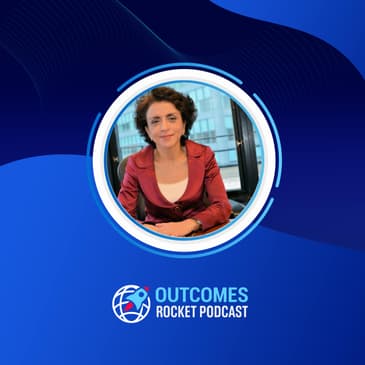
In this episode, Afsaneh Naimollah, Managing partner of Xen Partners, talks about the role of technology, challenges in innovation, and the transformative potential of generative AI. She discusses her role within Xen Partners, as a translation engine in healthcare acquisitions, and her involvement in mentoring both early-stage and established healthcare companies. Afsaneh touches on the hurdles faced by companies, the importance of embracing technology, and the promising impact of generative AI on healthcare, spanning education, administrative tasks, and potential clinical applications. She also invites listeners to subscribe to her insightful monthly newsletter, providing a concise editorial and highlighting significant deals in the global healthcare industry.
Tune in to learn more about the transformative potential of generative AI and how Afsaneh and Xen Partners are reshaping the healthcare landscape.
Resources:
- Connect and follow Afsaneh Naimollah on LinkedIn here.
- Learn more about Xen Partners on its website.
- Reach out to Afsaneh at Afsaneh@XenPartners.com if you’re interested in receiving Xen’s monthly newsletter.
- Listen to Afsaneh’s previous Outcomes Rocket episode!
[00:00:01] This podcast is produced by Outcomes Rocket, your healthcare exclusive digital marketing agency. Outcomes Rocket exists to help healthcare organizations like yours to maximize their impact and accelerate growth. Visit outcomesrocket.com or text us at 312-224-9945.
[00:00:29] Hey everybody, welcome back to the Outcomes Rocket. Kids, I'm so excited that you tuned in once again to our podcast. I have a guest that has been on the podcast before. Her name is Afsaneh Naimollah. She's had a distinguished career on Wall Street for over 35 years. She's a subject matter expert on next generation healthcare technologies and managing partners. Managing partner at, you know, Afsaneh, it's Xen, right? Right, Xen. Xen, okay.
[00:00:57] And she's managing partner of Xen Partners, an advisory firm focused on next generation healthcare technologies. In that capacity, she assists large and small health tech companies with their growth strategies, particularly in the digital health sector. Afsaneh, thank you so much for jumping back on the podcast with us. Of course. Glad to be here. For the listeners and viewers that haven't had a chance to listen to our previous episode that we did together. First of all, I'm going to put it in the show notes.
[00:01:27] But secondly, just wanted to give you a chance to share with them what inspires your work in healthcare. You know, as you said, I've worked on Wall Street for over 35 years. I started in the technology sector and about 20 years ago, I got involved in healthcare. And it was really by accident. But then when I saw what happened with the Hitech Act, where we actually paid doctors to use electronic medical record.
[00:01:53] And I think to date, we have paid like $35, $40 billion to doctors to use electronic medical record. And we have, I think we have reached almost like 95% saturation, which is great. You know, when I look at, it's the largest industry in the world. It's the largest industry in the United States. It's 18% of our QTP, sadly or happily, I don't know. It's also a very personal industry. You know, it affects all of us as human beings.
[00:02:23] It's our well-being. It's our well-care, sick care. And it's also, unfortunately, is the sickest industry when it comes to embracing technology and automation. It's very backwards. It's mired with legacy technologies. And unlike FinTech, which is also one of the largest industries in our country, you know, the financial institutions embrace technology much, much faster than, let's say, our payers or providers in this country.
[00:02:52] So, you know, between being the largest industry, being very personal and also really needing transformation, those three things were really the factors that not only brought me into the industry, but I stayed for it. You call out some of the big pain points, which are also the opportunities for a lot of the innovators that are in the space. Yes. Talk to us about Zen Partners. You know, how are you guys adding value to the healthcare ecosystem?
[00:03:21] A couple of things. I mean, one of the most important thing is, you know, we want to be this translation engine. So if, you know, we have some private equity clients when they are looking at buying large healthcare companies, we go in and we are not L.E.K. or McKinsey or anything like that. We're very much still investment banking. It's like, what are the opportunities for this company? Once you buy them, what are the M&A opportunities?
[00:03:47] What are the partnership opportunities with digital healthcare companies, with next generation healthcare companies? And that's one way. And then the other end is, you know, I mentor a lot of early stage companies, not startups. So I'm an executive in residence at the largest early stage we see in healthcare called Plug and Play. They are a huge organization, 600 people work there. They have 20 different verticals, 50 different offices.
[00:04:16] And, you know, I mentor healthcare companies. So I kind of see both ends, the little guys and the big enterprises and be a translation engine of facilitating partnerships, facilitating M&A, and hopefully bringing technology to the old co with the new co. And I think that translation engine going both ways is really important.
[00:04:40] Certainly, a lot of examples of stifled innovation with large companies and the ecosystem of innovative firms that you're sort of incubating at Xen Partners, coaching at Plug and Play, play a major role in how innovation gets pushed forward. Thinking about like what you guys do different or better out there to help the ecosystem. What would you say that is? The fact that we handle both.
[00:05:07] So we are really more of a, what I will say, strategy advisory firm with an eye towards value creation. That's sort of where the investment banking, my investment banking comes. And when we look at a company, let's say an early stage company, you know, it used to be triple aim. Are they going to reduce costs and or are they going to increase quality and or are they going to increase patient satisfaction? Now we have added a fourth goal.
[00:05:37] Now we're a quadruple aim. Can the company also enhance physician satisfaction? Because we have a lot of, I don't have to tell you, with all the burnout and all the silent quitting that is going on with nurses and doctors. So if you come to me and you don't answer any of those four, we are not for you. Right. So in that sense, I think it's really, really important to keep the quadruple aim in mind and really move the needle.
[00:06:07] Can you move the needle? You know, I just saw a company, actually a Japanese company. We have a flooring that is cushiony. So when the seniors fall, you know, they don't break things. Very interesting. Right. But I said, what's the cost? The cost was just so prohibitive, so expensive. I said, maybe in Japan, but in America, none of these nursing homes are going to buy this. Maybe my children will buy it for their elderly parents at their house.
[00:06:35] But come to me with something that is actually workable and economic as well. So all of those four boxes, then you're missing out. You've got to be decreasing costs. The margins are negative right now for some of these providers. Just a bad spot that everybody's in. It's terrible. And I'm saying you bring some major insights here in the approach. You've got to have the fundamentals in order if you're going to make progress. One question that I always like to ask is tell me about your biggest setback.
[00:07:04] But I'd like to kind of retool that one for you since you do work with a lot of different companies. What's the most common setback that you see with companies that you work with? Oh, I have a long list. I think, let me put it this way, a list of misconceptions by this founder. So let's start with the early stage companies. A lot of the founders are not humble enough to know that they have competitors.
[00:07:31] So a lot of founders come to me and say, oh, I can do this. And I'm the only one that, you know, and I'm like, who is your competitor? And I have no competitors. And then when I say, have you looked at this guy? And have you looked at that guy? These are four companies that are in your space. There's a blank fix. You know, like, oh, I didn't know. I'm like, yeah, these are bigger companies. A little bit ahead of you and more customers than they do.
[00:07:55] Because a lot of the founders come from technology and they've fallen in love with their technology that they built. Okay. And the technology in most cases is really, really good. But that's not it. Just because you build this technology and it's really amazing and it's really next generation doesn't mean that there is nobody else out there.
[00:08:15] So I always encourage early stage companies to be very, very much sensitive to competition and who is playing in the same sandbox as they do. On the bigger company side, a lot of misconceptions I see there is like, we're all set. We don't need to buy anything. Like, what do you mean you don't need to buy anything?
[00:08:39] This company can enhance movement of data faster in your company or this company can enhance data quality in your company. This company can give you more precision solutions, if you will. And no, we're all good. And I think non-invented here is a big deal. It's a really big deal with the larger companies. And it really takes very special CEO to be humble enough to know, you know, I have a great business.
[00:09:08] I have a hundred million dollar business, 20%, 25%, 30% EBITDA margin. But I'm always open to partnering. I'm always open to POC. I'm always open to buying for the right price to even enhance my own very good business or add another growth driver. I think of the pharmaceutical payers and providers, those are like the three main, if you will, subsectors of our industry.
[00:09:36] I think pharmaceuticals tend to be the ones embracing the technology better than most. I think because they're used to buying, 70% of their business is buying smaller biotech companies to feed their R&D. So they go and buy the R and then they do the D. So they're used to constantly bringing new people, new technology. I think the providers and the payers are both guilty, in my opinion, of not being fast enough to embrace technology.
[00:10:05] Providers always hide behind, I don't have money. And the payers hide behind, oh my God, what you're saying could mean I have to completely revamp my back office. Well, you know, it's time to revamp the back office because it's 20% over $4 trillion. You got to be open to change, you know, and you've got to be honest with yourself. There's probably something in your business that could be done better.
[00:10:31] And there's an opportunity that you could take advantage of if you're not partnering, if you're not thinking about creating. Let's say you have one moat. Why don't you have two or three concentric moats to make your business even stronger? And so the points you make are so strong, Mipsana. I really love that. When you think about the landscape of healthcare today, what would you say is one trend or technology? That's going to change healthcare as we know it. I am giddy. I'm really, really excited about generative AI.
[00:10:59] And AI has been around for a while, but generative AI is a whole different class. I think it could revolutionize our economy, our global economy in so many respects. And one of the main reasons I am excited about Gen AI is the interactivity. So I can interact with it rather than one-way technology. And I think it's going to touch healthcare on many respects.
[00:11:26] First of all, in no order of importance, education. A doctor sitting in Kenya, not having specialists in A, B, and C area, but consulting with generative AI. Not to have Gen AI make a decision for him or her, but guide him towards a solution or a diagnosis or a treatment. We have never had this before.
[00:11:50] So education, I think right now the best use cases for generative AI is on the administrative front. Basically automating our administrative tasks. So, for example, prior authorization, either for procedures or for drugs, is a huge cost. You know, ranges anywhere from $20 to $30 billion a year. Huge cost.
[00:12:14] If we can automate that for the doctor, so the doctor can just basically put a few lines and say, please write an essay for me to give to the insurance company for the following. And it writes. Obviously, these LLMs, the long language models, have to be trained specific to Cleveland Clinic or specific to Sutter Health. But once you have those basic rules in, it basically writes you the PA, the prior automation in revenue cycle management.
[00:12:43] Very big deal. Being able to have a Gen AI interact with a patient, like a nurse or a doctor, for no-import tasks. Really, really important. Now, the holy grail is obviously the clinical side. Can I use Gen AI to give me a diagnosis? Can I use Gen AI to give me therapeutic recommendations? We are not there, but I can assure you within three to five years, we will be there.
[00:13:12] Some say even two years. We will be there. There is work ahead. Chad GPT is not going to be your diagnostic buddy, but there are lots of things you could build on top of Chad GPT or other similar Gen AI engines that can do that.
[00:13:29] As a matter of fact, within a year or two, it is expected that we will have 5 to 10% of drugs actually being invented by Gen AI and go to FDA approval. And that scientists had very little to do with it because it's all about ingesting this gigantic, enormous amounts of literature and protein libraries and this and that. So the drug discovery is really helpful.
[00:13:58] The admin is really helpful. The clinical side, because obviously of the matter of life or death, we are not there, but we can definitely, I mean, doctors are using Chad GPT today for just recommendations. Like, what do you think? Is this diagnosis correct or not? So generative AI, the long-winded answer to your question is probably the most exciting thing that has happened.
[00:14:24] And I'm just hoping all providers are embracing it, payers less so, drug companies for sure. But I'm just hoping that is going to be something that we are not going to talk about as a generative AI. It's going to completely, we don't talk about internet anymore because everything is built on top of internet. So hopefully one day we are not going to talk about generative AI and everything is going to basically have some kind of LLM other underneath.
[00:14:51] It is revolutionary and it will continue to be in a lot of ways. Great examples. Speaking of which, you do a monthly newsletter. If you guys have enjoyed my conversation with Ahsaneh, she actually does a very insightful monthly newsletter. You want to tell them about it? And then maybe we could invite them to receive it by giving us thoughts. What can they expect? It's a two-minute editorial and the rest of the newsletter, a two-minute read editorial.
[00:15:19] It's a very short editorial and the rest of the newsletter is all the important deals in the industry globally above $10 million. So it's a nice kind of, you know, some people say I don't read anything anymore because I get all these deals all in one place. So if you are interested in receiving the newsletter, please email me. My first name, Ahsaneh, A-F-S-A-N-E-H, at zenpartners, X-E-N-Partners.com.
[00:15:47] And I will be happy to put you on the distribution list. That's awesome. Yeah, guys, I recommend it. I definitely am on it. She's always sharing some great insights and it's quick. Like she said, it's just a quick kind of glimpse of the latest, most meaningful things in healthcare, meaningful deals. So definitely check out the show notes of today's podcast. As I say always, don't stop at just listening. Take action with what you learn.
[00:16:15] If you want to get on the rocket and bring outcomes to your business and patient outcomes, take action. And today's action is check out Ahsaneh's newsletter. Ahsaneh, thank you for joining us today. It's been a really great pleasure as always. Pleasure being with you. Thank you. Have a good day. Cheers. You too.
[00:16:32] This podcast is produced by Outcomes Rocket, your healthcare exclusive digital marketing agency. Outcomes Rocket exists to help healthcare organizations like yours to maximize their impact and accelerate growth.
[00:16:57] Visit outcomesrocket.com or text us at 312-224-9945. Review guide wiz�abolism. Follow roadmap Kings. Cheers. Thanks for listening.