
This podcast is brought to you by Outcomes Rocket, your exclusive healthcare marketing agency. Learn how to accelerate your growth by going to outcomesrocket.com
The integration of AI and empathy is crucial to improving healthcare outcomes and affordability.
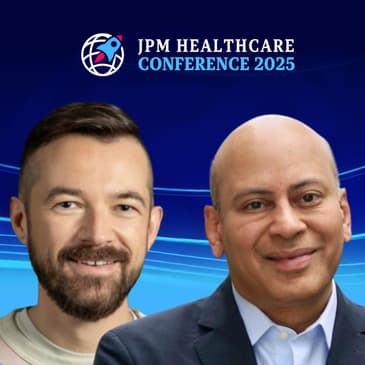
In this episode, Sanjay Doddamani, Founder and CEO, and Michael Gleeson, Co-founder and CTO, of Guidehealth, discuss how their company is tackling the healthcare productivity crisis by integrating AI into clinical workflows. They highlight the importance of expanding healthcare access without overburdening physicians while improving patient engagement and care quality. Guidehealth leverages AI to analyze previously inaccessible data, predict patient needs, and create personalized care plans for patients, families, and clinicians. They believe AI-driven advancements will enhance patient connections, streamline data access in EHRs, and open new opportunities for innovation in healthcare.
Tune in and learn how AI and empathy are transforming healthcare delivery and improving patient outcomes!
Resources:
- Connect and follow Sanjay Doddamani on LinkedIn.
- Follow and connect with Michael Gleeson on LinkedIn.
- Learn more about Guidehealth on their LinkedIn and website.
Fast Track Your Business Growth:
Outcomes Rocket is a full service marketing agency focused on helping healthcare organizations like yours maximize your impact and accelerate growth. Learn more at outcomesrocket.com
[00:00:01] This podcast is produced by Outcomes Rocket, your healthcare exclusive digital marketing agency. Outcomes Rocket exists to help healthcare organizations like yours to maximize their impact and accelerate growth. Visit outcomesrocket.com or text us at 312-224-9945.
[00:00:29] All right, everybody, welcome back to another episode of the Outcomes Rocket here at JPMorgan, San Francisco 2025. I am with two amazing leaders. First, I want to introduce you to Sanjay Doddamani. He's a founder and CEO of Guidehealth. But I'm also with Michael Gleeson, who's the co-founder and CTO of the company. Guys, welcome to the podcast. And it's such a pleasure to have you here. Thanks so much. Appreciate it.
[00:00:58] Yeah, you know, the beauty of this meeting is everybody's here. So I'm so glad that we're together to kick things off. Tell us a little bit about the company, what you do, why you do it. Saul, nice to be here on this crisp morning. If you really feel the optimism in the air, I think the meetings here are rife with tremendous, I think, outlook on innovation and excitement around what technology can bring into healthcare.
[00:01:23] We run a tech-enabled health services company that's partnering with health systems as well as clinical integrated networks to improve their performance. We integrate into clinical workflows using AI-integrated models. And we've been demonstrating some wildly incredible results on quality and healthcare engagement, patient engagement. I'll turn it over back to you and Michael. Sure. Michael, anything to add to what Sanjay said about the company?
[00:01:47] I think it was well covered. Just, you know, the market momentum for us, the need for health systems to get more out of their existing contracts and the approach that we take using both our staff, their staff and augmentation of that with Agentic AI has been spectacular.
[00:02:04] That's great. And there's been a lot of talk on Agentic AI. And the thing that we're covering here on these Insights podcasts are, you know, what are you guys hearing? What's making a difference? And in particular, maybe along the lines of your model and how you're helping your customers?
[00:02:19] I think the biggest challenge is we have a major productivity crisis for licensed clinical professionals in the country. Healthcare outcomes have stagnated. Quality is actually down. And this is impacting the overall total cost of care, but it's also impacting patient engagement and access. And so if we can scale that up without adding more burdens to physicians, we can actually improve the healthcare system, provide better access, reduce, you know, total costs and improve the overall quality of care.
[00:02:48] And that's what we've not only designed ourselves to do, we've actually done it. And so we're now across like five states, 550,000 lives, over 250 employees, all dedicated to this one mission of AI and empathy to help drive better health outcomes and affordability. Thank you, Sanjay. And so what role does technology have, Michael, in achieving that?
[00:03:11] The technology starts with us with predicting which patients we should connect to and using new and previously inaccessible data sources to do that. So how can we infer what interventions we can drive for specific patients? We then use AI to create a care plan for those patients that can be read by them, their care family and their clinician. And then lastly, we connect and integrate both interactions with that patient through multimodal channels,
[00:03:41] whether it's text or voice video, etc. through both our own human staff and those AI agents that we leverage to communicate and extend that staff. Think of it as predict, connect, transform. That's awesome. I love that triad. This has been an area where a lot of health systems have wanted to take action. They just don't know where to start, how to do it. And frankly, there's just been a lot of challenges, one of them being reimbursement. Do you guys want to speak to that?
[00:04:38] And I think the platform we've convened is actually driving that. Love that. All right. Well, let's get to the predictions, guys. This is my favorite part. What is 2025 hold for us? What should we expect? Michael? Maybe Michael, let's start with you and then Sanjay. I think we'll have continued fast movement with the frontier models and AI that will unlock use cases that people have struggled with to make an impact and particularly with how you connect and work with patients.
[00:05:04] And, you know, I think we may have some connectivity improvements as well as the existing ways to get data in and out of the HRs improves too. Love that. Sanjay? I think we are finally going to tackle the productivity crisis, the labor shortage and the ability to connect with more patients. If you think about value-based care, it is undergoing its own transformation. Over two decades ago, what VBC meant was restrictive narrow networks.
[00:05:32] In this past decade, it's been more about this 80-20 parader rule. Touch the 20% of the highest cost, highest needs patients, do risk adjustment and you will generate revenue. For us, we are entering a new era of VBC, which is about patient engagement, touching far more lives and having far more reach. So it's ultimately a win-win for patients. It's a win for providers because they've got these extenders that can be agentically supported.
[00:05:58] And we've got, you know, I think, a better outlook on how we can improve health outcomes that have stagnated for so long. Love it. Well, the future is looking bright, guys. And to close out this series, I am doing a fun question around JPM and specific to the meeting. Why are you here and what tips would you give the folks out there wanting to make the most out of this meeting, which oftentimes happens mostly outside of the Westin Hotel? And that's why we're doing these walking tours because it all happens outside. It does.
[00:06:27] Why are you here and what tips would you give the people wanting to make the most out of this meeting? It's crowded. You get a crappy room. You spend a lot of money, but you meet some of the brightest minds working on some of the greatest challenges of our time. And it's one of the most exciting times in health care to be able to make a difference. And how do you make the most out of it, Sanjay? Like what do you do personally to make the meeting count? Other than try to get some good sleep and exercise? Yeah.
[00:06:49] It's been great to connect with both investors as well as thought leaders, folks who are really moving the field and demonstrating tremendous innovation. I've met a bunch of tech colleagues and leaders, as well as a retinue of other folks, including some banking and policy folks. Awesome, Sanjay. What about you, Michael? Why are you here and how do you make the most out of it? I'm here to just get the energy of the year. It's a really exciting way to get things started and, you know, meet with people like yourself, others.
[00:07:17] And mine is just, I try to go to all the things. And, you know, unfortunately, I didn't catch up on sleep when I get home. That's fair. You've been evangelizing, I think, health care and some of the broadest topics. So kudos to the work you're doing. Thank you, guys. Well, thank you so much, Sanjay, Michael, for spending time with us here at JPMorgan Health. And for everybody with us, make sure you check out the show notes on ways to get in touch with Guide Health, as well as the tips that we were just discussing. Thank you all very much. And thank you guys for being with us. Thank you so much.
[00:07:58] This podcast is produced by Outcomes Rocket, your health care exclusive digital marketing agency. Outcomes Rocket exists to help health care organizations like yours to maximize their impact and accelerate growth. Visit outcomesrocket.com or text us at 312-224-9945.