
AI technology is aiding in early disease detection and patient engagement, making it a game-changer in healthcare.
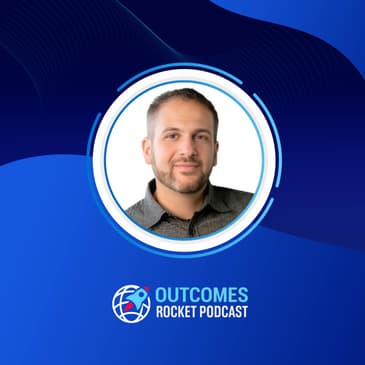
In this episode at ACC.24, Dr. Rami Bailony, co-founder and CEO of Enara Health, discusses the importance of comprehensive care in managing chronic diseases like obesity, emphasizing how the company's platform integrates virtual obesity management into primary and cardiology care. He also highlights Enara’s partnership with InBody to personalize patient programs, reducing muscle loss and optimizing outcomes, especially for those on GLP-1 medications. Dr. Bailony shares insights from ACC.24 as well, emphasizing the need for holistic care models and the potential of AI in cardiac care, from early disease detection to patient engagement and cost reduction.
Tune in and learn how comprehensive care and technology are transforming cardiac care for the better!
Resources:
[00:00:02] Hey everyone, welcome back to the Outcomes Rocket. Saul Marquez here at the American College of Cardiology 2022 conference in Atlanta.
[00:00:10] I have the privilege of being with Dr. Rami Beiluni today. He is the co-founder and CEO of Enara. Rami, welcome to the podcast.
[00:00:19] Oh, thank you for having me.
[00:00:20] It's a pleasure to have you here. There's a lot of conversations around technology, medications, specifically GLP-1s and their impact on patient care.
[00:00:30] And today we're going to have a couple questions for Rami. But before we do go into what Enara is all about, tell us a little bit about you and tell us about the company.
[00:00:38] Yeah, so my background, I'm an internal medicine doctor. I trained over at UCSF and then after that through my own was interviewing a couple of patients for type 2 diabetes app and realized that they were guilty and really could reflect back on what we as doctors sometimes do to stigmatize obesity and got really interested in the field.
[00:00:58] So I decided to get boarded in obesity medicine and ever since then, I've been trying to tackle the problem.
[00:01:03] That's great. And there's a lot of efforts, a lot of investment, a lot of attention around this topic of GLP-1s. There's the good, there's the challenges.
[00:01:14] So talk to us about Enara and what you guys are doing to provide more of the good.
[00:01:18] Thank you. So Enara is a company that is deeply passionate about changing the way that health care today approaches obesity.
[00:01:26] What we do is we have built a platform that supercharges and enables virtual obesity management on top of primary or cardiology care.
[00:01:36] And our platform basically allows clinics to develop and build multimodal and multidimensional services and departments that help them address and tackle chronic disease.
[00:01:48] And so the difference between us and other platforms is we're not taking a short term prescription first approach to obesity here.
[00:01:56] What we're really doing is taking a longitudinal approach where obesity will be part of what a clinic or cardiology or primary care clinic is managing long term.
[00:02:05] And that really is what we're trying to do in a nutshell.
[00:02:08] Thank you for that. Yeah, because oftentimes and what we've seen here at the conference is GLP-1s and their impact on muscle loss.
[00:02:17] Any programs that could be put into place to combat that I imagine is part of your platform.
[00:02:23] Can you talk to that? That is correct.
[00:02:25] So actually one of the things that we do and we just announced a partnership with InBody on this is that every one of our partner clinics,
[00:02:33] we put a body composition machine that looks at muscle versus fat.
[00:02:37] And then actually our back end data model actually personalizes the program for each patient based on how their muscle and fat is changed.
[00:02:46] And so if you look at our overall statistics, we have the lowest muscle loss.
[00:02:52] Most of our patients are losing 90 percent fat and only 10 percent muscle.
[00:02:57] And if you look at just the folks on GLP-1s, they're actually losing 50 percent less muscle than what was reported in the clinical trials for those medications.
[00:03:06] That's really great. And it is one of those challenges.
[00:03:11] And it's great to know you guys are thinking about it and putting a structure and technology in place to help prevent that.
[00:03:17] We're here at ACC24. It's as much as what we're sharing with the community, as much as what we're learning.
[00:03:24] Can you share any particular insight that's risen to the top for you?
[00:03:27] Yeah, I think one of the most fascinating things in almost all the discussions that I took place with, as well as the talks that I listened to,
[00:03:35] whether it's about new technology in regards to replacing heart valves or post-MI care or preventive cardiology,
[00:03:45] there is a discussion point around the need for comprehensive wraparound care, both pre-procedure, post-procedure.
[00:03:51] And the idea that the intervention, the procedure, or the medication itself is not really going to treat the whole individual.
[00:03:59] It might treat one particular point. But in order to treat the whole individual and take care of that person,
[00:04:04] it's really the care model that addresses that holistic being.
[00:04:07] That's great. Yeah, and it's really great to hear that given that you guys are focused on that type of wraparound care.
[00:04:13] That is correct. As a matter of fact, one of my takeaway points is our platform could probably contribute in a lot more ways
[00:04:19] given how many times I've heard that mentioned at the conference.
[00:04:22] That's fantastic. That's great news. And I'm sure validation for the efforts that you and your company are up to.
[00:04:29] AI, Gen. AI, we're hearing a lot about it. What is this technology's role in cardiac care?
[00:04:35] Yeah, so I think the question is where will it not play a role?
[00:04:39] So if you really look at what AI is doing, it's really almost like a new compute platform.
[00:04:43] I think that it's going to be playing a role from how we engage the patients,
[00:04:47] how we schedule patients, to how we diagnose disease.
[00:04:51] And so if you look at what we see at the conference, probably the earliest use cases of AIs
[00:04:56] is in the early detection of disease, particularly at the imaging.
[00:05:00] So auto detection of ejection fraction with ECHOs and similar technology.
[00:05:05] I think where it goes from there is really around what we're doing,
[00:05:08] which is evaluating large data sets to personalize care and understand
[00:05:13] what is the right therapy for the right person at the right time.
[00:05:16] And then I think beyond that, what you're going to see in the next wave is the ability to use AI to engage patients
[00:05:22] and really, hopefully streamline and reduce the costs of healthcare administration.
[00:05:27] Thank you for your thoughts on that. And look, the opportunity is big for providers
[00:05:32] to do more with their weight loss programs and their overall cardiac care.
[00:05:38] If people want to learn more about Anara and the things that you guys are up to,
[00:05:42] where can they go and what call to action would you leave them with?
[00:05:45] I'm going to start with Anara and then go to general call to action.
[00:05:49] For people that are interested in learning about Anara, if you are a provider,
[00:05:52] whether that's a cardiologist, primary care physician or an obesity physician,
[00:05:56] we post weekly on the top key studies or interventions or news in metabolic care.
[00:06:04] So you can follow us on LinkedIn if you want to see those posts.
[00:06:07] And then obviously you could reach out to partnerships at anarahealth.com
[00:06:11] if you want to have more in-depth discussions.
[00:06:13] In terms of the general action to care, I think my call to action
[00:06:18] or what I would recommend or my takeaway is I think it is important for all of us,
[00:06:22] whether we are interventionalists, whether we are preventive doctors,
[00:06:26] is to really look at the whole care cycle from beginning to end
[00:06:30] and understand how we can optimize that and make it more comprehensive
[00:06:34] and in particular make it more empathetic and patient-centric.
[00:06:38] And so really I would encourage whether you are a doctor,
[00:06:42] whether you are a patient who has just undergone a major procedure
[00:06:45] or come away from an event or whether you are an innovator who are innovating in this space
[00:06:49] to think not only about exactly what you're doing or where you're intervening
[00:06:53] but really around the nutritional, psychological and physical support system around that care journey.
[00:06:59] Great close there and again really appreciate the work that you guys are doing here
[00:07:04] and also sharing what you've learned and what you guys are contributing here at ACC24.
[00:07:08] Thanks for joining us.
[00:07:09] Thanks for having me.