
Imagine your dentist as a key player in preventing and managing chronic diseases, not just treating cavities.
In this episode, Dr. Brett Kessler advocates for dental benefit reform to shift dentistry from a surgical model to one focused on chronic disease management and overall health, expanding Medicaid benefits and providing care to 300,000 underserved patients. He emphasizes the connection between oral and overall health, aiming to improve patient outcomes and reduce costs by integrating dentistry into broader healthcare systems.
Tune in to learn how dentistry is evolving beyond the drill, tackling substance abuse, reshaping healthcare policies, and proving that oral health is the gateway to overall wellness!
Watch the entire episode on YouTube and get more details at Think Oral Health
Resources:
- Connect with and follow Dr. Brett Kessler on LinkedIn.
- Follow the American Dental Association on LinkedIn and explore their website!
- Watch the entire episode on YouTube and get more details at Think Oral Health.
- Mariya Filipova - https://filipova.health/
- Systemic Health Investor - https://www.4100dx.com/
- Care Convergence Thought Leader: Dental Economics
- Forbes Technology Council Member
- Jonathan Levine - www.drjonathanlevine.com
- Founder - JBL New York City www.jblnyc.com
- Founder - GLO Science LLC www.gloscience.com
- Co-Founder - GLO GOOD Foundation www.glogoodfoundation.org
[00:00:01] This podcast is produced by Outcomes Rocket, your healthcare-exclusive digital marketing agency. Outcomes Rocket exists to help healthcare organizations like yours to maximize their impact and accelerate growth. Visit outcomesrocket.com or text us at 312-224-9945.
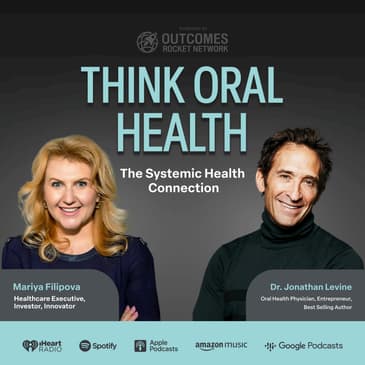
[00:00:31] Welcome to Think Oral. Where we connect the unconnected between oral and physical health. I'm your host, Dr. Jonathan Levine. And I'm your host, Maria Filipova. Let's get at it. Hi, everyone, and welcome to another edition to the Think Oral Health Podcast. I'm Maria Filipova, and as usual, I'm joined today by Dr. Jonathan Levine,
[00:01:01] our podcast host, co-host, and fellow troublemaker for good. Hi, Jonathan. How are you doing today? Doing great, Maria. And I am telling you that I am here in my office at the practice. Still a wet-fingered prosthodontist, I am. So it's great to be here with you. I'm super excited about having Brett Kessler with us. I'm so excited. And I think there's one of the special episodes where, first of all, this is the first episode we are recording where you are in your office. So let's see how that goes.
[00:01:30] And then it's also one of those rare episodes where we have two dentists in the conversation. So I'm very excited about that. I'm excited to see where the conversation would go. And I'm excited to introduce Dr. Brett Kessler as our podcast co-conversation partner for the podcast today. Brett, welcome. Hi, Maria. Thank you. Hi, Jonathan. Good to see you both. Glad to be here. Hi, Brett. Great to see you.
[00:02:00] If you feel uncomfortable, we will insist on reading through some of the highlights in your bio and some of the accolades that you have so deservedly received over your career. If you must, go ahead. Get it over with. We insist. We're great. So you come to us today, first of all, as a general dentist. You're based in Denver in Colorado, one of my favorite cities. But you also serve as the president of the American Dental Association. You've served in that capacity.
[00:02:28] This is your first, your main year of service, if you will. You've been involved in the ADA's House of Delegates since 2008. And you have also served as the vice chair of the Council on Dental Benefit Plans, which is near and dear to my heart. I also want to recognize you received the ADA's Golden Apple Award in 2010, which is the highest award bestowed by that association for outstanding leadership in mentoring.
[00:02:58] And I don't say this lightly. I think Jonathan and I spend a lot of time talking about outcomes and quality, but a large portion of our thinking and career is spent on how, what makes a good leader and what makes a good organization led well by its leaders. So we'll probably ask you a little bit about that. You are well recognized as an expert on well-being and helping dentists live their best lives.
[00:03:24] And as an expert, you've testified before the U.S. Congress, the Colorado State Legislature. And amongst most of your accomplishments, I personally am very impressed by your, the fact that you are an accomplished endurance athlete that continues to compete in events across the country. So personally, I find this very inspirational in addition to living a full life with four kids and a wife. And I really don't know how you do it. So thank you for everything you do. And thank you for joining us at the podcast today.
[00:03:55] Thank you. I hope the lighting is correct because I'm blushing as you. I got to turn the light more on my light here. Oh, my joke. Well done then. No case. Well, let's start. Jonathan and I typically have an opening question around the origin story. And you have a very interesting path that landed you where you are today. So tell us a little bit about your personal why and what drives you to do the work today
[00:04:24] and what drives you in the choices you made from a practicing general dentist to somebody who is advocating actively for change. So tell us a little bit about that journey and where it started and why. Well, I'll start with the origin story of how I got involved. I entered dental school back in 1991. I had a pretty bad substance abuse problem, but I was a high achiever. And I did very well in dental school. And I graduated with a worse substance abuse problem.
[00:04:53] I hit my bottom in 1997 in my third year of practice. I called the Michigan State Dental Association Wellbeing Program. And I attribute that phone call to the beginning of my recovery. And I attribute that phone call to the beginning of really what saved my life. And as I got better, I became inspired to live my best life.
[00:05:16] And I've been a pretty outspoken advocate for all things wellness for these past 26 plus years. And it's a time where when I got sober, there was a lot of stigma around that. And I think the stigma has lowered immensely, but we still have a lot of work to do. And so I got involved basically when I moved to Colorado a few years later. I was put on probation by the licensing board because they didn't really know what to do with me. And so I didn't.
[00:05:46] So I was mad about that. And the Colorado Dental Association was doing a project. It's called Sunset Review, where every 10 years, the Dental Association, the legislature will look at the state dental practice act and see what needs to be updated. And the Dental Association is a big part of that. And I set out to change some of the stigmatizing questions and actions and activities around substance abuse because all that I did was seek help.
[00:06:14] Why was I penalized for seeking help? And so we've made a lot of strides on that over the years. And I became the wellness person in Colorado where I was the one answering the questions or answering the phone for people who were hitting their bottoms. And I had to advocate for what I did because it wasn't mainstream per se, but many of our colleagues were suffering and are suffering. And so now I'm the person answering the phone and leading people, guiding them towards help like I got help, paying it forward.
[00:06:43] Over the years, I became a speaker on how to treat the patient who may have an addiction problem or who is in recovery. And I became a national figure spokesperson on that. I was asked to testify before the U.S. Congress by the ADA on a bill they were trying to promote around funding treatment for recovering methamphetamine addicts.
[00:07:10] Methamphetamine dissolves the teeth away pretty quickly and it's pretty devastating. And so I got to provide testimony on that. And when I came back from D.C., the Colorado Dental Association saw me as more than just a wellness person and started pushing me towards stepping up in a leadership role. And I did. I became president of the Colorado Dental Association in 2014, so a little over 10 years ago now.
[00:07:37] And one of the things I'm most proud of when I was president is we developed a Medicaid benefit program for adults. And now 300,000 people in my state had access to care that didn't have it before. All the while, I'm a fee-for-service, very relationship-based, comprehensive dentist, not a prosthodontist. But a lot of the things I do were prosthodontic-type reconstructions. But it was a very relationship-based practice.
[00:08:05] But we had, as president, you learn that we are to remain a profession. Everybody has to do something. And we have to find access for those that have no access. And that's where the genesis of that was. I had an amazing team pushing that forward. And I just happened to be president when it was instituted. And from there, I moved on to the Council on Dental Benefits at the ADA. And I was very active in learning about how benefits work. All the while, I'm still doing my wellness stuff.
[00:08:35] And when I became the vice chair of the council. And the ADA has had a—it's been an interesting history in the 15 or so years I've been involved in leadership. And we've been a very cottage-type of industry where, you know, a lot of solo private practitioners were the mainstay of the practice of the membership.
[00:08:54] And as we are evolving in present times, there's a lot more group practices, a lot more different practice models that we're trying to find ways to support with benefits, with wellness, with finding ways that they can succeed and helping them. And so when I was finished with my council term, I ran for—to be trustee of the ADA. And that's basically the board of directors. And then I ran for president four years later. And gosh, look at me now. Look at me. That's right. Very surreal.
[00:09:24] We're happy that you've made some of those choices. And for better or for worse, even the lowest moments in our life actually teach us a lot about who we are and how we serve others. Exactly, Maria. Exactly right. Maria, it reminds me I enjoy the hard-driving sports like Brett does. Brett, tell us—relate. I love this story, and it's amazing.
[00:09:47] From where you came from to where you are today and where you're going to be going in your own growth and development, the importance of hitting the bottom, the importance and the confusion around the concept of pain and how that can be something that's so instructive for us, to be flipping the switch on the conversation of how powerful that is, how powerful it is as a driver for change.
[00:10:14] And we think about emerging out of dental school and having this addiction and then being able to have the courage to confront it and to endure that pain, but really to come out on the other side that we all can say as athletes also that pain is good. So tell us a little bit about that, of how you had the courage to fight that, what your mindset was, and how that kind of set you on a path of personal growth and development to get to where you are today.
[00:10:43] So I'll start out by saying that I'm hardwired to feel good with the least amount of effort, and that's what happens with addiction, right? Yeah. And over the years, I became much less dependent upon those quick fixes, those quick hits.
[00:11:01] And when I was an aspiring athlete during my addiction, I did pretty well, but it was kind of my denial too, where I would cross the finish lines of a triathlon and say, wow, drug addicts don't do triathlons. Look, I just did a triathlon, therefore I'm not a drug addict. And so actually, once I got sober, a few years went by before I started getting back into the endurance athlete mindset.
[00:11:27] And I started going back to triathlons and I became pretty good. And then I became focused on running and I started doing marathons and then ultra marathons and trail runs. And then I got an opportunity to go back into triathlons and I was able to do the Ironman World Championships in Hawaii two times.
[00:11:48] And from the lessons I learned are immense and so many from the process of that, because running or doing like a 50 mile run or doing an Ironman, you get a lot of time in your head. And there's many battles that happen minute by minute, hour by hour. Scary place to be alone with yourself in your head. That's a very scary place. And I got to prove that I can go farther than my brain tells me to.
[00:12:15] I can do things that my brain says I can't. And crossing the finish line is quite a celebration, yes. But the journey of waking up at five in the morning in December, eight months before the race and running in the dark and the cold, all these decisions along the way. I learned to love the journey. And the lessons that I learned about it was I can't do hard things.
[00:12:38] The lessons are consistency prevails over talent and angels appear along the path with messages for me. And I translated all of that to my dental practice and my professional leadership development. And I love sharing about it because I'm just an average person who's been through some hard times. And there's nothing special. I'm very blessed for the grace that I got to turn my life around.
[00:13:07] And it's the best thing that's ever happened to me. And recovery, my recovery program, you know, is the same, you know, it forces me to do the same skills and practices that allow me to be a mindful person and a mindful leader. And when it is, you know, over the years, you asked me what my why is. I subscribe to the Simon Sinek why definition. And I feel my why is that I'm a catalyst for positive change in the world.
[00:13:37] And I do it through my dentistry. I do it through my leadership. I do it through my athletics. I do it through my recovery. And it gives me a purpose. And I was doing it unconsciously or maybe subconsciously. I was just doing it. But once I kind of coalesced that phrase that I'm a catalyst for positive change, it became very intentional. And it's a wonderful way to live. And it's not just for someone who hit rock bottom. It could be anyone. But, you know, what lights your fire? And that's the inner work that has to be done.
[00:14:06] And I'm grateful that I've done it small by small, piece by piece over time. And it allowed me to get to where I am today. And I'm really grateful for every minute of every day. Well, let's build up on that ethos and the momentum around gratitude. And as you think about catalysts for positive change, let's unpack some of the areas that you are driving positive change. You already teed up a few of them.
[00:14:34] For our listeners who are newcomers to oral health or dentistry. And they might think, OK, well, somebody has an addiction or substance use problem. The first thing we need to acknowledge is that we have come a little bit ahead as a society where it's less of a stigma to talk about these types of personal journeys that everybody goes through.
[00:14:57] And it's voices like yours that have made that more accessible and acceptable for people to have the conversation. So, number one, what I'm hearing is if you're going through something that's hard, it's part of your journey. Do the brave thing and see if you could share because most likely there would be receptive people on the other side. Today, more so than 10 years ago, I would hope. The other piece is for the listeners who are new to oral health.
[00:15:25] Could you just outline the role the dental team has in somebody in a patient's journey to recovery? And we know that there are specific conditions that substance use patients are dealing with from the tooth decay and cavities to meth mouth.
[00:15:47] And so tell us a little bit about the role that you and your team and your mission driven practice play in helping people on that journey to recovery. I had a practice that I started from scratch in northeast Denver. It's an upper middle class neighborhood. It was a fee for service practice, very relationship based. And I didn't wear a sign over my around my neck saying I'm an addict in recovery.
[00:16:12] But the conversation came up often because a lot of my neighbors and patients, I could see things in them and my dental team would see things in them. The wonderful thing about dentistry is that we get to see our patients pretty consistently over time. And we can see evidence of substance abuse in the mouth. But even more, we see behavior changes. We see appearance changes. And when I treat the person who may or may not have teeth, it was a very low volume.
[00:16:41] So I got to really see the person as a whole person. Some of the higher volume, it's harder to pick up on that because we're just going in and treating teeth. But it was a more holistic approach. And if I saw with anything, it's just basic motivational interviewing. And our hygienists are experts in. Hygienists could get someone to floss. They can get someone to look at making life changes. And so I had a dental team that surrounded me that was very into overall wellness.
[00:17:10] And I'll back up. I did a general practice residency where, you know, the mouth was definitely connected to the body in the hospital that I was in. When I got out, it was disconnected. And this led me to the changes in the benefit systems and the things we're trying to change. But we were fee for service. So the benefits were important to the patient. But it wasn't in the way of what we could and could not do. And as an athlete, I had many patients who were athletes in my practice. As someone in recovery, I had many patients who were in recovery in my practice.
[00:17:38] And as a neighbor of, I lived in the neighborhood where I practiced. So I had many of my neighbors in the practice as well. And I was able to just really be a catalyst for my patients to help them improve their lives. If I see they come in for their six-month cleaning and exam and all of a sudden there's fractures and five or six teeth. And I had asked questions like, do you notice yourself clenching? And they never want to say they're clenching. But I'm like, well, I'm noticing these teeth breaking. How's your stress level? How's your sleep? Do you wake up a lot?
[00:18:06] Do you chew ice or rocks or things like that? And then patients would just start opening up. And sometimes they would open up on things like, yeah, my stress level is immense. I'm clenching like crazy. But many times, six months later, they'd come back for their prophy recall. And they'd say, doc, when you talked to me last time, I didn't know I was clenching so bad. Now I can tell you I clench all the time. I'm sleeping horribly. I went and sought help for some depression.
[00:18:33] And it was just all that had to be was a catalyst for this and notice. And emotional intelligence is a big part of recovery. And so I try and grow that. That's something that we can grow and basically self-awareness. What am I feeling? And how are my actions reflecting based on what I'm feeling? And then you can sense what are the emotions in the people that are around me and in the relationships I'm in, patient-doctor relationships. You can sense when something's not right.
[00:19:02] And then you got a series of questions that break through some of those disconnects and discord. Well, thank you for that. And I'm hoping that the message that is clear here is that your dentist is part of your overall care team along with your primary care doctor and your nutritionist and your coach. If you're an athlete training for a triathlon, your dentist needs to be part of that overall care team that optimizes your health and helps you when you need an extra support.
[00:19:33] Chance, I want to just do a quick follow-up on that question because, Brett, you've taken care of people in recovery. We know that from a medical cost perspective, that's a really costly and complex patient population with multiple comorbidities. Is there anything from what you've learned around benefit design and reimbursement that you would like to see happen differently so that the care team, including the dentist,
[00:20:00] could offer better service and support those patients in recovery better? So what benefit design would you like to see if you could have your wish list and how likely is it that to happen knowing what now? And our benefit design in dentistry is not conducive to improving oral health to the level that it should. And it's definitely not conducive and contributing to overall health that it needs to be. As I said before, the mouth is connected to the body.
[00:20:29] And I'm going to back up into my GPR time when I did this residency in the hospital. I was treating a very sick patient who had infection around the heart valves and she was going to get heart valves replaced and she was very sick, but she had teeth that were infected. And I took out one of the infected teeth in a very sick patient, very high risk to do any dentistry. But I took out the tooth infection. Pus came out of the socket.
[00:20:58] And I'm sorry to be graphic, but I cultured that pus and it was the exact same bacteria that was around the infected heart valves of this patient. And in that case, the patient was treated by all sorts of medical specialties. They were being treated by a cardiothoracic surgeon, by cardiologists, internal medicine doc, nephrologist because she was in kidney failure. Everyone got paid when this patient was hospitalized except the dentist.
[00:21:26] There was no dental benefits for this patient. There was a separate benefit system. And that, frankly, it pissed me off and it continues to. And when I speak, I talk about why has it been culturally accepted that if I had degenerative joint disease in my hip, that I could get a titanium post in my hip. But if I was missing a tooth, I couldn't get a titanium post to replace my tooth.
[00:21:52] And if I had no matter what benefits I have, if I have Medicaid, which is a benefit program for poor people, if I had Medicare benefit program for old people, if I had just private benefits and whatever benefit model I had, medicine offers their doctors to provide the absolute finest care to their patients through a benefit plan. If we were and we're not allowed to do that in dentistry, if we were to translate the dental
[00:22:19] benefit model to medicine and you had degenerative joint disease in your hip, we would give you crutches because that's all that's covered in the dental benefit plan. And why have we allowed this to happen? So the big changes need to happen. Go, Jonathan. Now we're in the hot topic. I got it going. Maria, this is why we started this podcast. Brett, thank you for going where you went to. Great question, Maria. I'm jumping in. Here we go.
[00:22:47] 54 systemic inflammatory diseases impacted by the pathogens in our mouth. That's right. We are all physicians, not dentists. This podcast is all about connecting the dots. We bring in people like yourself to talk about this issue because we just know as you control periodontal disease, you can control cardiovascular disease. You control periodontal disease. You can control rheumatoid arthritis.
[00:23:12] On and on low birth weight babies, just keep going on everything that we know that messes us up from an inflammatory standpoint, which is every disease. So Brett, you're the president here of this great organization called the American Dental Association. How are we going to get change? How is you as a change agent, your journey, who you are, a clinician, you are a leader. How can we get change?
[00:23:42] How does dentistry, which has been so disconnected, get connected back to the rest of the body, which the last time we looked, it's connected pretty well. It's the top of the digestive tract. We have something called the superhighway of the body, which brings all diseases next to each other, right? Inflammatory markers, endotoxins, and all the rest. Okay. How are we going to affect change? How are we going to affect change? That's it. This is an easy question for you, Brett.
[00:24:12] We got it. Snap my finger and we're done. It's good. First of all, I've got this platform and I speak about this a lot around the country and so many ways that we can drive this. The dental benefit model as we have in place right now is very limited to affect the change. And so we're, as an organization, the American Dental Association is the biggest lever in moving the profession forward.
[00:24:38] And we've been shy about getting into these conversations because dentists have this fear of the unknown and there's a fear of a medical model that may not be like our dental model. And we understand that. But the bottom line is dentistry is changing. The cottage dentist practice, dental practice, our profit centers are on the baby boomers. Okay. My parents' generation, when they were teenagers, they got fillings in every single tooth. Okay.
[00:25:07] And they know fluoride wasn't in the water and fluoride may not be in the water. That's a whole other conversation. And fillings were a place in my parents' mouth and those fillings turned into bigger fillings. Those bigger fillings turned into crowns. Those crowns turned into root canals, new crowns, eventually extraction, implants, new crowns. A lot of dollars invested in that one tooth over the lifetime of everything. And that spiral of the tooth. Okay. Yeah. Baby boomers. So my generation, our generation has much less dentistry in our mouth. Okay.
[00:25:34] I've got a few fillings and some of those fillings turn into some gold onlays. And then the generation that's younger than us, I'm Gen X, generations Y, Z, Alpha, hardly any fillings in their mouth. So the demand for carries control is lowering. And the current benefit model pays the dentist only if their drill is spinning or if we're scraping something. Okay.
[00:25:58] If we continue along this way, the dentists will not be able to make it and they will miss out on a huge opportunity to affect, to improve the health of our patients. If in my hygiene chair, we had questions about how's your diet? How's your sleep? How's your stress? And if we were, when I was practicing, we didn't have A1C testing available. If our benefit system paid dentists to do A1C testing, every single hygiene appointment
[00:26:28] will have an A1C test. Yeah. But the benefits don't pay for that. The benefits don't pay for motivational interviewing, oral hygiene instruction, diet counsel, tobacco cessation, screening brief intervention, refer to treatment, SBIRT things. But medicine does. Medicine also measures outcomes and quality metrics, right? So could we, as my healthcare benefits hat on, all the things you're describing are activities.
[00:26:59] We should measure activities and compensate physicians, oral health physicians for that work and those activities. And in the same time, we need to be able to track outcomes and we need to be able to ascribe quality for those activities that were performed. So talk a little bit about that balance between basically fee-for-servicing, paying for activities, even if they're preventative activities and the right activities that are connected to
[00:27:27] some measurable outcomes in quality of care or even cost avoidance for more complex procedures down the road. So let's talk about the Medicaid benefit program that I have here in Colorado. Yeah. Okay. Which I think is one of the best in the country. We are, as a dentist, we are seeing a population that is underserved. Their demographic is poor. Okay. And there's all sorts of social determinants of health that dictate that they'll have more
[00:27:55] dental needs than those in a different demographic. Okay. So we've got patients who need serious work. And our Medicaid program pays for procedures at the highest level. We're at the 100th percentile of the American Dental Association fee schedule. It's higher than private benefits pay. Wow. Okay. And there's no cap on how much we can do on a patient. So it's truly an essential health benefit.
[00:28:19] And so we are, we're treating a lot of patients and we're measuring how is it improving their life? How is it improving their overall health? Because that's, to me, the biggest return on investment. For every dollar invested in periodontal treatment for an uncontrolled diabetic, we'll save $4 in medical costs down the road on that patient. It's an investment in health.
[00:28:45] So we are tracking the improvements in overall health while we're still getting paid for the procedures we're doing. But it's a slow go with these values-based outcomes because there are not a lot of quality measures in dentistry yet. And one thing that I'm really proud of that the American Dental Association is doing is we are convening an ongoing for the last 10, 15 years, Dental Quality Alliance to determine these quality measures. We have quality measures in the pediatric population.
[00:29:14] How many visits are they coming to a year? How many sealants are we doing? Are we applying fluoride? And those are quality measures that a doctor who or a practice that is doing well with those measures, they're getting bonused on that at the end of the year, including and not taking away from the reimbursements they're doing in real time in their dentistry. But it's tracking that way.
[00:29:38] Our system in a culture, I guess, in dentistry, we have to change our coding system, our mindset around coding system. Because right now we're on procedural-based codes and that's how we get paid. And very rarely are we in a position where we're putting in diagnostic-based codes. And that has to change too for us to get true quality measures. Because right now, like the quality measure in an adult, let's say in my mouth, if I have a tooth,
[00:30:07] number four needs a DO composite, okay? My mouth is healthy. I have a moist mouth. I don't have a dry mouth. I don't clench or grind. I take good care of my teeth. And I expect that filling to last for decades, okay? But if someone is, we place a filling in someone who has a dry mouth, who is clenching and grinding, who may be a smoker, and poor oral hygiene, that filling isn't going to last five years.
[00:30:33] But yet the five-year replacement clause that we have accepted comes from the insurance industry as an actuarial-based standard of care designed to benefit the insurance company. But there's no scientific basis for that five-year replacement clause. So there's a lot of stuff that we have to do to get a truly outcomes-based model that will be robust and really show things. But we are trying to figure that out because we need to know what best practices are. That's right.
[00:31:01] Do you think that we are going to go into a direction fairly soon that we are incentivizing the profession to be preventative? We incentivize the diagnostics that we can do that connects the dots of dentistry and medicine, i.e. salivary diagnostics, microbiome testing, inflammatory market testing, all these things where saliva is the new blood diagnostics, right? We know that. We understand that deeply now with the science and the research. How are we going to get there?
[00:31:31] We don't even have CBCTs, which need to be a standard of care as a dental reimbursement. And that to me is beyond obvious. Anybody who uses CBCTs understands the incredible amount of data that now really brings dentistry to the forefront as oral physicians, looking at everything from sinus to the airway and everything in between. So how long is that going to take? How long do you think? And how do we accelerate?
[00:31:59] There's such an obviousness here that there's so much savings downstream as we go upstream that everybody always talks about and become more of this wellness model. And I would personally like to say that I would do anything to try to shake things up a little bit as a wet-fingered prosthodontist clinician and an innovator to try to help this really happen because we, as clinicians, we eat, drink, and breathe this all day long.
[00:32:28] We understand what these new technologies are amazing. And we really, as we know, health care is 20% of the GDP. We can decrease costs and we can accelerate people's overall health. How long is it going to take? I laugh because I'm usually the one who's the impatient one. I'm really getting impatient, Maria. This is our 47th episode. How long is it going to take? We are high and ready. Let's go. Come on.
[00:32:56] So there are pockets where it's happening and it's starting to accelerate because, as you have already said, the research is compelling and it's robust. It used to be fringe. It's compelling and robust that if we improve the oral health, we have serious effect on improving the overall health of our patients. And so this podcast is going to go straight to Congress and President Trump and we're going to tell them, this is what we need to do. And I don't know if you saw, I did an editorial that was published in the Washington Post right
[00:33:25] before the inauguration. You changed it perfectly. Yes, that's right. Yeah. And I talked about, we are the American Dental Association. This is who we are. This is what we stand for. And this is what we need to do to make America healthy again. Okay. And I laid out a couple of things in there and I sent a letter to President Trump and I sent a letter to every single member of Congress as they were being sworn in. So they know who we are and they know our agenda. Okay. So there is the politics of healthcare and we have some challenges with us.
[00:33:54] With these challenges also come opportunities. And so the first opportunity is Natalia Chalmers, who's the head of CMS, is brilliant. And she's really helped to improve some of the benefits around medical necessity for dentistry. And because it says in statute, in the law, the Medicare law, that we do not pay for dentistry unless it's deemed medically necessary. And so she started saying, let's define what is medically necessary.
[00:34:23] And so that patient that I described that had the infection around the heart valves, had we not done the dentistry, that patient would have died because she would have got the same infection around the new heart valves that she had in the old heart valves. And so we're starting to connect those dots. But now we've got a new administration in America here. And RFK was just sworn in as the head of HMO. And he's anti-fluoride. And he's been known to be anti-vaccine, which we are very pro-fluoride. We think fluoride is one of the best public health measures.
[00:34:53] And it's been proven for that. And it really does reduce decay in a safe way that is not, there's no adversity, health side effects that have been proven and studied and real studies, by the way. But RFK is also very pro-reduction in sugar intake. Okay. And dentists can get behind reducing sugar. Okay. It's an easy discussion for us. So we've got this lever here with Natalia Chalmers, and we're expanding the benefits in
[00:35:23] this way. We've expanded the benefits in the airway and dentistry. Okay. That's why most dentists are now looking at being treating airway because they found a way to get paid for it. We need to find ways to get paid for it for us to be in the game. And that's why Natalia Chalmers with expanding or clarifying the definition is really important. Going back to technology, Jonathan, the CT scans and AI reading of radiographs, my eyes can detect about 12 shades of gray.
[00:35:52] And on the computer programs and the AI can detect six shades of gray. And we can see demineralization at the earliest possible point. And what if we then, when we see that, we can put something on the tooth like a curidont or a fluoride varnish that really will reverse that early lesion and we never have to drill a tooth. And there are systems here in America that pay for that curidont treatment at the level
[00:36:22] of a one surface amalgam or one surface filling. And so the benefits are starting to trickle in leveraging the technology. But we've got a big mountain to climb. I'm a Coloradan. I like to climb mountains. But this is a big one because we've got to change how we practice. We've got to add diagnostic codes. We've got to prove that our dentistry will improve health outcomes. We have to change the benefit model that we're in currently that everybody hates but takes it.
[00:36:50] And then we've got to fight medicine as well because they understand how important dentistry is in the medical necessity of certain diseases. But also their system isn't healthy either. Their benefit system isn't healthy either. And they're afraid of we get to the 11th hour of combining things and they're like, wait a minute, we're going to make less money and we can't afford to. And so it's going to have to be some, it's going to come from multi-pronged approaches from everybody involved in oral health. It's a big mountain.
[00:37:20] And luckily we have some skilled climbers on the team, metaphorically and literally speaking, maybe as we put a bow on this conversation, I want to pick up on a couple of threads. Number one, when we change our mindset from being mechanics for the mouth to oral health physicians, to members of a care team that manage inflammation, then the conversation changes.
[00:37:50] Because now if I'm in the business of doing fillings and making sure that my drill spins and I'm scraping things, that's a different behavior versus if I'm in the business of managing inflammation for that patient. Now my behavior will be different, but what's even more important, the people who join me in the climb, if we're going to stick with that metaphor, are going to be very different and much bigger group of climbers with me.
[00:38:18] Because to your example about reducing sugar, if we rally behind nutrition management or inflammation management as member of that care team, guess what? The American Diabetes Association is climbing with us. The American Heart Association is climbing with us. All other communities on health, wellness, prevention, chronic disease management are there with us.
[00:38:43] And that's a much bigger platform and much even more skilled group to work with. And so that's, I don't want to lose at all that thread that you started because I see the opportunities and I see them imminent to Jonathan's point, how and when. I think that's part of it. We need to be in inflammation management, chronic disease management and nutrition management rather than dentistry. And it's shifting the model that we're in right now from a surgical-based model. And we do surgery every day.
[00:39:13] We cut live tissue. That's what we do when we do a filling. We cut live tissue. We're periodontal management. We're cutting, we're dealing inside live tissue when we're doing that. We have to shift that surgical model to an internal medicine type model, management of chronic disease type model, because inflammation will always be a threat. And we are the ones that can see it first. The mouth is the litmus test to the body. And if we've got inflammation here in our mouth, it's guaranteed to be everywhere.
[00:39:40] And we can be a real big catalyst for positive change in our patients. How do you like that? How I tied that bow together, huh? Wow. Look at that. That was skilled. That was skilled. No, it's skilled. That's right. Jonathan, what's on your mind? I think it's exciting to have someone like Brett in a position to shake it up. And really, I truly made that.
[00:40:05] And I felt that when Brett and I first, we connected New York City at this group, the global leader group. And it was just great to hear someone who knows this profession. But it's also to cast forward and think about what's possible. To me, what you're talking about, outcome assessment, really developing a fact base of all the science
[00:40:27] and research and really show what are truly the dollars that can be saved as we look to go upstream. And Maria and I talk about it a lot, about oral health, prevention of these oral health diseases. And the diagnostics that we have at our fingertips now in dentistry for it to get adoption in dentistry. Not the top 1%, 2% dental practices, but really to go across the board. And we have to incentivize them to do that.
[00:40:58] Incentivization is probably going to come through a lot of this reimbursement model. Once we can get all of these use cases together, to me, we're going to be able to make this fantastic argument that says that dentistry is the tip of the spear for diagnostics for overall health. That's when we're working together. Dentistry and medicine start working together. In medicine and dentistry, we refer to each other. We do a shared database. We talk about that all the time.
[00:41:24] And we'll start getting this wonderful momentum of collaborations between the disciplines of medicine and dentistry. So you got to start somewhere and you're doing it. You're doing it. You're shaking it up. You're making noise. You're sending the letters out. And at the same time, we have a whole wonderful ADA behind this and also a lot of interested parties where, like you said, it's happening in pocket. And then we're going to get that groundswell and growing momentum. So I'm feeling pretty positive.
[00:41:52] The short answer, Marie, I'm feeling pretty positive about the direction we're going at the helm here, driving our leadership to move into ways that are going to accelerate and amplify this conversation and make change. Well, thank you for that. I think the golden age of dentistry is right in front of us. And we can craft it when we have these kind of conversations. And my successor, Dr. Rich Rosado, who will be president after me, is all in on this too.
[00:42:22] And he's developing a task force to really look at what is the future of oral health 25 years from now? And like, why 25 years? Because 25 years, most of us aren't going to be practicing anymore. And we can take away those self-limits that we have and how we practice now and really imagine what things are going to be like 25 years from now. When we started practicing, Jonathan, life was the practice of technology was a lot different than it is today. And imagine what it'll be like 25 years from now.
[00:42:52] And I know you're on the forefront of innovation, but it's unfathomable. But everything has to evolve for this to happen. And the bottom line is in our country, is health care a privilege or is it a right? And is oral health? Those are the questions that have to be answered. And I know the answer. You can infer what my answer would be based on what I said today. But that's where we need to go.
[00:43:17] I think you're in a similar like-minded company here with our listeners as well. That's for sure. That is for sure. We'll wrap up. I'll extend an invitation to our listeners as we always do. First invitation is, Brett, you mentioned that oral health as part of overall health is already happening in multiple places, in multiple clinics, in multiple payment models. So for those of our listeners who are part of those payment models, drop us a line.
[00:43:47] Let us know how you're doing, what you're doing, how successful it is, what data you have, because these are the data points we need to amplify and scale and build momentum to Jonathan's point. And how can we help anyway? You enroll us. Maria, are we ready to help? We are so ready. My sleeves, I've rolled up the sleeves. I'm ready. We are ready to jump in. So please- Whatever you need us to do. Whatever you need.
[00:44:14] And the other invitation, Brett, is for you and Rick. Last time we had a conversation, you said, I'm very comfortable about the momentum and the change, but I don't know what happens after Rick. How do we scale that? Right? We have a mandate and then the next mandate, what happens after that? The invitation is to you to think about, and we have that same conversation. Let's find the scale multipliers. Let's find people like me and Jonathan and others.
[00:44:42] So it's not only up to you and Rich's shoulders to carry that momentum. Let's recruit those champions so that we have this multiplier. And that's- Sign us up because we have a whole host of well-intended listeners to do that too. That's right. It's exciting. So I'm glad to have you on as partners with us and we're going to make a difference. We really are. That's the plan. Well, see you next time. Thank you. Good luck. And we'll see you soon.
[00:45:13] Come back to tell us all the exciting progress you've made. Anytime. Thanks for the opportunity. Thank you, Tapsu. Thank you, Brett. Thanks for listening to the Think Oral Podcast. For the show notes and resources from today's podcast, visit us at www.outcomesrocket.health slash thinkoral. Or start a conversation with us on social media.
[00:45:42] Until then, keep smiling. And connect in care. This podcast is produced by Outcomes Rocket, your healthcare exclusive digital marketing agency. Outcomes Rocket exists to help healthcare organizations like yours to maximize their impact and accelerate growth.
[00:46:10] Visit outcomesrocket.com or text us at 312-224-9945. Thank you.