
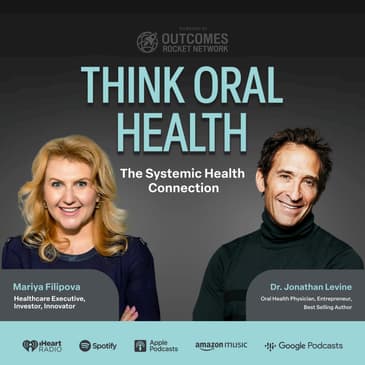
Back by popular demand, this fan-favorite episode is one you won’t want to miss! Whether it's your first time tuning in or you're revisiting this classic, dive in now and enjoy one of our most listened-to episodes!
A new generation of healthcare professionals is reshaping the landscape by connecting the dots between dentistry and medicine.
In this episode, Hatice Hasturk talks with hosts Jonathan and Mariya about the theories and pathways linking dentistry and medicine, emphasizing the promotion of overall health through improved oral health practices. She emphasizes the need to bridge divisions, prioritize prevention, explore the oral-systemic link, and promote overall well-being with education, innovation, and collaboration.
Join us for an eye-opening dialogue on how your oral health can impact your entire body and why it's time to break down the walls between dentistry and medicine.
Resources:
- Connect with and follow Hatice Hasturk on LinkedIn.
- Follow Forsyth on LinkedIn.
- Visit the Forsyth Website!
Think Oral Health is coming to HLTH. We are partnering with the Health Podcast Network and HLTH to bring you breaking news and updates from one of the largest health and innovation communities. Join us! Use this link to register: https://healthpodcastnetwork.com/hlth-registration and get a special discount on us. (Saves $250) Leave a comment to receive the discount code.
[00:00:04] Welcome to Think Oral. Where we connect the interconnected between oral and physical health. I'm your host Dr. Jonathan Levine. And I'm your host Maria Filipova. Let's get at it.
[00:00:23] We are so excited to have Dr. Hatice Hasturk to our Think Oral podcast. Our podcast is all about connecting the dots between dentistry and medicine, understanding why those walls are up, how do we break them down, and how do we bring the thought leaders to the table?
[00:00:41] To explain their area of interest and expertise in understanding this link between oral health and overall health.
[00:00:50] I can't think of anybody better than Dr. Hatice Hasturk to talk about the research and the science behind that concept. She's a senior member of the Center for the Clinical and Translational Research at Foresight Institute, Cambridge, Massachusetts.
[00:01:05] Really the number one periodontal testing center in the world is the way I like to describe Foresight. She also holds an adjunct associate professor ship at Boston University School of Dental Medicine.
[00:01:17] She got her dental degree in 1988, PhD in periodontology, advanced graduate sciences in Boston University in 2004.
[00:01:27] But what's really interesting is Dr. Hasturk's research. She focuses on the immune mechanisms between periodontal disease, the chronic inflammatory disease of the mouth, and systemic inflammatory diseases, which includes diabetes, cardiovascular disease, rheumatoid arthritis, and treatment of oral diseases by the regulation of this inflammatory response.
[00:01:52] She's co-authored more than 110 scientific publications, recipient of the prestigious William Geis Award from the IADR International Association of Dental Research, 2020 American Academy of Periodontology Clinical Research Award, ADA Norton Ross Award, and on.
[00:02:11] And I can keep going on and on.
[00:02:13] Atis, welcome to St. Laura Podcast with Maria Filippova and myself. Wonderful to have you here.
[00:02:21] Thank you so much, Jonathan. It's my pleasure. And thank you for this kind introduction. It makes me more humble. Thank you.
[00:02:28] That's because you are a humble soul. I'm going to kick it off with the first question.
[00:02:34] Why are there walls that are between dentistry and medicine? Isn't the mouth connected to the rest of the body?
[00:02:44] That's a wonderful question. Yes. We've been trying to find the answers to these questions, Jonathan.
[00:02:49] So I don't know if this time is going to be sufficient to discuss on this, but yes, you touched my heart because that is in my focus in my research.
[00:02:58] That's how I funneled my direction and focus in when I became a dentist and periodontist.
[00:03:04] I said, we should be the forefront of giving care, education, understanding, and make the people understand that having a healthy oral health will make them overall healthy too.
[00:03:21] But there are big roadblocks in the road.
[00:03:24] First of all, there are many things that makes medicine and dentistry disconnected for years, for centuries, maybe I could say.
[00:03:33] Maybe even before the 1700s, it was more connected, I would say.
[00:03:38] But then it became more separated.
[00:03:41] Many things.
[00:03:42] It's just because maybe it's the stakeholders.
[00:03:45] It's the fields wanted to protect themselves.
[00:03:48] It's the profit, how they get it out of it.
[00:03:51] It's the name, how to do this.
[00:03:53] But also, it went into the education.
[00:03:56] So medical school and dental school education sports are very separate.
[00:04:00] I was very fortunate in my school that I had three years of education with my medical colleagues.
[00:04:08] And they did also hear about some dental classes and topics.
[00:04:14] We just hear all about the general medicine.
[00:04:17] So it was an amazing mindset.
[00:04:19] I guess I was very lucky to start with.
[00:04:21] But not everyone has that.
[00:04:23] Not everyone had that.
[00:04:25] So I think that all starts from education as well.
[00:04:28] But this, of course, requires a dedicated decision-making structure.
[00:04:34] So whoever making these decisions should really make a commitment to connect these two fields.
[00:04:41] And that's how I see it.
[00:04:43] On the other hand, of course, our scientific approach should also be reflecting that.
[00:04:50] For years, any grants that we wrote to connect these two dots, two fields, were rejected saying
[00:04:57] that there's no proof whatsoever.
[00:05:00] But is it?
[00:05:01] Isn't there proof?
[00:05:02] Or is it like we don't want to see the proof?
[00:05:05] Or maybe we didn't have the tools to explore that complex relationship.
[00:05:09] So I think we're just, we might be late, but we're never late for future.
[00:05:16] We have to start somewhere.
[00:05:18] And we have great tools now.
[00:05:20] Technology is helping us.
[00:05:22] Scientific advancement is helping us.
[00:05:25] And I think mindsets.
[00:05:27] I teach in three dental schools here at Boston.
[00:05:31] And I know that the young minds are looking for that.
[00:05:35] So I see a light in the tunnel.
[00:05:38] That gives great hope.
[00:05:39] Because it's the young minds who are open and they don't, less biased thoughts.
[00:05:44] Let's put it that way.
[00:05:45] Absolutely.
[00:05:46] Of some of the traditional thinking.
[00:05:48] And while we're talking about traditional thinking, when we think about the siloed effect
[00:05:53] of the disciplines of medicine, we think about the disconnect between the oral cavity to the rest of the body.
[00:06:00] There's so much science today.
[00:06:03] And you're an immunologist, microbiologist, researcher, PhD.
[00:06:07] It's so basic for you to understand the cytokine storm and inflammatory response of inflammation anywhere in the body.
[00:06:14] We saw what happened with COVID-19.
[00:06:16] We saw how people with periodontal disease were five times as likely to get on a ventilator.
[00:06:21] We see how people with periodontal disease, when you decrease periodontal disease, you decrease pharyopathy.
[00:06:26] All this 58 systemic inflammatory diseases connected to the mouth.
[00:06:32] Tell us a little bit about what's that mechanism?
[00:06:34] Like we have a leaky gut.
[00:06:36] Things are happening in the mouth where these chronic inflammation has an impact in the body.
[00:06:41] Where's that connection in a simple way to express it for our listeners?
[00:06:46] There are, from the science, what we know is that there are certain theories and it could be pathways that connecting oral health, medical health.
[00:06:57] And we all know periodontal or oral diseases and major oral diseases are periodontal disease and caries.
[00:07:03] And also now we have cancer, oral cancer and other rucosal diseases.
[00:07:08] But major diseases that we have the bulk of the research and evidence are periodontal disease and caries.
[00:07:14] And now independently, two flows, I will come to that point, is actually a bacterially induced inflammatory disease.
[00:07:23] We know that microbial flora and the profiles in oral cavity, microbiome, wool is the initiator.
[00:07:31] But we don't know still which one is chicken, which one is egg.
[00:07:35] Are we still working on it?
[00:07:37] We are just saying that are these individuals prone to inflammation and they are easily, readily go for perturbations or oral microbiome changes.
[00:07:49] And that because of that perturbation that may happen more readily in these individuals, they get more booster for inflammation.
[00:07:57] And that inflammation that increases brings a hyperactive reaction.
[00:08:03] And of course, this immune system will produce a lot of cytokines, a lot of chemokines, proteins, enzymes that normally is protective.
[00:08:13] It becomes detrimental.
[00:08:16] And what happens is, of course, neural cavity, we have, it's not like a closed box.
[00:08:20] We have vasculature, we have tissues that this will be disseminated, so we spill over to the other parts of the body.
[00:08:30] And that what we see in rheumatoid arthritis, that what we see in diabetes or cardiovascular disease,
[00:08:36] and even in Alzheimer's disease, that now we have strong evidence that inflammation or oral microbiome virulence factors that are capable of inducing inflammation in the target organs can be spilled over.
[00:08:53] So this is a complex mechanism.
[00:08:55] It's like a vicious circle.
[00:08:57] So you induce one pathway, the pathway induce the other, and it comes back to that.
[00:09:02] And the amplitude of the infection inflammation increases much more.
[00:09:07] And that makes that individual more vulnerable individual for any underlying condition to be worse or even to initiate anything that new to these people.
[00:09:18] Actually, I was listening.
[00:09:21] We had Professor Ian Chappell from Birmingham University here as a guest speaker yesterday,
[00:09:27] and he gave a brilliant talk on rheumatoid arthritis and oral diseases.
[00:09:32] And it actually clearly shows that periodontal disease is capable of inducing antibodies in the blood, in the circulation,
[00:09:43] that one day it may be triggered with something else, maybe COVID infection, as you mentioned.
[00:09:50] And that may make that individual totally susceptible or develop new symptoms for rheumatoid arthritis or lupus or kidney infection diseases.
[00:10:00] Yes.
[00:10:01] So this is maybe I can give you a little simple but overall connection.
[00:10:05] If I missed anything, please let me know.
[00:10:08] That's exactly right.
[00:10:09] Interesting you talk about rheumatoid arthritis.
[00:10:11] We spoke with Dana Orange Researcher for Rockefeller University.
[00:10:16] That's right.
[00:10:16] They had some groundbreaking research testing the blood of RA patients and linking it up to P. ginger ballast and the propensity of the periodontal disease
[00:10:27] and increasing their rheumatoid arthritis.
[00:10:29] And then now further testing is underway with some fantastic breakthroughs that they had over there,
[00:10:36] which just talks a little bit about this human body, right?
[00:10:40] Let's talk about that.
[00:10:41] The ecosystem of the human body, it's not individual silos.
[00:10:46] Everything's connected with a roadway that could wrap around the world on each individual person.
[00:10:50] A couple of times, if you laid out our blood vessels, everything is connected.
[00:10:55] So you're describing this overwhelmed immune response when we have chronic inflammation in our body,
[00:11:02] whether it's an autoimmune response or an inflammatory response of our url and then our adaptive immunity.
[00:11:08] And it is so interesting that you at the forefront of research is there seems to be this growing body of evidence that you just can't discount anymore,
[00:11:22] that the professions have to listen.
[00:11:25] What's your thoughts?
[00:11:26] Absolutely.
[00:11:28] Absolutely.
[00:11:28] Absolutely.
[00:11:29] Absolutely.
[00:11:29] I totally agree with that.
[00:11:30] I think we scientists, we clinician scientists have a huge responsibility.
[00:11:35] We shouldn't just say, oh, my grant didn't get funded.
[00:11:40] We have to find a way to make that possible, to do those studies, to show that really these are an evidence-based information to disseminate to our colleagues,
[00:11:54] to disseminate to our medical colleagues, and to disseminate to our patients.
[00:11:58] So believe it or not, patients are more interested and more believer that if they keep their oral mouth healthy, they feel healthy.
[00:12:07] And they do us.
[00:12:09] They do challenge us in it.
[00:12:10] I still practice at least a pulse a day a week or one day a week, depending on my time.
[00:12:16] And I do really enjoy it because most of my time is about the conversation to understand my patient understanding.
[00:12:23] And I learned from them that they are really eager to get to know how these two connect and what they can do to make themselves better, feel better.
[00:12:34] So we have a huge responsibility.
[00:12:37] And again, researchers have responsibility.
[00:12:40] We have to conduct credited, well-conducted studies.
[00:12:44] But also we need the decision-making bodies to hear, to see, to read these publications, to get these evidence-based information, to make their decision when they make decisions.
[00:12:58] I think we are tired of just hearing, yes, we need to do, we need to make a global oral health or get general health, overall health much better for the future generation.
[00:13:10] But what are we doing?
[00:13:11] That's the question.
[00:13:12] In acting, we have to act.
[00:13:15] We have to act on.
[00:13:17] It's time, right?
[00:13:18] It's time.
[00:13:19] David Satcher talked about it 20 years ago when he talked periodontal disease as a silent epidemic.
[00:13:24] Now we have the new oral health in America that came out that validated 20 years ago.
[00:13:30] But yes, we can ask ourselves, what has really been done since then?
[00:13:34] And so, Maria Filipova, this goes into your world of how do people like Tatis and people who are involved in corporations and HR departments that are focusing on health and insurance companies, how did all the stakeholders work together to take action?
[00:13:54] How do we really take action?
[00:13:55] Think about, for a second, of the point of care.
[00:13:59] We have these dental offices where people go to the dentist before they go to their physician.
[00:14:04] And there's an opportunity because of the new research and really because of some of the new breakthroughs in salivary diagnosis and microbiome testing and pH testing of the mouth and on scanning of the mouth and the jaws to understand airway and sleep, which has an impact on systemic health.
[00:14:24] How can we employ some of these new breakthrough technologies in the dental office to maybe connect the dots between dentistry and medicine?
[00:14:33] You as a periodontist and a researcher and an expert.
[00:14:36] I love the question, Jonathan.
[00:14:37] And I also love that you always go for the quote unquote easy questions, right?
[00:14:42] If we are able to solve that question, then we will solve the skyrocketing cost of medical care.
[00:14:47] We'll solve social disparities.
[00:14:50] We'll solve the question around equity and access and integration of care.
[00:14:54] So if only there was an easy answer to that question.
[00:14:58] But when I think about what is it going to take to reach that tipping point, both on the level of clinical proof points.
[00:15:09] And I like how Dr. Herr has sort of started saying that years ago, there was this misconception or meant that there are not enough systemic health connections between oral health and overall health.
[00:15:22] And I've enjoyed listening to this conversation so far because it's now evident that the bacteria induced inflammatory processes that maybe start in the mouth have connections, very real connections to the rest of information and diseases, chronic diseases that we spend so much money on ineffectively treating, in my opinion.
[00:15:44] And so I believe that maybe when it comes to finding those clinical proof points, we have reached that tipping point that now allows us to start considering this mainstream knowledge and demanding it from our curriculum in schools, dental medical schools, demanding and being present in research agendas and funding opportunities because it is there.
[00:16:09] And please respond to that.
[00:16:11] Yes, Maria, you put together amazingly.
[00:16:14] That's very important what you said here that now we have capabilities, we have tools to analyze, we have actually amazing critical minds.
[00:16:23] And it makes me so exciting in the young generations as well that they're actually really shining out there, that they have critical thinking in this area is how to connect.
[00:16:32] And in fact, the good thing is that we're not just alone in dentistry.
[00:16:36] There are in medicine too, that this generation medicine also coming up, that they are seeing the real value of oral health in their own field.
[00:16:47] So that makes us a little bit more excited.
[00:16:50] But again, funding opportunities is very important.
[00:16:55] The classical way of funding coming from government, NIH or NIH systems are great, are wonderful.
[00:17:03] We cannot do without them and we thank them deeply.
[00:17:07] But it's not sufficient.
[00:17:09] It just takes a long time.
[00:17:10] It's like that and sort of like that somehow a contract inductive to do anything.
[00:17:16] Yeah.
[00:17:16] Short term.
[00:17:17] We don't have time anymore.
[00:17:19] We wasted a lot of time to repeat ourselves.
[00:17:22] To come back, as Jonathan said, we're repeating or you said, we're repeating again and proving ourselves.
[00:17:28] Like America, oral health America, all of a sudden said that opiate, all this is very important and this nation suffers from it.
[00:17:35] We knew that, right?
[00:17:37] We didn't need to do another study, but it doesn't matter.
[00:17:40] Actually, I like it.
[00:17:42] I like the people being reminded.
[00:17:44] We're actually short-minded.
[00:17:45] We forget things easily.
[00:17:47] So it's great.
[00:17:48] That's right.
[00:17:49] The WHO came out later on.
[00:17:51] America actually highlighted oral health importance for general health as well.
[00:17:57] So there are a lot of evidence.
[00:17:59] We don't need any evidence.
[00:18:00] We just need to act.
[00:18:02] We just need funding from every stakeholder.
[00:18:05] We can get from governments.
[00:18:07] We can get from who are dedicated, committed to make life better for people in the pharmaceutical area, in the investment area, who are really thinking ahead to make this life better.
[00:18:22] Because we're getting more and more complex diseases than we're actually scratching our head how to control it.
[00:18:28] And we go with the more expensive treatments and they're not that effective either.
[00:18:33] So I certainly agree with you, Maria, that when we get together, we can do better.
[00:18:40] If I can say one thing, we should leave our egos' side and come together and work, whoever we are, to bring anything to this table.
[00:18:53] What a powerful message.
[00:18:54] And the next follow-up question goes both to you and Jonathan.
[00:18:58] And understand the funding opportunity, diversifying the funding sources as an accelerator to additional research.
[00:19:04] So if funding was not a concern, what you believe would be the most prominent, most important areas that are currently under-researched.
[00:19:13] There are opportunities that no is currently going after a study.
[00:19:16] But they do have a disproportionate potential to impact the connection between medical and dental fields.
[00:19:23] What would some of those research opportunities be?
[00:19:26] There are, again, we have a lot of evidence for some studies, but there are not too many maybe in cancer,
[00:19:33] in areas of more complex diseases and rare diseases that we know of people are suffering.
[00:19:39] But I think the most important deal would be is that how do we prevent these happening?
[00:19:45] Do we have our full understanding between these and how they happen so that we can prevent?
[00:19:52] Because I think treatment is one thing, and we should definitely spend time for treatment because we have a lot of sick people.
[00:19:59] We have a lot of already affected people, right?
[00:20:02] But we should also think ahead, how do we prevent these happening?
[00:20:07] So prevention definitely needs a lot of effort.
[00:20:10] And it's not that easy.
[00:20:12] Prevention, to prove prevention is not easy.
[00:20:16] So...
[00:20:17] Right.
[00:20:17] Proving a non-event.
[00:20:18] Yeah, but if you don't start from somewhere, 10, 20 years later, we will still talk about why did we just do anything for prevention?
[00:20:27] We will still keep treating people.
[00:20:29] I'm not saying that we will not be still treating people.
[00:20:33] We will.
[00:20:34] But we will be...
[00:20:35] I believe that we will be able to prevent a big portion of it as well.
[00:20:40] So I think one of the areas that I would tap into that...
[00:20:44] And then there are many that my own interest that I like to study.
[00:20:48] If you have periodontal disease, should you just go ahead and check your brain functions?
[00:20:55] Should you just go ahead and check your kidney functions?
[00:20:58] Because as we all get older...
[00:21:00] Exactly.
[00:21:00] As we get older, these tissues are also getting older and being affected by aging.
[00:21:06] We just submitted a paper in it for aging.
[00:21:09] We studied them decades, like age decades, like 20s, 30s, 40s, 50s, 70s.
[00:21:16] And then we have seen that even these patients were pristine healthy, orally and medically.
[00:21:23] They do have a lot of changes due to aging.
[00:21:26] So you can imagine, on top of this aging phenomenon, aging tissues, when you have the exposure from
[00:21:35] the existing diseases or oral disease, you may think how it accelerates your aging and
[00:21:41] your aging of your organ.
[00:21:43] It's not aging of yourself, but aging of your brain, aging of your kidney, aging of your
[00:21:49] aorta, atherosclerotic environment, so that actually makes you more susceptible to cardiovascular
[00:21:54] disease.
[00:21:55] I think these are important areas to study, and I'm very excited to.
[00:22:00] I'm doing some studies, but I'd like to see more on these.
[00:22:04] Hopefully, we're also getting how some of our listeners are excited.
[00:22:08] Jonathan, what is your answer to that question?
[00:22:11] I want to jump in because I want to...
[00:22:12] It's such an interesting conversation.
[00:22:15] And I want to go to where Artis was talking about changing our thinking, changing our mindset.
[00:22:21] And if we use the corollary of what's happening in medicine, where we're really starting to
[00:22:26] shift or people are talking about the shift, the functional medicine people, from a sickness
[00:22:32] model to a wellness model, to make changes upstream to have huge economic benefits downstream
[00:22:40] on the efficiency of healthcare.
[00:22:42] Maria and I always talk about this, that currently healthcare in the United States is 20% of
[00:22:47] our GDP.
[00:22:49] And David Sinclair, at Harvard, had a great study that showed that when you made those
[00:22:54] upstream changes, you're literally saving not billions, but potentially trillions of dollars
[00:22:59] of these systemic inflammatory diseases, because we're treating sick people, cardiovascular disease,
[00:23:04] diabetes, Alzheimer's, dementia, cognitive function, diseases, and all of the rest.
[00:23:09] But there's this upstream effect.
[00:23:11] The corollary also that I think we can talk about is how do we get to the patients earlier?
[00:23:18] How do we take this more proactive, creative approach using new research, new technologies?
[00:23:24] And that's where I'd love to see dentistry and medicine connect so much better, because we
[00:23:31] like to say the dental practice is the tip of the spear of systemic health.
[00:23:37] If you think of diagnostics, right?
[00:23:40] If we can get to problems early and people can get healthier earlier because they're going
[00:23:45] to their dental office, let's think about behavior more than they go to their physician.
[00:23:50] Atis, as a period on us, what's your thoughts on that?
[00:23:54] I totally agree with John.
[00:23:56] You said everything as I would say, but what I would add to that actually is that, yes,
[00:24:02] we have the tools, we have desire to show, to make a change.
[00:24:07] And how do we change our mindsets is important.
[00:24:10] And I do see it, as I say, I do see it when I teach at the schools in Harvard or BU, the
[00:24:17] young generation that students in the classroom ask always the toughest question.
[00:24:22] And they, believe it or not, Johnson, these new generation know how to connect the dots.
[00:24:29] They are capable of it.
[00:24:32] They are computer-era students.
[00:24:34] They learn faster.
[00:24:36] So I have hopes, but I really don't see.
[00:24:40] I have sometimes, I feel so frustrated and disappointed when I see that things are not
[00:24:46] changing in the implementation, in the infrastructures, in the legislation level.
[00:24:52] I was actually conversing with one of my colleagues who is a rheumatologist.
[00:24:58] And because he had to leave the job because they didn't give him enough time to speak to his
[00:25:05] patient, to explain parents why the children might have traumatized arthritis at very early age and
[00:25:14] what do they need to do?
[00:25:15] Because they are dictated that they need to spend only half an hour or one hour for each
[00:25:22] patient.
[00:25:22] And then he refused to do this.
[00:25:25] He said, you're affecting my medical ability to help my patients that I left.
[00:25:30] So these are little things, but adds to many things.
[00:25:34] And it is the toxic things for our moving forward.
[00:25:40] With all this, we have brilliant minds that we can go to more.
[00:25:43] We can carry people to watch the space from there.
[00:25:47] But we're still dealing with these problems.
[00:25:50] And it's mind-blowing.
[00:25:53] I cannot believe that this is happening.
[00:25:55] We're the most intelligent creatures on earth, human.
[00:25:59] And with technology that we created, even made ourselves more intelligent.
[00:26:04] And we're still dealing with these things.
[00:26:07] And it doesn't, you don't have time that you're mandated to do this.
[00:26:11] You cannot do this.
[00:26:13] You cannot give this treatment to your patients because your insurance is not covering it.
[00:26:17] Or access to care for people that they cannot afford these.
[00:26:21] They don't have financial stability.
[00:26:24] That's also, it's not acceptable.
[00:26:26] It's just, it makes me disappointed.
[00:26:28] But it's also a driver for me to go and do more.
[00:26:32] Right.
[00:26:33] It's a lot about taking action.
[00:26:35] Maria Filippova, you had Smile Day up in Boston.
[00:26:39] And Forsyth at their conference, it almost felt like Boston was right at the center of oral
[00:26:44] health innovation.
[00:26:45] Let's get the forces together.
[00:26:48] We need all the stakeholders at the table, as Hattie says, the smart minds, the brilliant
[00:26:52] minds, and to come up with, hey, here's the research.
[00:26:56] Here's the science.
[00:26:58] Let's test some of these ideas.
[00:27:00] And let's put them into work, into real action, actionable steps.
[00:27:04] We can test the idea of what happens when we have these upstream protocols and systems.
[00:27:11] We reimburse them properly.
[00:27:13] And let's go test the downstream impact of the improvement of health and also the improvement
[00:27:20] of efficiencies through looking at the economics of it.
[00:27:24] Because there's such an opportunity here.
[00:27:27] When you listen to this conversation, Hattie, as a researcher and a scientist, the information's
[00:27:33] in.
[00:27:34] The science is in.
[00:27:35] Now the question is, are people going to take action?
[00:27:38] This is where probably I'm glad that we are going in that direction because I do wonder,
[00:27:43] what would I always ask myself the question, what would I like to see happen differently?
[00:27:48] And how can I influence that?
[00:27:49] We obviously are set up in the way we deliver care, the way we administer care, the way we
[00:27:56] pay for care.
[00:27:57] We're set up to be very siloed, very short term, and very, not even episodic, but like
[00:28:03] point of care specific.
[00:28:06] And so the health care that we have designed does not fit the preventative care model and
[00:28:12] does not fit the mounting body of evidence of interdisciplinary integrated care delivery
[00:28:17] models that happen outside of the medical setting and outside of the dental office.
[00:28:23] Jonathan, you say the dental office is the typical sphere of starting to talk about whole
[00:28:27] person health and integrated care.
[00:28:29] I believe it's not only the dental office.
[00:28:32] It should be the schools and the community centers and the churches because health care
[00:28:38] happens.
[00:28:38] Health starts at home, right?
[00:28:41] Starts with your nutrition, starts with education.
[00:28:43] And so the system is not set up to design what we have now evolved into our thinking as a
[00:28:51] community that the care needs to look like.
[00:28:53] And where do you see we need to, how would you like to see one or two things happen differently
[00:28:58] knowing what, you know, from a research perspective, and you are also an educator, being, shaping the
[00:29:05] minds of the future dentists that come out of Harvard and BU.
[00:29:08] What would you like to see differently within the sphere of visibility and influence that you have
[00:29:13] right now in terms of education and practicing?
[00:29:16] Yeah, that's a very good question and great comments in terms of the education and healthy
[00:29:22] habits starts at home.
[00:29:24] Yeah, it's from your environment.
[00:29:25] We've done studies to show that even care group givers, mothers or nannies who are giving
[00:29:31] the care to the babies could affect the baby's oral microbiome, could affect their inflammatory
[00:29:37] setting going forward.
[00:29:39] So raising a child is not something that you can just start from somewhere else to make
[00:29:45] them healthy.
[00:29:46] It starts from as before even you conceive your baby.
[00:29:50] So it's a lifetime commitment.
[00:29:52] What you do is in the first five to six years of your life to your child would actually determine
[00:30:00] the health of their rest of life.
[00:30:03] And this is true, and this has been told for years, but this is coming more shown by the
[00:30:09] scientific evidence.
[00:30:10] And this is very strong.
[00:30:12] This is very strong.
[00:30:13] And I want, what I teach in this school, I tell my patients that just when you see your
[00:30:19] patient, just look at the patient as a whole patient.
[00:30:23] Throw back to toe and evaluate.
[00:30:26] Ask them, do you exercise?
[00:30:28] What do you eat?
[00:30:29] What is your diet?
[00:30:31] Incorporate your diagnostic question to your general questions in the oral cavity.
[00:30:39] Even the patient comes in with a toothache or with an abscess, with a just periodontal
[00:30:44] disease or something.
[00:30:46] They may tell you, why are you asking these questions?
[00:30:49] Is there a link?
[00:30:50] And yes, you have a lot of evidence.
[00:30:52] You have a lot of references to speak to your patients.
[00:30:55] You can just start the communication saying, yes, we have because we know this, this, this,
[00:31:00] this.
[00:31:01] So with this way, you can also educate your patient.
[00:31:04] You can also tell them when they go home after dental treatment.
[00:31:08] So they don't always think that what I did get into dental office, just drilling and filling,
[00:31:14] but they also think that they learned a lot that day that they have to change something
[00:31:19] in their life as, as much as they're capable.
[00:31:22] Of course, we have like huge diverse situations in terms of unfortunate socioeconomical differences.
[00:31:29] And they, even they may know what to do better.
[00:31:33] They may not be able to do better, but that's the global problem.
[00:31:37] I think we will need to address that too.
[00:31:39] And that's what we're trying to do.
[00:31:42] But education is the number one tool actually for anything, for parents, for children, for students,
[00:31:51] for young dentists who will be getting into that.
[00:31:53] They have a huge responsibility to talk to the patients and make them believe that their dental condition today
[00:32:00] is not a random problem.
[00:32:03] It didn't come just like from last night.
[00:32:05] It's happening because that's happening because it's the accumulation of some problems.
[00:32:11] It may also, this problem can contribute to the problems going forward,
[00:32:17] not only oral cavity, but overall body.
[00:32:20] So I think that's what I see is very important.
[00:32:24] And as Jonathan said, this technology and dentistry has been very apart.
[00:32:30] They weren't together.
[00:32:31] Medical field, we had a lot of innovations.
[00:32:34] Medicine came up with a lot of technological improvements.
[00:32:38] But dentistry stayed only with materials there and here.
[00:32:42] We need to get better approach changes.
[00:32:46] I tell my patients in the school when I go to BU and Harvard saying that since 1795,
[00:32:55] the first surgeon general, oral surgeon general book that says that,
[00:33:00] yes, periodontology is important, you have to scale, you have to root plane,
[00:33:05] you have to give dent prices to brush the teeth.
[00:33:10] We're doing the same thing over centuries, right?
[00:33:13] We need tools to empower our care providers, not only for understanding,
[00:33:20] but also for application, for using, for utility.
[00:33:24] They know it, but if they don't have the tool, they are limited in their services.
[00:33:29] And I know a bunch of courageous dentists who are actually way above and beyond their classical
[00:33:38] understanding of dental treatments.
[00:33:39] And they go for wellness of their patients.
[00:33:42] And they tell the patients why it's important to treat them as a whole.
[00:33:46] And I congratulate them.
[00:33:48] I would like to see this to happen in the dental education that they have in the school.
[00:33:55] And they get the tools and preparedness and empowering them to give better treatment, better.
[00:34:03] So powerful.
[00:34:04] And to your point is the patients, first and foremost, right?
[00:34:08] Not as an executive, but we all look at this first and foremost as patients ourselves.
[00:34:12] And I have to tell you, for the listeners out there who are probably just patients like us saying,
[00:34:19] okay, Dr. Esterka, I really want to go to talk to my dentist about health and overall wellness.
[00:34:25] Where do I find a dentist who could talk to me about this?
[00:34:29] Unfortunately, we don't have a registry or a curated, validated, high-quality network of those
[00:34:38] integrated dentists who have gone beyond the traditional dental school education to connect the dots themselves.
[00:34:47] Unfortunately, at the moment, it's just few and four between.
[00:34:50] And it's anecdotal evidence.
[00:34:52] I know somebody and I tell my friend.
[00:34:54] Yeah.
[00:34:55] Do you see that as a true opportunity to increase patient engagement?
[00:34:59] Because I can imagine the more patients ask the dentists and demand and expect that conversation from the dental office,
[00:35:07] the hygienist, the dentist in the office, probably the more demand,
[00:35:11] the bigger number of dentists and hygienists who will talk about health for their patients, we will see.
[00:35:18] You perfectly touched it in a very important problem in our field, connecting registries,
[00:35:23] making registries that connect us, connect individuals who are specialized on this and focusing on the wellness or do this.
[00:35:34] We definitely need these registries to put together.
[00:35:37] And we need to be more open in communications.
[00:35:41] I believe communication is important.
[00:35:44] It's the key.
[00:35:45] If you don't communicate, nobody knows what you're doing.
[00:35:48] Even if you're doing the best, you're not telling it out, then you're not really spreading the word out.
[00:35:53] We've been putting together some talks in Yankee Dental for the last couple of years about oral and overall wellness.
[00:36:01] And the attendees were so much those that they were interested in.
[00:36:06] They were already started exploring how much they can learn from science, scientific papers, innovation,
[00:36:14] so they can go find the way that it's natural way to apply it.
[00:36:20] Because FDA takes like 10 plus years and billions of dollars to get a technology improved and get into dental clinics.
[00:36:29] So they are trying to find the way that in a natural way that it doesn't require such thing and try to implement it, at least educational level.
[00:36:39] So I think these things should be increased and more open to make dentists challenged with these changes.
[00:36:47] Because they have a huge debt after the school.
[00:36:50] They go to dental clinic.
[00:36:52] They want to make a life from it.
[00:36:54] They're getting married.
[00:36:55] They're having children.
[00:36:56] It's their time of the life to start.
[00:36:59] And they have a huge money to pay back.
[00:37:02] And of course, they only think about, okay, I need to see 10 patients within this four hours to get my bills paid.
[00:37:10] But we need to give them some sort of caution in their life to start with that they have to think that this is not going to be your practice.
[00:37:21] Your practice should involve more than what you are doing today.
[00:37:27] You have to really involve your patient, your patient conversation, your scientific knowledge.
[00:37:34] People leave reading ahead aside.
[00:37:38] They don't read anymore.
[00:37:38] They should continue reading and disseminating that information to their patients.
[00:37:44] But again, as I said, we have the responsibility to make these connections.
[00:37:49] And I think we should be dedicated and committed to do so.
[00:37:53] If we have the power as educators, as dentists, as scientists, as like what you do is unbelievable.
[00:38:01] Just to bring the voice of people out there.
[00:38:05] So that maybe some people might be affected and interested to explore more.
[00:38:10] But we need to get together more often.
[00:38:13] It's easy.
[00:38:14] We have tools for that.
[00:38:16] We have tools to bring people together, learn from each other, and challenge each other.
[00:38:22] Because if the dentist is not going to be favored or selected just because they're doing classical dentistry, then dentists will be challenged.
[00:38:32] The dentist needs to change their practice, needs to go find how to make a better service to their patient.
[00:38:39] I think we definitely need those provocations.
[00:38:43] Absolutely.
[00:38:43] It really comes down to challenging the status quo, not accepting the state of affairs and a bit of this mediocrity, I would say, that exists in healthcare as we look at the healthcare span as a runaway train.
[00:38:57] But this conversation is really very exciting because we're all defining this collaboration that needs to happen of thought leaders, of stakeholders coming together to improve a broken system of healthcare.
[00:39:11] And it can absolutely move in the right direction.
[00:39:14] I have some great key takeaways that you spoke about.
[00:39:18] And I just want to bring us and wrap this together as we are on.
[00:39:22] The listeners can hear this, but you talked about treating the patient as a whole.
[00:39:28] For the clinicians to look at it that way, and especially the hopefulness that you're giving us with young professionals that are learning this next generation gives us a lot of hope that things can change.
[00:39:42] You talked about the healthy habits start at home, that message to our patients.
[00:39:47] And really explaining to the patients the impact of those healthy habits, not only in the mouth and the oral cavity, but for, of course, overall health.
[00:39:57] And you really focused on how we can use education as a touchstone for both the young professionals and the dental professionals, but also to the patients, those two groups, to elevate their understanding and their learning.
[00:40:11] And for the profession to continue innovation in new tools, to give new tools to the professionals.
[00:40:18] We know that it takes at least 17 years for adoption of new technologies in medicine.
[00:40:23] Dentistry takes even longer.
[00:40:25] And only through a focused approach and a collaborative approach are we going to really have substantial change.
[00:40:33] I think we would all agree on that.
[00:40:35] I don't know about you, Maria Filipova, but for me, this is one of the most exciting conversations we've had.
[00:40:42] Of course, it's in an area that I deeply love to focus on and feel like it's one of the missions I have to have in life, which is to bring to the forefront this conversation, to try to be part of this conversation.
[00:40:55] And to have someone like Dr. Hatice Haster to really give us a bird's eye view of what the future could look like and where we are today in the science and the research that gives us a lot of hope of improving our healthcare system.
[00:41:11] Absolutely.
[00:41:12] Yeah.
[00:41:12] I think that through today's conversation, I think we're one step closer to helping listeners, decision makers, clinicians on the medical, the dental side patients, see and act and champion a better future.
[00:41:31] That you and I have shared the vision for a while.
[00:41:34] And I think that future through our guests, Dr. Sturkis, we've been able to paint it with vivid detail and we've been able to give some very real examples to the future is actually closer than I think.
[00:41:50] And it's more achievable and reachable than we might have otherwise this year.
[00:41:56] So, that perspective, I'm very grateful to you again, Jonathan, for jumping on board and doing this with me and seeing my vision and my vision resonating with your vision.
[00:42:07] And then, obviously, to our guests today.
[00:42:10] Thank you so much.
[00:42:11] This was a great conversation.
[00:42:13] Thank you, Maria, so much.
[00:42:15] My partner in crime on the podcast.
[00:42:17] But great thanks to Dr. Hatice Hester for joining us on Think Goral.
[00:42:22] Thank you.
[00:42:23] Thank you, Maria.
[00:42:24] Thank you, Jonathan, for having me.
[00:42:25] It was such a pleasant morning for me today to share my passion with you.
[00:42:32] And I see that you are even much more passionate than me.
[00:42:36] So, I'm so happy to see that.
[00:42:38] I'm sure you will be touching too many people live by your podcast.
[00:42:43] And I wish you all the successful days ahead.
[00:42:46] So, hopefully, it will be more that I can.
[00:42:49] If I can help, please let me know.
[00:42:51] I will be more than happy.
[00:42:53] Thank you.
[00:42:53] Thank you so much.
[00:42:54] Thanks for those kind words.
[00:43:04] Thanks for listening to the Think Oral podcast.
[00:43:07] For the show notes and resources from today's podcast, visit us at www.outcomesrocket.health.
[00:43:17] Or start a conversation with us on social media.
[00:43:21] Until then, keep smiling.
[00:43:23] And connecting care.