
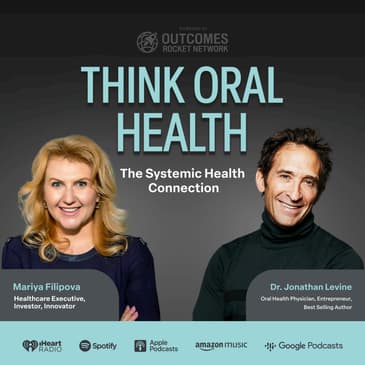
Back by popular demand, this fan-favorite episode is one you won’t want to miss! Whether it's your first time tuning in or you're revisiting this classic, dive in now and enjoy one of our most listened-to episodes!
Transformation begins with a commitment to smile and a commitment to show up and do the work that needs to get done.
In this episode, Mariya and Jonathan interview Eric Pulver, Oral and Maxillofacial Surgeon, and Gerard Meuchner, Chief Global Communications Officer at Henry Schein. They share their experience having attended the GLO Good Foundation oral health mission at Eleuthera, Bahamas that we covered in episode one with Lenny Kravitz. The mission involved caring for people’s needs, addressing tooth decay, extensive teamwork, leadership efforts, and commitment from everyone involved to have positive results. The outcome was extraordinary. Eric and Gerard share how this experience informed their views on access to care and transformed their outlook on serving others.
Listen to this episode and learn how the work that was done in Eleuthera Bahamas can give you inspiration and ideas to make care more equitable and accessible in your boardroom, practice, and community.
Resources:
- Connect with and follow Eric Pulver on LinkedIn.
- Connect with and follow Gerard Meuchner on LinkedIn.
- Discover the Pulver Oral Surgery Website!
- Follow Henry Schein on LinkedIn.
- Visit the Henry Schein Website!
[00:00:04] Welcome to Think Oral.
[00:00:06] Where we connect the unconnected between oral and physical health.
[00:00:10] I'm your host, Dr. Jonathan Levine.
[00:00:13] And I'm your host, Maria Filipova.
[00:00:15] Let's get at it.
[00:00:23] Hello everybody and welcome to the Think Oral podcast.
[00:00:27] We are so excited to have two very special guests on this show.
[00:00:32] Dr. Eric Holder.
[00:00:34] He's a dear friend, oral surgeon, academic, private practice, and living in the innovation space in dentistry.
[00:00:42] And one of the great thought leaders around how do we take these innovations and how do we connect the dots between oral health and overall health.
[00:00:50] Our other guest is Gerard Meuchner.
[00:00:53] He is the Chief Global Communication Officer of the company Henry Schein.
[00:00:59] Henry Schein is an amazing company in dentistry that spans all the way from distribution to how do we support the dental practices in many ways.
[00:01:09] The connecting thread between these two gentlemen is they were on our Glow Good Foundation mission just about, what was that, about three, four weeks ago.
[00:01:21] December, right.
[00:01:21] Yes, and the free Christmas time.
[00:01:23] Yes.
[00:01:23] That's right.
[00:01:24] And my partner in crime on our Think Oral podcast, Maria Filipova, is right here.
[00:01:31] So we're super excited to kick this off because that thread was we were at the Glow Good Foundation mission.
[00:01:38] So maybe I could start with Gerard.
[00:01:41] Your Henry Schein Cares made this mission one of the most extraordinary ones.
[00:01:47] It's our sixth mission.
[00:01:48] We were out for three years because of COVID-19.
[00:01:51] Henry Schein Cares with a team.
[00:01:53] We were on the phone with them every week of about eight people making it possible to bring in new equipment, bringing in new technology with 3D printing, special types of testing for diabetes, connecting the dots for this mission where people do not have access to care.
[00:02:11] It would be wonderful to hear from you and your experience and share some of the thoughts you had when you were there.
[00:02:18] Thank you, Jonathan.
[00:02:19] Thank you for allowing us to be on the podcast.
[00:02:21] Thank you most especially for the opportunity to participate in the mission work of Glow Good Foundation, Henry Schein Cares and our foundation.
[00:02:30] The Henry Schein Cares Foundation was just delighted to be a part of it.
[00:02:33] And I think it would be helpful if I just took a quick minute to provide just a little history.
[00:02:39] So Henry Schein celebrated our 90th anniversary last year.
[00:02:42] And one of the reasons the company has been able to thrive is this notion that I've heard you express as well, Jonathan, the notion of doing well by doing good.
[00:02:51] When Franklin had this phrase about enlightened self-interest.
[00:02:54] And so we're always happy where we can to find like-minded individuals like yourselves, like Dr. Pulver, where we can give back to society.
[00:03:04] Our view is if you're volunteering your talent and your skill to provide care for individuals, we feel a responsibility to provide what we can.
[00:03:15] In this case, it was supplies and equipment to help you do the work that you do to bring smiles to folks who otherwise would not have received oral care.
[00:03:24] Yes, we were just delighted to be a part of this mission.
[00:03:27] I had the great privilege of personally attending.
[00:03:31] I'd not been to the mission before.
[00:03:33] I really didn't quite know what to expect.
[00:03:35] And I will tell you, it was one of the most life-affirming experiences I have ever had.
[00:03:41] And in two ways, to see the smiles of folks who quite a few has waited years to receive a full set of dentures and to receive the care that they can't receive for all practical purposes on a loose throw was really heartwarming.
[00:03:55] But what I didn't anticipate and was also as heartwarming is the team from your practice, from JBL, from the extended network of folks from JBL who took the time to volunteer their services and literally were on their feet all day long providing extraordinary care.
[00:04:14] Care that in many ways was more advanced than the care many Americans receive in the biggest cities in the United States was just absolutely mind-blowing to me.
[00:04:25] And never once did anyone ever complain.
[00:04:29] Everyone was happy.
[00:04:30] Everyone was smiling and hugging.
[00:04:32] It was just an extraordinary exchange of joy.
[00:04:35] That was a word I remember you and I discussing one day down, Jonathan, while we were waiting for the bus.
[00:04:40] It was an accumulation of joy of a kind that I hadn't ever seen before.
[00:04:45] And it was really just so satisfying.
[00:04:47] And every person who participated said, we get as much out of this as I think the patients receive from us.
[00:04:54] Just extraordinary.
[00:04:55] I send you my congratulations and we look forward to playing our part in future mission.
[00:05:01] Thank you so much.
[00:05:02] It really does take a village.
[00:05:03] And what you said, like-minded people coming together with a kind of a purpose in mind that we could do well and do good at the same time.
[00:05:11] Henry Schein cares and all the folks there that have been so helpful to bring this to life.
[00:05:17] And then as we experienced it, because this was our sixth mission, it was for me personally quite transformative.
[00:05:23] And the feedback I got from people similarly.
[00:05:26] And that's something to think about is we're helping these people.
[00:05:30] But what happens to these professionals who leave their job and they're helping these people who have no access to care?
[00:05:39] Everybody thinks they've they're forgotten.
[00:05:42] They've walked around in pain thinking that's normal.
[00:05:45] And Dr. Pulver, you came down.
[00:05:48] You brought your family.
[00:05:50] Tell us personally, what was the impact for you through the experience on the days that you've spent at the Glow Good Foundation and the mission?
[00:05:58] Yeah, I'd love to share.
[00:06:00] It was super powerful for all of us.
[00:06:02] Before I do that, I wanted to thank you, Jonathan and Maria, to have included me in the Think Oral podcast.
[00:06:09] Because I think the message is so important for our profession.
[00:06:12] And I hope that we're able to spread that word and get people to make real change from it.
[00:06:17] So thank you again for including us.
[00:06:20] And really, when I first said, hey, I'm coming, I remember Jonathan talking about it.
[00:06:26] And he was describing it in a way that I said, I have to be part of that.
[00:06:31] I didn't know quite what I was getting involved with.
[00:06:34] But I knew if I was getting involved with something that Jonathan was doing, it was special.
[00:06:37] And I told my wife, hey, we're going to go down there.
[00:06:40] And I think that she first thought, what's the resort like?
[00:06:43] Or where are we going to go?
[00:06:45] And it was one of the most profound experiences we all had as a family.
[00:06:51] But I think that what's important is that you can go and participate in these things.
[00:06:56] But the way that Jonathan, you and your team, the Let Love Rule, Glow Good Foundation, put the event together.
[00:07:04] And Cody and Julian and Stacey was so well organized that I think it got the energy level of the team at a place that I'd never seen before.
[00:07:15] And everyone was participating and communicating.
[00:07:19] And I got your back.
[00:07:21] And then some like the improv stuff that you learn.
[00:07:23] And it was really a living kind of ecosystem between the patients and the providers.
[00:07:30] People coming in, that was the support teams bringing patients in.
[00:07:33] And then you'd see the patients.
[00:07:35] The gratitude was all the way around.
[00:07:37] And I kept learning more about Jonathan, like an onion being peeled, right?
[00:07:42] And it just keeps going.
[00:07:43] It never stops.
[00:07:44] And I keep pointing out there.
[00:07:46] I know it wasn't just you.
[00:07:47] It was a team.
[00:07:48] You need that leadership.
[00:07:50] And I learned a lot about leadership, a lot about understanding how to group dynamics and how to make that happen from this experience.
[00:07:57] So I started off thinking I could go and I would give back.
[00:08:02] But I think we as a family received more than we gave.
[00:08:06] And I think that that's and it's still affecting us.
[00:08:09] And we're still talking.
[00:08:10] We can't wait till next year to participate in that same experience.
[00:08:14] And the biggest challenge is that people are reaching out saying, how can we do this?
[00:08:20] And it's thank goodness I got to experience this now because not everyone can go.
[00:08:26] And so there's not enough room, but there's not enough of us to help all the patients that need help.
[00:08:31] That's right.
[00:08:32] And as the person who did not make it to that mission, the only person in the conversation, could we?
[00:08:38] And I love, Jonathan, that you teed this up with how much the people who were part of the mission took out of it and the personal and professional transformation for each and every member of that mission.
[00:08:49] Could we just do some context setting for those listeners of ours who were not in the mission?
[00:08:56] The island of Eleuthera is actually a microcosm.
[00:08:58] It's a small island in the Bahamas.
[00:09:00] It's in fact a microcosm that serves as a small scale representation of the barriers to access we experience in the U.S. healthcare system.
[00:09:09] One part-time dentist for the entire island.
[00:09:12] The population still is unfortunately or fortunately has been exposed to the Western diet, the sedentary lifestyle, the lack of dental insurance.
[00:09:21] This is all pervasive in the community of the small island in the Bahamas, but it also could be true for any of the multitude of dental deserts in the U.S.
[00:09:31] And so for me, it's very interesting to hear what this group of small, mighty mission-driven professionals were able to accomplish in the island of Eleuthera,
[00:09:42] because I really want to be able to tease out what we could translate in some of the communities who need the care in the U.S.
[00:09:50] So let's level set.
[00:09:51] What was the mission set out to do?
[00:09:55] And what are the lessons we could apply outside of the Bahamas?
[00:09:59] Very quickly, the goal and objective, and it was our sixth one, with the support of Henry Schein Cares,
[00:10:05] we truly flipped the switch for us as a foundation on the delivery of care because of the level now we can operate with real equipment.
[00:10:13] Now we have a three-standing clinic where we can be operating it literally all year long, but it was to level set the inequality of dentistry.
[00:10:25] You have people with no access to care, no education in schools, modern diet, sugary drinks, and an oral health disaster.
[00:10:32] And as we also know, an overall health systemic inflammatory disease disaster from diabetes to hypertension to cardiovascular disease.
[00:10:41] And so as a mission, we wanted to hit on all cylinders of the delivery of care.
[00:10:47] So we had periodontists, oral surgeons like Eric Pulver, hygienists, prosthodontists, and technicians fabricating prosthesis,
[00:10:55] both from a digital 3D printing standpoint and also the analog.
[00:11:00] That was the goal and objective.
[00:11:01] How do we level set this playing field to change inequality?
[00:11:05] And also to your point, Maria, to take those learnings from this microcosm of Eleuthera and being more expansive so that the industry can get elevated and we could help cross-pollinate and seed,
[00:11:20] whether it's other NGOs, other not-for-profits, or the dental profession in general, how do we create greater equality?
[00:11:27] Love it.
[00:11:28] Eric, anything that you would do differently after the mission, personally and professionally?
[00:11:31] We did have a debriefing and share some information.
[00:11:35] And one, it's criticism or constructive ideas when you're sharing them with something that's come along so far.
[00:11:44] It's nice to be able to share them.
[00:11:46] How they're implemented is a team discussion.
[00:11:49] I think that being able to build efficiencies into being able to identify and perhaps screen the patients more clearly ahead of time,
[00:11:57] having some patients come in earlier in the week that might need deliveries or certain prosthetic components later might be helpful.
[00:12:05] Identifying some of the hypertensum patients or diabetic patients or ones that we could maybe make an impact on their overall health with education
[00:12:15] and putting sessions together could be really beneficial.
[00:12:19] And maybe even offering some implant solutions would be something that I'm focused on helping to provide as well.
[00:12:26] Because after all, we're providing, going to clean up the infection, reduce inflammation, help people's systemic health.
[00:12:33] And then we want to keep them healthy by giving them something they can not only look great in,
[00:12:38] but function and chew their food and have proper digestion of the nutrients, right?
[00:12:43] And really make that impact.
[00:12:44] And that is an impact, Maria, that can be made here in the United States.
[00:12:48] And I think that it's from things like this and conversations like we're having now experiences like that,
[00:12:54] that we can make the change happen.
[00:12:56] So a number of those things might be helpful.
[00:12:58] It was staggering to me because you had a total of two sets of missions, if you will, four days each,
[00:13:04] 50 practitioners, clinicians, nurse practitioners, dentists, hygienists working 12, 13 hour days.
[00:13:12] Walk me through that integrated process that revolved around the patient.
[00:13:16] Yeah, to just jump in, we had COVID testing for 1,200 people.
[00:13:21] We were able to see 850 and we did services.
[00:13:25] Each person had about two or three services.
[00:13:27] So we did over 2,500 services.
[00:13:29] Public health team from Boston University under Michelle Henshaw went into the schools 10 days earlier,
[00:13:34] screen, fluoride treatment, brushing programs.
[00:13:37] And then we treated anybody who had decay.
[00:13:40] This is critical because this is a proactive approach that we all live with access to care.
[00:13:45] They don't.
[00:13:46] That decay becomes a life-threatening issue for the people of Eleuthera in the past.
[00:13:52] No longer.
[00:13:53] The question is, how do we take these learnings?
[00:13:56] And a lot of it is that whole proactive wellness model.
[00:14:00] What we did at the mission, to answer your question, is we started with COVID testing,
[00:14:04] registration, and then our nurse practitioners went into work and got baseline medical from a
[00:14:10] standpoint of blood pressure, hypertension.
[00:14:12] And we were doing A1C testing and healthcare questionnaires.
[00:14:16] But the question is, how can we improve?
[00:14:19] Clearly, if we can have more of a medical partners there at the mission, this cross-pollination
[00:14:26] is going to go to a much higher level to what Dr. Pulver is talking about.
[00:14:30] Gerard, I'd love to bring it over to you because Henry Schein lives in medicine and dentistry.
[00:14:36] And they are very much a truly an incredible company that's very innovative for a company
[00:14:42] their size.
[00:14:43] What do you think is possible as we whiteboard in the future for the foundation?
[00:14:48] What can we do to connect the dots between dentistry and medical and to not only upgrade
[00:14:54] their oral health, but also to diagnose?
[00:14:57] And how do we help their overall health?
[00:14:59] Thank you, Jonathan.
[00:15:00] As you mentioned, Henry Schein, of course, is the world's largest dental company.
[00:15:04] We also have a very large and thriving medical business as well.
[00:15:08] And increasingly, we're seeing that intersection of medicine and dentistry.
[00:15:12] Where we see it most notably, among other places in the United States, is in community health
[00:15:18] centers, because community health centers are designed to have both medical and dental services.
[00:15:23] And so it seems to me what you're envisioning for Eleuthera and beyond is the equivalent of
[00:15:30] a community health center where folks can go and get first-rate dental care, first-rate
[00:15:35] medical care.
[00:15:36] And obviously, we know that the intersection of those disciplines is increasingly evident
[00:15:43] from a clinical perspective.
[00:15:45] You and Dr.
[00:15:45] Bulber are the clinical experts.
[00:15:47] You can speak to that with greater intelligence than I can.
[00:15:49] But we see this movement where there is the ability to have joint mission sessions, if you will,
[00:15:59] whereby we're taking care of both the medical issues and the dental issues.
[00:16:04] Dr.
[00:16:04] Paul, we knew it mentioned some debriefing in your comments.
[00:16:08] I've had exactly that discussion with Dr.
[00:16:10] Levine's team, most notably Jessica Machado, who was the person from JBL who organized it.
[00:16:16] And we'll be having our own debriefing session in the weeks ahead to think about the workflow
[00:16:21] of all this, right?
[00:16:22] So we're going to create something that's more permanent.
[00:16:25] What does the workflow need to look like so that the clinical support we provide to you
[00:16:31] is optimal for that time and that place and that setting?
[00:16:34] So we see enormous opportunity here.
[00:16:37] And one of the things, Jonathan, we discussed in Eluthera is this idea of taking this mission
[00:16:44] beyond Eluthera because the need is so great, not only in the Bahamas, but even in the United
[00:16:50] States, the wealthiest country in the world.
[00:16:53] We have these extraordinary pockets of...
[00:16:56] Disparities.
[00:16:58] Disparity where people don't have access to care in places like the Ozarks, Appalachia,
[00:17:03] all throughout the United States and certainly in the inner cities, right?
[00:17:06] And so what we're doing at Eluthera, I think in many ways can become a pilot for the rest
[00:17:12] of the world and we're happy to be a part of it.
[00:17:14] I love that.
[00:17:15] I actually, and to Jonathan, to you, I was maybe presumptuous in assuming that what you,
[00:17:23] each one of you learned personally and professionally in that mission will impact the way you practice
[00:17:30] care, treat your patients and personally think about joy and that feeling of being rewarded
[00:17:38] from the work you do in helping patients.
[00:17:40] So how has that mission changed that for you?
[00:17:43] If at all, Eric, you're joining us literally from your office.
[00:17:47] You just stepped away from care of a patient.
[00:17:49] And so has a couple of days now after the mission, has the mission changed the way you take care
[00:17:56] of patients or the way you think about organizing workflows in your practice or will be in the
[00:18:01] future?
[00:18:02] Yeah, I think that's what it did.
[00:18:04] It served as a reminder of what we're doing is more than your day-to-day routine job and
[00:18:10] that the gratitude that patients shared with us.
[00:18:14] I don't know, I think a lot of us were thinking we could do so much more and this is what we're
[00:18:19] doing.
[00:18:19] And yet what we were doing was beyond the expectations of our patients.
[00:18:23] And it brought home the importance of what oral health care providers do and what we do
[00:18:29] working as a team and as a group with everyone together, including the medical side.
[00:18:35] And one of the things that I did like about what we were doing that I thought was impactful
[00:18:41] was that we were very efficient with it.
[00:18:43] So things got done relatively quickly, not in a rush, but we would take teeth out.
[00:18:50] We'd have a patient wait, they got scanned, they might then get ready for their prosthesis
[00:18:55] and they weren't coming and going and coming and going and multiple different appointments.
[00:18:59] So I think that workflow and building efficiencies and making it convenient and using the digital
[00:19:05] workflow or virtual consultations, or these are things that I'd love more of our team
[00:19:11] to experience and other teams around the country to see where that is.
[00:19:15] And maybe the fact is that not everyone can go to another country.
[00:19:18] Not everyone has a passport.
[00:19:20] But if we can have sites like that, people can take their teams to experience that whole energy
[00:19:26] of working together and you can bring that back.
[00:19:29] That could serve as one of those beyond what your income is or your salary or beyond what
[00:19:36] your job is.
[00:19:37] The thing that motivates you to be part of a team and to keep going in oral health care
[00:19:41] because we can make a real change in our patients.
[00:19:44] So that's what I've taken home.
[00:19:46] I'm still quite honestly trying to figure out how to share that because not everyone was
[00:19:51] there with me.
[00:19:51] So how do we go back and implement it back at home?
[00:19:54] And how do we carry that love into the practice and around?
[00:19:58] That's the challenge.
[00:19:59] And we'll keep working on it.
[00:20:01] If I may make an observation, what struck me, and I'm not a clinician, is the experience
[00:20:07] within the clinic.
[00:20:09] There was such a sense of teamwork and camaraderie and joy.
[00:20:13] We keep using this word joy.
[00:20:16] I never ever saw anyone who wasn't smiling.
[00:20:20] I never saw one moment of anyone being upset.
[00:20:23] And one of the things that struck me personally, particularly as someone who lives in the New
[00:20:29] York City area, and Jonathan, you're from New York, you know, we're kind of wired to be
[00:20:33] a certain way, right?
[00:20:35] And we get anxious if our lattes aren't made correctly and all of this kind of stuff, right?
[00:20:41] And I sat more than once outside with the patients and struck up conversations.
[00:20:47] And never once over the two days I was there did I see anyone approach the reception desk
[00:20:52] to say, when's it my turn?
[00:20:53] How much longer do I have to wait?
[00:20:55] All of the questions that we constantly ask in our big city lives, none of that ever happened.
[00:21:01] Everyone was just so pleased to just be there to receive this care.
[00:21:06] And so when I think of that experience, I think that's the kind of experience we can transport
[00:21:12] everywhere because it goes beyond the clinical care.
[00:21:16] It says, I want to go to a dental practice where you feel that sense of teamwork and joy
[00:21:22] and commitment for a higher purpose, which I'm sure is what people experience at JBL and as
[00:21:28] well as at pulver oral surgery.
[00:21:31] And that's really, to me, what was so striking.
[00:21:34] Just to put a coda on the story, one of the doctors has a practice that is devoted to cosmetic
[00:21:42] dentistry.
[00:21:43] And she had indicated to me that the work she did at some point becomes a little frustrating
[00:21:49] because it becomes vanity after a while.
[00:21:52] And she was having this kind of existential moment about whether the work she did as a
[00:21:58] cosmetic dentist had any great value.
[00:22:01] And then she started doing the mission work and that became her why.
[00:22:05] And so all of the skills and training she gets, caring for folks who are very privileged as
[00:22:10] a cosmetic dentist, provides for her a foundation to do the work that she finds particularly
[00:22:14] rewarding, which is giving smiles to people who, frankly, and you both know this, weren't
[00:22:20] smiling at all because they were embarrassed not to have teeth.
[00:22:23] To me, that was why I found all of this so life-affirming and the kind of feeling that
[00:22:29] we can transfer to our personal, professional.
[00:22:32] I would like to just build on that for a second is that as dentists, I've been doing this a
[00:22:37] little over 30 years, right?
[00:22:38] And we don't have Olympics or like a Stanley Cup.
[00:22:41] I'm Canadian.
[00:22:42] Or it's like we don't have that, right?
[00:22:44] But this was like that in a way, because usually you see people at meetings and you talk to
[00:22:50] people, but you don't do what you're really great at doing or what you do all the time
[00:22:55] with those people.
[00:22:56] And you get to share that in a different way and learn from each other.
[00:23:00] Doing your profession, when you care a lot about taking it to the most precise, careful,
[00:23:08] highest level that we can possibly practice on.
[00:23:11] And you put everyone together on a team that's doing that in a situation where maybe we have
[00:23:17] all this great equipment, but we still don't quite have our favorite hockey stick or, right?
[00:23:23] We're working together and making it happen.
[00:23:25] And it's a magic, right?
[00:23:26] And you get that flow.
[00:23:27] That's really rewarding.
[00:23:29] But it also allows us, we can't forget that Jonathan was doing digital scans and sending
[00:23:35] them off and getting them sent back.
[00:23:36] And we had a 3D printer.
[00:23:38] So we're using technology that a lot of offices still have to adopt in the United States.
[00:23:44] You can learn digital.
[00:23:46] You can learn oral surgery.
[00:23:48] You can learn endo restorative.
[00:23:50] You can learn health concerns.
[00:23:52] While you're also on a mission trip working to help people, there's a lot of really interesting
[00:23:58] opportunities that we can unravel within that whole experience.
[00:24:02] And you also learn about giving back and what you get from that.
[00:24:07] It all ties in.
[00:24:07] Beautiful.
[00:24:08] Something really big.
[00:24:09] But I'm listening to that.
[00:24:11] And we all shared, we shared this experience together.
[00:24:13] And Maria has heard a lot about it from me.
[00:24:16] What can come out of this is what we learned here, which was a lot about being inspired together,
[00:24:23] about sharing our thoughts together, about bringing the joy.
[00:24:28] And we talked about that a lot.
[00:24:30] And we talked about servants, serving people and leadership from a servant leadership perspective
[00:24:37] to inspire people.
[00:24:40] And that cut both ways.
[00:24:42] Because if we were doing a four o'clock stretch and we were dancing and then the patients would
[00:24:48] get up and they were dancing with us, that just is an emblem of that.
[00:24:52] Lenny Kravitz would walk in.
[00:24:53] And Lenny Kravitz walks in.
[00:24:55] This is a crazy place.
[00:24:56] But there are things, teachable moments here that I think we're figuring out at this mission
[00:25:01] that we can put in other missions in other places.
[00:25:04] And I love that Gerard said that.
[00:25:05] A community health system that is one big room where you literally have everybody that
[00:25:12] is working in sync like a good Broadway play working together for one reason, for the care
[00:25:18] of these patients.
[00:25:19] And of course, we get more than the patients because that's what happens.
[00:25:23] Our souls are filled up with the feeling that we're helping these people and we're doing
[00:25:28] it together.
[00:25:28] And it does give us, as Simon Sinek would say, our why.
[00:25:31] So I think there's quite a bit as we'll move forward here to think about what can we pull
[00:25:37] from this?
[00:25:38] What was really working to do more of it here?
[00:25:40] But also to think about how do we scale this so that our profession can generate leaders
[00:25:47] in their individual practices and their individual companies that understand that company is culture,
[00:25:54] that if you're going to do well, you've got to do good, that you have to have a social
[00:25:58] responsibility.
[00:25:59] And I know we all feel it.
[00:26:00] And that's why we've come together.
[00:26:02] And I'm so excited that I got you.
[00:26:04] Eric, you on this podcast with Gerard, because the first one we had Lenny on and we were playing
[00:26:11] some music with him.
[00:26:12] And it was really fun because it all came out of that conversation I had with him eight
[00:26:17] years ago and said, help my people.
[00:26:19] And I brought people and let's go help them.
[00:26:21] And it's evolving.
[00:26:23] Yeah.
[00:26:24] I also don't want to overlook another important partner that we haven't mentioned yet, which
[00:26:28] is Sprint Ray, which provided the 3D printers.
[00:26:31] And to your point, Dr. Baldwin, we were using, you were using those printers in what might be
[00:26:37] regarded as less than optimal circumstances, right?
[00:26:41] And yet the outcome was extraordinary.
[00:26:43] The product was extraordinary.
[00:26:45] It worked exactly as we needed it to work.
[00:26:47] And I think there's a wonderful lesson there about how easily one can incorporate digital
[00:26:52] into a practice.
[00:26:53] If you can do it in a Lutheran, in a building that was never designed for its purpose, I think
[00:26:59] we can do it most anywhere.
[00:27:01] That's a great message.
[00:27:02] And that's exactly right about new innovation, new technology.
[00:27:05] Unfortunately, in our fragmented industry, that is changing phenomenally fast.
[00:27:11] Thank God.
[00:27:12] The adoption rate that takes 17 to 20 years is getting a little bit faster.
[00:27:18] And with the high energy of these younger dentist generation, the adoption of digital technology
[00:27:24] to improve the efficiency of what we do.
[00:27:27] Like Gerard says, if we could do it in a Lutheran, we could do it everywhere.
[00:27:31] I think that's a good fight song.
[00:27:34] 100%.
[00:27:34] Yes.
[00:27:35] Yes.
[00:27:36] Absolutely.
[00:27:36] Let's talk a little bit about that, though, because I know enough about this mission to
[00:27:41] know that the Lutheran is a special place.
[00:27:44] Not only, and I raise my hand and I say I'm the first person who prompted the idea that
[00:27:48] what we did in Lutheran could apply in somewhere else.
[00:27:51] However, Lutheran is special.
[00:27:53] Not only because of Lenny Kravitz, but because you could pick up the phone and have the Minister
[00:28:00] of Health and the Minister of Education and the Minister of Transportation and the public
[00:28:04] service be all in the same room, if not be the same person.
[00:28:08] So the level of collaboration, integration and timelines that are required for different
[00:28:16] disciplines to come together is a privilege.
[00:28:19] It's unprecedented.
[00:28:19] So how much of that Lutheran-specific magic needed to be there for this model to hold true?
[00:28:28] I have some thoughts on that.
[00:28:29] I think that if you took like a root cause analysis, let's say not quite, what are the essential
[00:28:35] components that then and then Lenny put together over the years to create this?
[00:28:41] What are the building blocks?
[00:28:42] Then you have to find people with similar influence, similar opportunities to create this in another
[00:28:50] location because you really need some of the hardworking and organization and skill set that
[00:28:57] Jonathan and his entire family have.
[00:29:00] You need some of the charisma and notoriety that Lenny may have.
[00:29:04] You need to then connect the local people because there's got to be something that drives you
[00:29:10] to this place.
[00:29:11] Why is this place important to you?
[00:29:14] Who are the people from that place, from that community that will allow instant credibility
[00:29:20] and acceptance amongst the people living there?
[00:29:23] And when you put all that together, and I'm not saying this is all there is to it, but this
[00:29:28] is already a lot.
[00:29:29] How can you recreate that?
[00:29:31] And how do you get buy-in?
[00:29:32] And then you need to show someone what happened in a loose run.
[00:29:36] And then they may be able to go with some help to have that happen somewhere else.
[00:29:41] That's exactly right.
[00:29:42] Like all businesses, you're building a playbook to what Gerard was talking about before and
[00:29:47] it's systems and protocols.
[00:29:49] But it's also people, their own personal mastery when it comes to building culture and leadership.
[00:29:55] And that's why I think we could use, Eric, you and I talked about this at the foundation.
[00:29:59] We could use this experience to bring dental professionals who own dental practices to experience
[00:30:05] what we are experiencing and then to help set them up and take it to their community.
[00:30:11] Every community has an access to care problem.
[00:30:15] That's the truth.
[00:30:16] And so you don't have to go very far to a place where it gets very emotional and passionate
[00:30:22] to help the people in your community.
[00:30:24] And that's bringing like-minded people to Eleuthera, but then generating a class of people that
[00:30:30] could then take it further and using what we have and what we're learning together as
[00:30:35] a team.
[00:30:36] Guys keep saying my name, but I really am very humbled about the fact that this has been such
[00:30:42] an extraordinary team.
[00:30:43] We met you, Jessica Machado, Julie Terrison, all of my family, all of the people involved,
[00:30:49] over a hundred professionals.
[00:30:50] And every person gives it their all.
[00:30:53] These hygienists, they work in 13, 14 hours, all of us standing on our feet.
[00:30:58] And we have so much energy that we have a really great time at night also.
[00:31:02] And it's this juxtaposition of working hard, but having so much joy and happiness together
[00:31:07] that I think just inspires all of us to do more and to take this as a jumping off
[00:31:13] spot to really evolve this and to move it forward.
[00:31:17] Yeah.
[00:31:17] Sad.
[00:31:18] Agreed.
[00:31:19] Agreed.
[00:31:20] Terrific.
[00:31:21] Maria, any closing thoughts do we have for Eric and Gerard?
[00:31:25] I'd like to close with a note of gratefulness.
[00:31:30] First of all, for you making yourself available to that mission and then making yourself available
[00:31:33] to share your experience with us.
[00:31:36] And also maybe with a shared thought for the responsibility that we all carry is those of
[00:31:43] us who've experienced something so profound and meaningful.
[00:31:47] We do have that responsibility to talk about it, to share the lessons learned and to evangelize
[00:31:53] others who might not necessarily be, have been exposed to this different way of thinking
[00:31:59] and different way of integrating care.
[00:32:01] Because I do believe that it's one person at a time, one conversation at a time, one example
[00:32:06] at a time that's going to take for us to really see the change that we've been envisioning
[00:32:12] for the last couple of years.
[00:32:14] So with that, very grateful for your time and very excited and hopeful to hear about what
[00:32:19] we do next.
[00:32:20] Thank you, Eric.
[00:32:21] Thank you, Gerard.
[00:32:23] Thank you.
[00:32:23] I leave us with all the thought that we're just getting started.
[00:32:29] Thanks for listening to the Think Oral podcast.
[00:32:32] For the show notes and resources from today's podcast, visit us at www.outcomesrocket.health
[00:32:41] slash think oral.
[00:32:43] Or start a conversation with us on social media.
[00:32:46] Until then, keep smiling and connecting care.