
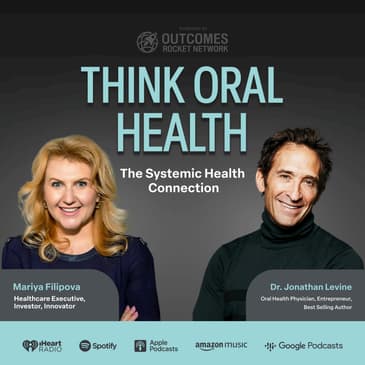
Back by popular demand, this fan-favorite episode is one you won’t want to miss! Whether it's your first time tuning in or you're revisiting this classic, dive in now and enjoy one of our most listened-to episodes!
Welcome to the inaugural episode of the Think Oral Health Podcast!
In the first Think Oral Health episode, Mariya Filipova and Jonathan Levine are joined by rock star Lenny Kravitz to discuss the connection between oral health and overall health. The conversation between Jonathan, Mariya, and Lenny centers around the topic of access and the work Lenny and Jonathan have done in the Bahamas to bring oral health care to the local communities of Eleuthera Island. It all started when Lenny Kravitz showed Jonathan how bad the situation was, which inspired them to bring a growing team of doctors and dentists to the island to bring back people’s health, self-esteem, and smiles.
Join the discussion to learn more about Lenny’s purpose and mission behind oral health access and how it intersects with Mariya and Joanathan’s similar mission.
Resources:
- Connect with and follow Lenny Kravitz on Instagram and Twitter.
- Explore the GLO Good Foundation Website.
- Discover the Twice Website.
- Read Mariya’s article titled “Lessons From My Journey As An Activated Patient: Why We Need Oral Health Care Innovation” and published on Forbes!
- Find more information about Let Love Rule here.
Think Oral Health is coming to HLTH. We are partnering with the Health Podcast Network and HLTH to bring you breaking news and updates from one of the largest health and innovation communities. Join us! Use this link to register: https://healthpodcastnetwork.com/hlth-registration and get a special discount on us. (Saves $250) Leave a comment to receive the discount code.
[00:00:04] [SPEAKER_03]: Welcome to Think Oral, where we connect the connected between oral and physical health.
[00:00:11] [SPEAKER_02]: I'm your host, Dr. Jonathan Levine.
[00:00:13] [SPEAKER_03]: And I'm your host, Maria Filippova.
[00:00:15] [SPEAKER_02]: Let's get at it!
[00:00:21] [SPEAKER_03]: So here we are, episode 1 of The Think Oral Health podcast.
[00:00:27] [SPEAKER_03]: Jonathan, why are we here?
[00:00:28] [SPEAKER_02]: Well, Maria, I am so excited to do this with you.
[00:00:31] [SPEAKER_02]: This really grew the whole concept organically.
[00:00:35] [SPEAKER_02]: We can go back to the first time we met with...
[00:00:38] [SPEAKER_02]: Oh, I don't know about it.
[00:00:39] [SPEAKER_02]: 78 years ago.
[00:00:41] [SPEAKER_03]: Yes, but who's counting?
[00:00:42] [SPEAKER_02]: Well, you know, we lost a couple of years there with COVID,
[00:00:45] [SPEAKER_02]: but there we were at exponential medicine on the west coast with the Daniel Kraft and team
[00:00:51] [SPEAKER_02]: and talking about health care innovations.
[00:00:54] [SPEAKER_02]: And that really, when we first met, it started us off realizing that it would be fun
[00:00:59] [SPEAKER_02]: to probably work together and to keep talking about the different healthcare industries.
[00:01:04] [SPEAKER_02]: And really, I always kind of talked about how oral care or oral health and
[00:01:09] [SPEAKER_02]: dentistry is so separate from medicine.
[00:01:12] [SPEAKER_03]: I don't know if I told you that, but I still remember we had a full day of speakers,
[00:01:18] [SPEAKER_03]: talking about the future of health and genomic sequencing and how the cost of the genome sequencing
[00:01:24] [SPEAKER_03]: is going to come down to in the hundreds of dollars and it's going to be accessible
[00:01:28] [SPEAKER_03]: and 3D printing and artificial intelligence and quantum computing.
[00:01:32] [SPEAKER_03]: And we've got a full day.
[00:01:34] [SPEAKER_03]: It was one of those eight in the morning, to eight in the evening days.
[00:01:37] [SPEAKER_03]: And I literally walked into the bar and I see this very animated gentleman who was talking about
[00:01:44] [SPEAKER_03]: dentistry and how forget all that cool stuff we talked about today.
[00:01:49] [SPEAKER_03]: Let me tell you about dentistry.
[00:01:51] [SPEAKER_03]: And so it stopped me in my tracks literally after a full day of exponential technologies.
[00:01:57] [SPEAKER_03]: And at the time I was leading the exponential technologies practice is one of the consulting firms
[00:02:01] [SPEAKER_03]: and I was thinking, okay, so how are these exponential technologies impacting healthcare?
[00:02:06] [SPEAKER_03]: Wait a minute, how about dentistry?
[00:02:08] [SPEAKER_03]: So for me personally, that was my first aha moment of dentistry as a field.
[00:02:13] [SPEAKER_03]: And then it started layers of the layers of connections and obvious opportunities
[00:02:19] [SPEAKER_03]: that we need to be cognizant of.
[00:02:21] [SPEAKER_03]: But somehow there were so obvious, yet nobody was really paying attention or doing much about it.
[00:02:26] [SPEAKER_02]: That's exactly right.
[00:02:28] [SPEAKER_02]: Just people weren't paying attention.
[00:02:29] [SPEAKER_02]: I think I was the only dentist and dental innovator at that meeting.
[00:02:34] [SPEAKER_02]: But so interestingly, genomics, digital workflow, scanning CAD CAMm, very much.
[00:02:41] [SPEAKER_02]: So a lot of the new research of the connection of aerosystemic medicine, of inflammation
[00:02:46] [SPEAKER_02]: in the mouth and relationships with the rest of the body.
[00:02:49] [SPEAKER_02]: This research is really taking the dental and oral health industry by storm as it is amplified today
[00:02:57] [SPEAKER_02]: as a very important part of healthcare.
[00:03:01] [SPEAKER_02]: And you know what they say, the mouth doesn't know that it's connected to the rest of the body
[00:03:04] [SPEAKER_02]: as Marriado said in her book, teeth.
[00:03:07] [SPEAKER_02]: And you know, it is connected, quite magically.
[00:03:11] [SPEAKER_03]: I know so many levels, right?
[00:03:12] [SPEAKER_03]: If you have untreated period on all these years, you're over 20% more likely to have Alzheimer's or develop Alzheimer's.
[00:03:20] [SPEAKER_03]: So it's not only the chronic conditions around the abeities and risks of cretterm labor, but it's also cognitive decline and mental health.
[00:03:28] [SPEAKER_03]: Really excited to explore those conversations with you and our upcoming guests here.
[00:03:34] [SPEAKER_03]: And to really bring it full circle, that conversation we started at the end of a long day at a conference.
[00:03:40] [SPEAKER_03]: We have kept up over the years and what I have also discovered that the conversations you and I are having at the dinner table or the side board at the conference are also conversations others are having.
[00:03:52] [SPEAKER_03]: And we thought what a better way to give voice to those questions and we're going to celebrate the initiatives in the work of the people who are actually doing something about this.
[00:04:02] [SPEAKER_03]: So that's to me, at least that personally, I think why this is a great platform.
[00:04:06] [SPEAKER_03]: This podcast is what we really want to bring to our listeners.
[00:04:09] [SPEAKER_02]: That's right, at the end of the day we're shedding a light on the connection of oral health and overall health.
[00:04:17] [SPEAKER_02]: And as you pointed out, there are today 58 systemic inflammatory diseases that have a direct link from inflammation in the mouth.
[00:04:24] [SPEAKER_02]: And we now know that the mouth seeds the gut and we understand the gut brain access better than ever before.
[00:04:30] [SPEAKER_02]: And it also is through the circulatory system in other areas, as you pointed out. So the focus of research and science and where we are today with comp science and genomics and how bioengineering and all of these disciplines are merging together at integrating creating incredible inventions.
[00:04:47] [SPEAKER_02]: We want to bring that to the listener. We want people to know about it and we really want to connect the dots between the profession because there's tremendous inefficiencies we always talk about.
[00:04:58] [SPEAKER_03]: Yeah, I'm very excited about the opportunity to connect the dots. And we started that conversation at a conference where the future was bright shaped by exponential technologies over the years have also learned and gotten more involved in the realities of health care today and oral health today.
[00:05:18] [SPEAKER_03]: And so when we think about health care more often than not, we don't think about oral health.
[00:05:23] [SPEAKER_03]: That's what we want to change. We want to say when you think about health think about oral health as well. And when you think about the future of health care, don't only think about the exponential technologies and the futuristic shape of the industry.
[00:05:38] [SPEAKER_03]: But think about the disparities. We know that low income populations are hundreds of times more likely to have difficulty doing their job because of oral health conditions.
[00:05:48] [SPEAKER_03]: We know that minorities are also more likely to be impacted by oral health disparities. And so this conversation is about doing something today and doing something that improves the overall health for folks in rural America, those that live in dental deserts and those who live in Manhattan who have the benefit of being your patients in your clinic.
[00:06:13] [SPEAKER_03]: And that would be really important for me and for you I know personally to get that message out.
[00:06:17] [SPEAKER_02]: That's exactly right. And well, stated access to care whether it's overall health care medical issues access to care for oral health. One of the number one reasons that people are missing work is because they're having pain from a toothache just pain in their mouths.
[00:06:33] [SPEAKER_02]: But when you go to these disadvantaged areas with these inequality people think that walking around it pain is normal and unfortunately cavity that could have been taken care of become something that is life threatening.
[00:06:46] [SPEAKER_02]: In our normal day practice the dental office, it's clearly becoming the tip of the spear potentially for health care because people go to the dentist more they go to their physician and their health care professional and because of our new technologies.
[00:07:01] [SPEAKER_02]: Salivary diagnostics being a new blood diagnosis. Well, there's excitement that dentistry and connecting to medicine could forecast problems with inflammation and different biomarkers that could get connected to their physicians and their cardiologist to get to potential cardiac events or inflammatory type diseases before it runs out of control.
[00:07:25] [SPEAKER_02]: So this tip of the spear potentially as dentistry in foreshadow issues and really get more of a wellness focus for all of health care is very exciting.
[00:07:36] [SPEAKER_03]: So let me ask you this, John. Are we going to go easy on our guests here with that whole premise of building bridges asking our audience to think oral health when they think about health.
[00:07:49] [SPEAKER_03]: Asking our audience to think about the patients in Manhattan as well as the patients in the dentist deserts are we going to go easy on our conversation partners.
[00:07:59] [SPEAKER_02]: No, we're not going to go easy. We're going to be challenging these amazing people these thought leaders these innovators these educators these CEOs of these organizations all of the stakeholders of health care and we are going to challenge them to say how do we think differently.
[00:08:14] [SPEAKER_02]: How do we put our collective minds together to make a much more efficient system 20% of our GDP goes to health care things have to change and that's where you and I are so aligned on this.
[00:08:26] [SPEAKER_02]: That changes in the air changes coming and everybody knows that you need courage to change and so we're going to challenge the people a little bit and get everybody thinking about how do we improve the system and how do we improve the lives of people who don't have access to care and also who do have access to care.
[00:08:44] [SPEAKER_03]: Who can impact people around them that's right the stakes are too high and we can't have easy conversations.
[00:08:52] [SPEAKER_03]: So these are going to be honest conversations and these are going to be actionable conversations because as you said a significant part this is an industry that significant part of our GDP oral health is going to be a hundred and eighty five billion dollar industry by 2025 and there's a lot of work to be done for us to build bridges.
[00:09:14] [SPEAKER_03]: And connect dogs and deliver health to everybody who needs it.
[00:09:19] [SPEAKER_03]: And so with that in mind I'm really excited I can't wait to get the conversation started and without in mind why don't you tell us about our first guest who is one of those change engines who is not only talking the talk,
[00:09:33] [SPEAKER_03]: and is somewhat of a non conventional voice in the conversation about overall health and oral health.
[00:09:42] [SPEAKER_02]: Well it's kind of interesting because this person might be the last person you would think that would be talking about the power of the smile but what binds this person to this conversation is he greatly believes that charity begins at home.
[00:09:56] [SPEAKER_02]: And so when Lenny Cravitz asked me to bring my team and helping some of our professionals down to his island that he grew up in NASA right outside NASA on a Luthera that people don't have access to care well I said let's go do it.
[00:10:14] [SPEAKER_02]: And very organically we just started and six years later it has become very exciting and so we'll be talking to Lenny Cravitz the rock star on the public facing persona but humble person who's very focused on humanity and bringing people to more of an equality when it comes to their health and their oral health and of course they're overall health.
[00:10:38] [SPEAKER_03]: And here we are episode one of the think oral health podcast series we are so excited to kick this off we're so excited to bring our listeners into the conversation with thought leaders change agents and innovators in systemic oral health.
[00:10:56] [SPEAKER_03]: I'm excited Jonathan is excited but don't take our word for it take it from somebody who you most likely have heard of yes and we're so excited to have our first guest.
[00:11:07] [SPEAKER_02]: So we'll be starting our think oral podcast with the rock star with the humanitarian Lenny Cravitz.
[00:11:15] [SPEAKER_03]: And here we are literally at a pit stop on the way to a rock concert taking a break and having a chat with a four-time Grammy award winning artist an actor an entrepreneur a humanitarian who is a larger than life figure.
[00:11:34] [SPEAKER_03]: And not necessarily known as a dentist so he will reveal that side of him to us today very very privileged to be able to talk to Lenny Cravitz.
[00:11:46] [SPEAKER_03]: He does not have much time before he needs to get back on that bus till his next gig so let's dive right into it.
[00:11:53] [SPEAKER_02]: Art of the smile Lenny Cravitz.
[00:11:56] [SPEAKER_02]: Thank you for doing this for us you are amazing creative multi-crabmy wood winner multi instrumentalist singer songwriter sold over 50 million albums.
[00:12:11] [SPEAKER_02]: You've done so much on top of that you're an amazing design company you produce and together you joined us let love rule and blow good foundation and it kind of all started here didn't it.
[00:12:24] [SPEAKER_00]: Well first of all I'm just trying to be a dentist man.
[00:12:27] [SPEAKER_00]: You know I'm this let's what we say.
[00:12:29] [SPEAKER_00]: I just want to do what you do but yeah did start here right here at this air stream trailer.
[00:12:34] [SPEAKER_03]: Lenny and I'm sure most people introduce was myself included actually introduced as the rock star the Grammy winner the humanitarian but not many have the privilege of knowing you as the dentist.
[00:12:46] [SPEAKER_03]: And so we'll keep that our little secret between us and our audience today you know seriousness though what sparked your interest and passion for make a difference in oral health.
[00:12:56] [SPEAKER_01]: But inspires me is the need people are in desperate need of medical and dental care you know I have a lot of friends that I was just observing and I saw that they were in pain.
[00:13:09] [SPEAKER_01]: They were having chronic issues that were probably leading to other major issues and it really concerned me.
[00:13:16] [SPEAKER_01]: And so this whole thing happened very organically and I think it's really beautiful when things just happen when you follow the vibe as I say and Jonathan came down to visit me for a few days some years ago.
[00:13:30] [SPEAKER_01]: And the joke is that Jonathan is the dentist that wants to be a rock star and I'm the rock star that wants to be a dentist.
[00:13:38] [SPEAKER_01]: So we like to talk shop and I was telling Jonathan about these beautiful people that were in need of serious care and I don't think he really realized how severe it was so we got in my Jeep and we drove through the village and I stopped a bunch of people I think we ended up thinking about 15 people that Jonathan examined.
[00:13:58] [SPEAKER_01]: And he saw how bad it was and so this is how the whole mission with let LaRouille and Claude started and this is well before the thought of twice and creating oral health care products.
[00:14:14] [SPEAKER_03]: And this is so true all of us tend to forget or neither remind their everyone's in a while that health care is personal it's very local and it's very very personal.
[00:14:26] [SPEAKER_03]: I had to learn that lesson myself as a patient the 18 months that I spent as a patient fighting for my life and for my kidney dealing with a rare oversized kidney tumor really thought me more about health care than the prior decade that I was
[00:14:44] [SPEAKER_03]: spent as an executive and an advisor. And so with that grounding of the personal impact on lives and communities that health care has on people let's just make this very local and very very personal.
[00:15:00] [SPEAKER_03]: Lenny I heard and Jonathan shared a story with me about a community member in a Luther who had unbearable pain and unfortunately in the island their plumbers and their teachers and their construction workers but they are no dentists.
[00:15:17] [SPEAKER_03]: And that person needed to resort to dealing with his pain in all kinds of other creative ways including using bach pepper and cork.
[00:15:30] [SPEAKER_03]: So tell us about the impact your work has had in the community and tell us about Vardo.
[00:15:35] [SPEAKER_01]: That was the original guy I saw him in the morning. I was just watching him he works with me and I just saw him doing doing things to his mouth and I said what are you doing?
[00:15:47] [SPEAKER_01]: And he said oh man I have this most incredible toothache and there was a hole in his tooth and he was putting black pepper into his tooth to smooth the pain and then he would take a matchbook cover roll it up and use that to cork it.
[00:16:01] [SPEAKER_01]: So that was it. That guy whose name is Vardo who's a very good friend and I've known for you know 30 some ideas he was the initial inspiration.
[00:16:11] [SPEAKER_01]: And then I got far worse from there believe me it got the things that Dr. Levine was seeing these were problems that needed to be handled many, many, many years ago, you know.
[00:16:21] [SPEAKER_01]: And he put together the most amazing team we decided on that occasion that we're going to do something. He looked at me I looked at him what are we going to do we talked about it and we got right into it next thing you know we had a full blown mission going down there doctor.
[00:16:37] [SPEAKER_01]: And we put together an all star cast of doctors and dentists or will surgeons etc folks making dentures on the spot I mean it was incredible and we set up this thing that looked like something out of match you know just doctors in this one space doing incredible work and at the end of those days they had given people their smiles back given them their health back their self esteem and it was beautiful.
[00:17:04] [SPEAKER_03]: And I'm sure that as Dr. can tell you we got that much more than was given well said and what a beautiful way to describe your work and the mission that you have and the rewarding experiences that your mission has delivered to you and your team this sparks a thought in my mind that has to do with access and inequity and the disparities of access that we see.
[00:17:33] [SPEAKER_03]: And frankly not only in the uther or remote islands but here in the u.s. next to affluent communities and those disparities are equally stark and dire and yet most likely not very often seen in the light that they need to be they're not as present in our discourse when we talk about systemic health and when we talk about oral health.
[00:17:59] [SPEAKER_03]: So perhaps maybe I'd love to talk to you more about access and how the lives of folks who live in poverty or the lives of folks who are of diverse backgrounds and ethnic backgrounds have been impacted this proportionately in a negative way because of their lack of access to health care and oral health solutions.
[00:18:21] [SPEAKER_03]: And to be very very specific we know that people living in poverty or over a hundred times more likely to have difficulty doing their job because of oral health conditions.
[00:18:33] [SPEAKER_03]: They're over 200 times more likely to have an oral pain than those in high income communities and so the stories of vardo and the stories of the people in uther are also the stories of our neighbors here in the u.s.
[00:18:48] [SPEAKER_03]: And I couldn't help myself but draw those parallels and I invite you and Jonathan looking at you right now to share does that resonate with you as well.
[00:18:58] [SPEAKER_03]: And what do you think we could do here in the u.s. having seen the impact of your work in a luchera.
[00:19:05] [SPEAKER_02]: You know, access to care is an interesting concept we take it for granted because we're able to go to the dentist.
[00:19:11] [SPEAKER_02]: We learn about nutrition and we learn about oral hygiene or hygiene instructions when we go to the dentist's young people and we have that access but when you don't have.
[00:19:21] [SPEAKER_02]: And when you think that you walk around in pain is normal everything's upside down and lany is a deeply empathic person he really is and he wanted to help his people and he said, you got to come help my people and we did we went down there and then we started.
[00:19:35] [SPEAKER_02]: But the fact of matter is you know I first brought my team down we have a team with about 27 28 people that we came down in year one by year seven we had over 110 people down old specialists high genist admin ops people and lany's right it was like a mash unit but you know what's amazing everybody's working 13 hour days with the biggest smiles on their faces the most highest energy and I do a lot of things in the industry.
[00:19:59] [SPEAKER_02]: Nothing makes me happier and gives me more of a feeling a depth of joy than watching my people work their tail off and getting so much out of it.
[00:20:10] [SPEAKER_02]: And even more than the people that we really take them out of pain and for the first time they can smile with a beautiful smile and always taking pictures and selfies with our doctors.
[00:20:18] [SPEAKER_02]: So we started and it was it was just so organic year one year two years.
[00:20:23] [SPEAKER_02]: It just it was like a beautiful song that lany's playing with the crescendo of every year if there another got better and better and better.
[00:20:31] [SPEAKER_02]: Now we're looking to do something even more special to build something that is more stable with real equipment so that we can help more people and for us it's very special lany and my sons were all one big family and we're people like minded
[00:20:46] [SPEAKER_02]: and when we come together with a thought that not only we're going to do well in life but we're going to do good we're going to help people and we can level the playing field of inequality and look to do more and more every year and hopefully to inspire people in the profession to do more of this.
[00:21:01] [SPEAKER_03]: It will absolutely bring the joy it has my partner in crime lany cravat was say let love rule so incredibly grateful for so many of the insights that you've shared and I promise you this a lot of the insights you just touched on.
[00:21:17] [SPEAKER_03]: We share and we actively worked to advance wow what an impressive and inspiring story and what a way to bring humanity into what we're doing.
[00:21:26] [SPEAKER_02]: lany can surprise people but when now really family we spend a lot of time together and who would have thought a prosthetonist dental specialist working so closely with a rock star but it works so well.
[00:21:40] [SPEAKER_02]: And in fact the story about the person who puts pepper in his tooth and lany tells me that story back at the practice to really give me that narrative of why these people need help.
[00:21:55] [SPEAKER_02]: And then going down there and seeing the problem and then bringing the team there and now if you fast forward because of covid we missed three years and we just finished we just finished our six mission and we had two missions in a row four days of peace.
[00:22:14] [SPEAKER_02]: We brought down about 55 professionals for each session with support staff technicians and I must give a big kudos and thank you to our supporters people who believe in what we're doing.
[00:22:40] [SPEAKER_02]: And now that we're going into the schools with the public health team of Boston University with Michelle Hanshaw and we've been going there now our six mission.
[00:22:49] [SPEAKER_02]: We feel like we can make real change we're looking at all kinds of testing with celebrate diagnostics and a one seed testing for diabetes and you're dealing with a patient population that with education and teaching and with a combined effort of medical and dental.
[00:23:08] [SPEAKER_02]: We have nurse practitioners we're getting baseline medical dermatologists there and the more the doctors and the dentist work together you can see how you can change this population.
[00:23:18] [SPEAKER_02]: So with these missions become a microcosm of what potentially could happen as the medical population, the medical physicians and the dental specialists and dental professionals were close together improve the communication and develop technology so that we're sharing this information very efficiently.
[00:23:37] [SPEAKER_03]: Yeah, that's a great teaser and such a rich conversation to pick up on in our next episode because I cannot wait.
[00:23:45] [SPEAKER_03]: First to hear about the meaningful and measurable impact that change in people's lives that you've seen even in the short amount of time of four to eight days.
[00:23:55] [SPEAKER_03]: But secondly, the lessons you learned that are very transferable to some of those hard to reach areas and the communities who really need that care and not episodic care not dental care not health care.
[00:24:07] [SPEAKER_03]: But integrate it health and so I am really excited to follow up on the first mission that post pandemic I should say that you and the team just came back from and I can't stress enough.
[00:24:21] [SPEAKER_03]: The importance of us as executives and leaders being always grounded in the life of a patient and getting that visceral reaction and visceral grounding of why do we do what we do.
[00:24:35] [SPEAKER_03]: The frustration and urgency that only a patient can feel with our system.
[00:24:40] [SPEAKER_03]: That's what I would love for us to stay grounded in in all those episodes and remember that as you shared and as any shared in our last conversation.
[00:24:48] [SPEAKER_03]: The people who went in on the mission got as much if not more out of it than the local community who got bright new smiles and who got diagnostics and first class care.
[00:25:00] [SPEAKER_03]: So it truly is feeling good and rewarding and recharging to be able to do that work.
[00:25:05] [SPEAKER_02]: Hey Marie, I couldn't agree with you more about the why and what has come out of these missions and I'm just coming back from our sixth mission which we are going to have a group of the.
[00:25:18] [SPEAKER_02]: professionals and the people who are involved with that mission.
[00:25:22] [SPEAKER_02]: I hear this consistent theme from everybody that we get more out of this than the people were helping and we're taking people out of pain and we're giving them their smiles back the before and afters are just incredible.
[00:25:35] [SPEAKER_02]: But the why, why we do what we do and the profession we've chosen there's so much validation that comes out from the hugs and the love and this sincerity from the people that we're helping.
[00:25:48] [SPEAKER_02]: But really the like minded people that come together to take time from their busy lives and to come help these people and what ends up happening is your change forever.
[00:26:00] [SPEAKER_02]: This filling up your soul by not only doing well, but also by doing good has just a wonderful wonderful impact on us personally and finding your why as Simon Syneck would say is exactly what happens almost an unintended consequence.
[00:26:15] [SPEAKER_02]: But it does happen to everybody who I think does this kind of work and is really exciting to reflect on the feelings that we had and I know my own team back at the practice they are charged up for months and telling the stories to patients and to people.
[00:26:32] [SPEAKER_02]: What just happened and that's exactly the beauty of this that everybody has their circle of influence they go back to their lives and the idea of helping each other and having that kind of serve mentality to help people.
[00:26:47] [SPEAKER_02]: Well, if everybody is thinking that way our society is greatly improving and so this is just a small example of how we can have these levels of impact this resounding effect just by starting and everybody giving their own contribution.
[00:27:02] [SPEAKER_02]: We'll talk about it at the next episode. So until then let's connect the thoughts between oral health and health care and let's elevate their profession and elevate our mindset to look for solutions to the situation that we have in healthcare which is to improve efficiency and effectiveness for people who don't have access to care and for people who do.
[00:27:24] [SPEAKER_03]: And with that in mind I invite our listeners to join us for our next episode where we will be covering those types of questions and many more so stay tuned and in the meantime keep smiling and keep connecting the dots in health.
[00:27:42] [SPEAKER_02]: Thanks for listening to the Think oral podcast for the show notes and resources from today's podcast visit us at www dot outcomes rocket dot health slash think oral.
[00:27:55] [SPEAKER_03]: or start a conversation with us on social media until then keep smiling and connecting care.