
Imagine having a dedicated nurse advocate by your side, ensuring you receive the best possible care wherever you call home.
In this episode, Jeannemarie Bozza discusses founding Commodore Concierge Nurse Management, a unique home nursing company focused on personalized, holistic care that empowers nurses and prioritizes preventative medicine. Her passion for exceptional care led to a rapidly growing referral-based business that aims to improve patient quality of life and elevate home healthcare as an alternative to traditional settings.
Tune in as Jeannie Bozza shares how her innovative approach is transforming patient care and redefining home nursing!
Watch the entire episode on YouTube and get more details at Think Oral Health.
Resources:
- Connect with and follow Jeannemarie Bozza on LinkedIn.
- Visit the Commodore Concierge Nurse Management website!
- Watch the entire episode on YouTube and get more details at Think Oral Health.
- Mariya Filipova - https://filipova.health/
- Systemic Health Investor - https://www.4100dx.com/
- Care Convergence Thought Leader: Dental Economics
- Forbes Technology Council Member
- Jonathan Levine - www.drjonathanlevine.com
- Founder - JBL New York City www.jblnyc.com
- Founder - GLO Science LLC www.gloscience.com
- Co-Founder - GLO GOOD Foundation www.glogoodfoundation.org
[00:00:01] This podcast is produced by Outcomes Rocket, your healthcare exclusive digital marketing agency. Outcomes Rocket exists to help healthcare organizations like yours to maximize their impact and accelerate growth. Visit outcomesrocket.com or text us at 312-224-9945.
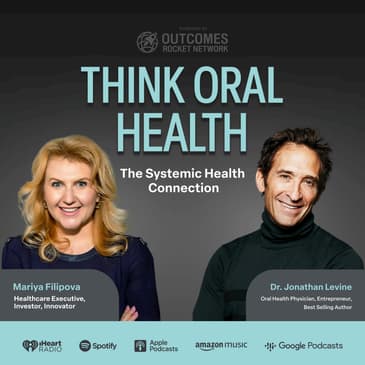
[00:00:31] Welcome to Think Oral. Where we connect the unconnected between oral and physical health. I'm your host, Dr. Jonathan Levine. And I'm your host, Maria Filipova. Let's get at it. And welcome to another edition of the Think Oral Health podcast.
[00:00:58] Boy, am I excited about our episodes today and our topics that we will be covering for you. No surprise, we're talking about cross-disciplinary care. No surprise, we're bridging silos. We're removing barriers. And no surprise, I'm here with my partner in crime and troublemaker for good, Dr. Jonathan Levine. Hi, Jonathan. How are you doing today? Oh, Maria, I'm doing great. And I'm super excited to have Jeanne Bozza joining us. And you're so right.
[00:01:28] This dental medical integration and what's happening and reinventing the systems, which is so necessary. It's going to be so exciting to talk to Jeanne and what she's built. Very excited. So welcome, Jeanne, to our podcast. We like to start off the guests by singing their praises because most of our guests are too humble to go through the amazing repertoire of things that they've done.
[00:01:53] So I'm going to ask Jonathan to tee up for our audience, your background, the perspective you bring to the conversation, and then we'll kick it off from there. Terrific. Well, Jeanne really has a very impressive resume. But to hit the high points, she reinvented this new concept. It's called Commodore Concierge Nurse Management. She's the CEO, founder. And what it is, it's an elite home nursing company.
[00:02:22] And it specializes in hospital at home care. So we're going to talk about those kind of diseases that they treat and really taking care of that patient at such an extremely high level. But she's built a team of 160 ICU nurses and 60 aides, and they're all highly trained by Jeanne herself, who is an amazing nurse as her background. They focus on treating the whole patient.
[00:02:48] So we're going to talk about this holistic approach in preventative care as it relates to the discretion and compassion you need to have with people who have many of these chronic illnesses. Well, Jeanne's got 25 years of experience as a registered nurse, and she has a mindset that she's always looking, how do we provide solutions? This solution-seeking philosophy has built her business on a passion for empowering individuals to take control of their health.
[00:03:18] How's that one, Maria? That is near and dear to our heart. One of the new things I want to talk about also with Jeanne is that the Commodore Cares Foundation, they're building a purpose-driven organization, which is the company's commitment to the individualized patient-centered care when they don't have access to care. And they're going to create a ripple effect, a really positive change in the lives of these patients.
[00:03:44] Jeanne, welcome to our Think Oral Health podcast with Maria Filippova and myself. Thank you guys so much for having me today. This is such an honor. This is, I don't know where to begin, but I'm just curious. Like all of us, we found our way to this cross-disciplinary integrated care convergence, if you will. And we all start with a personal story or personal why. And so maybe start us there.
[00:04:12] What is your personal why that drove you to build the business? First of all, to draw you into nursing. That right there tells me that you are all about service and taking care of people. But then being from a nurse to now an executive in this company. Start us there. Why? I knew at a young age that I wanted to be involved in medicine. So I actually went to nursing school when I was in high school, which is kind of unusual. So I spent half my day at nursing school and half my day in high school.
[00:04:38] So by the time I graduated high school, I was a nurse, a nursing aide, and then certified as an LPN. So when I left high school, I started immediately working in a hospital setting. And I watched five floors of monitors. At 18 years old, I was calling the codes for this level one trauma hospital. And it was an amazing experience.
[00:05:00] During that time, I learned all the different things from specialists because they would come by my desk every day to look at all the difficult cases. And they taught me so much. And it was just such an amazing environment. I then tested out of RN school and took just the exam, the practical exam, and started my nursing career in the cardiac step-down.
[00:05:23] So from there, I actually did a year of med-surg because I very much believe that every nurse should do a year of med-surg. It's really the garbage of the hospital. But it's where you really learn how to time manage and to figure things out. And so in that one year, I was so beaten down because you'd have 12 to 15 patients. And I would go home every night and feel like, did I give each of them what they really deserved?
[00:05:51] Because it's so difficult time management-wise. So once I hit my one year, because I promised I would do my one year, once I did that, I specialized and I went into cardiac. So I had started with cardiac, then I did my med-surg, and then went back to cardiac. And the reason I loved cardiac so much was it was one of the only fields that you could save everybody. Like an 89-year-old person could undergo a cardiac catheterization or a bypass and live another 10, 15 years and do really well.
[00:06:21] A young person, there was so much that could be done for them. So it was very few times that you really couldn't help somebody. And with 2 to 1 nursing, I was so happy because now I was able to really give all of myself to these people. So I, like any good story, it's not like I planned it at all. I was out one summer and someone turned around to me and said, It's too bad you're not a nurse. You'd be really good for so-and-so. And so I said, Actually, I am.
[00:06:48] And so they said, Well, he's looking for a private nurse. So I started working for this gentleman. And I loved it because that one-on-one care was something I had always craved. And so from that, I ended up with 3 to 5 referrals. And from those 3 to 5 referrals, and so this business just grew. And then I couldn't handle it on my own. So I ended up bringing in a bunch of girlfriends. And the next thing you know, we had this booming business. So I can't say that I was so brilliant and thought the whole thing up.
[00:07:17] It really just always came from a place of providing exceptional care. And that's all I've ever wanted to do. I wanted to treat everyone always like they were my mom or my dad. How would I want them treated? And I think when you come from a place of that, good things just constantly keep coming your way. Because you're always looking out for someone else. And people see it. And they're grateful. So that's really how the whole thing happened. It's a great entrepreneurial story, right, Maria?
[00:07:47] So authentic, so real, with organic growth. A lot of people talk about product market fit. I like to talk about, or product problem fit or whatever. I like to talk about founder or people market fit. Because you have to find the right founder, the right leader who is passionate about going after the problem. And unless you are really passionate about taking care of patients and the whole person and giving high quality care,
[00:08:14] if you're the exact person who is interested in punching in and punching out, that's not the problem for you. So you went after that industry and that problem and created that business that kind of found you. But you attracted the problem that came your way because of your passion and the way you actually, what you care about. I'd love to hear more about that special care, that special sauce and how you train your nurses. And maybe Jonathan can chime in there a little bit too.
[00:08:42] But what is so unique about the way you treat patients that come in? So I will say, and people have asked me this multiple times, what is the secret sauce? And I will tell you the secret sauce is my staff. And the reason that we are so successful is, think of, I think it's the way this company was built. So we are a fully referral-based company. Even our website is locked. So you can't get into it unless you have the password.
[00:09:11] And so there's not a lot of companies that would do that, right? Off the bat, that makes us a little bit different. Discretion is certainly our business. And we want to make sure the fit with us is just as good as our fit with the person in order for everyone to be successful. But when I started this and I brought my few girlfriends in, I never wanted to make money off my girlfriends. So I sat them all down and said, let's all be business owners. Let's all be entrepreneurs.
[00:09:40] Let's all be in the same boat. And so they were like, what are you talking about? You're crazy. We're nurses. And so I said, listen, I'll show you. If I can do it, you can do it. So what essentially happened was I taught each and every one of my nurses to be their own business. And so they all opened LLCs and they all work underneath me, but they all have the same benefits that I have. So everyone's just as invested in what we do because we're all in the same playing field.
[00:10:08] And so I don't accept any new nurses unless they've been referred to me by someone who already works here. So the team built the team. That's very different than when you go to the hospital and you're working next to someone who may not even like nursing, may not even like medicine, may not be invested. Every single person who works here is invested in the vision and in making the patient succeed and making their fellow co-worker succeed.
[00:10:36] Because if everybody succeeds, then more referrals come in and more great care happens. So I would love to say I was smart enough to figure this all out. It just unfolded that way. And again, I think it always just comes from a place of what's the best thing for everybody rather than what's the best thing for one person. Yeah, that is amazing. Well, you got to love the humility, but let's unpack that a little bit.
[00:10:59] When you went to these nurses who are your friends and you're starting a business and you're ready to take the risk of starting a business, what was your thinking in your mindset? As you said, I want to teach you what I know. I want you to be a business owner also. What were you thinking? And then take us out a little bit of how that translates to the culture that you've now built at Commodore.
[00:11:23] So my thought was really just that we have a saying here at Commodore, work smarter, not harder. All of these nurses start out with the dream of helping someone. And then you see them in the hospital having to work so much overtime and just to get little Johnny's soccer camp paid for this. And they're so overtired. And then when they go home, they are short with their kids. And then they have the guilt that they were short with their children. And then they're exhausted and they're going to do that extra day at work.
[00:11:52] And so I really wanted everybody to be smarter and have financial freedom so that when they were at work, they were so invested in what they were doing. And then when they were at home, they were just as invested there because that was going to make everybody happy. Quality of life is very important to overall success and health. And so those were all the main players in this quality of life, financial freedom. And so there was some pushback.
[00:12:21] Don't think there wasn't because they were like, we can't do it. I was like, it's not that hard. I promise I'll show you. And so we put together a whole education component on how to open your business. How do you do your taxes? I actually have a tax advisor who can do all 50 states who understands how our business is built, can help every one of my people. Gave them like a discount as a group to do it. And then I sourced financial advisors that were really phenomenal.
[00:12:47] And then they helped them set up their 401ks and their cash balance plans and things they never would have had if they had stayed in the hospital setting. And so everybody over here is just grateful to each other and everybody teaches each other. And when somebody learns something new, we have this great thread on WhatsApp called the Hunger Games. Because when we have everybody working and the schedules aren't aligning, we throw a job into there and say, this is what we have and this is where it is.
[00:13:14] So they say it's like the Hunger Games because everybody just starts grabbing at it real quick. But in there, more often than not, what I will find is tips and tricks from our staff. And they'll be saying, I just found out this great tax incentive or I just found out that these amazing shoes, you can work in these all day or on sale. And so it's very much community driven. But everybody is financially secure.
[00:13:41] And so when they work, a lot of them don't have to go to work anymore and do these extra days. But they do it because they're committed to the cause and to helping the company grow. And to me, that's just that warms my heart that they could stay home. They don't really need to go, but they go because it's for me. It's for the company. It's for the better good. But let's explain this. Everybody's a partner, basically. But how does Commodore as an overall business?
[00:14:08] Everybody's their own business contractors underneath our company, underneath my company. So even when I go work at the bedside, I have my own LLC that works for the company. I see. And then the company, how does the company itself, that holding company or the company, the general company, how does it make money? Is there on a comp structure? Is it a royalty fee? Is it a... How does that happen? I'm interested. Yeah, we receive a certain amount per hour.
[00:14:37] The total amount comes into the company and then the contractors are paid their piece. But on the back end, I handle all the stuff none of them would want to handle. Like when we have to sign NDAs, they go through my attorneys. I go back and forth with all of that. And the girls and the guys that work for me all know that if I'm telling you you can sign it, it means I signed it. So then you know you're good. You're good. You're good. And you have a whole corporate team, don't you? And it's no law for nurses. It's tremendous. Yeah. It's like a professional service business.
[00:15:06] And you have this corporate infrastructure that really takes care of everybody, right? Negotiates the pricing and all that good stuff. So everybody's winning. Yeah. And then all the patients come through me. So I am the one who... I've been doing this for a decade now and 25 years in total as a nurse. But every single client speaks directly with me. So I'm the point of contact because if there's something going on and there's a problem,
[00:15:34] then I should be the first person because I'm the one who has all the different contacts everywhere to fix that problem. My main goal is always to avoid going to a hospital. So there's really very little we can't do at home. My two hard stops are blood products and MRI. That's it. Everything else can be done at home. We do all our own lab work. We do all x-rays. We can do ultrasound. We can do all our own IVs. We run vents at home.
[00:16:00] There's nothing that we can't do at home because of the amazing skill set of the people that I work with and their attention to detail. A big piece of our business is really preventative medicine. That's what it is. We get you home. We get you squared away. And then we keep you there and get you to your optimal level of function and keep you there as long as I possibly can. And what do the patients say? Right, Marie? You're saying to yourself, I'm sitting there. I have Jeannie and the team work on me. I got to imagine they are out of their mind with happiness.
[00:16:29] But tell us a little bit about that, about the patient feedback for this. The patients are phenomenal. We really work with the most grateful, wonderful people. I think that they're not used to experiencing a company that considers their family member as if it was our own. And so I get on all the major calls and help families make decisions on, is this the right move?
[00:16:53] Like just this morning, I was on with a doctor in Israel who's the world's expert on hyperbaric chamber. And so we also do a lot of traumatic brain injury patients. And we do that full rehab. They have the neurosurgery. Then we take them home and we do the full rehab at home. And so recently, I have hit a wall with one of our clients that I just don't see them moving forward from at this moment. So I need to turn and pivot. We need to do something different.
[00:17:18] And so then we brought in some other physicians to be able to tell us, well, maybe if we turn this way, we might see some more improvement. Or if we go down the stem cell path, that's where we go. But where we are now is not where I'm going to land. We got to keep going. We just got to find what path that is. So that's interesting, right, Maria? The mindset. She's so solution driven, right? There's no wall that you're going to hit, that you're going to stop and say, that's it. I'm throwing my hands up.
[00:17:46] To me, this also sounds not only as nursing and care at home, but it also sounds to a large extent like care coordination. There's a tremendous amount of that. You are a patient advocate, the care quarterback, and you are the clinical mind, enough to go and ask the questions, the smart questions.
[00:18:09] You don't have to be the expert on every single discipline from cardiovascular to neurology, but you need to know enough to ask the questions and pressure test some assumptions. Yeah, I think the way to be successful in medicine is never to think everything. And when you are open to hearing from other people, then you're able to really help others.
[00:18:33] So when I see that we've hit a wall, I call in all the people I know and say, who do you know? So that we can then get further. You can't possibly be the best at everything, but I can be better if I keep looking for people who know more than I. If these patients weren't using your service, imagine this is not a covered benefit.
[00:19:00] So if these patients and their families couldn't be fortunate enough to be able to afford or find their way to you, what is the alternative for patients who are in those types of highly complex conditions? It's pretty awful. It ends up being mostly like long-term care facility LTAC scenarios. And in most of those scenarios, the length of life is smaller for a lot of different reasons.
[00:19:27] When you go to these places, staff versus patient ratio can be partially a problem, right? And then you have situations like bedsore and infections, and a lot of times people fall in these places. And so those complications are what get the patient in the end, not the original diagnosis that sent them into the LTAC, right? A perfect example of this is we took a vented patient that was given three to six months to live. It was an ALS patient that was vented three months earlier.
[00:19:57] And in those three months, that patient had four pneumonias. She never spent more than five days at home in total in consecutive days during those three months. So the family called me up and they said, listen, we want to switch gears and we want to bring in a different nursing service. Is this something you would do? And I said, certainly.
[00:20:17] But those numbers, those figures that the patient was given for three to six months are just their data points based on going to an LTAC, not going home with me. So a year later, the patient's still home with me, has never gone to a hospital, has not had an infection. She was living on a regular hospital bed, like the crank out old ones, not even a special airflow, nothing, and didn't have a single wound.
[00:20:43] And so in all that time she was home, she was managed at home with me. And now it's a year out and the family says, we thought we only had to pay for you for another three months. We didn't expect it to be 12. We don't have the means for this. So the data that we're seeing on three to six months is only based on the fact that these patients, unfortunately, will fall victim to one of these complications that happen in these settings.
[00:21:14] When you have a vented patient who's being fed through a peg, you're giving them all the air they need and you're giving them all the nutrition they need. So as long as you don't give them any type of infection or bedsore, why would they pass? Could I just double click on this? Because this example is so profound and so illustrative of the reason why Jonathan and I do what we do. Ventilator-associated pneumonia is actually a very common, more common than we want to admit.
[00:21:42] That's a very common condition that patients who are in ventilated situations over 48 hours, that bacteria that's accumulated in the oral cavity travels through the rest of the body. And we're in places where you don't want bacteria infections like the lungs. And so that is a very preventable, deadly disease. Yeah.
[00:22:09] So it's mind-boggling to me that oral hygiene, regularly brushing the patient's teeth who are on oral cavity, tongue, teeth, who are ventilated, could prevent those deadly outcomes. Yeah. It doesn't have to be anything more complicated than that. Let's make sure that we're cleaning the teeth and the oral cavity. And sometimes it's twice a day. I've seen studies. Some settings, they're doing it a couple of hours, multiple times a day.
[00:22:39] There's new innovations for that where at home, they can keep their mouths very healthy. It's all about the bacteria that unfortunately turned into pathogenic bacteria. Because if you don't have good home care, you know what happens. We have chronic inflammation and chronic inflammation anywhere in the body creates an overwhelmed immune response. Over COVID, 4.5 times more likely to end up on a ventilator if you have periodontal disease. And it's hand-in-hand with these type of infections.
[00:23:10] But what's so interesting, Jeannie, let's just also talk about the learnings that you've had. You're a concierge nursing service. You're doing an amazing service for people who can afford it. But let's talk about the learnings that you have that can improve the overall health care system. What are the learnings that hospitals could take from what you've learned over the decade? From even the nurses, the environment the nurses live in, the culture that you've been, the comp structure.
[00:23:39] All of the things that you're talking about seems to me, don't you think, Maria, you've lived in the health care insurance business and understand it so well, that there's so many wonderful learnings to come out of this really creative, new, innovative business. Cleaning the teeth of a ventilated patient. Yeah. You know, it's funny because for me, that's just common sense. And so that's something that happens. We're doing mouth care all day long. But on top of that, we have dentists that come to the home.
[00:24:07] So like our dementia patients that wouldn't typically be willing to go out of a house and go to a dentist's office, like they come into the house. So by coming into the house, the patient's more willing to accept it. Same with our like autistic children and things like that. They'll be seen in a home setting better than they will in an office setting. So even that patient had a dentist that came to the house and did oral care on her multiple times during that year.
[00:24:33] So if you have to look at the holistic patient, everything about it. The other thing that people leave out all the time is the mental health component. And whenever you have any disease process, that's something I look very closely at because you're not where you once were. So you really need to address that in order to move forward. And sometimes it's just a matter of therapy or finding a soft place to land and to talk to somebody about it. And sometimes it requires a little medication. But either way, it needs to be addressed.
[00:25:03] And to answer your question, Jonathan, about the hospital settings, I think that they're catching on because we are extremely expensive. The cost of us per year is quite large. But when you look at what it would cost a hospital to continuously take in that vented patient, I discussed she was in the hospital four times in three months. And those were long stays because she was only ever home five days in total in a clip.
[00:25:31] So if you were to continue down that path and even let's say she only got three more months, the amount of money that would have been spent over those three months in hospitalizations would probably exceed the cost of me in a year. And so hospitals are starting to do their own research on this. The Mayo Clinic had its own hospital at home program that they tried. And so I think we're going to see us moving towards that kind of hospital at home model.
[00:26:01] I've had several people ask me if I would do what they refer to as a team B, an insurance driven hospital at home model. And I just don't see myself doing that. And the reason is once you get involved in insurance, it's still going to be lesser than what I do. And I think I would be so distraught knowing that I could do more and I can't. I just think that would be really bothersome for me. And then other people are like, well, then you should try to write that ship.
[00:26:30] But I don't even know how I would do it because it's such a difficult problem. But I do think that we're going to see the hospital moving more into that hospital at home model. And you are going to see a lot of people doing better. Because when you look at the hospital model and you look at the amount of additional diseases people get, Mercer and VRE and all these different things that they run into when they're there. Also, the hospital is not where you go to rest, right?
[00:26:59] Like I've stayed in hospitals with patients for a week solid. And the amount of interruptions throughout the night, when you finally get done with the last med pass, then an aide's coming in to do their vitals. And then once that's done, the gentleman's coming to empty the garbage cans and mop the floor. And this is all happening when a patient is trying to rest. And your body needs to reset. It needs that time. And you're not given it in the hospital.
[00:27:25] So when we take patients home almost instantly within those first 24 hours, there's a massive change because they get the rest they need. They're eating the food they like. Maria, don't you think, listening to this, and one of the great things, Jeannie, you could do is help identify all of these pain points in addition to other people living it and help consult it. You don't know the insurance business from an executive standpoint.
[00:27:53] Like I don't know the insurance business and dentistry. But what is interesting is what we do with our patients that we have currently. And how does that translate to improve the delivery of care? And almost as a consultative role you could take within the healthcare system. Because we're always trying to improve it. And with that in mind also, Maria, I'd love to just switch gears a little bit because Jeannie's entrepreneurial story is pretty amazing.
[00:28:21] So for the listeners out there, these entrepreneurs that are starting companies, from a standpoint of building the culture, how would you personally say, this is what I've learned about building this company and building it even to greater heights that you would share with future entrepreneurs and people within different industries and even in healthcare. What would you share with them? I would say always treat others the way you like to be treated.
[00:28:49] I constantly, even when there's something, the silliest thing comes up, I always think, well, let me talk to them first. I never think that's probably how it went. I always think that they're the second side to that story. I always think that my people are always trying to go above and beyond. So let me just hear them out on that one before I get upset about this. There's something else there. And if you always treat people the way you would want to be treated, that goes a really long way. It doesn't take a lot to just...
[00:29:18] My mom taught me that at a very young age, that there's people have things going on in their lives you'll never know. And you should ask, are you okay? That doesn't seem like you. What happened? And that's how I approach everybody that I work with. And I even approach our patients that way. When our patient may behave poorly, I'll call them up and say, what's going on? That's not you. I know that's not you. What happened? And then they'll tell me and I'll say, oh, we had no idea. If you shared that with us, we could be helping on this end.
[00:29:48] What if I did this and this? Will that help? And so that's how I look at everything. I really, it's from a place of like, everybody's good. Nobody's trying to do anything bad. So what happened there? That's a great way to a high note to end the conversation today. Isn't that great? One more question. That's a brilliant high note to reflect on. You've probably noticed Jonathan's favorite topic is culture. Judging by the number of questions, and that's actually a really important topic for us.
[00:30:17] My favorite topic is outcomes, scalable outcomes. That's why the two of us work so well together. Jonathan is always asking, how do we build sustainable culture? And I'm always asking, how do we scale those outcomes? How do we build scalable outcomes? And the combination is so powerful. And so we kind of touched on the culture aspect of this. And I love the outcomes you've been able to create. Now, in the back of my mind throughout our conversations,
[00:30:46] I kept asking myself, how do we scale this? Right? How do we take that secret sauce, this solution that works in a very small, fairly protected scale? Because you said your team built the team. Every patient gets to be screened by you. Everybody. And to me, that's my invitation for our listeners. And our last invitation and question to you is,
[00:31:13] how do you see your model scaling being replicated? And what do you need for that? Enlist us, enlist our listeners as your champions and your partner in your growth. So I get this question a lot because I am very involved in all the different pieces. And I recently lost my mom in March. And it was after that, that I took a step back and really thought about things and about the amount
[00:31:42] of time that I spend invested in everything all the time. It was a moment to reflect, right? And so from that experience, what I learned was I was probably preventing our growth, which is crazy because I'm one of the hardest workers in the entire company. But I was probably the problem. And what I realized was I am a huge proponent for collaboration and teamwork. And I say it all day, every day. I'm not the smartest person in the room.
[00:32:11] That's why I hired you guys. Let's talk about it. And what I realized was I wasn't leaning on the team the way I should have. And when I did, I have doubled my growth every year since I opened. And the first year I tripled when we opened. And so this year, when I finally leaned into my team, I made a bunch of nurse managers. And I took people that I had worked with that I knew understood me and knew understood what I would say if I were given a question.
[00:32:41] And so I named them all nurse managers. And we broke up the work. And because of that, we've grown even more. So I think that's what I needed in order to move forward was to lean in and to understand that I have built a beautiful team because the team built the team. And now I just got to let them do it. That's really the key. I think the secret sauce is the people that work here. And you just have to trust that.
[00:33:10] The team built the team. And you know what, Maria? Maybe sometimes scaling doesn't mean scaling the business, but scaling the business model and scaling the concept and the learning that Jeannie and her team are having. It seems to me that these concepts and the learnings can be translated in a much bigger way. And that's how it's scaled. Because she has a high level of predictability because the people built the team.
[00:33:37] And to me, that speaks to my culture concept that they can maintain such a powerful, high performance team and really a very unique business model. We're over 200 nurses deep at this point now. The 160 was an older stat. So we grow every day. And the cases never stop coming in. So I think if I just continuously lean into that team and we keep elevating from within, we will just keep growing because there's no reason not to.
[00:34:07] Everybody is so committed to the medicine and the cause. And I always laugh that this is Disney World Nursing. We have the best of the best working with us. We have the capability of having whatever we need for our patient whenever we need it. Like, how could you be unhappy doing this ever? Yeah. And I'm hoping that some of those learnings get to reach the majority of the patients in a fortunate position that are relying on the alternatives.
[00:34:34] And that's where my intent, that was the intent behind the question. How can we translate some of what you're doing to Jonathan's point? Make best practices, playbooks, whatever that is, to make sure. It's really staggering and gets me with so much sadness that because the difference between a patient living three months or a patient living years is whether or not we're able
[00:35:01] to get home to somebody who's capable of taking care of them at home. Yeah. But there's another piece to it too that you guys talk about all the time, the silos. That's how that patient ends up passing. Because you have people who are involved in the care, but nobody's talking to each other. The nephrologist is doing this and the pulmonologist is doing this, but nobody's talking about when the nephrologist does this, it creates this problem for the lungs.
[00:35:26] And so it's like you have two ships passing in the night and the patient doesn't have that holistic type of care. And I think the bigger issue here is in medicine, if we all start talking to each other, just like dental and medicine combining, and we talk about this all the time, Jonathan, that that's where we fix this bigger problem. You can't just have different specialties coming in the room and nobody's talking to each other. This is pervasive in medicine, this silo effect.
[00:35:56] This is pervasive in dentistry. The specialists are all in individual offices and both business models are changing where the specialists are all under one roof. And this collaborative approach of medicine is definitely changing. And founding people and CEOs like Jeannie are helping drive this change. And this has been just absolutely inspiring. Thank you for joining us.
[00:36:24] On so many levels, from an entrepreneurial level, from a people side of the equation and culture building level, right? From an economic level of raising up a profession of nursing to be business owners. Jeannie, we love you and what you're doing. You just keep doing what you're doing. What do you think, Maria? I'm impressed and I'm excited in the best possible way. There's a little bit of that frustration that translates into action.
[00:36:52] And so I think we should all start asking and advocating on our behalf and on behalf of our loved ones who might be to ask some of these questions. If you're in the hospital, transitioning from the hospital to a home care or long-term care, but it's because that's a different quality of life and living a life and not. So thank you, Jeannie, for bringing this up. Thank you both so much. Thank you, Jeannie. Thanks so much.
[00:37:23] Thanks for listening to the Think Oral podcast. For the show notes and resources from today's podcast, visit us at www.outcomesrocket.health slash think oral. Or start a conversation with us on social media. Until then, keep smiling. And connecting care.
[00:37:52] This podcast is produced by Outcomes Rocket, your healthcare exclusive digital marketing agency. Outcomes Rocket exists to help healthcare organizations like yours to maximize their impact and accelerate growth. Visit outcomesrocket.com or text us at 312-224-9945.