
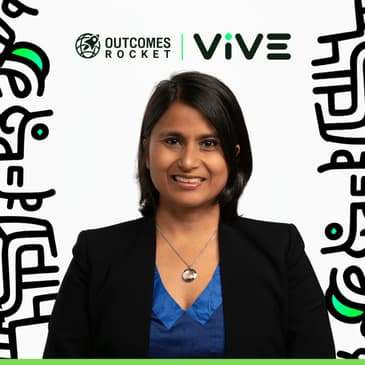
Healthcare is drowning in documentation and fragmented data, but what if the system worked for clinicians rather than against them?
In this episode, Dr. Richa Gupta, Vice President of Care Transformation at Ambience Healthcare, explains how Ambience provides a layer of intelligence on top of electronic medical records to optimize clinician workflow and patient interactions. Ambience’s ambient listening system captures physician-patient interactions, supports documentation, and ensures accurate coding and billing, boosting clinician satisfaction and reducing revenue leakage. ROI is driven by high clinician utilization, validated outcomes, and measurable improvements in documentation burden, coding accuracy, and physician retention. In 2026, Ambience is expanding across the full care continuum, including ambulatory, emergency, and inpatient settings, offering a platform that surfaces real-time insights and enhances patient care.
Tune in to hear how Ambience is transforming physician workflows and delivering real ROI across the care continuum!
Resources:
[00:00:00] Outcomes Rocket, recorded live here at Vive in Los Angeles. I'm excited to be with Dr. Richa Gupta. She is the Vice President of Care Transformation at Ambience Healthcare. Richa, thanks for joining us. Thanks for having me. Great to be here.
[00:00:27] It's such a pleasure. You know, I had the privilege of chatting with Nikhil, your CEO at Health, chatting with us about the fragmentation problem and the end-to-end solution that Ambience brings. I want to just say it's exciting to be able to have you here. To begin with, let's talk about, you know, Ambience as a company. What do you guys do and what's your role there about?
[00:00:54] Absolutely. Just a little bit about me. I spent 22 years in healthcare as an administrator before I joined Ambience. So I'm new to the startup space, but the reason I joined is I truly see this as a transformative solution to solve healthcare's biggest challenges.
[00:01:11] So what does Ambience do? Ambience is a layer of intelligence that truly sits on top of the electronic medical record to surface the right insights for clinicians and to be able to support them to get the most out of the time they spend with their patients. So that's it in a snapshot. I love it. Well said. And by the way, I want to congratulate you on the Class Chime Trailblazer Award.
[00:01:36] Thank you. Honor to be recognized by Class and Chime in their second ever award. And as Nikhil mentioned in his acceptance speech yesterday, we truly received the award on behalf of our clients that are the true trailblazers that trust us to do this work with us. Yeah, that's fantastic. Well, congrats on that. Let's get into some of the questions that we have for today's program.
[00:01:59] How is your company using digital health and technology today to drive meaningful change in healthcare? Fantastic question. And I'll anchor on that word meaningful. Change in healthcare is plenty. Plenty of change is needed in healthcare. The way that Ambience is really structured is it's a layer of intelligence, as I mentioned, that sits on top of the electronic medical record.
[00:02:25] And our goal is to really drive the right insights for clinicians to be able to make the most out of their day. So what does Ambience actually do? In the ambulatory setting, which is what we're most known for so far, we have three different care settings. So all you think about in the ambulatory setting is a patient-physician visit. But the way that Ambience works is well beyond that.
[00:02:50] We queue up even before the physician meets with the patient, we queue up inside. So we're prepping that physician to be able to do a chart review and be prepared for the visit so that they can get the most out of that visit and the patient can get the most out of the visit. Then, of course, is the visit. And now, instead of having to take notes or remember what they have to in order to be able to document and eventually bill and follow up, Ambience is doing all of this work.
[00:03:19] So it's an ambient listening system that has ears in the room, but also has eyes on the record and captures this interaction, which creates an incredible patient experience because now there's eye contact with the patient. And both the patient and the physician are able to get most from the visit.
[00:03:39] And then finally, once the visit is done, because Ambience is a coding-aware solution, which we'll talk about a little bit later, what Ambience does is it tees up the right codes for physicians so that they're able to bill for the right level of service and be able to really claim credit for the great work that they did.
[00:04:00] That's fantastic. So on the one hand, point of care, helping physicians tee up things from the record, give the best experience, the right stat, bright diagnoses to back end, making sure everything gets paid for. A hundred percent. So clinician love and revenue integrity. Fantastic. That's a great combination. And so on the revenue piece, ROI is increasingly on the minds and important for technology deployments.
[00:04:27] There's a microscope on it. You know, from your perspective, how does Ambience think about ROI? ROI is what drives us. And the reason for that is that there's many solutions out on the market. And as organizations are thinking about what to add to their tech stack, they have to think about how to rationalize this, right? So the way that we think about ROI is actually starting with clinician love.
[00:04:50] So we think about a value realization funnel. When we sign a new client, we maximize the utilization. So while the standard prior to my experience with Ambience was 30 to 40 percent utilization, we repeatedly deliver 80 percent utilization. So 80 percent of our visits for organizations that have signed up with Ambience are done using Ambience. This in itself gives a lift in terms of pajama time and the documentation burden.
[00:05:20] So clinicians fall in love with the product. And the reason that they use it so much is because they love it. Right. So that's the starting point. But this level of utilization now gives us the ability to support them in coding and diagnosis capture, which really prevents that revenue leakage that is very common in organizations and what physicians would call leaving money on the table and not being able to claim credit for the great work that they do. So that in itself on an ambient front starts to capture that ROI.
[00:05:50] What we've seen, what we've delivered and what we've actually showcased in a class research study at St. Luke's is a $13,000 per physician per year ROI that was signed off by the CFO. Very cool. I mean, that speaks for itself. If I could touch on one more. It's good to hear it. One more factor. So revenue leakage is a really important topic.
[00:06:17] The other very important topic is I'll just pull through on the clinician love piece. So this is a difficult time in health care for a number of reasons. Margins are tight. Labor is expensive. The labor market is challenged. There are physician shortages, nursing shortages. Everywhere you look, it's hard to hire to be able to get the access for patients that they need.
[00:06:41] And what Ambience does is not just engage in that clinician love at a very deep level. But we've heard just the most beautiful stories from our clinicians. There are physicians that have wanted to retire and now they have access to Ambience and they are no longer retiring. They've decided to stay for another few years.
[00:07:03] If you pull this all the way through for some of our clients that have been live on Ambience, and actually this was shared on stage by Memorial Hermann yesterday. They went live in 2022 with Ambience. And now four years later, of course, that was the post-pandemic period. Very difficult start of the labor market shortages. 18% turnover in physicians. Today, it's 4%.
[00:07:28] Now, Ambience was an important enabler that supported all of their other efforts to get this done. But that's what really excites me. Yeah, that's outstanding. I mean, low single-digit turnover with physicians is, I think, a stat that any healthcare executive would be proud of. I would think of it as the holy grail of medicine. One of them. Love that. Yes. Love that.
[00:07:49] Dr. Dukka, for CFOs and CIOs that are evaluating technology and AI advancements today, what should they measure to determine whether the technology is truly delivering value? Yeah, great question, Saul. I'll start on with the approach before I get into the measurement, if that's okay. So, we feel very confident that we're the best solution out there.
[00:08:14] And what we recommend is for CFOs that should be skeptical for their organizations and should look to rationalize the investments that their organizations are making, they should do a head-to-head comparison. We have done this time and time again with top medical centers across the country and have done very well across top three, top five solutions. And measure us on different fronts. Measure us on utilization.
[00:08:43] Measure us on reduction in documentation burden and actual validated ROI. And then pick the right solution. So, I would say that's the first lens. Know what's out there.
[00:08:54] Know what's out there.
[00:09:24] But we're really getting to validated ROI. And one last piece I'll talk about is the importance of trust, right? So, when we're in this category of not just ambient listening, but CDI, diagnosis capture, coding billing, it's really important to know that we're claiming credit for the work that's already done. And it sits in exactly the right spot. So, we test ourselves externally.
[00:09:50] We contract with American Academy of Professional Coders. And we audit our own specialties and our performance on coding accuracy. And we repeatedly get to over 95% accuracy. That's great. I like the word that you used. You called it vendor math. That's how CFO sing about it. I've been on the other side for a long time. You guys doing vendor math out there? Or are you actually doing validated studies? That's so good.
[00:10:20] So, what are you most excited about in 2026? There's much to be excited about. I think we're actually at an inflection point, right? So, the case for ambient listening, for reducing the documentation burden, even CDI and ambulatory has been proven. But what's next? So, this is where ambience becomes more than that ambient listening tool and that point solution for ambulatory.
[00:10:45] But that intelligence platform across the continuum of care. What I'm most excited about is deploying across that continuum of care. You might have seen recently we had an announcement with Houston Methodist. We are deployed across all settings. So, we're in the ambulatory setting. We're in their emergency department and in the inpatient setting.
[00:11:09] So, the opportunity there in terms of the inpatient setting, the burden of documentation, the thickness of the chart and the amount of conditions and inputs that are coming from various directions, from the patient, from the family. It's not really an ambient listening. This is where the eyes become as important as the ears on the record. And the chart awareness becomes a really important topic, right? So, we're not just looking at what's being said.
[00:11:39] We're looking at what's being done. So, we're looking at what's being documented by various members of the care team. And we're also looking at labs that are coming in. We're looking at diagnostic tests that are coming in. We're also looking at them in care everywhere. So, longitudinally, we're able to really understand what's going on with this patient and surface the right insights.
[00:12:03] The way we like to think about it is think about your best trained colleague that knows the most about this patient and they're at your elbow at all times. So, that's really what we're looking to deliver in the inpatient setting. And we're very excited about it. Well, that's beautiful. Thank you so much for walking us through the solution. Congratulations on Houston Methodist and the work that you guys do there. The commitment from both organizations to make this work is really important.
[00:12:33] The partnerships make a big impact. For other organizations out there seeking the partner to make things better for their clinicians, to improve the patient experience, to get better at RCM and billing, where can they reach you? And where can they reach out to the organization? Absolutely. We're here at VIVE. As I mentioned, we did this great panel yesterday. And if you didn't catch it, I would love for you to watch the panel with Dr. Underbrink and Dr. Mishra.
[00:12:59] He described us as the Ferrari of solutions, which was fantastic to hear. But please reach out to me on LinkedIn. I'm available to talk more. I'm clearly very passionate about our solution and the topic. And also, AmbienceHealthcare.com, which is our website, well updated, and you can get in touch with our entire team. That's fantastic. Well, there you have it, ladies and gentlemen. Dr. Richa Gupta. She is the Vice President of Care Transformation at Ambience Healthcare.
[00:13:27] Check out the show notes where you'll find all the ways to get in touch, the short notes. So you could share this interview with your colleagues that are looking for solutions similar to this. Thank you all for tuning in. And Dr. Gupta, thanks for joining us. Thank you, Sol. This has been fun.