Lindsay Dymowski is transforming pharmacy with innovative medication management, value-based care, and patient-focused solutions
Lindsay Dymowski, co-founder and president of Centennial Pharmacy Services, is rethinking how independent pharmacies support patient care, chronic disease management, and value-based healthcare. In this episode, she discusses medication adherence, Medicare changes, and why pharmacies should do more than just dispense pills; they should improve patient outcomes.
Tune in to learn how innovative pharmacy services are transforming patient care, improving medication management, and shaping the future of value-based healthcare!
Resources:
[00:00:01] This podcast is produced by Outcomes Rocket, your healthcare exclusive digital marketing agency. Outcomes Rocket exists to help healthcare organizations like yours to maximize their impact and accelerate growth. Visit outcomesrocket.com or text us at 312-224-9945.
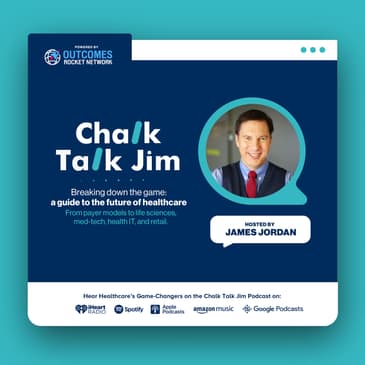
[00:00:29] Welcome to the Chalk Talk Gym Podcast, where we explore insights into healthcare that help uncover new opportunities for growth and success. I'm your host, Jim Jordan.
[00:00:45] I'm excited to welcome Lindsay Dymowski to our show. She grew up in the pharmacy world watching firsthand how her independent pharmacy parents served their communities. But instead of following the traditional path, Lindsay took a bold step, investing in medication management technology while still in college.
[00:01:01] And she's built a pharmacy model focused on patient care, medication adherence, and value-based healthcare. As the co-founder and president of Centennial Pharmacy Services, Lindsay is transforming how pharmacies support chronic disease management, clinical medication reviews, and partnerships with healthcare providers. Her team works closely with specialty practices, long-term care facilities, and payers to ensure patients not only receive their medications, but can actually afford and manage them.
[00:01:30] In this episode, we explore the future of pharmacy, the impact of Medicare changes, value-based contracts, and how pharmacies can do more than just dispense medications. Lindsay, tell me and our listeners a little bit more about yourself. I grew up in pharmacy.
[00:02:14] I grew up in pharmacy. And actually left college. Used the tuition money to purchase an adherence packaging machine that was cutting-edge technology at the time to put into a pharmacy. You typically saw this in long-term care pharmacies, closed doors, not ones that patients went to in the community. We started a medication management program, and it has since taken off.
[00:02:41] And so it's been a lot of fun being able to innovate in pharmacy and provide something that is a need for patients and a need for the healthcare system, but do it in a different way that actually has tangible impacts for patient care and even providers. It's a lot of help for the providers who are out there taking care of these chronically ill patients. What were you seeing was the problem? Yeah. I think there was a lot going on in pharmacy at the time.
[00:03:11] And I was in school, and I had this very unique perspective from an educational standpoint of going a traditional route. But I was also around pharmacy my entire life. Around the pharmacy, there's really nothing to do. And it was basically my chore to be there. So I would take all these pharmacy books and different magazines and things, and I would end up reading them.
[00:03:33] There was a lot of discussion about how the pharmacy could actually make an impact within the greater healthcare continuum. But I didn't really know of any pharmacies that were making those impacts. I didn't know of any pharmacies who were doing an appointment-based model or doing med synchronization. Our family pharmacies were doing bits and pieces of this, but we didn't necessarily call it what the industry was calling it.
[00:04:00] Got this idea that we can deliver pharmacy much differently. And if we can be really successful at this, we can go to the hospital systems and the ACOs and the payers and the MCOs, and we can actually show that there's a difference that can be made when patients' medications are being managed properly. And we were able to do that. What parts of the continuum do you work in, or is it all of the above? I would say a little bit of everything, but within its own swim lanes.
[00:04:27] The biggest impact that we have are with the providers who are in the communities. Specialty practices that are dealing with multiple chronic diseases within certain patients. Your endocrinology, your kidney units, your cardiac providers. And then, of course, your geriatric providers. There's so many geriatric specialty practices out there now, and that population obviously needs that support.
[00:04:49] I think when you go beyond that, it gets really interesting because when you have pharmacy that is taking care of patients properly, you can make real impacts to the measured outcomes that groups like CMS are measuring and paying differently for. So you can actually build partnerships with value-based entities with the MCOs that are looking at these pools of high-risk patients and saying,
[00:05:18] we need to find a tangible solution for them in the community that stops them from having hospital re-emissions, that supports them more holistically. And you can build relationships with them from a pharmacy standpoint where you can provide those management services and not only build your patient population, but also be paid differently from those entities because you can build value-based contracts, but then you can go at risk with them.
[00:05:44] It really starts to open up the avenues of how you can be paid differently in pharmacy. Instead of being paid for just dispensing a medication, you can be paid for the actual care that you're providing the patient. So are you also monitoring all the drugs that a patient gets for interactions and different things like that? Absolutely. One of the cornerstones of the services that we provide are reviews where every single time something is going on in a patient's profile, whether it's us dispensing a medication or we get a new order for them,
[00:06:14] we are actually doing an entire clinical med review on those patients. And we're looking at everything for interactions. We're looking at different types of socioeconomic barriers. Can a patient actually afford this medication regimen because their costs change month to month, right? There may be something where they could afford it last month, but they're not able to afford it this month. And we don't want a patient stopping, say, a blood thinner because they can't afford it.
[00:06:40] What can we do proactively to make sure that the patient can actually continue to take this medication? And how can we coordinate that type of care? It's not only pharmacy and the clinical aspect of pharmacy, but it's a lot of social work as well. We recently did an interview with a neurologist that was working with a young Parkinson's patient, like a 42-year-old mother. And she had a branded drug that worked fine for her. And of course, her health plan wanted her to have the generic. And this doctor put aside all this work and found a program for her.
[00:07:09] And that program is up. And so now all she got is the generic one. She's got back to tremors and she can't work and she's having issues. And so he's trying to figure out what programs are available. So for a doctor like him, who is going to lift his head up every few years and figure out what he can do for an individual patient, are you actually a resource to figure out for that disease state, given these pharmaceutical companies that supply these drugs? Are you knowledgeable of all the programs that are out there?
[00:07:37] I can't say that we 100% know every program, but we can 100% look anyone up. We put a lot of work into researching what options are out there for patients and making sure that they are able to continue on the regimen that makes the most sense for them. Because it's true, if you look at a medication and the main ingredients of these medications, whether they're brand or generic, are the same. But there may be different things in the meds like fillers or sugars or whatever it may be
[00:08:03] that makes an impact into how a specific person's body absorbs it or how they can tolerate it. And if something's working for a patient, especially a young Parkinson's patient, you don't want to disrupt that regimen. You want to make sure that they're taking the medication that works. Now, can you deliver that to the hospital too? We make deliveries directly to patients' homes or to facilities that allow us to make deliveries in there. Typically, a hospital has an inpatient pharmacy, but if it's something like a long-term care facility
[00:08:32] or an assisted living facility, skilled nursing group home, things like that, we can make deliveries into those types of facilities. The reason I ask that question is the timing of their medicine is critical. Every time one of his patients goes in the hospital, it takes him a couple weeks to get them back to normal because they do their rounds for giving out the drugs so many times a day. And it doesn't matter if Mrs. Jones needs it at 1145. I didn't know if that was something that you all did. Yeah, it's frustrating.
[00:09:00] And we actually see that in practice as well. One of the things that is very nuanced when it comes to someone being in a hospital is that those medications really need to be handled by the hospital staff. So it's difficult for a patient to manage their own meds because they're not allowed to when they're in a facility like that. Okay. How about long-term care? Depends on how the facility is set up. Some of the facilities do rounds where the patient's getting the meds off of a nurse at a MedCart.
[00:09:29] Those are more often your skilled facilities. But your typical assisted living facilities or your group homes, often the patient can self-manage their medication. And at that point, we're delivering it. Our medications come prepackaged in a roll, so it has the time and date on it. Someone like a Parkinson's patient is usually taking medication six to maybe eight, even potentially 10 or 12 times a day. Yeah. Breakfast, lunch, dinner, 8 a.m., whatever they need. And we're putting that on there,
[00:09:58] and we're making sure that the patient can independently manage taking their meds with that tangible tool as much as possible. Where does this business model go from here? Oh, my goodness. Yes. Centennial in its current form, and by current form, I say fully closed door, office building, 40-plus, 50-plus employees, has been operating like this since about 2017, 2018.
[00:10:23] Truly, the Centennial model started back in 2012 when we decided to move forward with the medication management business model. And it took us a few years to figure out how to differentiate ourselves and differentiate pharmacy, truly, and get providers to trust pharmacy. We don't want to be a nuance, right? We want to show that we can help. Once we got past that hurdle and we got a really stable patient base, we were able to become more of a medication management company than just a pharmacy. We're growing.
[00:10:52] I'm excited that we're growing. We have a regional expansion that's going on right now, and our goal is to be able to bring this to different areas of the country over the next couple of years. We have big plans, big dreams, but we know that we're going to be helping a lot of people along the way. So we're excited. Are they doing services now? Are they what area of the country? Right now, we support Pennsylvania, New Jersey, and Delaware. Okay. And as you're going into other states, what challenges do you end up having?
[00:11:20] Is it state regulations or licensing, or what's the biggest challenge to expanding? There's really two, and it's the state regulations. So every state has different types of pharmacy laws and rules. But then also every state has different payers and MCOs and providers who are in the states, and they all have their own rules. We may be able to enter a state and get a pharmacy operational there, but we may not be able to engage with a specific payer until we have a presence in the state for a certain amount of time.
[00:11:50] So it makes it difficult to be able to operate on some initiatives because we know that there are different groups that we want to build our partnership that we have in our area right now, be able to build off of that. But there's a lot of nuances, particularly more, I think, with the payers than anything. With expanding. But nothing that we can't get through. So do you have to go through pharmacy benefit management, too, in some cases? We do. The majority of our contracts are through PBMs.
[00:12:19] All of our contracts are through PBMs. The way that we get reimbursed is by contracting with a pharmacy benefit manager, and then they contract with the health plan. But we do have some value-based contracts that we have a direct line to the plan or to an MCO with those value-based contracts. But to be paid for dispensing the medication, we have to contract with a PBM. So switching topics, tell me of a time when you've had to adapt and switch your strategy as you've done this business model.
[00:12:48] We've never been afraid to try something. And we always figured if we try it and it doesn't work, you just stop. You figure out what happened and then you move forward. I think one of the biggest challenges we had, especially when we were going from that small business mentality to more of a medium-sized business, was how do we keep this patient-centered and community-focused but also grow our team to what it needs to be?
[00:13:17] Keep that small business feel but make sure that we can grow and expand. I think one of the best things that we did was really reach out to the customers and say, what is your favorite thing at Centennial? If you could say the number one thing that you absolutely love about utilizing our pharmacy, what is it? And almost every patient came back and said, I know who my pharmacist is. We took that insight and we decided to build our business off of different pods
[00:13:47] where we know that certain groups of patients are always going to be seen by one specific pod so that as we grow, we still know that the patients are getting the care that they want and a familiar voice when they get the phone call. So it's funny because my grandmother lived with us when we grew up, so obviously we would go down and get her medications and such. And it's the same thing. You knew who Joe was at the pharmacy and he would, it's another doctor put in a new script.
[00:14:15] He'd call and maybe caution or ask to double check something. And I think we went through this period of time where the CVS said, I was a kid in Boston is totally different from CVS today, right? It's a big place. And so I think what people probably don't realize is how much education on medication comes from the individual pharmacy. And I think we've lost that personal neighborhood touch as we've scaled. What strikes me is I worked at McKesson at one point in time. We had a congestive heart failure model that was very successful.
[00:14:44] Part of the success was these nurses teaming up to know the patient. The compliance ratios were crazy because these are patients that weren't terribly mobile. So they knew they had about seven minutes. And if they did their job in two minutes, they'd be done. And then they could have a chat for five minutes or get a lecture for seven. And because they knew them and they knew their grandchild and everything, they kept these notes. There was a compliance and a relationship there that's really hard to beat. So good for you guys. Thank you.
[00:15:13] Yeah, and that really, all that matters at the end of the day is the patient. We try to build those relationships and foster that trust. And we do the same thing. Our teams know the kids' names, where they live, what schools the grandkids are in, all of that fun information that the patient actually cares about. How do you keep current on all the rapid changes that are going on in this marketplace? Besides a hope and a prayer? The rapid changes in the drugs, but it's actually the administration and the patient side and the flow, right? You're absolutely right.
[00:15:41] I'm fortunate to be pretty active with a lot of the different pharmacy associations that are out there. I really stay up to date with going to those meetings, whether it be a board or a committee meeting that I'm on. And I'm always able to get questions answered, which I think is the hardest part when you're going through this. You can read something, but you can't really understand it even when you read it. It's all still confusing. The beginning part of my workday is reading newsletters.
[00:16:07] I do a lot of the newsletter readings from the state associations, the state boards, the pharmacy associations. And it helps you get an understanding of what is truly going on in the market. And honestly, it brings me back a little bit into how Centennial was started because reading a lot of those different newsletters and the magazines and how everything was changing was how we started Centennial. So I've always appreciated those publications.
[00:16:35] And I try not to take it for granted, even though I get frustrated with the amount of emails in my inbox sometimes. How many hours a day do you spend reading? Oh, gosh, four. Yeah. Seems like everyone I thought later that I interview spends about two hours at minimum a day reading. Yeah. And it's not always consistent. I do a lot of audio. So I love now that a lot of the associations and publications will do like podcasts. So I'll even just listen to their podcast.
[00:17:04] I include that into that number. But you're not going to learn anything if you don't go find it yourself. You can't wait for the information to come to you. You have to go get it. So as you look forward the next several years, what's your biggest opportunity and threat as you look at your business? The changes to Medicare always scare me. The Medicare population is probably 85 plus percent of our business. If anything changes with that, it can have significant impacts into who we can support, how we can support, where we can support.
[00:17:32] So I'm always looking for changes into that. I think there's also the Medicare drug pricing that's potentially maybe getting reversed. I don't know. There's a lot of stuff in that IRA bill that could change in the next year. But that really scares me because I think that can significantly change the cash flow of pharmacies. And I look at a pharmacy like mine and we're fortunate where we're filling thousands of scripts a day. So when you look at something like that, it's impactful. But there's a lot of cash flow there.
[00:18:02] My heart goes out to a lot of those independent pharmacies that can really be impacted by that because it's going to hurt them. I don't know how many independent pharmacies left in America. I believe the last time I was looking, it was around like 9,000. Don't quote me on that. It might be a little more than that. NCPA has some good information. They provide a digest every year that has some great information on pharmacy metrics and numbers, particularly for the independent markets.
[00:18:31] Yes, actually. I'll look it up and share it in the notes. But it seems to me that the past 20 years, the independent pharmacy has had a lot of challenges in terms of staying viable financially. And those who are successful have forwarded and integrated. Your model is about keeping the intimacy that was always there. And that's what makes it work, right? Yeah, that's why people want to use community pharmacies. They want to know who their pharmacist and who their technician is.
[00:18:58] They don't want to feel like a number, and that's what makes independence unique. And if you start to lose that, you're going to lose your patients. There are some pretty forward-thinking independents that are out there that are doing some really cutting-edge things, getting into point-of-care testing, becoming wellness centers, just doing things that are different. And that's what's helping them survive. But it very much is a differentiate-or-die type of community out there right now for independent pharmacy.
[00:19:27] You can't just fill 150 scripts a day and go home at night. You're not going to survive. Yeah. Anything else you'd like to share with our audience? I would love for your audience just to understand the impact that pharmacy can have, whether they are a patient or a provider. Utilize the power of your pharmacist. If you can find a high-performing pharmacy that is out there that is supporting patients differently,
[00:19:51] it can make significant impacts to your practice, to your health, to outcomes, whether they be measured outcomes or just satisfaction outcomes. Pharmacy is the most accessible provider in health care. So don't be afraid to utilize it. That's great. Thank you. Yeah. It's good to learn. All right. It strikes me as I do a lot of consulting, I find that people focus on their strategy.
[00:20:17] They don't realize that a lot of their competitive advantage can be from frictionless operations and unity in people. And it strikes me as listening to you, that there's a lot of frictionless operations and unity in people that you spend your management time on. And it strikes me that makes you very adaptable to any strategy changes in the industry. Tell me a little bit about that. We were growing Centennial.
[00:20:39] We knew that we could grow faster, but we had this mentality where we wanted to really hold ourselves back because we knew if we could figure out how to grow internally and figure out how to make sure that we had the teams in place so that we could adapt to any situation, that we could easily plug and play into any strategy. So that's been a big component for us as we've looked to growing in the future.
[00:21:04] And we just talked about all those different states and what the different regulations with the boards or the payers are. Thankfully, our workflow and our model and our management team has a lot of experience in being able to provide our core personalized focused service and do it in a way that makes sense for the places that we're going.
[00:21:56] That's excellent. We know that we're growing that there'll be different partnerships that will end up entering, but the correct partner for us is going to be someone who appreciates the community focus and the patient-centered focus that we've always had and appreciates our workflow and understands that at the end of the day, it's about the patient and making sure that you're doing everything in your power to ensure that the patient is taking their meds properly. Excellent. Thank you.
[00:22:28] Thanks for tuning into the Chalk Talk Gym podcast. For resources, show notes, and ways to get in touch, visit us at chalktalkgym.com. This podcast is produced by Outcomes Rocket, your healthcare exclusive digital marketing agency.
[00:22:58] Outcomes Rocket exists to help healthcare organizations like yours to maximize their impact and accelerate growth. Visit OutcomesRocket.com or text us at 312-224-9945.