
This podcast is brought to you by Outcomes Rocket, your exclusive healthcare marketing agency. Learn how to accelerate your growth by going to outcomesrocket.com
To expand mental healthcare access and balance operational growth with quality care for diverse populations, including underserved communities and teens.
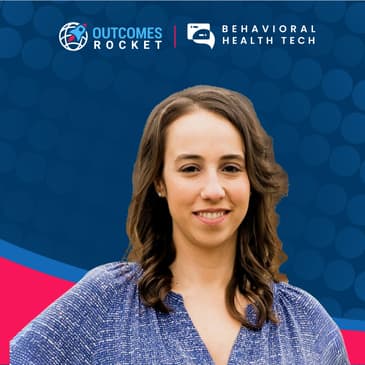
In this episode, Julia Bernstein, Chief Operations Officer at Brightside Health, explores the challenges and innovations in scaling quality mental health care to underserved populations. She talks about leveraging evidence-based practices to ensure quality care delivery. Julia discusses utilizing digital tools to address barriers to accessing care for teens. She also shares some insights on navigating regulatory frameworks to expand equitable mental health services.
Tune in to discover how digital health innovation transforms access to quality mental health care for underserved communities!
Resources:
- Connect with and follow Julia Bernstein on LinkedIn.
- Follow Brightside Health on LinkedIn and discover their website.
Fast Track Your Business Growth:
Outcomes Rocket is a full service marketing agency focused on helping healthcare organizations like yours maximize your impact and accelerate growth. Learn more at outcomesrocket.com
[00:00:01] This podcast is produced by Outcomes Rocket, your healthcare exclusive digital marketing agency. Outcomes Rocket exists to help healthcare organizations like yours to maximize their impact and accelerate growth. Visit outcomesrocket.com or text us at 312-224-9945.
[00:00:25] Hey, everyone. Welcome back to another episode of the Expanding Access podcast, recorded live here at the Behavioral Health Tech Conference in Arizona. Today, I have the privilege of hosting Julia Bernstein. She is the Chief Operations Officer at Brightside Health. Julia, thanks for joining us. Yeah, it's great to be here. Thanks for having me.
[00:00:54] Oh, of course. Of course. How's the conference been and what brings you here? Yeah, well, I have actually been coming to this conference since it was online during COVID. Amazing. So this is my second year in person. And so I'm here really just to catch up with friends, hear what's going on in the industry, and get a chance to represent Brightside. Amazing. Amazing to hear that you've been with it for so long. And so tell us a little bit about you and about Brightside.
[00:01:21] Yeah, so I'm the Chief Operations Officer at Brightside Health. I've been working in the mental health and digital health industry for most of my career. I was one of the first employees at Ginger. I then spent some time on the payer side at Carillon. And then for the last six years have been running operations. I was at Tempest in the alcohol use disorder space at 30 Madison and now at Brightside, where I've been for a little over a year. Brightside provides life-saving mental health care to those who need it.
[00:01:48] We serve all 50 states, and we serve those 13 and up. And our services really are comprehensive. We range from one-on-one therapy and psychiatry for those with mild and moderate anxiety and depression, all the way through those who need our suicide prevention program. And we recently acquired a company called Lion Rock Recovery, which is one of the early pioneers of virtual-based IOP for substance use disorder.
[00:02:14] So with that acquisition, we've been able to start providing an IOP level of care for folks with SUD, primarily alcohol use disorder. And we're really looking to expand that service pool so that we can really be that comprehensive, life-saving mental health provider that's doing the hard work in our industry. That's great. And can you tell me, what is IOP? Just so that I know. Sure. Sorry, too many acronyms. I've been doing this for way too long. I'll always ask you, okay?
[00:02:43] So IOP is an intensive outpatient. Intensive outpatient. Got it. Program. Got it. And it's a level of care where folks go through nine hours of group care and some one-on-one therapy and potentially psychiatry over the course of eight to 12 weeks. And it's a really great program for folks who are looking for a step down from an inpatient program or a step up from one-on-one.
[00:03:07] And we have a growing base of evidence that it works really well virtually and in some ways can be even better for folks because they don't have to drive to a facility for three hours a day. They can do it around a work schedule. They don't have to get childcare. So it's been a really exciting addition to our scope of services. Amazing. Thanks for highlighting that. Yeah, it helps a lot. And so what we want to do is really learn more.
[00:03:31] So how do you scale and keep operations running smoothly while ensuring high-quality care reaches more underserved communities? Yeah, so we're really asking the questions that keep me up at night. But for me, I think about it in two pools, which is how do I scale internally? And then what do I need to be thinking about externally and from a growth perspective? So internally, like most startups, we started out with duct tape and bubble gum and way too many Google Sheets.
[00:03:57] And so we've been in a very fortunate position a few years into this to be at a position where we now have a really good set of processes for most of what we're doing from a core perspective. And so I'm constantly looking at what's going to break next and how do I think about building, buying, or partnering, whether it's bringing in some of these new generative AI tools, whether it's thinking about building some really great features in with my product data and engineering teams, whether it's thinking about changing my model operationally.
[00:04:25] And so I'm really focused on how do I look around corners? How do I use my metrics? How do I do early warning systems so that nothing breaks or when it starts to fray, we've already got a solution in place? So that's the internal scale challenge. And then externally, as I think about our growth, we've got a really fortunate position in where we're what I call payer agnostic. So we have a cash pay program. That's where we started. We take commercial. We take MA and traditional Medicare.
[00:04:55] 22 states there. We're expanding into the subpopulation. So as we move into each of these different populations, I'm constantly thinking about how do I need to change my operations? What do I need to do differently? Do I need to switch my customer service team to much more of a tech space program for teens who we know are on much more of a mobile phone program?
[00:05:15] You know, as we move into some of these other populations, do I need to strengthen my care coordination and care navigation because we're dealing with folks who are coming in from outpatient services or even from an ED? And then how do I really think about tying everything I'm doing back to the broader system of behavioral health care, whether it's referrals in or having places to send people when they're not a fit for our platform? That's great.
[00:05:39] A very comprehensive view that starts from the inside and optimizing and then looks to the outside for scaling. Love that. Love that. And so Brightside Health now offers care for teens, as you shared. Could you share why it was important for Brightside Health to treat younger patients and how the company supports caregivers of teens?
[00:06:00] Yeah. So when Brad and Mimi and Jeremy, our co-founders, started Brightside, the goal was always to get care to people who were underserved and to make sure that everyone was able to live their best life with our platform. And so as we looked around, I think like everyone else, we've seen the growing statistics on the teen mental health crisis, as well as the inability to access not only care, but quality care.
[00:06:24] We also have a lot of parents on our platform. I've got slightly younger kids. We've got, and I think we're all experiencing firsthand, not only the challenges that we see our kids seeing, but even just what we're experiencing as parents. And we didn't need the surgeon general to tell us that parents are struggling, although it's a good reminder that we need to think about the whole family. We launched our teen program earlier this year. We're now in about 22 states.
[00:06:48] And one of the things that we did as we launched the program was we really tried to be thoughtful about what it would mean to build a teen program that incorporated a lot of the things that had really driven Brightside's quality in our adult care. So our clinical decision support tooling and our use of data when it came to better prescribing, building our therapy protocols around the unified protocol, and just really being thoughtful to make sure that the offering we put in the market was something we were proud of.
[00:07:15] And I think we really are. And now as we grow it into different states, we're thinking more about the second half of your question, which is what do the supporters of the teen need? Is it access to care themselves? Is it resources? Is it an ability to do a session with their teen? And so that's really the next thing for us is really thinking about how do we serve the teen and then how do we serve the family that supports the teen?
[00:07:39] That's great. Very thoughtful approach and looks upstream to the parent, which is, like you said, we don't need the reminder. Yeah. It's apparent, but we got to be intentional about the approach. That's great. What policy changes do you believe are needed to support access to mental health services for those with more severe needs? Yeah. Well, we're recording this on election day, so obviously we're watching to see what'll happen there.
[00:08:04] On a federal level, we're watching a lot of what's going on with the extension of the public health emergency and the ruling around prescribing of controlled substances virtually. Brightside actually doesn't prescribe controlled substances, but we think that legislation is a bellwether of the industry's embrace of telehealth as an ongoing and vital part of how we deliver care. So we're very much watching that.
[00:08:30] We also do believe that everyone, again, should have access to lifesaving treatment, whether it's treatment we provide or whether it's things like medication-assisted treatment that some of our peer telehealth companies provide. So that's one of the big things we're watching on the federal side. We're also watching some of the new codes for things like digital therapeutics. Personally, I'm an operator. I am dealing in 50 state licenses every single day.
[00:08:56] And so the other thing that I'm paying a lot of attention to is what's going on with the state licensure programs? Where do we have new compacts coming out? Where are we seeing changes in different licensure policies? Can people get cross-licensed more easily? So I'm thinking a lot about the regulatory barriers to care that exist between states that make it that much harder to operate in a scaled way.
[00:09:19] Yeah. And making sure that there's easier ways to keep licenses up to speed and training up to speed. Yeah. Yeah. I feel you. Yeah. I feel like if you ask anyone who's spent any time in the trenches of visual health operations, like, I call it, it's modeling in 4D. Yeah. Because you're modeling across licensure, you're modeling across payer coverage, you're modeling across training, you're modeling across availability. And before you know it, it's like you need a degree in advanced calculus to forecast your network.
[00:09:49] So, leader regulators, anything we can do to make that easy. I love that. I love that. Great call to action there, folks. And as you think about the purpose of the podcast, which is to expand access. Yeah. What call to action would you leave to our viewers and listeners today? And where can they reach out to you or Brightside to collaborate, learn more? Yeah. So, I think my line on access is it's necessary but not sufficient.
[00:10:18] We really need to have quality front and center in how we're delivering care. And I think that's been core to the Brightside mission from day one. It's been core to how we've scaled. And it's also a big part of how we look at our growth going forward, which is continually involving data and technology to make sure that our care is consistent, our care is quality, our care is outcomes-based. And we're tracking not only your PHQ and your GAD-7, but also what your personal outcomes are.
[00:10:46] And that, to my earlier point about things that are keeping me up at night, that as we continue to scale our populations, we're really thinking about what quality means to every individual who's seeking care and not just a blanket statement. So, I think it's just continuing to think about how we define quality above and beyond our current standards of measurement and being very innovative and exciting with how we use data.
[00:11:09] If anyone wants to talk about that, if they want to talk about partnership, if they want to talk about how they can work with Brightside, please come find me on LinkedIn. That's the best place to find me. You can find Brightside at brightsidehealth.com. And we really look forward to engaging with anyone who wants to talk about these topics. And thank you, Saul. Oh, my gosh. My pleasure, Julia. I appreciate you being with us on the podcast.
[00:11:34] And everybody with us, make sure you check out the show notes for ways you, too, can get in touch with Julia Bernstein, Chief Operations Officer at Brightside Health. Make a move today. That's how you're going to increase access. Julia, thanks for being with us. Thank you so much.
[00:11:49] This podcast is produced by Outcomes Rocket, your healthcare-exclusive digital marketing agency. Outcomes Rocket exists to help healthcare organizations like yours to maximize their impact and accelerate growth.
[00:12:19] Visit outcomesrocket.com or text us at 312-224-9945.