
Reliable patient identity is essential for avoiding duplicate tests and procedures in healthcare.
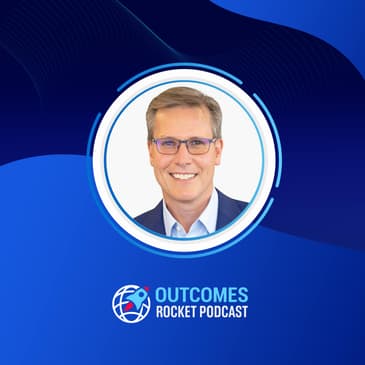
In this episode at HIMSS 2024, Clay Ritchey, the CEO of Verato, explains how Verato specializes in identity solutions for healthcare, ensuring accurate patient information across the care continuum. He highlights the repercussions of identity errors, such as redundant tests and inaccurate risk assessments, emphasizing the crucial role of reliable data in AI-driven healthcare. At HIMSS, he observes a growing awareness of the importance of data quality for successful AI implementation, signaling a shift towards prioritizing identity management. Clay stresses the need for healthcare to harness the full potential of digital transformation by first getting identity right and invites listeners to engage with Verato, underscoring the importance of collaboration in driving healthcare innovation.
Tune in and learn how prioritizing identity management can pave the way for more effective AI-driven healthcare!
Resources:
[00:00:02] Hey, everybody. Welcome back to the Outcomes Rocket here at HIMSS 2024.
[00:00:07] I have the privilege of having Clay Ritchie on the podcast.
[00:00:10] Clay, welcome. Thanks, Saul.
[00:00:12] So Clay is the CEO of Verato.
[00:00:15] He's got 20 years of experience driving innovation and results in health care.
[00:00:20] Clay, so grateful that you're here with us.
[00:00:22] And to kick things off, I'd love to just level set with the audience.
[00:00:25] Let them know what is Verato?
[00:00:28] Who do you guys serve and more about you?
[00:00:30] Great. Verato, everything we do at Verato is we are the identity experts in health care.
[00:00:35] We enable better care everywhere by solving the problem
[00:00:37] that drives everything else, knowing who is who.
[00:00:40] And believe it or not, as many of us have probably experienced in health care,
[00:00:44] we do a lousy job of knowing who is who.
[00:00:46] And Verato's mission is to make sure that every time, whether you're a patient,
[00:00:50] a member, a provider, at the point of care,
[00:00:54] the point of interaction with the health care system, that we know who you are.
[00:00:57] We can anticipate your needs.
[00:00:58] They can really better serve you as a person.
[00:01:01] And also, we understand the community that you come from.
[00:01:04] We understand the family or the household you come from.
[00:01:06] So we can give better information and better insights into those folks
[00:01:09] who are taking care of us to make sure that they can do it in the best way possible.
[00:01:13] I've been leading Verato for the last three years, and it's just been a pleasure
[00:01:17] to work with our clients.
[00:01:19] Our clients come across all walks of life, whether it be providers, payers,
[00:01:23] state, local governments, other health care tech platforms and life sciences.
[00:01:28] So just really enabling the flow of information in a trusted way,
[00:01:32] knowing who is who across the care continuum.
[00:01:34] I really appreciate that, Clay.
[00:01:36] And it seems simple, but in health care, it's quite difficult.
[00:01:41] You know, and this identity theme is something that's really important
[00:01:45] for a lot of reasons.
[00:01:45] Can you highlight maybe the top two or three reasons, things that often go wrong
[00:01:50] when you don't get identity right?
[00:01:51] First of all, as we don't get identity right,
[00:01:54] all kinds of bad things happen for our experience.
[00:01:57] Things like we end up having multiple tests or labs or procedures ordered
[00:02:02] because we're only seeing a fractional view of you
[00:02:05] because you were charted, this patient was charted in two different views.
[00:02:09] Things like we're trying to figure out how to proactively meet your needs
[00:02:12] to make sure that somebody who's at risk for a chronic condition doesn't turn chronic.
[00:02:17] But if we don't understand who you are and we don't know
[00:02:20] all the engagement we have around you,
[00:02:22] so we don't have one complete horizontal view of who you are,
[00:02:25] we oftentimes our algorithms don't get it right.
[00:02:27] We are AI algorithms aren't going to be trained properly
[00:02:30] if they don't have all the information about people all in one place
[00:02:34] so they can truly understand what the risk factors are
[00:02:37] and how to close those gaps in cares and identify the gaps in care
[00:02:40] in order to close them.
[00:02:41] So those are the things that can go right if you can go wrong,
[00:02:44] if you get identity wrong.
[00:02:45] And the converse, of course, if we get it right.
[00:02:47] Thank you so much, Clay.
[00:02:48] It really helps to understand that the nuances and why it's so important.
[00:02:53] You're here at HIMSS.
[00:02:54] Tell us why you decided to come this year and one key insight
[00:02:58] that's risen to the top for you.
[00:02:59] HIMSS is always a pleasure to come to because it's a great chance
[00:03:02] to actually meet not only other health care tech vendors like Verado
[00:03:06] that are innovating and driving digital transformation in health care,
[00:03:10] but also with those folks across the care continuum
[00:03:14] that are dedicating their careers and their organizations
[00:03:16] to help really deliver better care, better outcomes for health care and our patients.
[00:03:20] And I think that as I came into HIMSS,
[00:03:24] I was really curious to see how much AI would be on everybody's minds.
[00:03:28] And of course, I'm not disappointed.
[00:03:30] AI tends to be the topic here.
[00:03:32] And what I keep hearing from organizations
[00:03:35] are starting to think about AI is, of course,
[00:03:36] they're worried about things like the right governance
[00:03:38] and making sure they do it the right way,
[00:03:40] making sure they're not going to have outcomes from AI that they can't trust.
[00:03:44] But I'm also hearing people talking about that you can't have good AI
[00:03:47] if you don't have a good data set that you trust and you can train it on.
[00:03:52] And how important identity is, identity and management problem
[00:03:55] is to also AI because garbage in, we garbage out.
[00:03:59] And if you don't understand who is who and aren't using good data
[00:04:02] that's associated with the right person,
[00:04:05] then when you're trying to train these models on how to deliver better care,
[00:04:08] you're going to have a lot of challenges.
[00:04:09] So I was really heartened to hear the market understand that.
[00:04:12] And I think it's got a large tailwinds for the data management industry
[00:04:16] if we help solve those problems.
[00:04:18] Clay, that's really great and insightful for everybody listening.
[00:04:22] Let's just close with a call to action around that topic that you just brought up.
[00:04:26] It's identity and how AI will change the game in health care.
[00:04:31] The call to action for me is that we're living in a world now
[00:04:34] where over the last 10 years we have done the unthinkable.
[00:04:38] We've moved a whole industry from paper to digital.
[00:04:42] And we did it at record breaking pace.
[00:04:44] While we've done that, we've got all these challenges with now
[00:04:46] how to realize the full potential of that digital transformation.
[00:04:50] And the reality is that we haven't really found that potential
[00:04:53] because we have all these disparate data sources
[00:04:56] across any organization at an enterprise level.
[00:04:59] And I really think that the call to action is that before we can really get
[00:05:02] the full potential out of our digital investments,
[00:05:04] we have to first get identity right.
[00:05:06] By getting identity right first, then we can transform those experiences.
[00:05:09] We can use the analytics platforms that we're investing in
[00:05:12] to be able to give us the right insights to deliver better care at lower costs.
[00:05:15] And we can just really start driving the imagination that we have.
[00:05:19] And we decided as an industry, we wanted to take this challenge.
[00:05:22] And I think that as we start thinking about things like moving to the cloud
[00:05:25] and things like embracing AI, we have a new mandate now
[00:05:29] to think about identity data management and to getting it right
[00:05:31] because the stakes are getting higher and higher
[00:05:34] as we embrace the next level of transformation.
[00:05:36] Well, we really appreciate your expertise on this topic, Clay, today.
[00:05:40] And if people want to learn more, how can they get in touch with you
[00:05:43] and how can they get in touch with your company?
[00:05:45] Certainly I welcome anybody who wants to talk to me to call me at 919-995-3656.
[00:05:51] I really mean that.
[00:05:52] Love that.
[00:05:53] Folks, there you have it.
[00:05:53] We're going to leave that in the show notes. Use the number.
[00:05:56] Yeah, use the number.
[00:05:56] Like we're only as good as the engagement we have with the marketplace.
[00:05:59] And I welcome that.
[00:06:00] Of course, our website at router.com is a great entry point
[00:06:03] into understanding what we do and how to get in touch with us.
[00:06:06] We got a lot of content there on there for thought leadership
[00:06:08] as you're starting to think about cloud migrations or clinical
[00:06:11] interoperability or digital patient engagement.
[00:06:14] You want a playbook for how to do that?
[00:06:16] You know, you're going to find great resources like that at our website.
[00:06:19] Sounds like a wealth of information.
[00:06:21] We're thankful for you and appreciate you jumping on to the podcast with us.
[00:06:25] You're welcome, Sol. Great meeting you.
[00:06:27] Nice to meet you.
[00:06:28] And everybody, make sure you check the show notes
[00:06:29] for today's amazing links that Clay shared with us.
[00:06:32] See you all next time.