
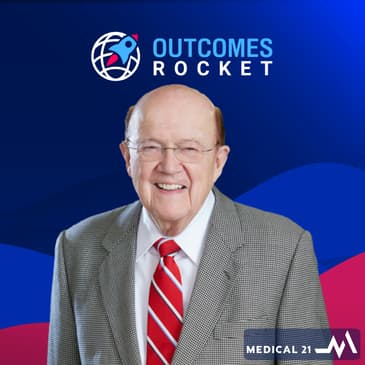
Taking the risk no one else will: how Medical 21 is working to replace harvested blood vessels with an artificial coronary artery that becomes part of the patient’s own body.
In this episode, Manny Villafana, Founder and CEO of Medical 21, returns to discuss his team's progress in developing an artificial coronary artery for bypass surgery. Drawing on more than five decades of medical device innovation, he reflects on how his earlier companies helped create longer-lasting pacemakers and lifelong heart valves that transformed cardiovascular care. Manny explains how Medical 21's graft is designed to grow into a living blood vessel made from the patient's own cells, potentially eliminating the need to harvest vessels during bypass surgery and reducing pain, recovery time, infection risk, and costs. He also shares updates on the company's preclinical progress, partnership with the Mayo Clinic, fundraising efforts, and why pursuing seemingly impossible ideas is essential to advancing medicine.
Tune in to learn how bold thinking, regenerative technology, and a willingness to take risks could reshape coronary bypass surgery!
Resources:
[00:00:02] Hello, everyone. Welcome back to the Outcomes Rocket. I'm really excited to be hosting Manny Villafana again on the podcast. He is the founder and CEO of Medical 21. Manny, thanks so much for joining us again. Pleasure. Pleasure.
[00:00:20] We had the chance, you guys were following us on LinkedIn, had the chance to connect with Manny at Device Talks in Minnesota. And when I ran into Manny, I was like, wow, Manny, you guys have made so much progress with the company since we talked three years ago. And so we said, let's get back on the podcast and share what's happening.
[00:00:41] So Manny, for those listening and watching that don't know you, give them a little bit of the nutshell background on the many companies you helped start. But then let's focus our conversation today around Medical 21 and the massive things you guys are doing for patients today.
[00:00:57] Okay. Okay. Well, thank you, Saul. The story starts about 55 years ago when we started making pacemakers at a time when a pacemaker was the size of a hockey puck and would be implanted in the body. But unfortunately, in 12 to 18 months, that pacemaker would fail. They were enormous things.
[00:01:19] There were things about this size, about the size of a hockey puck. And like I said, in 12 to 18 months, we would have to replace it. So what we did is we developed a pacemaker that is about half the size, half the weight, and would run hopefully for 10 years, but instead actually ended up running for 40 to 50 years.
[00:01:43] The pacemaker. The pacemaker that I'm holding in my hand actually just failed on the 29th of June in the year 25 last year after running a total of 52 years. Wow. That's an external one, right? That's an external one. An implantable one. This was implanted in a patient for 24 and a half years. Amazing.
[00:02:09] Took it out. Then we put a load on it to see how long it would really last, and it lasted 52 years. Amazing. And that company was called CPI, which today is known as Boston Scientific. Boston bought it for, in today's dollars, for about $50 billion.
[00:02:28] The second company we developed was a company called St. Jude Medical, where we were developing heart valves at a time when a heart valve would last maybe four or five years and would clog up, would break, would cause strokes and things like that. And we developed the first lifelong heart valve. That is the same one that was designed to last the entire life of a patient.
[00:02:54] And we have patients now with our St. Jude valve approaching 49 years. So we have done that and accomplished that. And that company was bought by Abbott. Yep. And also in today's dollars, about $50 billion again. We also developed another heart valve, another impossible task was to try to develop a valve better than the St. Jude valve.
[00:03:22] And in my opinion, we developed the ATS valve, which in my opinion is a better valve. So Medtronic bought that out earlier and paid in today's dollars again about a billion dollars. So we have a history of doing devices that extend the life of patient much better than any other products. And in many cases, doing things that have never been done. Now, I've been approached many, many times by doctors who say,
[00:03:49] Manny, our biggest challenge today is that we would like to be able to implant a vessel on the heart rather than taking them out of the body. When a person has a heart attack and they determine that there are some blockages, they will try to open them up with stents and things like that. But many times the stents will close, et cetera. And we end up with a patient that needs to have bypass surgery.
[00:04:16] They will take a vessel out of your leg, out of your arm, off of your breasts. All of these things are tearing things out of your body and they will put them on your heart. And why don't we use one? Manny, and I'll pause for a second. And folks, if you've ever seen Manny's presentation, when he talks about this, he has images and literally they fillet your entire leg and they have to sew you back up.
[00:04:44] So it's really a shame, but that's just where we're at right now. And it doesn't have to be that way. So Manny, you and your team are working on something very promising. Tell us about it. We have developed what we call an artificial coronary artery. We have tested it for over three years now. We have images, what we call angiograms, where we can show a doctor how it's working, et cetera, et cetera.
[00:05:13] We've euthanized certain animals. We take out the graph. We chop it up, cut it up so we can look at it under a microscope. And what we have done is create a graph. When we put it in the body, it's made of materials that actually promote, regenerates new tissue right inside. So we are creating a new vessel in the body of the patient.
[00:05:40] So therefore, with time, it doesn't get rejected because it's made out of your own cells. Okay? No one's ever done that. And now we have done it. And we're now starting to do overseas in Europe. A couple of countries right now are ready to go to begin our clinical trial. So in the period of time of 10 years, we have financed this company through friends and investors. And we're now looking for additional capital. We were trying to do an IPO.
[00:06:10] But unfortunately, the current Iranian conflict that we have has caused small companies to, it's impossible to do an IPO. And so we're struggling. So we would like to get, hello, Manny, do you need some money? Okay? And if you do, I'll take care of you. Okay? I'll put my hand in your pockets. Okay? And that's where we are. This company is really no different than what all the things that we have done.
[00:06:37] We're doing it the same way, the same approach. Many of the same doctors. We have the Mayo Clinic, as an example, as one of our partners who have already agreed to do the clinical trials in the United States for us and things like that. As soon as we get the FDA go-ahead and things like that. So we're doing everything like the way we've done before. We have done seven IPOs before. Okay?
[00:07:01] This eighth IPO has been a little bit tough because somebody decides to bomb a few places and it's causing havoc for us. But other than that, with friends like you, Saul, if we can get more friends to help us and say, okay, what can we do to continue this work while the IPO either comes forth or maybe just continue our work for another three or four years without the IPO, we can do that as well.
[00:07:28] It's up to your visitors who are visiting the site to say, Manny, can we help? You can go to medical21.com. There's our website. Again, medical21.com is our website. And you can see the whole story. Well, that's fantastic, Manny. And for everybody listening, like this is a huge opportunity. If you're in the venture community, you know devices, you know Manny. I mean, he doesn't need an introduction.
[00:07:58] Definitely an opportunity to keep your eye on and to reach out on. We'll leave the ways to get in touch with Manny in the show notes. And Manny, I want to bring back sort of a story that you shared while we were at Device Talks. And it was about taking risk. I want to also share that with our listeners, but also potential investors. I was once asked to give a talk at one of the universities, and there were a whole bunch of professors in the audience.
[00:08:26] And I said, you know, gentlemen, ladies, gentlemen, we are failing our students at this university and a lot of other universities, and that we are not teaching the art of taking risk. You realize that one of the greatest hazards in life is an individual who does not take risks.
[00:08:49] Because if he does not take risks, he will do nothing, will accomplish nothing, and end up being nothing. And that's a strong statement. I remember when I made that presentation at Harvard University, one of the students got up and said, what are you, crazy? And we talked about it in front of his professor. And I said, you see that guy at the door? That's your professor.
[00:09:13] He can give you an A, a B, a C, a D, or an F. Okay? But you got up, took risk to make your point. And that's what I'm trying to teach you. Learn to take risks. Otherwise, you're going to be doing nothing. All right? And that's the name of the game. If I were to sit down and study this, I said, man, no one's ever done this. Everybody and his uncle has tried it.
[00:09:41] The big guys, the Medtronics, the St. Jude, they spent a gazillion dollars, et cetera, and they haven't been able to do it. But that's a high risk. I said, yeah, I'm going to take that risk because I believe it can be done. I believe there is a tremendous need. It's the biggest single operation in the world. And if I can make it safer, cleaner, without pain, without infection, and things like that, that will be the single biggest accomplishment I've ever done. And I am working on it. And we are there.
[00:10:11] We are there. We are ready to go into humans. I have already told them. I told my doctor and my wife, if I had a heart attack, boom, and I wake up and I said, Manny, it looks like you're going to need a bypass. I said, great, do it. But you're not going to touch my legs. You're not going to touch my arms. I got a little package. I open it up. And there is a vessel for you. Okay? It saves up tons of money. No pain to the patient. It's just unbelievable.
[00:10:40] And doctors have said to me, Manny, when can we have it? I said, well, patience, guys, because they got to do it. I love that. How much money do you need, Manny? Like, how much money do you guys need right now? Okay, since you asked the number, I'll tell you. I would like to raise $10 to $15 million to allow us to run the company for another two years or so and get some more data to add value to the company and then take it public. That's not much. No, it's not that much.
[00:11:08] I mean, we spent about $27 million into the company already. Okay. We don't have any venture capital. If some new venture capital company wants to talk to me, Sol will be happy to give you my telephone number and things like that. And anyway, we get the money. To try to raise money just to hold it until the IPO window opens is a little bit scary because none of us, nobody knows when this war will end and knows when this market will open again.
[00:11:36] So instead of trying to just raise money to carry us until the window opens, I would just rather say, look, I need $10 to $15 to give me two to three years of run rate and I can do this. And then we'll do that financing that way or some other way. I'm open to whatever way of financing. I'm not stuck on the IPO other than I've done seven IPOs successfully in the past. No one's ever done that. Okay. I have a few records and that's one of the records.
[00:12:05] The other record, I did the youngest when I was the youngest person ever to do an IPO. How old were you when you did it? I was 31 years old. Nice. Okay. I was 31. And then the second record was it was the fastest IPO. I did it in 114 days. On the day the company opened till the day we went public, it was 114 days. I had the third record, which is seven IPOs.
[00:12:33] I don't think any entrepreneur has ever done seven IPOs. Nobody, not even close. Okay. And then the, I don't know. You're a beast. That's one more record I want to go after. The next IPO I have another record that I'll mail. No. Well, you're a beast, Manny. I certainly respect and admire the work that you have done and that you continue to do. The example that you set for all of us on the risk.
[00:13:00] And for everybody out there listening, this is an opportunity of a lifetime. And frankly, that's not much money for where Manny's going with this one. So certainly check out the show notes, reach out to me. Happy to put you guys in touch with Manny. Manny, thank you so much for doing this. This is always fun to hang out with you. I'm always learning. Okay. Thank you very much. Thanks everyone for tuning in and we'll see you next time.