This podcast is brought to you by Outcomes Rocket, your exclusive healthcare marketing agency. Learn how to accelerate your growth by going to outcomesrocket.com
Patient safety and improved surgical outcomes are achievable through innovative technology and a focus on the needs of clinicians.
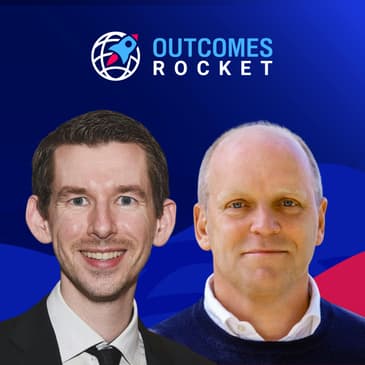
In this episode, Philip Siberg, CEO, and Michael Noble, Vice President of Global Marketing, discuss how Senzime is transforming perioperative care with Tetragraph, a quantitative neuromuscular monitoring technology. Philip shares their bold mission to improve outcomes for 100 million surgical patients by reducing anesthesia-related complications, while Michael emphasizes their customer-centric approach, offering education, protocol development, and seamless hospital integration. They acknowledge the slow pace of change in healthcare and stress the importance of perseverance and strong partnerships with clinicians. Together, they aim to enhance patient outcomes, lower healthcare costs, and drive meaningful change at every level of the hospital system.
Tune in and learn how innovative neuromuscular monitoring can transform perioperative care and improve patient safety!
Resources:
- Connect and follow Philip Siberg on LinkedIn.
- Follow and connect with Michael Noble on LinkedIn.
- Learn more about Senzime on their LinkedIn and website.
- Discover more about Senzime’s Next Gen Tetragraph here.
Fast Track Your Business Growth:
Outcomes Rocket is a full service marketing agency focused on helping healthcare organizations like yours maximize your impact and accelerate growth. Learn more at outcomesrocket.com
[00:00:01] This podcast is produced by Outcomes Rocket, your healthcare-exclusive digital marketing agency. Outcomes Rocket exists to help healthcare organizations like yours to maximize their impact and accelerate growth. Visit outcomesrocket.com or text us at 312-224-9945.
[00:00:25] Hey, everyone. Welcome back to the Outcomes Rocket. So excited that you're joining us again for today's episode. I've got two outstanding leaders in healthcare with us. First, I want to introduce you to Philip Siberg. He is the Chief Executive Officer at Senzime. He's an accomplished leader with over 20 years of experience in the life sciences industry,
[00:00:53] previously served as Chairman of the Board of Senzime, and just an incredible leader in the space. We also are joined by Michael Noble, Vice President of Global Marketing at Senzime. He's a seasoned marketing executive with over 15 years of experience, had a chance to work with him during our share time at Medtronic, but also served at other outstanding companies such as Cochlear Americas, always at the top of his game.
[00:01:20] I'm excited to have them here on the podcast to share more about what they do at their awesome company. So, gentlemen, welcome to the podcast. Thank you. It's a pleasure to have you guys here. And so, look, to kick things off, please, I'd love to start with just kind of sharing a little bit about really what you do, what inspires your work in healthcare. So, yeah, like you said, I've been doing this for ages, started a number of companies, had the fortune of doing it together with a lot of brilliant clinicians and professors.
[00:01:49] And out of coincidence, about 10 years ago, I met up with a professor at Mayo Clinic down in Florida, and he had these brilliant ideas of revolutionizing patient safety and bringing a new technology to the market. So we said, hey, guys, let's build a company together. So 10 years ago, we started. And the mission was very bold from the start. Let's make a major impact on 100 million people. Let's make that happen.
[00:02:14] If we do that, we're going to thrive for patients, for investors, and for the team in making a great impact. So I think the dream here in this industry is really to make a change and to make a lasting impact. Thanks for sharing that, Philip. Michael? Yeah, great beginnings. And for me, I think it really started from birth, honestly. I was born profoundly deaf. I received a cochlear implant at the very young age of two. And that led to a summer internship with the manufacturer of my device called Cochlear.
[00:02:44] And that's how my internship turned into a full-time job. So I started my med device, marketing for her, if you will, at the age of 21. And often reflect of how did I get here and what is my why? And I think it really comes down to knowing the firsthand impact that healthcare has on me as an individual. I know what that means for other patients all around the world. And it's one thing to sell, let's say, an electronic device or a luxury item. And those can bring for anyone.
[00:03:12] But to say that I've had a role in either restoring a sense for someone, like hearing, all the way to saving patient lives in the operating room too when they recover. That's pretty remarkable to have that as your why. Being able to see that firsthand and knowing that impact that it has on me and so many people around me. You know, I'm really inspired to have this opportunity to do this at scale, especially with this wonderful Swedish company.
[00:03:36] Since I'm working very closely with Philip and an amazing group of individuals with that shared mission of improving patient safety and outcomes. Thank you for that, Michael. Appreciate you sharing that as well. That very lived experience that I think does bring a lot of value to the work that you do. So tell us about Senzyme, gents. Help us learn about it. How does the organization add value to the healthcare ecosystem? Yeah, I can start. But we started this venture about 10 years ago.
[00:04:01] As I said, 30, 40% of everybody that went through a major surgery with anesthesia, you know, were getting severe complications. So they came out of surgery, partly paralyzed, couldn't breathe, ended up staying a long time in the hospital and lots of strange and really scary complications. So what we're doing is we brought this fantastic new technology to market that measures your electricity of your muscles and your nervous system. And it's used in the operating room.
[00:04:28] And it helps to make sure you get perfect dose, the right dose of paralytic drugs, which are used in anesthesia. It makes sure that you are woken up at the right time and that you can breathe on your own. And it really eliminates any post-operative complications. And it cuts a lot of expenses, reduces the amount of drugs, and gets you out of the hospital a lot faster. So it's really making a huge impact for patients that are undergoing surgery, which is about 100 million patients a year.
[00:04:57] That's your 100 million mark right there, Philip. Yeah. Well, I love it. I thought you were going to say. Yeah. And just to really add to that, what I really appreciate about what we do at Zenzyme is just delivering these innovative product solutions, especially this quantitative trainer for a monitor, which we just call a petrograph. And we just recently launched the next generation petrograph. Thank you. Thank you. Yeah. And what we're really focused on is we have to think about the customer and our clinicians first.
[00:05:26] So how do we make it easier to comply with new clinical guidelines that recently came out in just the last two or three years, really? And don't just stop there. I think it's still important that we provide the education, the expertise. I mean, we've got an amazing team with previous clinical experience working directly in the hospitals.
[00:05:46] And so really, all of that is to help clinicians around the world and also health care leaders, if you're on the C-suite even, is to help improve patient care, patient outcomes, patient safety, satisfaction, all the while reducing cost and making sure that they have that compliance to the guidelines and the clinical literature that's out there. Yeah. And if you guys are doing all that, sign me up. There's huge opportunities in delivering care.
[00:06:13] This is one of those areas where anecdotal medicine has been a big part of it, or at least like a division in camps, right? I can do it without any tech, but the reality is there's measurable and reproducible ways of doing it. How is what you guys do different or better than what's out there already? And let's talk about the status quo as well. Yeah, absolutely. I think a lot of companies sometimes can get to a set in the mindset of, well, we're going to focus on the product. That is absolutely important.
[00:06:41] But you can't just stop at the product and how the product works, features and benefits, all of those things, which, again, is very important. But where I think we really try to do a better job, and again, it's going back to the customer, what exactly is it that they need? And I think a lot of times clinicians are not waking up in the morning saying, by golly, I want another monitor or I want another device to add to my huge plethora of tons of devices they're dealing with on a day-to-day basis.
[00:07:10] What we try to do is think about, okay, what is in value and how are we setting up these clinicians for success or even hospitals for success, whether it's a patient safety initiative, a quality improvement project, all of those things. And so what it comes down to is, as Enzyme, we are really focused on delivering value beyond just the product. And what that means is we're not just going to show up to the hospital and say, hey, we have this great monitor, want to buy? Okay, here you go. Here's a contract. We drop it off and then we run away.
[00:07:39] We're there with you every step of the way from before the contract even starts to ongoing support way after the contract is signed and monitors are delivered. So part of that is looking at protocol development, looking at device connectivity so you're not having to manually chart everything, and then you're getting the data to see am I truly improving outcomes?
[00:07:59] And whatever other quality metrics that you may have established as a goal, and then just overall integration with your other OAM multi-parameter monitors to your electronic health records or your PDMS if you're outside of the U.S., we really try to think more holistically and globally to providing the value beyond just the product. Thank you, Michael.
[00:08:20] Like I said, Michael, yeah, just to summarize, I think we're here, I like to say, a radical change, really helping to transform perioperative care. And we're doing this. We're having the fortune to work with anesthesiologists all around the world and develop solutions and services together with them. So it's so much more than just delivering a monitor or a sensor. It's really a long-term solution with such a clear benefits for so many parties. So it's truly a pleasure to do this.
[00:08:50] No, that's great, Philip. And Michael, thank you for sharing how the product's different and how you're adding value to the ecosystem. Look, creating these types of companies is not for the faint of heart. And Philip, you've been at it for a few years here. Tell us about the biggest setback you've had and a key learning from that. And Michael, we'd love to hear one from you as well. Yeah, good question. But yeah, I would probably summarize it in, my God, it takes time. On average, it takes 17 years to bring a new technology and new therapy to market. And it's so true.
[00:09:20] Despite making such an effort, it just takes time to change healthcare. Again, we're fortunate to work with all these people. But driving change in protocols and guidelines, despite us being, you know, we're supported by US and European guidelines now. It's still a very slow progression. We're getting all the key opinion leaders, everybody. We raised about $70 million to get to where we are.
[00:09:46] So to summarize the setback, you can't do a business case in Excel. You just have to be, the reality is different and prepare for a long ride. But it's a lot of fun. Yeah, thanks, Philip. And the highs are easy, but the lows, tip would you give for other medtech entrepreneurs? How do they deal with the lows? What's a tip you could leave them with? It's grit, grit, and grit. And be out there, meet the patients, see the change you're making.
[00:10:13] And that will give you the energy and do it together with clinicians. Keep fighting. You will get there. I love it, Philip. Thank you for that. And folks, take that one home. Think about it. Because coming from a couple startup founder here, definitely experience we can learn from. Michael, what about you? Yeah, well, that question. I think the biggest learning for us is, you know, that true change really happens at the hospital level, at the clinician level, at the patient level.
[00:10:39] And I think the most important thing is we have to have that sort of continuous partnership and reinforcement. Change in clinical practice does not happen overnight. And it kind of goes back to, we're not just selling a device. As Philip well said, we are truly transforming how neuromuscular monitoring is approached in these operating rooms, not just in the U.S., really around the world. And sometimes people just don't know. They don't know what they don't know.
[00:11:06] And so it's our job to really educate and bring to light the latest clinical guidelines, clinical evidence supporting the use of this change of this transformation of anesthesia care. And I think the other thing, and this is me, I really like to move fast a lot of times, and I want this to happen quick. And so sometimes just realizing adoption is not necessarily about speed. It's about sustainability. And we see institutions in goodness adopting these other technologies because it really,
[00:11:34] truly is improving patient safety and outcomes. But we just have to remind ourselves that the reinforcement of the work that we do in understanding the why every single day. And it's just really had to look at every challenge is truly an opportunity to drive real change at the clinician level, the patient level, and the hospital level. And the progress that we are currently seeing today is truly because of the commitment that we've made to education,
[00:12:00] partnership, whether it's with the hospital, the clinician, or even other industry partners, with all the end goal of improving that goal and mission and vision of improving patient safety and outcomes. That's what it really comes down to. Thank you, Michael. Yeah, that alignment's super key across all stakeholders. So I really appreciate that. Look, we're here at the end, guys. Time flies when you're having fun. And you guys are just doing an incredible job. What call to action would you leave for the folks with us today?
[00:12:30] And what's the best place they could reach out to learn more about maybe demoing the technology or more about the science behind it? Because I'm in marketing, of course, I have all of these great places you can come check us out. I think the one thing that I just want to share is we all have a role in healthcare, whether you're on marketing or you're the CEO or you're on the manufacturing line. I mean, we all have a role to improving patient care. And so if you'd like to learn more about what we do as an organization and the role you can play,
[00:12:58] I encourage you to visit us at senzyme.com, where we talk more about the clinical problem that we're solving for with this goal of helping basically 100 million patients around the world. And of course, you know, we just recently launched this brand new product that I'm super excited about because I'm a nerd and I love new technology is the next generation Tetragram, which you can learn at senzyme.com forward slash next gen. Of course, we're on LinkedIn. We post frequently and we'd love to hear from you and love to stay connected. And that's where we share a lot of the greatest information.
[00:13:28] And of course, we have amazing clinicians also in the field that are more than happy to provide a demo or simply just hop on a 15-minute Zoom chat to talk about the clinical problem that we're really trying to solve for around the world. So just want to say thank you so much all for this great opportunity. Really appreciate being able to share our mission. Of course, Michael. Thanks for joining us. And thanks for that call to action. Philip, do you want to leave us with your closing thought? My God, it's a mission.
[00:13:53] You know, we have 40 years of science and over 100 patents and so much love and care and studies behind this. And really, we're doing it, again, as I said before, for the patient. It's all about safeguarding the patient's journey from they come into the operating room until they leave the hospital. Making a major impact for mankind is not about meeting the budgets every year. It's about being a legacy with you. And we're always looking for good people to attract and join our mission,
[00:14:24] but we want to work with the leading clinicians in the world to realize this. Get in touch with us and let's make a change. I love it, Philip. Thank you for that. And, folks, we've got all the ways to get in touch with Philip, Michael, and the Senzyme team in the show notes. So make sure you check those out. We'll leave their LinkedIn profiles there as well as all the links that Michael shared for the company as well as their new product. Congrats to you guys for the newest iteration of the device.
[00:14:52] You're making change happen, and we need it. So appreciate what you guys do. Thanks for joining us. And for everybody with us tuning in, thank you all for tuning in with us. Philip, Michael, thank you, guys. Thank you, Alex. This podcast is produced by Outcomes Rocket, your healthcare-exclusive digital marketing agency.
[00:15:23] Outcomes Rocket exists to help healthcare organizations like yours to maximize their impact and accelerate growth. Visit outcomesrocket.com or text us at 312-224-9945.