Unlocking unstructured clinical data within electronic health records can revolutionize healthcare by providing actionable insights to improve patient outcomes.
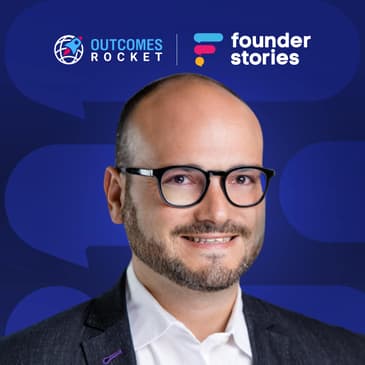
In this episode, Aaron Leibtag, CEO of Pentavere, a HEALWELL AI company, discusses his journey into healthcare, driven by a personal tragedy. Motivated by his partner's mother's death due to an overlooked medical detail, he co-founded Pentavere to transform unstructured clinical text into meaningful information for clinicians. Aaron emphasizes that over 90% of healthcare data is underutilized because it is siloed and unstructured, leading to many patients "falling through the cracks." The company uses AI and natural language processing to convert this data, thereby enhancing patient care, identifying patients for clinical trials, generating evidence for regulatory processes, and more. Aaron emphasizes that the company is uniquely positioned to make a global impact on healthcare outcomes.
Tune in and learn how Pentavere is harnessing the power of data to transform healthcare!
Resources:
[00:00:02] Hey everyone, welcome back to the Outcomes Rocket. We are doing another episode of Founder Stories today and I am so thrilled to be with Aaron Leibtag today. He's the CEO of Pentavere, a Heal Well AI company. They were acquired about a year ago. He built a globally recognized healthcare AI organization rooted in patient-first mindset, which we need more of, inspired by the tragic loss of his partner's mother,
[00:00:31] due to an overlooked medical detail. Aaron co-founded the company to prevent similar oversights by transforming unstructured clinical data into actionable insights, enabling clinicians to identify patients eligible for better treatments. So really excited to have you here. Aaron, thanks so much for joining us. Aaron Leibbrandt Thank you so much for having me. Looking forward to this discussion.
[00:00:57] Aaron Leibbrandt Likewise, likewise. So hey, just to kick things off, can you share with us what got you started in healthcare? Why entrepreneurship? Why are you doing all this? Aaron Leibbrandt Yeah, I'll start with healthcare. The why entrepreneurship is a longer story. I think me, my fellow co-founder, we just have the bug. Because you got to go through that pain and be okay with that to start a company, build a company and successfully exit a company.
[00:01:26] Aaron Leibbrandt The why healthcare. My background is finance. I spent the first good chunk of my career in finance on the corporate side, also on the private equity side. And through that, saw firsthand the magic that happens when you connect great data with great people and great processes and the disaster that can happen when that triangle is pulled apart. Aaron Leibbrandt And you lose sight of what's important to the customer. So that was always an ethos of mine.
[00:01:54] Aaron Leibbrandt My fellow co-founder, Stephen, spent 25 years in finance, but on the system side. Think about building large global systems so companies can better understand risk and make huge amounts of money. Aaron Leibbrandt And the why healthcare is unfortunately his mother went into an operation that should have been routine. Aaron Leibbrandt And the fact that she had to be put on certain medications was missed by her care team.
[00:02:22] Aaron Leibbrandt And let me mention, at no fault of her care team. Aaron Leibbrandt They go through so much documentation. They're so busy. Aaron Leibbrandt They're so overworked. But critical life-saving information is missed. Aaron Leibbrandt And she passed away as a result. Aaron Leibbrandt So you have two folks from finance used to leveraging data so these companies can make huge amounts of money and saying, how is it in healthcare so much of this information is not used today?
[00:02:50] Aaron Leibbrandt How is it that in healthcare so many patients fall through the cracks in their healthcare systems? Aaron Leibbrandt And what we chose to really focus on back in 2017, before large language models and natural language processing and AI is as ubiquitous as it is today, is if we can unlock the value within the electronic health record, all of the notes, all of the documents,
[00:03:13] so patients can get better care was our founding story and continues to be our North Star inspiration as we continue to grow the company. Aaron Leibbrandt That's great, Aaron. Aaron Leibbrandt Look, so sorry to hear about your partner's mom. Aaron Leibbrandt These things are terrible. Aaron Leibbrandt And to your point, there's so much data out there that we can be leveraging, but it tends to be locked in silos and unavailable or unstructured in a way that is tappable for use.
[00:03:41] How is Pentavere, part of Heoil, how are you guys making a difference with your solution? How are you adding value to the ecosystem? Aaron Leibbrandt Yeah, exactly as you just described is the core of what we do. Taking unstructured clinical text, clinical siloed documents, how it exists in our electronic health record system,
[00:04:07] structuring that and turning that into meaningful, actionable information for clinicians so that they can deliver better evidence-based care, that they can understand what's happening with their patient population. What I just described, Saul, is still such an unknown reality that each and every one of us face every day.
[00:04:33] We are generating more data in healthcare than in any other industry, yet unlike any other industry, the majority of that data, well over 90%, be it siloed, but the biggest issue is it's unstructured. It's in paragraph after paragraph of narrative text that's describing our deepest, most significant healthcare realities,
[00:04:59] that clinicians just don't have time to read through all of that in order to deliver the best care. And as a result, we talk about 90% of the data isn't used to improve healthcare outcomes. Just as significant, if not more significant, 90% of patients fall through the cracks in some way, shape, or form. And we have delivered better patient interventions in cardiovascular disease, in oncology, in family medicine, in women's health.
[00:05:29] So we can look people in the eye and say, patients are doing better as a result of the AI system that we built. That's awesome, Aaron. And look, that data is everywhere from payers to providers to communities. Talk to us about who benefits from your solution, number one. Like, who's your customer? And who do you want more customers from? What's the stakeholder group? And then secondly, where does all the data come from?
[00:06:27] Yeah. Evidence for regulatory processes. So bodies can say, okay, we're going to approve this particular therapeutic. We're going to streamline access to this particular therapeutic. All of those are applications around what we do. In terms of who our first customer was, and this is unique to our story, is we built and validated our system over the last seven years.
[00:06:54] That's now the most published AI NLP company in the world. We just received a pre-gallion award, recognizing that. But in partnership with life science companies, doing real-world evidence clinical studies. So our initial funding, which really funded R&D, was in partnership with life science companies, but also in partnership starting with Canadian hospitals and health authorities,
[00:07:23] because we were able to build our initial platform generating data sets for these institutions so that they can do better research, better quality improvement initiatives. And as a result, life science companies got clinical study reports, publications, no different than how research has been going on for the last hundred years, into the populations and diseases that they really wanted to unlock knowledge around.
[00:07:54] Super cool. I think it's fantastic. And congratulations on that award. Thank you. That's phenomenal. And so you guys started with, was it lung cancer or where'd you guys start? We actually started in tuberculosis. So myself and my partner, when we decided we were going to take that jump into healthcare, instead of creating a pitch deck and going out and raising seed capital,
[00:08:22] at our expense, we embedded ourselves at Canada's one of Canada's leading hospitals for two years. So we can really understand how clinicians work, how siloed and fragmented are health information systems. And I can tell you, they are as siloed and as fragmented as you can imagine. How does things like privacy and ethics come into play? And that resulted in one of the first natural language processing papers back in 2018
[00:08:52] that compared the results of our early algorithms to clinicians manually going through the charts to understand what is that patient journey. And it was a pharmaceutical company, and Roche in particular, who read that, who was looking for specific information into lung cancer patients. And Canada's largest cancer center really was looking to build a best-in-class data set.
[00:09:19] Seven months later, we were presenting both meaningful clinical knowledge into advanced lung cancer patients on immunotherapy with liver metastases and further validation of our AI platform. And you can imagine, then life science companies and institutions started to call because we accelerated the current processes of manual chart review. And that's how we built and matured our platform to become best-in-class. That's awesome. That's so great.
[00:09:49] We talk to founders all the time on the podcast. Sometimes you didn't see where it was going, but oftentimes the founders did. They saw where this was going. What was the case for you? Was this the end that you thought you'd be heading towards? Obviously, it's not the end, right? But you guys had your exit, and now you're amplifying through HealWell. Is this what you envisioned?
[00:10:15] So we had no idea when we started what our business model would be, what the product was. We couldn't articulate for the life of us what was the SaaS model and that hockey stick. What we believed in our hearts coming off the stinging reality of patients falling through the cracks and the consequences of that is here in healthcare, you've got an industry
[00:10:41] that in most developed countries is just shy of 20% of GDP. 90% of patients fall through the cracks in some way, shape, or form. And 90% of the data we generated, and often the most important data, that relationship between ourselves, our clinician, our diagnosis, our treatment, and our outcome, is not used.
[00:11:06] So we were like, it is such a big pile of poo that there's got to be a poony out there. And if we do it by building trust and validating our technology using the same high standards that therapeutics and medical devices are validated, right? Peer-reviewed publication, scientific methodology validation, that we'll be able to uncover that pony,
[00:11:33] and that pony will be transformational in people's health. And we're seeing that today. That's great. And so now that you guys are with HealWell, what's the vision for the future? Yeah, it's such a wonderful partnership. And I really have to commend the chairman of the company, a gentleman by the name of Hamid Shabazi. He's not only the chairman of a company called HealWell, but he's also the chairman of a company called Well Health Technologies,
[00:12:01] which is Canada's largest private healthcare provider, but a global company. So over the last six years, they've been acquiring electronic medical record companies, clinics, interoperability platforms. HealWell is the data science patient identification company. That's a spinoff of that. And why it's such an incredible fit is if we have now our Darwin AI engine that can unlock this information,
[00:12:31] we're uniquely positioned, well, as a billion-dollar company, where one in three clinicians in Canada interact with one of their touchpoints, and a third of their revenue comes from the U.S. If we can combine those, we can truly tech-enable our healthcare system, identify patients, unlock the value of electronic health records, and intervene earlier so patients get the better outcomes
[00:12:59] and costs are reduced within healthcare systems. And that's really the vision of where we're going and the journey that we're now part of. And for us, it wasn't that we needed capital to grow and scale. We needed all of the pieces to the puzzle that now Well and HealWell brings to the table and what we now have together. Yeah, I love it. A huge part of WINS and scaling is the ecosystem, right?
[00:13:24] And it sounds like they have an incredible network and ecosystem where you guys can thrive. So congratulations on that to you and your co-founder and team, but also the Well and HealWell team. I think it's a good match for sure. Thank you. Hey, look, so these things don't happen. Like companies don't get built without issues. Tell us about one of your biggest setbacks, Aaron, and what was the key learning that came from that?
[00:13:49] Yeah, so if you're a founder or you're an entrepreneur, I'm sure we'll agree with this statement. Every day you wake up and you deal with more challenges, with more stepbacks than you could have ever imagined. It's hard. And those challenges and those setbacks usually overwhelm the WINS by a 10 to 1. So resiliency is critically important.
[00:14:19] One of our biggest setbacks was, I shared earlier, how we funded ourselves by relationships with life science companies, by delivering essentially retrospective non-interventional studies that allowed us to sustain ourselves, allowed us to build the partnerships with the hospitals. And when COVID hit, you can imagine there was a complete change in focus.
[00:14:45] So imagine a number of those studies being canceled. No different. Every entrepreneur tells the story when they had X amount of cash or what were they going to do if this pony or this rabbit didn't come out of the hat? And that by far were some of our largest setbacks. But what we learned through the process, especially now looking back, is if you stay true to the reasons
[00:15:10] on why you're going through this crucible, and for us it was always about the patient and continues to be about the patient, and you wake up every day willing to work hard and hustle and be resilient while not compromising on your ethics, you find a way. There's always a way. You just got to stay alive. And that's our story. Every day was various setbacks.
[00:15:34] But when all of a sudden 70% of your expected revenue falls through, what do you do while staying true to your mission? Yeah, no, that's great. Great message there, Aaron. And something for everybody listening, that's a founder that has, you have your own journey. So if you're in one of those hard moments right now, or if maybe you haven't hit one that's as big as the one Aaron mentioned, it will come.
[00:16:02] So don't forget your North Star. Don't forget your values. Keep all of those at the center and push forward. It will work out. Aaron, this is awesome. I really appreciate what you've shared. If anybody wants to learn more, I imagine you're working with life sciences, health systems that are both in Canada and the U.S. Is that right? And Europe, Australia, New Zealand. We're truly global and scaling to really have global impact.
[00:16:33] One of the things when we stood on stage during the pregallion award, I look to my left and I see the head of Pfizer for Pax Lovid. And I look to my right and I see Texas Medical Center where we're truly committed in scaling around identifying patients so that they can get better care by accelerating the ability to understand their health duties within the electronic health record. I love it.
[00:16:57] And so if people want to reach out to you to partner, learn more, Aaron, where can they reach out? Yeah, very active on LinkedIn. You can find me on LinkedIn. My email is alieptagntvo.ai and I'm accessible. It takes a community. Healthcare is really hard. And we're at the very beginning of the transformation that is coming from AI. AI is real.
[00:17:26] It will be transformative. And how we deploy it, how we scale it for patients will be the difference between it being truly revolutionary or it actually hurting us. So we're always looking for like-minded people as part of a community to come together to build this future together for patients. Outstanding. Aaron, thank you so much for that, folks. Make sure you check out the show notes. We'll leave Aaron's LinkedIn there so you can get in touch with them. He also shared his email.
[00:17:56] We'll put it on there for you to get in touch. He's accessible. Start the networking. Get these partnerships up and running. That's how we make things happen in healthcare. Thank you all for tuning in. And Aaron, thank you so much for joining us today. This was a lot of fun. Thanks so much for having me, Saul. And congratulations on your success with your podcast and all the things that you're doing. Thank you, my friend. Appreciate you.