
Empowering analysts to make quick decisions can significantly improve clinician satisfaction and patient care.
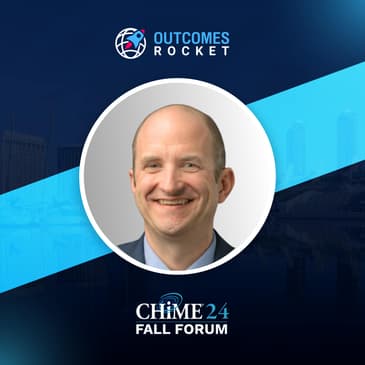
In this first CHIME 2024 Fall Forum episode, guest host Christopher Kunney interviews Ryan Cameron, VP of Technology and Innovation at Children's Nebraska. Ryan shares his non-traditional journey into healthcare IT and the organization's success in winning the Pinnacle and Synergy Awards. He highlights the importance of cross-industry innovation, a strong partnership between clinicians and IT, and empowering analysts to make swift decisions that enhance the clinical experience. Ryan emphasizes Children's Nebraska's core value of innovation and their focus on a continuous improvement mindset. He also shares the organization's commitment to accessible and affordable care through a robust telehealth program, further fueled by their newly launched innovation center.
Tune in and learn how empowering your team and embracing a forward-thinking approach can transform healthcare delivery!
Resources:
[00:00:03] Hello, this is Christopher Cunning, and I'm coming to you from San Diego, California. I have the pleasure and honor of serving as the guest host for Outcomes Rocket's podcast. And that podcast is being sponsored today by CLASS, Research, and CHIME.
[00:00:20] Today, I'm attending the 2024 CHIME Fall Forum, and in particular, I am highlighting three amazing individuals who recently received the Synergy Award that was awarded here at the conference.
[00:00:35] The Synergy Award recognizes healthcare organizations that have achieved the highest levels of excellence in both EHR user experience and digital health innovation.
[00:00:44] By combining the accomplishments of the CLASS Pinnacle Award winners and the CHIME Digital Health Most Wired Award designees at Level 9 or above, this award celebrates organizations that demonstrate unparalleled synergies between exceptional EHR implementation and cutting-edge digital transformation.
[00:01:03] Recipients of the award are at the forefront of healthcare technology, setting a new standard for both clinical efficiencies and patient care through seamless integration and innovative solutions.
[00:01:15] Today, I'll be talking to three of the award winners as they share their thoughts and insights on digital transformation and the impact it has on the delivery of care.
[00:01:25] So join me as we have an opportunity to spend time with these amazing individuals and learn more about their journeys and the work that they're doing to transform healthcare.
[00:01:35] Hello, everyone. This is Christopher Cunning.
[00:01:37] And I'm serving as your special host for the Outcome Rocket and CLASS Podcast, where we are interviewing Ryan Kammer, VP of Technology and Innovation at Chauvin, Nebraska, who is recipient of this year's Pinnacle and Synergy Awards here at the TORSHAI Fall 4.
[00:02:00] Ryan, thank you for taking time with your busy schedule.
[00:02:03] Absolutely. Thanks so much for including us and talking to us about our story.
[00:02:08] Wonderful. First of all, congratulations on winning not only the clinical award, but the Synergy Award as well, too.
[00:02:13] And the clinical award is really about achieving excellence in the delivery of care, using technology, and truly making a transformation within your health system itself.
[00:02:25] First of all, talk to us a little bit about your journey as we were preparing for this interview.
[00:02:30] You have an interesting background.
[00:02:32] And so it's not a traditional, quote-unquote, healthcare IT leader's background.
[00:02:37] So just take a few minutes and share your journey, and then we'll ask a couple of questions about your experience now.
[00:02:43] Sure, I'd be happy to.
[00:02:45] I do have a bit of a varied background.
[00:02:48] Before I joined Children's Nebraska, I'd been in healthcare for almost three years, and I've had some exposure to clinical education in my background, but not full-time focused on healthcare like I am today.
[00:02:58] So I was with an artificial intelligence startup called IV.AI for two years, just about two years before I joined Children's.
[00:03:05] And then before that, I was higher ed CIO for about eight years at Crepe University.
[00:03:10] And along the way, what I discovered is innovation was really key to being successful in those roles and starting a mindset where you're thinking across industry verticals.
[00:03:22] Sometimes you see a problem as you try and solve it, which is within the marks.
[00:03:27] But when you start looking at what people are doing in other industries, you can find some help or defense.
[00:03:32] I'd like to think that my journey to Children's Nebraska was kind of part of that, and I can hopefully illuminate some blind spots.
[00:03:41] Maybe we've seen a pediatric care just with my background experience.
[00:03:44] No, that's great.
[00:03:45] And I do think that for myself as well, too, I did originally come into healthcare or birth into healthcare.
[00:03:51] I worked for companies like Hewitt Packard and others as well.
[00:03:54] I brought, I think, a different mindset and a different perspective to healthcare that I think some of the more traditional CIOs and IT weeks who've grown up in it didn't have.
[00:04:02] You as an entrepreneur, you working in another different verticals, brought those years of experience and background.
[00:04:09] And probably much more disruptive, and I mean that in a positive way, what's happening in the industry than some of the, I think, more traditional CIOs.
[00:04:18] So obviously, it's what measures you and your organization to the success and the rewards you're receiving for that.
[00:04:24] So talk to us a little bit about that positive experience.
[00:04:27] I just think the Pinnacle Award is all about the positive experience you're delivering for health readers and for the organization that's health.
[00:04:34] Tell me, what was some of the biggest success factors you contribute to and really transforming what's happening in your organization?
[00:04:43] I could certainly share part of our story.
[00:04:45] I can take no credit, really, for that relationship that had been established over many years before I arrived at Chilbert's, Nebraska.
[00:04:53] Our CMIO, Dr. Steven Dolter, has been just a conduit for great communication and collaboration between clinicians and the IT world.
[00:05:02] And in fact, he speaks both languages.
[00:05:05] As a hospitalist, a technology professional, he can help us bridge that gap.
[00:05:09] And two things have really made us successful.
[00:05:11] One, many of our IT employees have clinical backgrounds.
[00:05:16] So we have former nurses, former caregivers, docs, crosses board that has meetings in the technical space.
[00:05:22] And then we also really try to make our governance structure very effective.
[00:05:29] And everybody will say governance is the secret to your success.
[00:05:33] I would say it's actually empowerment within that government.
[00:05:37] So what's different about your governance and how you instilled that discipline or transformational governance into your organization versus what some other ways you should use?
[00:05:48] It would say allow your analysts to make decisions.
[00:05:52] Allow them to make quick decisions.
[00:05:54] Empower them.
[00:05:55] Trust them.
[00:05:56] We've had just tremendous success with that.
[00:05:58] And we have sharp people across the board.
[00:06:01] So it really doesn't matter where you sit on the hierarchy.
[00:06:03] If you can make a good decision, that's going to save the clinician time.
[00:06:07] Absolutely.
[00:06:07] And give them more time with the patient.
[00:06:09] Exactly.
[00:06:09] We empower folks to do that.
[00:06:11] And that's definitely the case with us.
[00:06:13] That's great.
[00:06:13] What kind of spurred your interest in working on your organization's interest as a whole and working on this clinical experience and making some of the transformational changes you're making through the use of the EHR and some of the other technologies in regards to the doctor?
[00:06:31] Patient populations are changing.
[00:06:32] So the expectations of what a pediatric experience looks like is very different than what it was five years ago, truer years ago.
[00:06:41] We've really tried to meet into a PCM or mindset to meet people where they're at.
[00:06:45] Right.
[00:06:45] And that's internally and externally across the organization.
[00:06:49] And Children's Nebraska is such a cool place because we actually, our first core value is innovation.
[00:06:55] Which is unique for us.
[00:06:57] It's interesting.
[00:06:57] You have to buy us as a core value.
[00:06:59] Yes.
[00:06:59] 100%.
[00:06:59] So we like to say that we lead with innovation.
[00:07:02] Having a team that really builds a family atmosphere.
[00:07:05] We work together.
[00:07:06] I don't know if you could chop it up to Midwest.
[00:07:08] Work at this.
[00:07:09] A little bit of that.
[00:07:10] Yeah.
[00:07:10] Yeah.
[00:07:11] So we just, we own it.
[00:07:13] And as we think about it each and every day, it's just a part of our DNA of what we do.
[00:07:17] Absolutely.
[00:07:17] And those things have really helped us be successful.
[00:07:20] I'd love to say there was a bag of magic beans.
[00:07:23] Sure.
[00:07:23] I can hand you that that makes it so successful.
[00:07:25] But I would say for us, it truly is keeping these deep sprints of mind.
[00:07:30] It's a part of our strategic plan.
[00:07:32] It's a part of our stand-ups.
[00:07:33] We're constantly looking for that 1% gain, that 2% gain.
[00:07:37] Absolutely.
[00:07:38] And it, much like an athlete would look at how their physical performance works.
[00:07:42] We look at it across the board in our organization and say, what's that next one versus this?
[00:07:47] That's great.
[00:07:47] That's a great good strategy.
[00:07:49] Again, as a winner of the Pinnacle and Synergy Awards, what advice would you give to the
[00:07:54] cobbles here today that I was listening to you and envying that award and say, I want
[00:08:00] to get that next year.
[00:08:01] What do they need to do?
[00:08:02] I definitely don't envy us because we're surrounded by a fantastic variety for the Children's
[00:08:08] Hospital Association, China class.
[00:08:11] All these great organizations are such incredible supporters of what we do.
[00:08:16] And we've created a sense of community where we can get things done.
[00:08:20] Definitely, it's not about envying us or looking at us like we did something that was profoundly
[00:08:25] different.
[00:08:26] I think it's great to be celebrated and that we've had a lot of success.
[00:08:30] The advice that I would give folks is use the tool, trade benchmark, get stuff.
[00:08:35] It's really easy to get distracted.
[00:08:38] It's really easy to say, we got to go put out this fire.
[00:08:41] We have to go deal with this.
[00:08:43] Hospitals are high knowledge, IQ, like the high stress organization.
[00:08:47] Sure.
[00:08:47] Invest the time to think about what type of organization you want to be 10 years from then.
[00:08:53] Right.
[00:08:53] And be intentional and say, looking at the projects that we're working on, looking at the
[00:08:58] strategic investments that we're making.
[00:09:00] Are those vehicles to be there?
[00:09:02] Right.
[00:09:02] Or are we just worrying about today?
[00:09:04] Exactly.
[00:09:04] So that future mindset will be definitely helpful.
[00:09:06] We look to our peers and our level 10 organizations, maybe with a little bit of envy.
[00:09:11] Sure.
[00:09:12] And I've been asking lots of questions, sir, at the Fall Forum about how they achieve level
[00:09:16] 10.
[00:09:16] And so that's where we want to go next.
[00:09:18] Wonderful.
[00:09:19] You're always good as your last win as well, too.
[00:09:21] Well, center right, that's right.
[00:09:23] And you're always looking to strive to be better.
[00:09:25] So as we wrap up this, Ryan, and you led it to my follow-up question, and that is, what's
[00:09:29] next for children in Nebraska in terms of innovation, some of the strategic initiatives
[00:09:36] they're focused on?
[00:09:37] We just opened a 10,000 square foot innovation center.
[00:09:40] Very much.
[00:09:41] We're particularly proud of it.
[00:09:43] In Nebraska, we do a lot more than just in the metro, close of Omaha and Lincoln, and
[00:09:48] we go throughout the state.
[00:09:50] Sure.
[00:09:50] So we're a growing enterprise, like Gary Saw, the Northeast, one nation from every state
[00:09:55] in the U.S., which kind of surprises folks, but we have a very strong telemedicine telehealth
[00:10:00] program.
[00:10:01] And we'll continue to lean into that trajectory because we're only seeing that grow.
[00:10:06] We want to eliminate travel time for our patients.
[00:10:08] We want somebody who lives in rural Nebraska to get the exact same quality as care as they
[00:10:13] would in the Betchner area.
[00:10:15] So accessibility, affordability of care, it focuses for us.
[00:10:19] And the innovation center hopefully will be a catalyst to help us get there.
[00:10:22] Wonderful.
[00:10:22] Okay, congratulations.
[00:10:23] Congratulations.
[00:10:24] Ryan, Vice President of Technology and Innovation at Children's Nebraska, being the recipient
[00:10:30] of the Clinical and Synergies Awards this year.
[00:10:33] Thank you so much.
[00:10:34] I wish you much success in your continued journey in innovating and transforming future.
[00:10:39] Thank you so much.
[00:10:40] It's a great honor.
[00:10:41] Happy to be here.
[00:10:42] Thank you.