
Imagine a dental school where students don’t just learn clinical skills; they’re immersed in entrepreneurship, advocacy, and real-world healthcare integration from day one.
In this episode, Dr. Ali Shazib, Dean of the Workman School of Dental Medicine at High Point University, talks about how he is transforming dental education by integrating medical and dental fields to address the complexities of modern healthcare. Through the C.A.R.E. Curriculum (Clinician, Advocate, Researcher, Entrepreneur), students gain a well-rounded, patient-centered education emphasizing life skills, entrepreneurship, and collaboration. Dr. Shazib’s model includes a unique clinical network, the High Point University Health Oral Health Network, which immerses students in real-world practice acquisition and patient care. Connected through Epic's EHR, this network enables seamless collaboration with other healthcare systems and prepares students to meet emerging healthcare needs. By reimagining dental education, Dr. Shazib hopes to cultivate healthcare professionals who can bridge gaps across disciplines and contribute to a broader evolution in care delivery.
Don’t miss this deep dive into the future of dental education, where visionary leaders are breaking down silos and redefining how healthcare professionals are trained to meet tomorrow's challenges!
Resources:
- Connect with and follow Dr. Ali Shazib on LinkedIn.
- Follow High Point University’s Workman School of Dental Medicine on LinkedIn and visit their website.
- Watch the entire episode on YouTube and get more details at Think Oral Health.
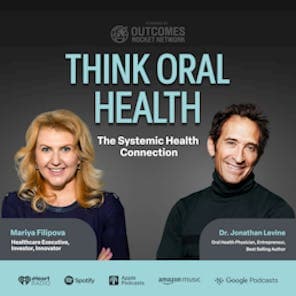
[00:00:04] Welcome to Think Oral, where we connect the interconnected between oral and physical health. I'm your host, Dr. Jonathan Levine. And I'm your host, Maria Filipova. Let's get at it.
[00:00:16] All right. Hello, everyone, and welcome to another exciting episode of the Think Oral Health podcast. We are here at Health, the largest healthcare innovator conference. And as of last year, it is also the largest healthcare conference that also includes oral health speakers, content, innovators, solutions.
[00:00:46] So we are so excited to be part of this conversation, part of this community, even more excited to bring you exclusive insights from some of the thought leaders in this space. As usual, I'm joined by my partner in crime and co-host, Dr. Jonathan Levine. Hi, Jonathan.
[00:01:04] Hello, Maria.
[00:01:05] And we are super excited because we are catching this leader on the go. He is coming into this conference for 24 hours and making space in his busy schedule to talk to us. So without further ado, hello and welcome to the podcast to Dr. Ali Shazib.
[00:01:24] Thank you so much for being here. It's a pleasure.
[00:01:26] Hi. And for those of you who haven't had the privilege to encounter Dr. Shazib and his vision, Dr. Shazib is a trained dentist, a surgeon who ran his own practice, who sold his own practice, and who is now taking on the very humble role of teaching the next generation of dental leaders.
[00:01:48] He serves as the dean of the workman school of dental medicine at High Point University, and he is reimagining what medical and dental integrated care and education looks like.
[00:02:01] So we're very happy to have you at our podcast. Welcome.
[00:02:04] Thank you so much. And a point of note is my training was in oral medicine, which is a very tiny specialty managing the complex medical manifestations.
[00:02:14] I absolutely did that on purpose so you could correct me and our listeners would know.
[00:02:17] Now everybody knows the distinction between the oral medicine and DMD actual difference in the degree.
[00:02:25] So Ali, could you tell us a little bit about what brought you?
[00:02:29] You have had a nontraditional path and what brought you to where you are now changing medical education, medical dental education.
[00:02:38] Throughout my journey through being a dental student in the British system and then redoing dental school in the United States and going through dental school again and going through the journey of being a leading DSO and being a managing director and understanding the mechanics of that system, transitioning to private practice and ownership and all the conundrums that go with it and venturing into the hospital environment and academic systems.
[00:03:04] The common thread and the common theme that really reverberated with me was that we have too many silos.
[00:03:11] And what we're doing in the pipeline, which is education, is we're not exposing at the embryonic phase to our learners.
[00:03:20] We're pursuing and aspiring a career in dental medicine of what are the care delivery models?
[00:03:26] What are the needs of our population in the next five to 10 years?
[00:03:30] And that is representative of the needs that I'm trying to build at Workman School of Dental Medicine.
[00:03:36] So that's been my energy or my drive or my passion is how can we bring down the barriers of silos by equipping education that will feed the workforce to be more integrated?
[00:03:47] That's fantastic.
[00:03:48] Ali, we were talking a little bit before and as you were talking to me and telling me what you were doing, what reverberated in my mind was the rule of opposites.
[00:03:58] As I talked about in Maxwell's 21 irrefutable laws of leadership and he has the law of opposites.
[00:04:05] You are following the law of opposites with this new approach to dentistry and medicine.
[00:04:13] Can you tell our listeners a little bit about what your model is, what your vision is?
[00:04:18] Because it's really inspiring.
[00:04:20] You know, and I also like to say that when you're building from scratch, you want to ask as many questions from a hundred times smarter people and be able to look at the common assumptions and say, what if we flipped it?
[00:04:36] Or what if we did something else?
[00:04:39] How would this happen if we did this?
[00:04:41] So the first step was really gathering senses on what is the current status.
[00:04:48] We did an interview across the leading employers in our industry, healthcare leaders, folks in entrepreneurship.
[00:04:55] And the common thread was that the dental or oral health graduate is not proficient in the life skills, the entrepreneurship skills, the integration with digital technology and understanding the consumerism and the review of products.
[00:05:13] Oh, wow.
[00:05:14] And most importantly, the medical needs of our ever growing complex population.
[00:05:18] So we put those few things on the whiteboard and said, OK, now how do we build a program that continues to be agile, flexible and adaptable with the ever changing needs of our healthcare population?
[00:05:32] What defines us is our mission.
[00:05:34] And we came up with our mission statement or our mission is putting those who need our care at the center of everything that we do.
[00:05:42] So if we have a patient-centered approach towards how we're going to train our students and deliver care in our network, and we can assimilate or link that with the real world, then we will be able to come closer towards what the needs are rapidly increasing for our population.
[00:06:01] So as an example of that, our model includes a curriculum known as a care curriculum, which is the operating system of how we learn and how we think and how we deliver education.
[00:06:13] That stands for C-A-R-E, which is clinician, advocate, researcher, and entrepreneur.
[00:06:21] These are four integral fabrics that are weaved into the curricular network, which allow our aspiring learners to be as broadly and systematically exposed to the needs of our healthcare system.
[00:06:35] And then our clinical network or the domain is the first of its kind, which is a structure that we have developed as a non-for-profit LLC owned and operated by High Point University, which is called High Point University Health Oral Health Network.
[00:06:51] This is a distributed clinical network of practices that we, as the university, are acquiring from qualified dentists who are looking to transition and sell and to incorporate them into our evidence-based academic oral health system.
[00:07:08] And we're also building larger surgical specialty hubs for tertiary referral sites.
[00:07:14] Wow.
[00:07:14] So the care curriculum plus HB Oral Health Network inculcates what we think is the ground for a fertile ground for having our learners be assimilated in the real world.
[00:07:28] It's really something you're hitting all my buttons right now because one of the biggest...
[00:07:32] You're visibly excited.
[00:07:33] Your face is lit up.
[00:07:34] Thank you.
[00:07:35] But one of the biggest pain points, unfortunately, for the students coming out of dental schools is they are ill-prepared to face what they're about to face.
[00:07:45] Business decisions, associate decisions.
[00:07:48] These people have...
[00:07:49] People, culture, team building.
[00:07:50] It's just, it's so deep.
[00:07:51] You know, when I came out of dental school, the idea of a clinician, a dentist, to be also a businessman was the worst thing you could ever do.
[00:08:01] And I found myself over the last three and a half decades being an entrepreneur, being an educator, being someone who...
[00:08:09] A coach and a mentor.
[00:08:10] You know, on and on and on with those things.
[00:08:12] And that's, I evolved to that.
[00:08:13] It took me three and a half decades to evolve to that.
[00:08:16] If I only had a mentor like you, Ali, then I want to quote Steve Thorne.
[00:08:21] I wish I was 30 years old again.
[00:08:23] But this is quite amazing for these students who are going to be coming to this university and going through these four years.
[00:08:31] Amazing learnings and capability buildings in all of these different categories.
[00:08:37] Thank you.
[00:08:37] And we're trying to embody all of those very important attributes that make it very difficult or hinder the ability for someone to reach their potential.
[00:08:48] Whatever that potential is, their potential could be to be an aspiring entrepreneur and to make a difference.
[00:08:54] How do you calculate risk as an entrepreneur?
[00:08:56] How do we expose the fundamentals of calculating risk, which is a lot about the foundation of entrepreneurship?
[00:09:04] Advocacy, how would you align and rally up a momentum to push a certain policy that will affect the interest of public?
[00:09:13] Clinicians, how do you develop empathy, compassion, and then be able to deliver evidence-based practice?
[00:09:19] All of it has to happen synchronously.
[00:09:22] Otherwise, there's this lag time when you learn by, oh, shoot, I wish I had known this when I was in school.
[00:09:28] I had a HIPAA breach.
[00:09:29] I'm 30 years old.
[00:09:30] And this is a true story of my own.
[00:09:32] And what do I do?
[00:09:33] Who do I call?
[00:09:34] What's the first resource I navigate myself towards?
[00:09:38] And several panic attacks and reflections after, I realized that I promise that our students or whoever reaches out to me,
[00:09:47] I will walk them through the black, white, and gray of navigating complex situations in the real world.
[00:09:54] And we need to bring that in the school, in the education sector, so that there's open vulnerability to be able to take those risks.
[00:10:02] Wow.
[00:10:02] He's defining a new category, Maria, and I think it is the educational entrepreneur.
[00:10:08] That's right.
[00:10:08] That has faced challenges and pain.
[00:10:12] I haven't met an entrepreneur that hasn't faced challenges and pain that developed the grittiness and the determination to exceed and to excel.
[00:10:21] And that's what's going on here.
[00:10:23] And Lord knows our educational system, these people like you, Ali, because it's truly something special.
[00:10:29] That's right.
[00:10:30] You are helping these students learn.
[00:10:32] We're going to learn at a rate that's going to put them into a position of success and really to help them accelerate their future of success.
[00:10:41] And I love what you said about understanding the black, white, and gray of being a clinician, of being an entrepreneur, of being a researcher, of being in academia, an advocate.
[00:10:55] Yes.
[00:10:55] Right?
[00:10:55] Right?
[00:10:56] And it's interesting because each one of these areas comes with its own superpowers.
[00:11:00] That's right.
[00:11:00] Empathy.
[00:11:01] Dealing with risk.
[00:11:02] Dealing with ambiguity.
[00:11:03] And how do you handle all of this?
[00:11:05] And it's one of those core foundational life skills that you need.
[00:11:09] I, first of all, grateful for all your work and thank you for picking yourself up from all these challenges that you've gone through because you've gone through the school of life.
[00:11:18] You have many credible degrees from many credible institutions next to your name, but the school of life and those hard-earned lessons that you accumulated over the years is what you really make you who you are and you're passing on that wisdom to your students.
[00:11:31] When you think about what you're building, because to Jonathan's point, you are in academia, yet you're building a startup, which is brilliant and scary in so many ways.
[00:11:41] Tell us a little bit about the engagement and the involvement you have with the rest of the ecosystem.
[00:11:48] You are a leading thought leader in education.
[00:11:51] How can DSOs, other clinicians, entrepreneurs, investors get involved with what you're building so it could accelerate your vision?
[00:12:03] Thank you again, Maria, for that point.
[00:12:06] And you pose a very heavy question.
[00:12:08] And we are in a startup mode where we're building a school from scratch.
[00:12:13] And some may not like the term, but we're building a DSO from scratch.
[00:12:17] Yeah.
[00:12:17] In parallel.
[00:12:18] That's right.
[00:12:19] Concomitantly.
[00:12:20] It's happening simultaneously.
[00:12:21] We are acquiring practices.
[00:12:24] And by the way, our students are in that process.
[00:12:27] They're exposed to how you do a market analysis, due diligence, and how the whole steps of practice acquisitions occur live.
[00:12:36] So we have the challenges of both.
[00:12:38] And the position we make is that we want to be as open source as possible about our pitfalls, our challenges, and what we're trying to do.
[00:12:50] We see an opportunity to change the way education and healthcare is perceived.
[00:12:57] We would like to have an education model that others can emulate or they can cooperate and collaborate on.
[00:13:04] And our practice network is powered through a number of fundamentals.
[00:13:09] One is bringing care to the doorstep of our communities.
[00:13:14] Number two is interoperability and having a wide referral network within and externally with other healthcare systems.
[00:13:23] And that was a very strategic decision we made was to embark on an electronic health record known as EPIC.
[00:13:31] Wow.
[00:13:31] That allows us to be in the healthcare ecosystem.
[00:13:34] So our students and our patients are able to communicate on the same platform as our community is and other healthcare providers are.
[00:13:43] And thirdly, when you think about the perception of your loved ones having a complex diagnosis of a cancer or a rare condition,
[00:13:52] you instantaneously think about, I want to go to Mayo Clinic, Sloan Kettering, MD Anderson.
[00:13:59] I want to go to MGH, Dana-Farber.
[00:14:02] What are they in essence?
[00:14:03] They are a distributed model.
[00:14:05] They are a destination for preeminent clinical care.
[00:14:09] They are the destination for access to cutting edge research and clinical trials.
[00:14:15] And they happen to have training programs.
[00:14:17] We are aspired by that model where we would like to be a destination for investors,
[00:14:24] where we can empower that network with the ability to ask that clinical question
[00:14:31] that may allow our patients to receive that cutting edge solution, treatment, workflow, technology
[00:14:39] that would bring impact to society.
[00:14:42] We want to also incubate a space that would allow innovators to translate something that is pre-market
[00:14:50] and be validated through a randomized controlled trial or a clinical research organization
[00:14:56] built into the standard of care that's provided across the network.
[00:15:01] Not isolated, but part of each and every 35 locations that we will have will be a site for patient care,
[00:15:08] number one, clinical research trials and collection of sampling for patient research.
[00:15:15] And number three, for training.
[00:15:16] Wow.
[00:15:17] You honestly, you make me want to go to dental school.
[00:15:21] This is one of those.
[00:15:22] It's a tremendous, tremendous vision.
[00:15:24] But to follow up on your question, I know we have to close it up, but to follow up on Maria's question,
[00:15:29] who did you surround yourself to come up with a vision that is so comprehensive and so positively reinforcing each other?
[00:15:38] How did you come up with that?
[00:15:40] It would not happen without a village of people.
[00:15:43] Right.
[00:15:43] I think we are in the business of people to listen to people, to your mentors,
[00:15:47] to people you've worked with, who you currently work with, you formerly work with,
[00:15:52] to the challenges in society and in our sector.
[00:15:55] And I could go on for a long time to name all the people we've talked to.
[00:15:58] Amazing.
[00:15:59] But the number one credit I give to is to High Point University and specifically to the president of our university,
[00:16:06] Dr. Nito Cobain, for seeing and believing and allowing us to execute a vision where we could try this
[00:16:14] and we could give it an attempt on a model that is fairly unconventional.
[00:16:21] And he saw it.
[00:16:22] He saw the life skills, attributes of it, and he really liked the entrepreneurial distribution of the model.
[00:16:29] And then we were able to, through that mechanism, further refine our model by assembling an amazing board of advisors
[00:16:39] that have leaders all across healthcare, education, technology, investment, private equity.
[00:16:47] So we have a diverse set of leaders challenging us and giving us sort of a reflection on what are we doing,
[00:16:56] what are the challenges, and how we can get better.
[00:16:58] It would not happen without all of that.
[00:16:59] Amazing.
[00:17:00] It reminds me of the line, we are the company we keep.
[00:17:03] Yes.
[00:17:04] And that is very special.
[00:17:05] And it's really something for everybody listening and the entrepreneurs really is to put the right people around you.
[00:17:12] We can't know everything as individuals and we can't do anything as just one person, right?
[00:17:17] We say life is a team sport and so is whatever we're going after, to surround ourselves with us like-minded people.
[00:17:24] I want to applaud you for that.
[00:17:26] And so excited to watch the growth and development of this huge vision in education that's so necessary.
[00:17:33] Thank you.
[00:17:33] I am beyond excited as well because I see how you're applying care convergence across multiple areas,
[00:17:40] from education to care delivery to even the way you think about IP and research.
[00:17:47] And so that's really powerful.
[00:17:49] And as we wrap up, we have a question that we'd like to ask all our guests.
[00:17:53] We are at Health.
[00:17:54] This is the largest health innovator, investor, entrepreneur ecosystem that is now just getting introduced to oral health.
[00:18:03] What is your invitation to the health attendees in the context of the big, bold vision that you have taken on?
[00:18:10] This has been an eye-opening forum.
[00:18:13] And to see that oral health is developing incremental presence is extremely exciting.
[00:18:18] I think the model we're delivering intersects and complements very well with health.
[00:18:24] And already in my 24 hours here, I've made some very enriching connections and look forward to building that in a way that converges medicine and dentistry and all the other health sciences into one.
[00:18:36] So it's been amazing.
[00:18:38] And as a last note, I would say thank you for the opportunity to be at this forum.
[00:18:43] And also nothing happens without the people you serve.
[00:18:47] So all the faculty and the staff and our students who are pioneers to take this risk.
[00:18:53] Yes, I know.
[00:18:53] The first class, the inaugural class of the Workman School of Dental Medicine.
[00:18:57] I applaud them for taking this venture on a journey that I think is yet to be fully actualized.
[00:19:04] Well, kudos to you.
[00:19:05] Kudos to them.
[00:19:06] And onward, count us in.
[00:19:08] We're in your corner.
[00:19:09] Thank you.
[00:19:10] Thank you, Ali.
[00:19:11] Thank you.
[00:19:17] Thanks for listening to the Think Oral podcast.
[00:19:21] For the show notes and resources from today's podcast, visit us at www.outcomesrocket.health.com.
[00:19:31] Or start a conversation with us on social media.
[00:19:34] Until then, keep smiling.
[00:19:36] And connecting care.