
Imagine if a simple saliva test at the dentist could predict your risk for chronic diseases years before symptoms appear.
In this episode, Stephen Thorne discusses the critical link between oral health and systemic diseases, advocating for better integration between dental and medical care. He highlights the promise of saliva diagnostics for early periodontal disease detection, the need for shared electronic health records to bridge communication gaps, and the importance of educating the public on the mouth-body connection to encourage proactive health management.
Tune in and dive into a groundbreaking conversation where dental and medical experts reveal how the latest advances in oral health could be the key to unlocking better overall wellness!
Resources:
- Connect with and follow Stephen Thorne on LinkedIn.
- Follow PDS Health on LinkedIn and discover their website.
- SmileGeneration.com
Watch the entire episode on YouTube and get more details at Think Oral Health.
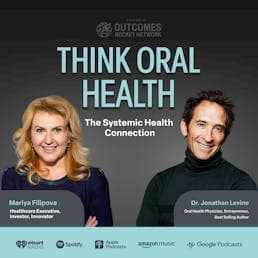
[00:00:04] Welcome to Think Oral, where we connect the interconnected between oral and physical health. I'm your host, Dr. Jonathan Levine. And I'm your host, Maria Filipova. Let's get at it. Hi, everyone, and welcome to another episode of the Think Oral Health podcast. I am Maria Filipova, and as usual, I am joined by my co-host, Dr. Jonathan Levine. Hello, Jonathan. Hello, Maria.
[00:00:35] We are so excited to bring this exciting series of episodes to our listeners because we are at Vegas at the health conference, HLTH. And this is probably where all the news in the next couple of months are going to be happening.
[00:00:56] But there's so many leaders in healthcare and oral health concentrated in this one venue and this one conference. And so we're very excited to be here and to bring you some of the exclusive insights from the top leaders of the industry.
[00:01:11] Yeah, it's pretty exciting to be here. But Maria, we got to shout you out because it was you last year that had that vision of bringing oral health to the big stage of health. And it is a big stage here, that's for sure.
[00:01:22] I couldn't be happier to see that this year we are bigger and brighter and bolder than last year. And with that, I am so excited to introduce our first guest from our episodes at the health conference.
[00:01:38] Steve Thorne is here with us today.
[00:01:40] And hi, Steve. For our listeners, Steve is a familiar face, familiar voice. Steve does not need introduction.
[00:01:47] But for those who are just tuning in, Steve leads PDS Health, who is a leader in care delivery, the largest provider of oral health services and integrated care services in the U.S. and maybe even globally.
[00:02:02] And Steve is a friend of the show, a friend of the podcast and a fellow troublemaker for good.
[00:02:08] Steve, welcome to the podcast.
[00:02:10] Thank you.
[00:02:11] We're so happy to have you.
[00:02:13] But you got to define troublemaker because what you really mean is a change agent.
[00:02:18] That's right.
[00:02:19] And a person who challenges the status quo.
[00:02:21] And Lord knows in health care, that's what we need.
[00:02:24] We absolutely do.
[00:02:25] And troublemaker for good is a change agent for good.
[00:02:27] That's right.
[00:02:28] You've been busy in the last couple of months, in the last 12 months since you were here.
[00:02:34] Last time, for those of you who are paying attention, we introduced you as the CEO of Pacific Dental Services.
[00:02:40] Yes.
[00:02:41] Today, you come to us as the CEO change agent of PDS Health.
[00:02:47] Right.
[00:02:47] Tell us a little bit about that.
[00:02:49] That sounds different.
[00:02:50] You said I was busy the last couple of months.
[00:02:53] There was a lot of planning behind the scenes that got us to this stage.
[00:02:58] It's like a decade of thinking about this and researching and studying everything you learned, Dr. Levine, in school and getting out those textbooks about oral bacteria and oral health and all the, man, thousands and thousands of studies out there about how oral health impacts overall health.
[00:03:21] And the journey for me actually started in 2012.
[00:03:27] Wow.
[00:03:27] I can't believe that.
[00:03:28] Oh, wow.
[00:03:28] When I was first learning about all this.
[00:03:31] See, I grew up in a family of dentists.
[00:03:33] I love you know that.
[00:03:34] You know that?
[00:03:34] I do know that.
[00:03:35] Yeah.
[00:03:35] So my grandfather graduated Harvard Dental School, I think, in 1939.
[00:03:41] And then my father's dentist and he graduated UOP Dental School in 1966.
[00:03:49] Two of my brothers are dentists.
[00:03:51] One of them is actually a periodontist.
[00:03:53] Wow.
[00:03:54] All these years.
[00:03:55] All these years.
[00:03:56] We never talked about how oral health impacts overall health.
[00:04:01] All those years.
[00:04:02] It just wasn't discussed.
[00:04:04] So when I was first learning about it in 2012, I go, wow, what is this?
[00:04:11] I just started seeing some of the research.
[00:04:13] And it comes from, so a little bit of history is important here, right?
[00:04:17] Dentistry has been separated from overall health care since the mid-1800s, depending on which version of history, 1840 or 1860.
[00:04:26] 1840, grand rebuke.
[00:04:28] Okay, 1840.
[00:04:29] Okay, you're with me on 1840.
[00:04:30] That's what I say.
[00:04:31] Yeah.
[00:04:31] Harvard says it's 1860 since they started the first integrated school.
[00:04:35] There was second school.
[00:04:36] That's right.
[00:04:36] But first, I don't get all the medicine.
[00:04:39] We'll have to educate that in another.
[00:04:40] Yes.
[00:04:41] So we have to get to the bottom.
[00:04:42] Yeah, yeah.
[00:04:42] And then 1965, the Medicare Act came, right?
[00:04:46] And dentistry was explicitly excluded from Medicare.
[00:04:52] Know the history beyond that?
[00:04:54] I do not.
[00:04:55] Okay.
[00:04:55] So from what I understand and read, the ADA specifically wanted dentistry excluded from Medicare because they thought, and maybe rightly in retrospect, too much pressure on pricing and things like that.
[00:05:10] I get it.
[00:05:10] Okay.
[00:05:11] But it further separated oral health care providers from primary care and the rest of the team.
[00:05:19] We have specialists that work on your left pinky in medicine, and yet dentists who focus on everything related to the face are separate.
[00:05:31] Right.
[00:05:32] And it's insane.
[00:05:34] It's insane.
[00:05:34] It's totally.
[00:05:35] So should I start reading about all this and going, I didn't understand this because nobody's ever told me, is this true?
[00:05:41] Is this voodoo?
[00:05:42] But back to where it came from is the Surgeon General Report in 2000, in the year 2000.
[00:05:48] David Satcher.
[00:05:49] David Satcher was the first Surgeon General.
[00:05:51] I'm going to paraphrase.
[00:05:52] Oral health is vital to overall health.
[00:05:57] 2010, Dr. Regina Benjamin doubled down and said oral health is integral to your overall health.
[00:06:04] And she went deeper into it.
[00:06:06] And then the big study in, what was it, 2021, 22, 725 pages around oral health.
[00:06:13] Yes.
[00:06:14] But going back, the science and research really started exploding from the 2000 report and then the 2010 report especially, right?
[00:06:23] That's right.
[00:06:23] The invest studies came out of Moisey Devereaux's group that directly connected cardiovascular disease and periodontal disease and finding peach ingivalis in the carotid artery of cardiovascular disease.
[00:06:34] And then further reports, I couldn't agree more, and further reports from Dr. Brad Bale and others out of Texas.
[00:06:41] Bale Donene.
[00:06:42] Bale Donene that found the five bad bacteria that are causal to cardiovascular.
[00:06:47] Pathogenic spikes.
[00:06:48] That's where we, you and I first met.
[00:06:50] That's where we first met.
[00:06:51] At Bale Donene.
[00:06:52] Oh, that's right.
[00:06:52] At the resident center.
[00:06:54] That's right.
[00:06:55] That's right.
[00:06:55] And just more and more.
[00:06:57] You're telling me that you've basically become an overnight success two decades in the making.
[00:07:01] Overnight success.
[00:07:02] PDS Health has been decades in the making.
[00:07:06] Well, that was the first time I had heard it.
[00:07:09] Yes.
[00:07:09] Before, I think of it like the iceberg.
[00:07:11] Think of an iceberg, right?
[00:07:13] If you're out in the ocean and you see an iceberg, you only see the very top coming out of the water.
[00:07:18] Yeah.
[00:07:19] And most dentists, and what I had been taught my entire life with my dad and my grandpa and my brothers, is they worked on, that's what they worked on, the top part.
[00:07:29] Right.
[00:07:29] Completely siloed.
[00:07:30] That's a whole other area that's five, ten X, the size of that little tip below, right?
[00:07:37] Exactly.
[00:07:37] And that dentists can focus on the entire overall help of an individual.
[00:07:44] Yeah.
[00:07:44] It's such a great analogy.
[00:07:46] And when you look at the research, it just keeps getting deeper from a standpoint of direct connectivity of chronic inflammatory diseases of the male into chronic inflammatory diseases of the human body.
[00:07:58] You talked a little bit about FN and fusobacteria that literally just came out a week ago, which is just one more of those conversations of the connectivity and the need for dentistry and medicine to be interconnected.
[00:08:11] And we need more to understand.
[00:08:14] I was told there was a, I'm a big fan of saliva science and where all that's going.
[00:08:20] And I was told that somebody submitted to get a point of care device for P. gingivalis, something that well known to get a point of care device through the FDA.
[00:08:33] And the FDA advisor or whoever was looking at it said, there's no need for that.
[00:08:38] What's the need?
[00:08:39] Why?
[00:08:40] I don't get it.
[00:08:41] And yet P. gingivalis is going to have to do so many.
[00:08:44] PG is the number one of those pathogens.
[00:08:47] That's the number one.
[00:08:48] And it's found in all of these distant organs from periodontal disease.
[00:08:52] The science is there.
[00:08:54] So it's irrefutable.
[00:08:55] It is.
[00:08:55] At this point, it's irrefutable.
[00:08:57] And we can measure in the office now.
[00:08:58] We have to send it out to a lab, but we can measure.
[00:09:01] That's right.
[00:09:01] That's right.
[00:09:02] We would love to have a microbiome testing that's point of care, similar to what you're doing now in all your clinics with some of these inflammatory markers.
[00:09:10] Maybe you should talk a little bit about that because it's quite groundbreaking using these new technologies that are coming to dentistry of how that is connecting the dots between medicine and dentistry.
[00:09:22] And it's going to force the disciplines to come together.
[00:09:25] It truly will.
[00:09:26] So for the medical world, they have diagnostic coding, right?
[00:09:31] Dentists do not.
[00:09:32] I think saliva will be the path towards diagnostic coding for dentists.
[00:09:41] So think about periodontal disease.
[00:09:42] Let's take something really simple and commonplace out there.
[00:09:46] Active MMP8.
[00:09:47] Yes.
[00:09:48] AMMP8, we call it.
[00:09:50] We can take a test, a little spit test, and within five minutes, know how active the periodontal disease is in your mouth based on the breakdown of the collagen, right?
[00:10:03] And we can know that years before you would see the destruction from the disease.
[00:10:10] The endothelial of the inner linings of the arteries.
[00:10:14] Absolutely.
[00:10:14] And I've talked to so many dentists like you and physicians now that say, I can look in a patient's mouth and see the bleeding inflamed gums and know that's what their arteries look like.
[00:10:28] That's right.
[00:10:29] Would you just, on that point, because AM8 is important to be able to see early signs of potential periodontal disease, could you talk about how actionable that is?
[00:10:40] Because we covered beautifully the clinical side and literature is there.
[00:10:44] To your point, we don't need more clinical connections.
[00:10:47] We see them.
[00:10:48] We know them.
[00:10:49] How do we act on that?
[00:10:50] So give us in that example, Steve, what happens if I score at risk on my AAMP8?
[00:10:57] So there's a practice.
[00:10:59] I'll let Dr. Levina answer the clinical part.
[00:11:02] I'm not a clinician.
[00:11:03] I can talk about the practical side of the operational side from a patient standpoint.
[00:11:09] So when a patient spits in the little tube and we run it through the machine, they get a score.
[00:11:15] It's people like scores.
[00:11:17] So do.
[00:11:17] Like they want to know their cholesterol score.
[00:11:19] They want to know all sorts of other scores.
[00:11:22] Right?
[00:11:22] So a high score is not good.
[00:11:25] A low score is good.
[00:11:27] But so what we're seeing in the real world of practicing is that twice the level of activation of patients into their own care.
[00:11:38] Accepting their treatment plan.
[00:11:39] Which at the end of the day, that's what we want.
[00:11:41] We want patients to self-activate.
[00:11:44] Into care.
[00:11:45] 2X.
[00:11:46] Wow.
[00:11:47] Into their care.
[00:11:48] And we have, but there is an issue we have.
[00:11:52] Right?
[00:11:52] So we can know that the periodontal disease is starting or it could be gingivitis.
[00:11:58] Right?
[00:11:58] Mm-hmm.
[00:11:58] I'll let, again, you respond, Dr. Levine.
[00:12:00] But carriers won't pay for that at that point.
[00:12:04] No.
[00:12:05] Because you don't see the destruction yet.
[00:12:08] The system we're currently stuck in almost all healthcare, but especially dentistry, is dentists don't get paid until something bad happened.
[00:12:19] Until the destruction happened.
[00:12:21] Yeah.
[00:12:22] We've got to change that mindset.
[00:12:24] We've got to pay for prevention.
[00:12:24] We've got to get to prevention and predictive.
[00:12:27] Exactly.
[00:12:27] AMMP8 is predictive, right?
[00:12:29] Absolutely.
[00:12:30] And it's all in healthcare, really.
[00:12:31] It's a sickness model.
[00:12:32] We always are talking about it.
[00:12:34] And what Steve's doing with his company, he is taking action.
[00:12:39] The action is going upstream to develop this wellness model.
[00:12:43] Look, the insurance companies and the payers are going to be forced with the good science, good research, and great consumer education.
[00:12:49] So there'll be adoption.
[00:12:51] You talk about, Stephen, all the time about consumer awareness.
[00:12:54] Mm-hmm.
[00:12:54] That they're going to get coverage because we're going to be able to demonstrate through these use cases that we can improve people's health, that we don't have to go downstream into the sickness model.
[00:13:34] And the body looks at it like a foreign invader when it gets into the rest of the body.
[00:13:40] And that's the double-edged sword of inflammation.
[00:13:42] You start getting bolos in the mouth, and now you're starting to get inflammatory response, and the body gets overwhelmed.
[00:13:48] We all heard about comorbidity problems in COVID-19, and people with periodontal disease were five times more likely to get on a ventilator.
[00:13:57] On a ventilator.
[00:13:58] Just think about that.
[00:13:59] Here we are as dentists, and we say, and people, Stephen and myself and a group of us, we all say, hey, dentistry is the tip of the spear for overall health diagnostics.
[00:14:09] That's right.
[00:14:09] They come to us more than they go to the primary care physician.
[00:14:11] Here we are, as Stephen said, we can be predictive and we can get upstream.
[00:14:16] Yeah, just to put that in context, we are in health.
[00:14:20] There's a lot of self-insured employers at this conference.
[00:14:22] There's a lot of payers at this conference.
[00:14:25] And what you beautifully described is the clinical connection.
[00:14:28] When we connect teams between medical and dental side, we get better outcomes, period.
[00:14:33] Now, the other layer is that we also get care at a lower cost.
[00:14:38] And just to pick up on periodontal disease has direct connections to hypertension, diabetes, cardiovascular, cancer, preterm labor.
[00:14:47] Those five conditions alone last year, guess how much money we spend on the medical side treating those five conditions?
[00:14:54] 1.2 trillion, $1.2 trillion went into interventions that are not as effective because none of these interventions were connecting to the dental team.
[00:15:07] And we know that a diabetic patient who gets their periodontal disease treated would have reduction in their A1Cs by 20%.
[00:15:14] That's meaningful.
[00:15:15] How many kale salads do you need to eat and how much time you need to spend on the treadmill to get that 20% reduction?
[00:15:22] Just go see your dentist.
[00:15:23] And from that perspective, it makes good business sense to talk about my body connection.
[00:15:30] That's right.
[00:15:30] We're talking about converging and all of it.
[00:15:32] So, yes, care integration, care convergence, there is a business.
[00:15:35] Wouldn't you love to get all these employers that are here, all the self-insured?
[00:15:41] Yeah.
[00:15:41] And get them in a room and talk to them about this.
[00:15:44] Exactly.
[00:15:45] Talk to them about we can help you reduce your overall health care costs.
[00:15:51] Right.
[00:15:51] The studies, there are hundreds from around the world.
[00:15:56] I challenge the audiences that I get to speak to.
[00:15:59] Yeah.
[00:16:00] Send me a study that shows that oral health care increases overall health care costs.
[00:16:08] Yeah.
[00:16:09] I've never had one sent to me in years.
[00:16:11] Yeah.
[00:16:12] Good oral.
[00:16:13] They did the New York study, right?
[00:16:16] The New York Medicaid study is so powerful.
[00:16:19] Okay.
[00:16:20] It's a Medicaid population.
[00:16:21] So, a younger population.
[00:16:23] Medicaid.
[00:16:23] Okay.
[00:16:23] So, maybe some other health issues.
[00:16:25] But younger, that's 34 to 65, I think, in New York.
[00:16:29] 65.
[00:16:29] And they just looked at something super simple.
[00:16:32] They looked at if these patients got zero cleanings, one cleaning, two cleaning, three
[00:16:39] cleanings, or four cleanings during the course of two years.
[00:16:43] And then in the third year, they looked at their overall health care costs.
[00:16:47] Wow.
[00:16:47] So, whatever costs went into it.
[00:16:50] So, Medicaid, very tight study.
[00:16:52] Ira Lamster did the study.
[00:16:53] You can look at it.
[00:16:56] Exact inverse correlated the cost of care.
[00:16:59] And it was so simple.
[00:17:01] And that's not even getting into looking at any other comorbidities.
[00:17:06] That's right.
[00:17:06] That's not like you're just talking about diabetes or whatever.
[00:17:08] But that's it.
[00:17:09] Look, we talk about, I hate to throw them under the bus, but they have a new leader.
[00:17:14] And their amazing organization today is ADA.
[00:17:18] It's the ADA coming together with thought leaders to create a task force to get this
[00:17:23] data to the right people, to change the perceptions of the CEOs of the companies and
[00:17:30] get these people who can make these decisions to make the difference.
[00:17:34] Because you got to follow the money, right?
[00:17:37] That's how it always goes in society.
[00:17:39] And the ROI is big.
[00:17:41] You're right.
[00:17:41] I actually wonder, because I'm like all of us, we're data-driven.
[00:17:44] We like to make decisions based on data.
[00:17:46] And for the longest time, I thought, let's isolate the impact of oral health on total
[00:17:50] cost of care.
[00:17:51] Yes.
[00:17:51] Or isolate the impact of treating periodontal disease on diabetes or hypertension.
[00:17:56] And then I realized, wait a minute, learn today, 80% of oral or 80% of chronic conditions,
[00:18:03] chronic diseases manifest in oral health issues, right?
[00:18:06] And so in that case, it doesn't matter which one of your multiple comorbidities as a patient,
[00:18:13] oral health, treating your oral health conditions helps, right?
[00:18:17] At the end of the day, the total cost of care is going to be impacted.
[00:18:19] It doesn't matter if your diabetes was improved or your risk of oral cancer got decreased.
[00:18:26] At the end of the day, total cost of care is going to get reduced.
[00:18:29] Right.
[00:18:29] So let's accept this as that connection in multiple fronts and not get so worried about,
[00:18:34] is it going to impact diabetes or your hypertension or your dementia?
[00:18:38] Because all of these are going to be impacted by better oral health.
[00:18:41] We're talking here about personalized care is how I frame this, right?
[00:18:46] So a high level of oral bacteria, of FN, a high level of PG, TF, whatever, right?
[00:18:51] We have to reduce those.
[00:18:52] We can also move to predictive care.
[00:18:56] We talked about AMMP8, but there's also IL-1 and IL-6, right?
[00:19:00] And we can look at a couple other inflammatory markers on the medical side that our blood draws still.
[00:19:05] C-reactive protein.
[00:19:07] C-reactive protein and others.
[00:19:08] What's for cardiovascular?
[00:19:09] Exactly.
[00:19:09] And we can know how our body responds to our inflammatory response to these different elements that are coming in.
[00:19:19] When I did all that for me, a lot of people have heard my personal story.
[00:19:23] I have about every bad gene you could ever get for an inflammatory response.
[00:19:29] And I didn't know that before I started studying all this.
[00:19:32] I lost my mom when she was 65 years old.
[00:19:35] Wow.
[00:19:36] Stroop.
[00:19:37] Oh, Heria.
[00:19:38] Heria.
[00:19:38] I heard you talk about it.
[00:19:39] Yeah, you've heard me talk about it.
[00:19:40] And it gets personal.
[00:19:41] And I've lost my dad.
[00:19:43] Same deal.
[00:19:44] I know about this from the poor because I've checked my genes that I got from them.
[00:19:50] And my brother got all the good stuff.
[00:19:53] I got all the bad stuff.
[00:19:54] So I have to be so careful.
[00:19:56] I get my teeth cleaned every eight to 10 weeks.
[00:20:00] Thoroughly, I'm on every type of procedure that you would ever diagnose or treat me with
[00:20:06] because I care about my oral health.
[00:20:09] My physician is Brad Bale.
[00:20:10] If I haven't elevated any of those bad bacteria, he like screams at me.
[00:20:15] He chews my butt out because he said, he goes, you know it.
[00:20:19] You got to live it.
[00:20:20] Yeah.
[00:20:20] That's right.
[00:20:21] Wow.
[00:20:21] And he's a pretty big guy.
[00:20:23] So he can intimidate.
[00:20:25] He could definitely intimidate.
[00:20:26] I have another, I have also a personal story about my mom very similarly where she died
[00:20:31] young and she always had cardiovascular and obesity.
[00:20:35] She just couldn't beat it.
[00:20:37] But back in the day, we didn't understand the connection of the mouth and overall health,
[00:20:43] what we call oral systemic health.
[00:20:46] And it's a different day.
[00:20:48] But there are so many things that have to change.
[00:20:51] Let's talk a little bit, Stephen, a little bit about the educational system.
[00:20:54] Yeah.
[00:20:55] Because that's a really important conversation.
[00:20:57] Jump in, Marie, on this.
[00:20:59] But the teaching of oral systemic health and teaching it in the dental school and also in
[00:21:07] the medical school, it truly doesn't really exist except for a couple of big thought leaders in
[00:21:15] some of these new dental schools.
[00:21:17] That's right.
[00:21:17] And we'll be bringing one of those people on our show real soon.
[00:21:21] But I know how Stephen feels about this.
[00:21:23] Can you comment on this?
[00:21:25] As many of I do sit on the boards or advisory boards of many of these schools, too.
[00:21:29] There is movement in the schools.
[00:21:31] It's exciting to see.
[00:21:34] And I think more than a handful now, too.
[00:21:36] I'd say close to 20 schools are moving in that direction, teaching these new—I call
[00:21:43] them kids now because they are—kids about the oral systemic link.
[00:21:48] And they're interested in it.
[00:21:50] I think it started maybe with Harvard and a couple others, but it's growing.
[00:21:55] The key that is making this start to work—and I have no equity stake here—
[00:21:59] is the move over to Epic to have an integrated health record.
[00:22:03] I have tried this hard for years to get physicians and nurse practitioners and dentists and hygienists
[00:22:10] to all talk to each other where they didn't have the same electronic health record, and I
[00:22:15] couldn't make it work.
[00:22:16] It wasn't until we moved to an electronic health record where they all had to work in the same language and see the same data, see the same information, see the same biomarker, see the same inflammatory markers,
[00:22:32] same genetics and genomics, that they really started to respond.
[00:22:36] And more and more schools are moving over to a health record like that.
[00:22:40] It doesn't have to be Epic, but they're just the best right now.
[00:22:44] Others may get there.
[00:22:45] But I tell you, it's happening.
[00:22:47] It is really exciting.
[00:22:48] We were talking earlier right before we started, right?
[00:22:51] I wish I was 35 years old.
[00:22:52] If I could go back and start again, holy man, it would be so much.
[00:22:59] We are about to wrap up here, but from that place of understanding how personal health is, not only oral health, period,
[00:23:07] and from that place of understanding that it's up to us to raise awareness and raise the future generation of care providers, really,
[00:23:15] I would like to perhaps end with an invitation to our listeners, not a call to action, but an invitation to our listeners and to the attendees at health.
[00:23:26] What would your invitation be to them?
[00:23:29] What could we as decision makers, as parents of children, as children of parents who grew up in a different generation and ours,
[00:23:37] what can we be doing differently to be part of this mouth-body connection movement, this care convergent movement,
[00:23:45] this medical-dental integration movement that we are talking about, that we're experiencing now?
[00:23:50] And breaking down the silos, right?
[00:23:52] Great, yes.
[00:23:52] That's that convergence concept, right?
[00:23:55] And this may sound, this is not self-promotion, please, but we have been working on this so long.
[00:24:01] We've collected all the data, all the science.
[00:24:03] It's all on smilegeneration.com.
[00:24:06] It's free.
[00:24:06] You can go get it all.
[00:24:08] You've got to study it.
[00:24:09] You've got to learn it.
[00:24:11] You've got to educate yourself because education leads to engagement, which can then lead to activation.
[00:24:19] We know education alone doesn't do it or we would never smoke.
[00:24:24] We'd never eat a French fry.
[00:24:25] We'd never drink a Coca-Cola.
[00:24:26] But education can lead to the engagement where we really want to improve ourselves and then activate
[00:24:35] into caring better for ourselves.
[00:24:38] Yeah.
[00:24:39] So beautifully stated.
[00:24:40] It really is.
[00:24:41] Knowledge is power.
[00:24:42] And I think, just to add to what Stephen said, is that the consumer has to push the profession.
[00:24:49] And if they walk into the hygiene room and says, I heard a lot about this connection of the mouth
[00:24:55] and overall body.
[00:24:57] What do I need to know?
[00:24:58] And they would push that hygienist to push their professional to be on the top of their game.
[00:25:04] Because dentistry is still a fragmented industry.
[00:25:07] It really is.
[00:25:08] Pacific Dental PDS is making a movement.
[00:25:11] But still we have about 60% of this industry is still private practitioners.
[00:25:17] And because of that, they have to be nudged.
[00:25:21] A lot of the young people coming on board, they're the future.
[00:25:24] And by having these dental schools engage in these kinds of conversations, educational program,
[00:25:30] things are going to change.
[00:25:31] But we always say it doesn't change fast enough, does it?
[00:25:35] No, it doesn't.
[00:25:36] And maybe to put a highlight on everything that was said so far, I think all of us are
[00:25:40] extending an invitation.
[00:25:42] Steve is open sourcing the learnings and the data from decades of his, quote unquote,
[00:25:48] overnight success to decades in the making.
[00:25:50] And so the invitation is really learn more and then demand more from your care team, from
[00:25:57] your primary care provider.
[00:25:59] All of us are aware about nutrition and mental health.
[00:26:03] And yet we're not asking for more from our dental care providers.
[00:26:07] And that's really where it starts.
[00:26:09] And as a self-insured employer, ask for more from your insurance partners and brokers.
[00:26:16] And because at the end of the day, this is real money that comes out in your pocket.
[00:26:20] Talk to your HR people at your company where you work and push for this.
[00:26:24] Push for better integrated plans.
[00:26:27] It works and it'll help you help your loved ones that are on your plans.
[00:26:31] It's real.
[00:26:32] That's right.
[00:26:32] It doesn't have to cost more, but it will have a bigger impact.
[00:26:36] And if after all this, you're still lost, reach out to any of us.
[00:26:40] We love to talk about this topic and you will find out more how you would find us in
[00:26:46] the notes of this episode.
[00:26:47] With that, as usual, thank you, Steve, for finding time, making time, joining us.
[00:26:52] Thank you for having me.
[00:26:52] Great to have you here again, Steve.
[00:26:54] Thank you.
[00:26:54] And as always, it's been a pleasure, Dr. Levine.
[00:26:57] Like always, Maria, right back at you.
[00:26:59] All right.
[00:26:59] Until next time.
[00:27:07] Thanks for listening to the Think Oral podcast.
[00:27:11] For the show notes and resources from today's podcast, visit us at www.outcomesrocket.health
[00:27:19] slash think oral.
[00:27:21] Or start a conversation with us on social media.
[00:27:24] Until then, keep smiling.
[00:27:26] And connecting care.