
Have you ever heard of a hobby blog transforming into a health IT empire?
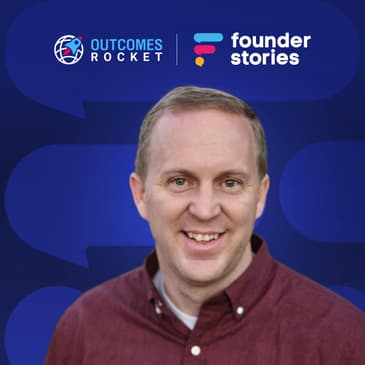
In this episode John Lynn, founder and chief editor of Healthcare Scene, shares his journey building a successful media company focused on health IT. Throughout the conversation, he explains the impact of AI in healthcare, strategies for vendor engagement, and the importance of aligning solutions with health systems' strategic priorities. John also reflects on the challenges faced in his entrepreneurial journey and emphasizes the value of learning from failures.
Tune in to receive insights on AI's impact on healthcare, vendor strategies, and entrepreneurial lessons!
Resources:
[00:00:02] Hey everybody, welcome back to the Outcomes Rocket. Saul Marquez here and I have a treat for you on this episode for Founder Stories today. I've got a man that needs no introduction. His name is John Lynn. But of course, for those of you that haven't met him, I'll give a brief one here. He's, apart from being a great guy, he's the founder and chief editor at Healthcare Scene, which includes Healthcare IT Today and
[00:00:32] also Sway.Health communities, blogs, podcasts and conferences. Health IT Today is a common publication that we all know. It's a leading healthcare IT community with over 17,000 published articles, 600 plus video and audio podcasts and a community of 200,000 followers. The Sway.Health brand is one actually that I can't believe I just learned about a year ago, but this is the word getting out if you guys haven't heard about it.
[00:01:02] It's the only place for healthcare B2B marketers and hospital and health system marketers to come together and improve patients lives. And I'm gonna be excited to be there next year with John and the crew that he's assembled. And so with that, John, I want to just welcome you to the podcast. So glad you can make it.
[00:01:19] John Lynn Thanks. I don't know if listening to that intro just makes me feel old. If it makes me feel tired from all this. There's the beauty of time. If you do something persistently over time, then the numbers just grow. So that's a good idea.
[00:01:32] John Lynn That's a good thing. But man, I might chop out this. He's a great guy. And I'm gonna post that to social media. I appreciate that. I do what I can to be helpful to people. That's the goal of our brand. We call ourselves the friendliest media company out there. My colleague Colin is a Canadian. So it comes naturally to him. For me, it's a little more work. But we really do try to be helpful to everyone we work with.
[00:01:52] John Lynn That's awesome, John. Now that's great. It was good to see you in Atlanta, by the way, a couple weeks ago for a SOAR Leaders Conference. And we end up seeing each other at a lot of these conferences.
[00:02:03] John Lynn Yeah, maybe too many. Is that what you're saying?
[00:02:07] John Lynn That's an existential question, right?
[00:02:11] John Lynn You always have the best stories, man. You always have a new one.
[00:02:17] John Lynn A few years back, actually, right before I quit the day job, a couple years, right as I started all of this, a guy told me life is about making stories and telling stories. So it probably helps that I have a network of a media company where I get to tell stories. So I get to live that every day. But it's true. That's what I love in life is making stories and telling them.
[00:02:39] John Lynn Well, you do a damn good job. So kudos there. Look, this is founder stories. So one of the fun things I get to do is interview founders like yourself, understand your journey. And to kick this off, John, what is it that more specifically got you to turn your company into a company where it was at once just a hobby?
[00:03:04] John Lynn And we're talking about healthcare scene, which includes healthcare IT today and Sway.Health.
[00:03:12] John Lynn Yeah. So it definitely was a hobby to start, right? Like I was learning.
[00:03:18] John Lynn And when was it, by the way? Like when was it?
[00:03:21] John Lynn 18 years ago.
[00:03:22] John Lynn 18 years ago.
[00:03:23] John Lynn 18 years ago. So I think we're almost at 19. It's coming close to 19. It was a long time ago I wrote that first blog article. And it was such a hobby. I put it on a website called crashutah.com.
[00:04:03] John Lynn
[00:04:05] John Lynn I reached that goal within about six months. And then I was like, well, who reads this? And so I started exploring other things.
[00:04:13] John Lynn Wait a minute. What was the first one? Google for EMR?
[00:04:16] John Lynn Yeah. So if you searched EMR, I was on the first page of Google.
[00:04:20] John Lynn Oh, that was your goal and you hit it. Nice.
[00:04:22] John Lynn Yeah. And it was emr and hippo.com was the original site. After I was like, you know what? I'm actually making more than $10 a year. I was making more than $10 a month. I might as well buy a domain and be legit.
[00:04:32] John Lynn And so I did, right? And emr and hippo.com was the first one. Then emr and ehr.com. But I was making date money, right? It was fine. I got a check every month. It was cool.
[00:04:42] And I would publish two, three times a month and I was rolling along.
[00:04:47] John Lynn And then it goes back to the question of every business. How much of it is perspiration and how much of it is luck and how much of it is skill, right?
[00:04:57] John Lynn Like there's these three things that kind of play into every business, right? And I'd done some perspiration, right? Like I posted a thousand times on the EMR update forum to drive traffic to the site and get my site to the first page of Google for EMR.
[00:05:12] John Lynn Skill Obviously, I had some skill as far as putting the website up. I think I'm a reasonable writer, right? I always have a lot to say. Here's a fun story. You wanted a story.
[00:05:22] John Lynn So my uncle, when I turned 16, I could date and that's how we approach dating is we wait till we're 16. Like before that, you don't need to. And so my uncle called me up and he said, hey, I want to set you up on a blind date with this girl. And I was like, no, thank you. I'll choose my first date. But you know, it was nice of him.
[00:05:40] John Lynn Well, about 10 years later, he told me, he's like, John, you want to know why I wanted to set you up with her? And I was like, why? He's like, because I wanted to see who would talk more, you or her.
[00:05:49] John Lynn So I guess I do have some sort of innate skill to be able to talk and be able to share something about nothing if I need to, or at least to have a conversation. So anyway, and then you add in the luck. Well, what was the luck portion? So I worked hard. I had some skill. I had tech skills, obviously, to do the website, to put it up and things like that.
[00:06:09] John Lynn Wordpress made it easier. But back then, it wasn't as easy. But so the luck part was $36 billion of stimulus money by the government to EHR. And we heard about it early on. All we knew was government money for EHR.
[00:06:23] John Lynn So I started writing about that. And from when I learned about that, for the next four years, five years, I published every single day on EMR and HIPAA and EMR and EHR. Every single day, there was an article about something. And obviously covering how do you get the government stimulus money.
[00:06:40] John Lynn So anyway, that's the background story is when the stimulus money hit, everything blew up. There's a lot more to the story. I actually had a potentially a startup I was doing, which really motivated me to leave. But here's the other one that really made me realize, hey, I could make a business out of this. And I was sitting there watching TV on Sunday, watching Meet the Press, right? The political show most of the time on Sunday. And I saw an advertisement for an EHR company.
[00:07:09] John Lynn So I thought to myself, what in the world? How is it possible that they're spending millions of dollars for this ad on Meet the Press when they could just spend $5 or $10K for me, right?
[00:07:23] John Lynn Yeah.
[00:07:24] John Lynn Why aren't they? That was a real huge disconnect for me. So I went to HIMS and this EHR vendor pitched me. And I wrote back and I probably did a faux pas. Now I've done this a few times, but they're like, hey, do you want to talk to our audience?
[00:07:38] John Lynn Nice.
[00:07:39] John Lynn And I was like, yeah, I do. That would be cool. And then I replied back. I was like, hey, and could I meet with your marketing person while I'm there too?
[00:07:46] John Lynn Nice.
[00:07:47] John Lynn He said, yes, that's great. And so I did. I met with the policy guy. I wrote an article, did a duty. And then they took me to the marketing person. And I went up to her and she's like, oh, hey, John, I know you. I read you every day.
[00:07:58] John Lynn And I sat there and I'm like, you read me every day, but you can't throw a brother a bone. Like, give me some cash.
[00:08:06] John Lynn Well, I knew that they were a big company and I knew that I just had to go all in. So I created a very special package for them.
[00:08:13] John Lynn It was a 20 grand package. And it didn't matter. I think it was 25K, actually. I was like, this is just everything that I could do for anyone at the time. And so I said, it's 25 grand package. It's like a turnkey solution for you. And she said, oh, yeah, we want to do it. Here's our agency. Talk with him. I think they negotiated me down to 20. I was like, great. This is perfect.
[00:08:36] John Lynn Nice.
[00:08:36] John Lynn But when I did that, I realized, oh, I do have something really valuable. I need to just take it more seriously. I need to do some more work, make some better connections. So anyway, that was this opening. It's like, okay, I do have something that could become a real business.
[00:08:51] John Lynn That's great, man. I love that story. And just going back to that, I'm sure makes you feel proud of what you've accomplished to date. Today, a lot of people subscribe to your publications.
[00:09:05] John Lynn Sponsor them. And certainly, you've accomplished a lot. As you've built the business, it's been a business built around the happenings in healthcare. So I think it's worth chatting about what's going on out there, specifically around the topic of AI. What are we going to do with it? How do we implement it? There's a lot of health systems out there confused and maybe at a standstill in many cases.
[00:09:30] At the same time, you've got so many companies in the space innovating and offering their solutions. What's your latest take on this dichotomy?
[00:09:40] John Lynn You're right. I think that AI is going to be and is as exciting as $36 billion of stimulus money. Like I called it the golden age of EHR when $36 billion of spending was going to happen. The same thing is going to happen with it and no stimulus money is going to be needed. I mean, like chew on how amazing that is. And just look at one specific use case, the ambient clinical voice, AI medical scribe.
[00:10:09] No one has to simulate that because the impact is so powerful that everyone is going to want to buy it. I said 80% three months ago. I'm up to 90% now. There's going to be 10% that are laggards.
[00:10:23] But like everyone is pretty much going to buy that solution to solve the problem of documentation for their clinicians. And it's going to become the interface for the doctor. And of course, what's most exciting about this and also a little bit disturbing is the fact that we're just getting started.
[00:10:41] Like what's going to be possible is going to blow our minds even two years from now. Now, there's a lot of like cultural adoption that's going to need to happen. And so that's what I would be focusing on if I was an organization right now.
[00:10:56] I'd focusing on clean data. And I would focus on what is the culture of acceptance of AI. Because right now, we treat AI as needing to be perfect. And yet we're extremely accepting of human imperfection. And we need to change that culture and mindset so that we can say, AI doesn't have to be perfect. It just needs to be better than the current status quo.
[00:11:22] And if you change that culture and mindset, then you'll look at AI in a different way that says it's okay if AI fails some. It's still progressing us in ways that we wouldn't have otherwise. Because if you just sit there stagnant, there's going to be massive damage because you're going to miss out on the opportunities that AI presents.
[00:11:42] Yeah, I agree. There's a ton of opportunity and the standard that we have around it does tend to be that why is it not perfect? It's a machine. It should be. Maybe it shouldn't actually because it's helping us make that progress.
[00:11:55] Yes. And really, yet, while that adoption could be 90%, John, I feel like there's still so much indecision out there.
[00:12:05] There's so many opportunities, right? I think the indecision comes because so much is happening. They don't know where to start. It's like, what do I do? There's so many things.
[00:12:16] So how do people get started, man? I know there's different frameworks out there that they could look at. Chime's got one. Hims has got one. There's a lot of different frameworks out there. What can people be thinking about?
[00:12:29] Yeah, I don't think the frameworks are going to work. I actually saw a framework for RCM out of a couple of companies. Finthrive is leading it with HFMA. Actually, that one seems pretty reasonable for RCM people approaching AI.
[00:12:41] Oh, really? Cool. I have to check them.
[00:12:43] But for the most part, I don't like frameworks. I like look at what your problems are. What are your biggest problems? And then work backwards from the problems to what areas of focus should you have?
[00:12:56] So I think that's probably the best way. What are my strategic priorities? Now, how can AI solve some of these strategic priorities? Because here's the problem we have.
[00:13:06] We have this current mindset that implemented our previous workflow. And the reason we implemented the previous workflow is because a lot of things weren't possible that are now possible today.
[00:13:18] And we don't realize that they're possible. And so you have to go in and rework those workflows and say, what's our priority? Is it burnout by the doctors?
[00:13:27] Is it trying to improve the efficiency of the doctors and the nurses? If it is, okay, then let's focus on that. And what are some solutions to do it? And let's not use past experience with the workflows.
[00:13:42] Sure, that's going to inform your decision. But let's not use our past understanding of what's possible. Let's look at what's possible today that has changed dramatically and quickly and then implement that.
[00:13:54] So I always start with what is the real problem? And AI is not always the solution. Sometimes it's simple analytics. Sometimes it's a little post-it note, right?
[00:14:03] Like, I'm a tech guy, but I'm not a tech purist that you should solve everything with tech. Sometimes it's just bringing people together and communicating. Like, that solves a lot of different problems too.
[00:14:15] But AI has introduced a whole set of new capabilities that allows us to create workflows that we couldn't have imagined when we created the original workflows. And that's the work that needs to be done.
[00:14:28] Hey, I love that you went there, John. And I was recently having a conversation with a chief revenue officer at a company and he says to me, you don't know how many times we run into the challenge of we go into an executive's office and we show them like the savings.
[00:14:49] And they look back at a company and they look back at a company and they look back at them and say, there's no way I could present that because I'll get fired.
[00:14:55] And he says, yes. However, the thing that you need to know today is that you couldn't have done it a year ago because what's available today gives you the opportunity to do it.
[00:15:10] So actually, you wouldn't get fired. And I love that frame. It's essentially what you just shared.
[00:15:16] But I love the frame because it's so true. And AI, all of this is giving us that opportunity.
[00:15:22] So I love that you went there. What about the vendor side of things, right?
[00:15:26] You also work with a lot of vendors and they're working to get people to understand their capabilities and take action.
[00:15:34] What advice would you give to our vendor community thinking about how to engage with health systems and get them to act?
[00:15:42] Yeah. You know, it's a tough time right now. I have to say for most of the vendors, there's a few pockets of exceptions that are doing exceptionally well.
[00:15:51] Ambient voice being one, right? But they have different challenges.
[00:15:54] Like there's still challenges. It's hyper competitive, et cetera.
[00:15:57] But most of these health IT vendors aren't selling something that's really sexy, right?
[00:16:03] And you can't really apply AI to make it sexy, right?
[00:16:07] Like some of these solutions are just stuff that solves a real problem, but they're not sexy.
[00:16:13] And so the question is, how do you put lipstick on a pig, right?
[00:16:19] Pigs are delicious, right? Bacon goes on all sorts of things.
[00:16:23] But if you don't know that you can use bacon that way, then you might get distracted by the steak, right?
[00:16:30] So the problem is our health systems only have money for so much steak and they can't afford the bacon right now.
[00:16:37] And this is the challenge that they face, which I'm not sure how good that analogy is.
[00:16:40] So this is what they face is like, how do I get into a health system that is so distracted, that is so busy?
[00:16:48] And that sure, they could benefit from that solution.
[00:16:52] But actually, I'd say some of them are the opposite of what you described.
[00:16:55] They're like, that's a cool archiving system.
[00:17:00] I love that.
[00:17:01] I want to archive my old systems, but that's not aligned with our strategic priority, right?
[00:17:06] Or, hey, that's an amazing digital front door.
[00:17:09] I love that.
[00:17:10] But it's not aligned with our digital priorities.
[00:17:13] Like, this is what a lot of these systems face.
[00:17:16] So what I could tell a lot of these health systems is go and look at their strategic priorities and find the alignment for them.
[00:17:24] Unfortunately, too many health IT companies go into it thinking, hey, I'm going to say this is what we do.
[00:17:30] And then the buyer is going to connect what you do with their problems.
[00:17:35] And it turns out we are really bad at that.
[00:17:37] We are really bad at connecting a capability with our own problem.
[00:17:43] So you have to go and do the work for them, which says, I have these capabilities, and they are strategically aligned with these problems you're trying to solve.
[00:17:53] If you don't do that work, then you're not going to be successful.
[00:17:58] Sure, maybe your salesperson will create a deep relationship with someone and maybe happen upon that or that relationship will be deep enough.
[00:18:06] But if you want to be uber successful, you've got to align those two and do the work for them.
[00:18:11] That's awesome.
[00:18:12] I love that.
[00:18:13] Great takeaway there on both sides, both the provider side.
[00:18:17] Start with your problem.
[00:18:19] Work your way back.
[00:18:20] Vendors, figure out what the strategic priorities are.
[00:18:23] That's huge.
[00:18:25] And by the way, like every meeting that I go to, John's there.
[00:18:28] And he's at all the ones that I'm not, too.
[00:18:30] So he's connecting with these folks.
[00:18:32] And when you sit down at a table with people, you learn.
[00:18:35] And so I'd definitely take some good nuggets away from this convo.
[00:18:38] Love it, John.
[00:18:39] Hey, let's get back to the founding story.
[00:18:42] So we learn a lot more from our failures than we do our successes.
[00:18:48] Talk to us about a challenge or a setback, potentially even an existential one for you,
[00:18:54] that really has made you and your business that much better.
[00:18:58] It's interesting.
[00:19:00] We're pretty conservative, I'd say.
[00:19:02] That's the beauty of what we've done.
[00:19:04] I look at some of the media companies.
[00:19:06] They get out over their skis and then they just are done.
[00:19:09] And I don't think in the media company that's a good strategy.
[00:19:12] It may be a good short-term strategy to get up to scale.
[00:19:15] But eventually that catches up with you in most cases.
[00:19:19] It's like the banger bus.
[00:19:21] We're much more conservative.
[00:19:22] Thankfully, we haven't had too many issues where it's really scary.
[00:19:26] But I will tell you this one story.
[00:19:30] When you look at our revenue stream, when we started, it was all display ads and pay-per-click
[00:19:36] through Google Ads.
[00:19:38] That's how we made our money.
[00:19:39] And that was the majority of the money that we made.
[00:19:41] Now, of course, this is 18 years ago.
[00:19:43] Then we saw this shift to sponsored content, sponsored articles.
[00:19:48] And if you look year to year from another year, and I forget which year it was, you
[00:19:53] can see where it's like 90% of our revenue is display ads.
[00:19:56] Now 90% is sponsored content.
[00:19:59] And what happened there?
[00:20:01] Well, we had an email list of about 5,000 email subscribers, maybe 6,000, something like
[00:20:06] that.
[00:20:06] If we had tried to switch from display ads to sponsored content with 5,000 email subscribers,
[00:20:13] we would have been dead, man.
[00:20:15] Like the business, I don't know what the business would have looked like, but it wouldn't have
[00:20:19] been the same.
[00:20:20] Well, it turns out I received an email about a job board called Healthcare IT Central.
[00:20:25] And the lady wanted to get out of the business.
[00:20:27] She thought we'd be a good home.
[00:20:29] It would be synergistic.
[00:20:30] The health IT job board with a health IT publication.
[00:20:34] I said, that sounds interesting.
[00:20:35] And to be fair, I was also looking at a house to buy, a second house, like a rental property.
[00:20:40] And so I was like, do I want to buy a rental property?
[00:20:43] Do I want to buy this company?
[00:20:45] I was like sitting in between.
[00:20:47] I do.
[00:20:48] Yeah.
[00:20:48] But I looked at it and if the rental property was $10,000 cheaper, I probably would have
[00:20:53] bought it.
[00:20:54] And I don't know how that would have played out if I had bought it.
[00:20:57] If I wouldn't have had the cash, it wouldn't have felt comfortable.
[00:20:59] But anyway, long story short, it was $10,000 higher.
[00:21:02] I was like, oh, let's see if it comes down.
[00:21:04] So I waited.
[00:21:05] And then I went to the, I saw the company.
[00:21:08] I dug into it.
[00:21:09] They had 30,000 email subscribers from people who'd filled out their job board.
[00:21:13] I'm like, I could take those emails, subscribe them to Healthcare IT Today.
[00:21:17] Hey, this would be good, right?
[00:21:19] Like as they sign up for the job board, they get subscribed to Healthcare IT Today.
[00:21:24] This would really grow.
[00:21:25] Long story short, I bought the company, grew the email list, right?
[00:21:30] With all those email subscribers.
[00:21:32] Some didn't want it.
[00:21:33] That's fine.
[00:21:33] We didn't do a full swap.
[00:21:36] And some people had left, whatever, right?
[00:21:38] They bounced, et cetera.
[00:21:39] But we grew that list.
[00:21:41] And if that was key to us being what we are today, if I had not acquired the job board
[00:21:47] and got the emails and be able to grow the email list to now we're up to 47,000 email
[00:21:51] subscribers to a daily email newsletter.
[00:21:54] If I hadn't have done that, I think the business would, I don't know.
[00:21:58] I don't know if it would have survived or if I would have survived without that.
[00:22:01] But because of that, we were able to make that shift.
[00:22:03] Now, to be fair, I should have bought the house too.
[00:22:05] And I shouldn't have been greedy over the 10 grand.
[00:22:07] I should have bought both.
[00:22:08] So the hindsight is 20 on all of these things.
[00:22:10] I should have bought both.
[00:22:11] But then you look at that shift.
[00:22:13] We went from display ads to sponsor content.
[00:22:15] And now we're almost fully video.
[00:22:18] Like we've seen another shift from articles to now sponsored videos.
[00:22:22] And that was all part of this evolution.
[00:22:25] Now that we have 47,000 email subscribers, that's more powerful when you're doing a video.
[00:22:30] I think that was part of the growth of the community.
[00:22:33] And I'd say for me, it feels like an existential moment because
[00:22:36] we could have disappeared if I didn't have all the growth of email subscribers.
[00:22:41] That's cool, man.
[00:22:42] And are you still doing the board or?
[00:22:45] Yeah, we did the job board for about seven years.
[00:22:48] She sold at the right time.
[00:22:49] It was the downturn of when EHR jobs were being filled.
[00:22:53] The consulting companies weren't filling as many because they were already implemented it,
[00:22:57] et cetera.
[00:22:58] So we caught it at the tail end.
[00:22:59] So in some ways, that was a bad investment as far as where it was going.
[00:23:03] And it also probably wasn't our focus.
[00:23:05] If I'd focused on it more, it would have been different.
[00:23:08] So we actually shut it down, I think, about a year ago.
[00:23:10] Okay.
[00:23:11] So we had the job board until then.
[00:23:12] Now we just incorporated it into healthcare IT today.
[00:23:14] We do a weekly job newsletter with an article with the various health IT jobs.
[00:23:20] That's cool.
[00:23:21] Hey, man, look, when you acquire a business, you're acquiring the whole as well as the components.
[00:23:25] Well, you'll like this too, when we acquired it.
[00:23:27] So when I acquired it, I think we had 10 different sites, EMR and HIPAA.com, EMR and EHR.com,
[00:23:33] hospital EMR and EHR.com, EMR and EHR News, EMR Thoughts.
[00:23:38] Like we had this plethora of bad names, right?
[00:23:41] If I'm a PR person or a branding person, I'm like, what were you thinking?
[00:23:46] But from an SEO perspective, it was great.
[00:23:49] And so anyway, Colin came in and said, John, we need to consolidate.
[00:23:52] He says he was really how he did it.
[00:23:53] He said, we need to consolidate it on something.
[00:23:56] Well, as part of the acquisition, she had healthcare IT today, which she used as a blog
[00:24:01] for healthcare IT central, originally just talking about jobs and careers and things like that.
[00:24:07] And we're like, that's actually a good domain.
[00:24:09] And I told Colin, I was like, that's the domain that does better than all the rest
[00:24:13] from a branding perspective.
[00:24:15] So long story short, we collapsed it all into healthcare IT today, maybe five years ago,
[00:24:20] four years ago.
[00:24:20] So it was a nice, we got the domain as well.
[00:24:24] I love it, man.
[00:24:25] No, that's great.
[00:24:26] It's great.
[00:24:26] You've obviously made it worked out and nice job on buying the business, not the house.
[00:24:30] I think that's awesome.
[00:24:32] Yeah, that house went from 110 to 400 though.
[00:24:35] It's like, man, that's pretty.
[00:24:38] All right.
[00:24:38] So you should have bought both.
[00:24:40] Yeah.
[00:24:41] There's a book out there called Buy Real Estate with No Cash.
[00:24:46] It's actually a good book.
[00:24:47] Some really good ideas.
[00:24:48] Even if you have cash to buy a real estate, this guy gives some really great negotiation
[00:24:54] ideas and different things to leverage that I think is one worth everybody reading for
[00:25:00] sure if you're in the real estate.
[00:25:01] Well, John, this is super cool, man.
[00:25:03] Thanks for sharing that.
[00:25:04] And look, I want to leave this talk with an opportunity for all of our viewers and listeners
[00:25:11] to really understand how they could engage with you and what is it that you offer.
[00:25:18] So help us understand those two things and then leave us with the best way to get in touch
[00:25:22] with you.
[00:25:23] Yeah.
[00:25:24] So at Healthcare Scene, we have two communities.
[00:25:26] We have Healthcare IT Today.
[00:25:28] That healthcareittoday.com is our health IT publication.
[00:25:31] There's an email newsletter.
[00:25:32] There's three podcasts right now.
[00:25:34] You can go and subscribe as my kids say.
[00:25:37] So that's always great.
[00:25:38] But we try to be really practical, relevant health IT content.
[00:25:42] So if you're looking for that, check it out.
[00:25:44] If you're a health IT company, you can look at sponsoring.
[00:25:47] Have a lot of different sponsorship packages available there.
[00:25:50] Then our second community is our healthcare marketing community, which ironically came
[00:25:55] out of the advertisers for Healthcare IT Today.
[00:25:57] It was born out of giving a place for them.
[00:25:59] As you mentioned, it's the only healthcare B2B marketing community, but also brings together
[00:26:04] hospitals, health system marketers in one community to be able to share and learn from
[00:26:09] each other.
[00:26:10] We do our annual conference every year.
[00:26:11] It's going to be in the amazing San Diego, Coronado Island, amazing venue with great people.
[00:26:18] So that's going to be awesome next year.
[00:26:20] We're excited to have Outcomes Rocket involved as well.
[00:26:22] But you can also go to Sway.Health.
[00:26:24] It's Sway with two A's.
[00:26:26] And Sway.Health is a publication.
[00:26:27] We're about to launch the podcast on it as well.
[00:26:30] It has videos, articles, other content.
[00:26:32] I like to tell people, if you can't find me, you didn't try.
[00:26:35] Because if you search for John Lynn, I think I'm like five of the top 10 Google ones.
[00:26:39] But yeah, if you go to healthcareittoday.com or Sway.Health, go to the contact us page.
[00:26:44] That's probably the easiest way.
[00:26:45] Hey, I'm at TechGuy on Twitter or X or whatever you call it these days.
[00:26:49] If you're still on that LinkedIn, obviously, I'm pretty prolific.
[00:26:53] So yeah, reach out.
[00:26:54] I always love to connect with people.
[00:26:56] I love it, John.
[00:26:57] But you certainly have left us with a lot of value, both to think about and to act on.
[00:27:03] So folks, make sure you check out the show notes of today's podcast.
[00:27:06] You'll have all the ways to connect with John and his team there.
[00:27:10] If you're a healthcare B2B marketer, it's Sway.Health.
[00:27:13] If you're into health IT, it's health IT today.
[00:27:16] Get in touch.
[00:27:17] Make a difference.
[00:27:18] Find out the ways that you could expand the impact that you and your organization are making.
[00:27:24] The way you do it is by collaborating.
[00:27:26] And so, John, I really appreciate you jumping on today.
[00:27:29] This has been a really good time.
[00:27:31] Thanks, Saul.
[00:27:32] I appreciate you having me on.
[00:27:33] Of course.
[00:27:33] I out on behalf of Jeff Rotten, who's got three singles in the show, throws it off the
[00:27:33] been in the show.
[00:27:33] We're not looking for you if you need us.
[00:27:33] The way you go.
[00:27:33] We need to save enough space.
[00:27:34] I love you.