
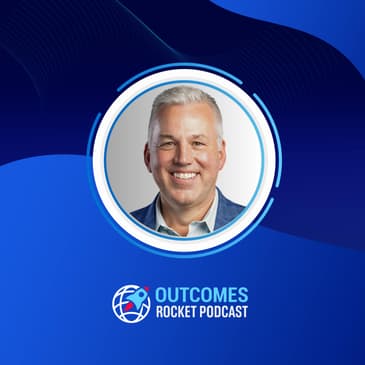
Behavior change, visionary leadership, and practical insights can transform metabolic, emotional, and physical health.
In this episode, Scott Paddock, CEO of Wondr Health, talks about the company's mission to transform metabolic, emotional, and physical health through behavior change. He shares insights on Wondr Health's unique value proposition, the challenges faced in the healthcare landscape, and the importance of leadership in navigating these challenges. Scott also highlights the need for hope and vision in leadership, offering practical advice for entrepreneurs in the healthcare space.
Tune in to uncover the power of behavior change in health, the value of visionary leadership, and practical tips for navigating healthcare challenges!
Resources:
[00:00:02] Hey everybody, welcome back to the Outcomes Rocket. So excited that you joined us. Today I have the privilege of hosting Scott Paddock on the podcast. He is the Chief Executive Officer at Wondr Health, the proven leader in metabolic, emotional, and physical health transformation for everyone through behavior change. We all need it. Paddock leads Wondr Health's efforts to engage populations, improve quality of life and health outcomes, and prevent and reduce the health of life.
[00:00:32] Reduce the Cost of Chronic Health Conditions. Really excited to have you on the podcast here, Scott, and I really want to thank you for making the time to join us.
[00:00:40] Yeah, Saul, thank you. I appreciate the introduction and certainly appreciate the opportunity to spend some time with you.
[00:00:45] Likewise. Look, one point before starting my business was at a company that used Wondr, so I actually used it as an employee and I can tell you that it works.
[00:00:57] While I was on and definitely shed some pounds and felt better. And so I want to say thanks for the work that you're doing and really want to tee you up to just share what got you started in the business and in healthcare and entrepreneurship.
[00:01:10] Yeah, Saul, listen, we're going to have to grab this clip of you just saying that you used it and it was effective. We'll put that, we'll just reverse marketing and put it on our website.
[00:01:18] I love it. Let's do it.
[00:01:20] Yeah. What got me into healthcare, I had a fantastic mentor that ultimately went on to lead GE Healthcare and he just guided me into healthcare.
[00:01:27] Like go in and solve the problems, use your background in engineering and problem solving and go solve the problems that will be the biggest problems of the future, which is how to get people effective in affordable healthcare and all aspects of their lives.
[00:01:42] And so that's what drew me into healthcare. And what drew me to Wondr was just this enormous opportunity for them to help 12 plus million people that currently are engaged in the program one way or another have access to it.
[00:01:55] You don't find too many organizations that have that sort of ability to impact those many lives. And it was an easy decision. Just drew me right in and we have had nothing but fun since then.
[00:02:07] Yeah. That's great. That's great. And look, metabolic health is one of the biggest problems in developing nations in the U.S.
[00:02:15] As you see all these companies popping up left and right in the space, differentiation's key. How would you describe Wondr and how you guys are adding value to the healthcare ecosystem and how does it differ?
[00:02:27] Yeah.
[00:02:28] First is how we add value is it's proven it works. I've got you as a data point of one and millions of others that have worked. And the way that we really set ourselves apart is we don't take a position of Mr.
[00:02:42] and Mrs. Employer or Mr.
[00:02:43] and Mrs.
[00:02:44] Payer, you pay us a PEPM model. We don't do that. What we simply say is we're going to put together an experience.
[00:02:51] We're going to put together a program that will have a direct impact on people.
[00:02:57] And if they engage in the program and see success, that's how we reward ourselves economically.
[00:03:02] It's all about directly tying our program to the success of the people that are using it and making sure that they stay in the program.
[00:03:10] If they don't do that, we shouldn't get paid for it. So we really set ourselves apart by putting our money where our mouth is.
[00:03:15] And then really the clinical outcomes over 10 plus years of doing this, we've got papers and studies and emails and all these testimonials from folks that it truly works.
[00:03:27] And it does. If you come into the WONDER program, you give us 8 to 12, 8 to 14 weeks of your time and just walk through it.
[00:03:35] Like we're going to teach you some really unique life hacks that will have a demonstrable impact on your health as you go forward in a positive way.
[00:03:42] I love that. And there's so many little things that you could do or different frames of thinking that you could apply and it works so well.
[00:03:51] And it is those small things. What other things would you point to Scott as things that stand out as part of the program that's helped employers with their employees and employees with their lives?
[00:04:02] Yeah, I think the first is we bring together so many like you and you think of a weight management program.
[00:04:07] Everybody thinks of calorie counting or food and jumping on a scale and having to walk X amount of steps.
[00:04:15] And yeah, that's all that to a degree is important as you go through.
[00:04:19] But it's am I emotionally in a spot where I can focus on me and having to have that emotional capability in which we have having that physical content and capability in there around?
[00:04:30] OK, how do I just move around a little bit better with less pain? I don't know about you just standing up now hurts.
[00:04:36] But how do I do that? And if I do all these little life hacks, that'll help me lose weight.
[00:04:41] So it's about helping someone emotionally, physically and helping them lose weight.
[00:04:47] You bring those three things together. That sets us apart in a way that we're attacking that.
[00:04:52] We're not saying, hey, you can only have 1400 calories.
[00:04:55] That's just that's not a sustainable lifestyle. Like you just got to go at it in a different way.
[00:04:59] We go at it in a kind of a more holistic way and we present it to users in their lifestyle, put it into their hands and the way that they're living today.
[00:05:08] And just helping them pack a little bit different things, eating at a different thinking about hunger levels differently, leveraging water for hydration.
[00:05:16] All the hacks around sugar that we all love.
[00:05:19] You do these things like it'll have a positive impact on you. That's how we set ourselves apart.
[00:05:23] That's awesome. That's very clear. And really, it's not just the X number of calories, but all the different angles you could get at it and the different perspectives.
[00:05:34] Building a company is not easy, especially in health care.
[00:05:38] Let's not talk about all the layers that that happen in in businesses that need to deal with brokers and the HR profession like it's hard.
[00:05:47] So what would you point to as a setback that you've had to deal with that's really made you that much better as a result as a company and even as a leader, maybe?
[00:05:56] Yeah, I think it's a company like we started off in a direct employer model.
[00:06:01] And so you just you've been in this since you just described how it is.
[00:06:04] You've got brokers, you've got consultants, you've got employers.
[00:06:07] We started off that way and continued to be that's a cornerstone of our business.
[00:06:12] And then we launched into really going after health plans and helping the health plans embed our product into their offerings that they would take to their employers.
[00:06:21] A real setback that we had was just the speed at what they operate at is so much different than we were used to.
[00:06:28] You know, I wouldn't say a running gun kind of attitude, but we move very quickly because employers move quickly and payers are very methodical.
[00:06:34] They do a lot of homework and it really set us back in the sense of, listen, we have to change our, we have to change the way that we think, change the way that we approach these payers.
[00:06:44] Like we can't come at them with the speed that we normally would.
[00:06:47] It puts, it sets them back.
[00:06:48] So it set us back in regards to how quick we can expand that market.
[00:06:51] The good news is we've since expanded that market for us quite well and has given us an opportunity to really dig deep in helping employers out.
[00:06:59] A big setback you asked about me personally.
[00:07:01] I take what we do for our, my most important asset.
[00:07:05] They're the people that I care about deeply and setbacks come from making commitments to them that business has an impact on.
[00:07:12] And you have to change those commitments one way or another.
[00:07:15] Well, it's whether it's the amount of investment dollars we're going to put in, we're going to have to change down now because of this,
[00:07:21] or we're going to have to move our investment dollars over here, or we're not going to be able to hire so many people.
[00:07:26] But it's to me that any, my biggest setback is when I can't execute to what I've committed to my employees, right?
[00:07:32] That, that bothers me immensely.
[00:07:34] Yeah, no, I feel you.
[00:07:36] I feel you for sure.
[00:07:37] People move companies.
[00:07:39] And when you're able to put together that group of people to really help you grow the company, it's never easy to need to change.
[00:07:46] But as a leader, we got to make those choices.
[00:07:48] And so you've made those choices.
[00:07:50] The companies benefited from it.
[00:07:52] And I think in the long run, the trust remains strong.
[00:07:55] And so kudos.
[00:07:57] I was going to ask you about the payer shift.
[00:08:00] You go from a really fast dance to more of a slow tango.
[00:08:05] And so what advice would you give to other leaders out there that are building companies if they find themselves challenged by these timelines?
[00:08:16] Yeah, it's, I think first is making sure that you set the expectation upwards.
[00:08:22] We all have a boss.
[00:08:23] I may be the CEO, but I have a boss.
[00:08:24] I report to a board and a chairman.
[00:08:26] It's setting those expectations of whether it's time or results.
[00:08:30] Doing that early, doing that often, have check-in points.
[00:08:32] That's number one.
[00:08:33] The other coaching I would say is don't go.
[00:08:36] Some people are going to come back and say to Scott, that's absolutely wrong.
[00:08:39] I never go into something with just one plan.
[00:08:42] If we're going to go into the payer market, and I know that's going to take me a little bit longer, I've got to double down on the employer market at the same time.
[00:08:48] The business can't go backwards while we're going forward.
[00:08:50] So it's always having that alternative plan always in motion at the same time.
[00:08:55] Oh man, that's gold.
[00:08:57] That's gold right there.
[00:08:58] Hey folks, hit rewind on that one.
[00:09:00] You're going to want to write that one down.
[00:09:03] If you were maybe booking a flight or maybe driving and something distracted you, rewind that.
[00:09:09] You're going to want to hear that.
[00:09:10] Always have a plan B.
[00:09:11] Always have a growth plan B because more often than not, your plan A is not going to work right away, especially in this space.
[00:09:18] So Scott, huge gold right there.
[00:09:20] Thank you for that.
[00:09:21] Wow.
[00:09:22] So we're here.
[00:09:23] I can't believe it.
[00:09:24] We're already at the end of the podcast, Scott.
[00:09:26] You guys are making a huge splash.
[00:09:28] If you had to leave our audience with a closing thought, what would you leave them with?
[00:09:34] And I want to just also offer you an opportunity to share what the best place to collaborate and reach out to you is.
[00:09:41] Yeah.
[00:09:41] And the best place to collaborate and reach out to me is LinkedIn.
[00:09:44] I spend almost all my social media time on LinkedIn.
[00:09:48] It's where I can communicate with like-minded people and they can communicate with me.
[00:09:53] So check me out on LinkedIn.
[00:09:54] I think if there's one thing I would leave anybody with, which is it's words I've always lived by, which is it's hope is a powerful weapon.
[00:10:02] And if you can figure out a way to put together a mission and a vision and a strategy and put hope around that, you can organize a group of people that will get with you and get on your bandwagon and fight and claw and scratch and dig with you in order to achieve what you're trying to get to.
[00:10:18] But you got to put some hope behind it and show them how you can actually get there.
[00:10:22] That's how I do it.
[00:10:23] I love that, Scott.
[00:10:24] And like just to unpack that one here as we conclude, how do you create hope for leaders that say, wow, I love that idea.
[00:10:31] But is there like a process to create it?
[00:10:34] Is there a way to do it?
[00:10:36] I think a little bit of this is there's the reality of what you can achieve and then there's the dreaming component of it, right?
[00:10:41] In between the reality of what you can achieve and the dreaming is where your hope you can fill that gap in.
[00:10:48] And it's getting people's heads around both like, okay, what can we do?
[00:10:51] Oh, we can do that.
[00:10:52] Well, God, if we didn't have all this stuff working against us, what else do you think we could do?
[00:10:56] And establishing that new gate point, that new gate point becomes that next ridgeline that you want to go attack.
[00:11:03] And so it's identifying those both and then helping people understand how they can step over the reality and get into that sort of chasm.
[00:11:10] I love that, Scott.
[00:11:11] I love that.
[00:11:11] It's like the four minute mile idea, right?
[00:11:13] Like the Roger Bannister thing and just putting it on repeat.
[00:11:18] Love that.
[00:11:19] Love that.
[00:11:21] Scott, thank you so much.
[00:11:22] You're an inspiring leader doing incredible things in the market.
[00:11:26] We thank you for what you're doing.
[00:11:28] Listeners, viewers, make sure you check out the show notes for ways to get in touch with Scott.
[00:11:32] Figure out a way to get wonder at your workplace.
[00:11:35] If you don't already, it works.
[00:11:37] I tell you firsthand.
[00:11:38] And Scott, I just want to thank you again for being with us.
[00:11:41] This is a true pleasure.
[00:11:43] I appreciate it.
[00:11:43] Listen, thank you for your time.
[00:11:44] And thanks for being a user of wonder.
[00:11:47] My pleasure.
[00:11:47] My pleasure.