
AI, data, interoperability, communication, and transparency are key technologies and trends that will impact healthcare over the next five years.
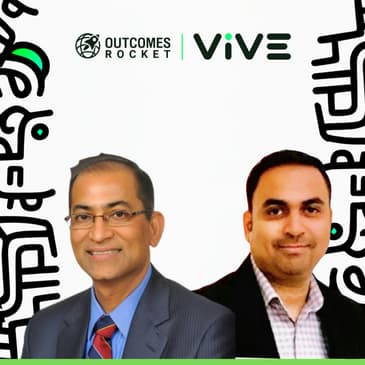
In this episode, Dr. Shafiq Rab, Executive Vice President and Chief Digital Information Officer for Tufts Medicine, and Suman Mishra, Chief Technology Officer of Healthcare for GS Lab GAVS, share their insights on the emerging trends and technologies that will impact healthcare over the next five years. They discuss the importance of AI, data, and interoperability in improving healthcare outcomes, as well as the need for strong governance and change management. Dr. Rab and Suman also delve into the challenges and opportunities of partnerships in the healthcare industry, and the importance of understanding patient needs and preferences to create a positive member experience.
Tune in to learn how Tufts Medicine and GS Lab GAVS are collaborating to drive innovation and improve healthcare delivery!
Resources:
[00:00:01] This podcast is produced by Outcomes Rocket, your healthcare exclusive digital marketing agency. Outcomes Rocket exists to help healthcare organizations like yours to maximize their impact and accelerate growth. Visit outcomesrocket.com or text us at 312-224-9945.
[00:00:35] Hey everyone, welcome back to the Beat Podcast recorded live at Vive in Nashville. I'm so excited to be with two outstanding leaders of healthcare. I want to introduce you to Dr. Shafiq Rab. He is the Executive Vice President and Chief Digital Information Officer for Tufts Medicine. I'm also with Suman Mishra. He is the Chief Technology Officer of Healthcare for GS Lab GAVS.
[00:01:03] I'm excited to dive into the work that they're doing to chat more with you about their partnership. But first I want to welcome both of you to the podcast. Thanks for joining me. Thank you so much. Thanks for having me. It's a pleasure to have you guys. And look, to begin with, let's talk about how your organizations are working together to help drive change in healthcare delivery. Healthcare is not easy. But we need healthcare.
[00:01:30] Especially our institution is known for many things, including low cost and providing care to the needy. We serve our community with our hearts. We're also known for the most transplant that we do in the Commonwealth of Massachusetts. So from academic medical center to community hospitals to integrated network with clinical network with private physicians, we have a very collaborative place.
[00:01:58] So if you're asking how we are working with healthcare, we're trying to do our best with the regulations, whatever is thrown at us. But the most important thing that I want you to know in this podcast, that the people who work at Tufts Medicine, the healthcare workers, the doctors, the nurses, the MHAs, the transport people, the cleaning people, our senior executive, every day they have only one mission.
[00:02:26] How to improve the quality of life of people who we are responsible for in our community, in our clinic setting, in our hospitals. And for that, we all try to work as one team with courage and with heart. Well, it's a very clear mission. And I really appreciate you sharing that, Shafiq. And Suman, kind of shifting over to emerging trends. We're here at Vive, right? Emerging trends, technologies, we have our eye on them.
[00:02:54] What are the technologies and trends that are going to have the biggest impact on healthcare over the next five years? I think it's a very interesting question and a very important question at the same time. If I were to look into my healthcare experience last 18 years, some of that in Kaiser Permanente and then working in GS Lab Gavs as a services organization, which cuts across many health organizations. I think technology has a very profound and very important role to play there.
[00:03:19] One of the things that I've always said is, as you look into technology, don't look into the technology in its entirety, but look at its impact, where it is going to make an impact. And then flip it on the other side saying, who is going to use this technology, right? Who is going to basically take that and operationalize it? Because there are so many cool solutions you will find in this, you know, aisles and booths and at Vive that they have AI, they have analytics, they have data management frameworks, awesome solutions.
[00:03:46] But is it usable at the end when the doctor presses or clicks on a thing? Does that work on the other side, right? Does the nurse get a text back to act on certain things? Do the population healthcare managers go and knock on the door because some actions were triggered by the technology? I think that's where the success lies. So if I were to sum it up, I would say, I feel that AI is going to have a big and profound role in it. Let it be predictive AI, generative AI, and now an agentic AI world where actions are going to be taken.
[00:04:16] It will disrupt the IT system completely. It will give more power to the doctors, the likes of Dr. Rob and the likes of physicians that he supports. They will have more say in how this will be used. So the traditional technology is going to be disrupted. But what the health outcomes will be is exactly what I said. It goes back to the operationalization of the technology, and that's where it lies. I love that. Very well said. AI is here to stay. It's not going to go away.
[00:04:42] So if you're asking of emerging technologies, the things that will not change is governance. The things that will not change is change transformation. Things that will not change is how do we bring about that change? But most important, that will not change at all. How do you create a digital and AI workforce?
[00:05:06] That means from top to bottom, whether it's a nurse, whether it's a doctor, whether it's a transport person, how do we create an education system in which people understand that? Because you can put any technology, but if people don't understand it, And how do we take their input, like someone said, to increase the user experience? Because user experience is what makes us pleasurable and meaningful.
[00:05:34] Technology, when you're asking about emerging technologies, of course, communication will improve. Video will improve. AI will improve. Chatbots will improve. But the thing that's going to make healthcare better is automation and the administrative work. And everywhere we do need, what I'm going to say something that may not resonate with everybody, but here's what it is. We need doctors. We need nurses. We need AI behind it.
[00:06:02] We need other augmented technology that makes things meaningful, useful. Means how do we get the data that we have together so that it becomes actually useful? And not tomorrow, but instantaneously. So technologies that will make and make people's lives better is when you ask a question, you have an answer.
[00:06:28] More to that, before you ask the question, they gave you the answer. But to do that, you really have to get into the heart and soul of the user. And that means when we design a healthcare of the future, then the following people should be in their mind. The customer or the patient, the caregiver, nurses and doctors. Because if you make their lives better, they will come and work in your healthcare place. It becomes a destination place.
[00:06:55] So when you're asking emerging technologies, AI is one part of it. Data is second part of it. But interoperability, communication, transparency, accountability, they all come into it. And they all start with governance. And then change management. Very well said. Very well. I love that. Couldn't agree more. No, for sure. And you know, I love that you went to what won't change. Because what won't change allows us to build models that last and make an impact.
[00:07:24] Okay, I'd love to hear more about the partnership. And also, in your opinion, what is a good member experience? Yeah, so I'll take a stab at it. And Dr. Rob, please chime in. I had first-hand experience in my past job when I was going to the patients directly and asking them, what is the biggest issue you have today? And I went to Downey Medical Center in Southern California. I had very good experience in terms of what patient experience looks like.
[00:07:51] And it's as simple as the limited English proficiency speaking people who can't speak English properly. They were given medication, and the medication was written in English. So they couldn't read it. Most of the time, they don't take medication because they don't understand it. That leads to non-adherence. That leads to patients who are chronically ill who should have taken the medication get readmitted for the same cause. It's as simple as changing English to Spanish, right?
[00:08:17] So it has got nothing to do with technology, but got everything to do with patient experience. The second example I'll give you is I was working with a decision support system. The clinician came to me and said, I know how many patients are coming to my hospital today, but I don't know how many chronically ill patients come to my hospital today. And that's where we started to build something called insight-driven organization, piece by piece, right? One slice at a time. But the idea was to say how many of the chronically ill patients came in today,
[00:08:45] how many of them were readmitted for the same or similar cause. The results were astounding. Again, it's nothing to do with technology. It's how you see the data evolve over a period of time, and how do you zone in on certain insights that can lead to action. So these experiences are both from a clinician standpoint, both from a patient standpoint, all focused on making their care better, making the care outcomes better. And I feel that that is where the focus should be.
[00:09:14] One last thing I'll say and yield to Dr. Rob is when you're looking at patient experience, you're also looking at how connected you are with the patient. Is keeping a portal open enough or ordering a medication through phone enough? Or are you going and saying, hey, person X, you are in Seattle. There is an appalling allergy or asthmatic. You need to pack certain things before you go. And when you get down, you can say, oh, there is a flu shot available you haven't taken.
[00:09:41] Take the flu shot and give them a navigational map because customers are now demanding it. So hyper-personalization is also a factor that comes into the play. I love that. Thank you, Zaman. What we have to be aware of is that health systems really, really don't get reimbursed or paid for what they work on. Every institution, whether it's a private payer, whether it's a government payer, the amount of money we get for what we do is always less.
[00:10:10] So that means the pressure on our healthcare systems is to become efficient. Cut out the fat, as they say, and how to become better at it, right? We all have technology debt. We all have threat of cybersecurity. The people who work to attack, they don't go to sleep. Second, they work 24 by 7, have three shifts, but they are also using AI to do attack vectors.
[00:10:38] So cybersecurity itself is a big deal for healthcare to deal with. Then we have equipment, then we have our buildings. In short, there is a tremendous pressure on us technology people is to first understand the workflow, then understand the processes, then how to improve it and improve the bed and butter help desk, infrastructure, which nobody wants to talk about because it's not emerging technology.
[00:11:07] But those things make a difference. And then how do you run the IT department as a train runs or as a clock runs? And from there, you go layer up and layer up and layer up. And as you're doing that, you have to make a choice. And the choice is every shiny object is not important. Yet you can't be left behind. So sometime you have partnerships. Sometime you look at other companies who work with you, support you, help you do things. And different people do that.
[00:11:37] Within healthcare system, labor is the number one costs. Number two is the supplies that we get. So to understand all of this, this is the good thing about technology, that we are data rich. We have to become information rich. And we have to use it. And I use the word, we have to democratize technology.
[00:11:58] Like, you know, you, my daughter and my children, they use TikTok and they use Instagram and they use Snapchat and other things, right? You guys use Signal and Telegraph because you don't want anybody to know what the hell you're saying there. So I get all that, right? So similarly, apps are important. API is important. Connectivity is important. Patients' information is important. And doing different types of clinical decision support. They are important.
[00:12:27] So to do all this, you need tremendous amount of money. And we have to find partners who are willing to invest in us, work with us, or we have to find partners outside who we work with. Either you call it a joint venture or you can call it an investment. There are different ways of doing it. So healthcare and a health system are finding partners to do things. And some are investing in technology to make it better.
[00:12:54] It's not easy at this time to be a health system. Especially you are an academic medical center. You have to teach young men and women. You have to teach them for future. And that also needs a lot of time. You know what I'm saying? Absolutely. So when you're asking the question, how's the partnership? The partnership is great. We all talk about partnerships. But there are multiple types of partnership people need to have to make healthcare go forward. And that is the burden.
[00:13:24] That is the burden on chief information officers, on chief data officers, on chief information security officers. How they work with the operation. How they work with the physicians. How they work through. And I always say that what I learned, governance is key. Everybody's input is key. But at the same time, you have to execute it. So when you're asking about partnership, that's a very important aspect in healthcare. Yeah. That's great.
[00:13:52] And the partnership you guys have is a strong one. It's the age-old question. You build, do you buy, do you partner? And partnerships seem to be one of the best ways to go. Thank you for saying that. Because, you know, build, buy, lease. All these are options. So basically, at the highest level, we have to look at it as business. You know, and I'm not making this up. I'm just telling you, there is a tremendous economic pressure on all health systems. Tremendous. Tremendous.
[00:14:21] And the only way to solve it, in my mind, is to make use of technology, use automation, use efficiencies, use data, use artificial intelligence, use all those things to decrease the cost, and make it quicker, faster, easier with what we got. If you can't afford LLM, use small language. You know what I'm saying? So our job, we have to become adaptive.
[00:14:49] We have to become agile, and we have to learn things. That's why we are at a while. So we can learn from each other. I love it. That's so great. Were you going to add to that? No, I was going to say that everything that Dr. Rob said, look at it in the context of the adaptability and flexibility of the organization, too. A lot of organizations are very risk-averse, and I think this is the time where you're going to go in the next level to say, can I partner with this group? Give them a shot. Work with them on small POCs.
[00:15:19] Making sure the technology is understandable and relatable, right, before you jump both feet in. So that's one of the additional points I would make. That makes the partnership stronger. I think so. The thing is that I don't know why you're asking these questions, but the reason you are asking these questions from me, I'm not like a luminary or someone out of this world. I'm just a common guy, okay? But what I'm going to tell you, people's lives depend on the health system.
[00:15:48] It's not a manufacturing unit. So the care and the love and the passion that the healthcare workers have, that's why we are in this profession. We're in this profession because we love people and we love to serve. We serve because that's what makes us happy. And technology has a key role to play in it. But technology itself cannot do anything without the support of the operations, without the
[00:16:17] supports of the caregivers, without their voice in it. You know what I'm saying? Totally. I, as a CIO, can't do it. It's not right without everybody being in it. But when you're asking that, we always keep the patient in mind. We understand that. But at the same time, this is a podcast, so I don't know what people are going to say when I say that. But we need to become more efficient. But at the same time, you have to find ways of making money. Totally. Yeah. No margin, no mission. Yeah.
[00:16:44] And so we're talking about member and patient experiences. And without the strategy, without the metrics, it's all tactics, right? And so what metrics should healthcare providers track for member experience? So I think there are many ways to look at it, right? And I wanted to go a little bit detail in terms of how you would look at a patient experience, say, this is a good patient experience. So close your eyes. You're in front of a clinic or a hospital, and you are sitting there waiting for you to be seen by a doctor.
[00:17:14] Maybe if you see a clock that tells you eight minutes to see a doctor, that alleviates 60 to 70% of your stress level. It's just clinically proven. People have gone through that exercise and said, yes, that helps. Second thing, if you go and then while you wait, if you browse certain things about your condition, let's say you have diabetes and you're looking at certain things or how to take care of your food or something like that, that adds a lot of value because it kind of immerses you in certain things.
[00:17:40] So not like a coffee shop, not like an airport, but like a coffee shop kind of experience. These were the next generation health systems that are coming into play where patient experience is the key, right? Every person who is a member, who is the patient also is demanding if I can do everything from my app to book an airline ticket and fly in an airplane, why can't that be done for my health system? This is a demand. This is not an option. People have to do it. Now, a lot of people are not there, right? So I talked about average wait time being one.
[00:18:10] There is another one called net promoter score. People ask questions, they give response. It's okay. My NPS is here. So that is just another way of looking at it. Are people happy? Are they allowed to say things that can make changes, right? The other thing I always say is digital engagement metrics. Do you have people digitally enabled? Do they have smartphones? If they don't, they're too old. Do their proxies have smartphones? Because everything is in an app and not every app runs on normal phones. So I think there is a digital divide. We've got to close that too.
[00:18:39] I think there's a lot of factor in this. A lot of organizations are going and doing that in a digital transformation manner, front door, back door. They know who you are. There is actually, we have built a cool solution. Dr. Rob has seen it. It's called blockchain-based key that you can show, which will allow you to interrupt. If you're in the in-network, you can show that QR code and that basically logs you in and that's it. There's nothing else. And your private key remains with you. The public key is what they get. So the information is secure behind the firewall.
[00:19:08] So there's a lot of other things. But doctor, do you want to comment on that? No, no. I think someone you hit it on the nail. I can only tell you three KPIs that we look for. One is the net promoter score, what you just said, which is known as NPS. Customer satisfaction score, which is CSAT. And customer effort scores, which is CES. Then people also look at patient retention rate, appointment cancellation rate, wait times, first
[00:19:34] contact resolution rate, abandonment rate, quality scores, and number of positive reviews. So there are multiple KPIs that I just mentioned when the podcast goes late slowly so people can write it out. But there's a whole team behind it that works on it. It's not one person. You know what I'm saying? And it's also important you get the feedback when the patient is there. And we try to do customer, we call it if something goes wrong, we try to make up for it.
[00:20:03] Many hotel people do that. Many hospitality people do that. And we learn from that. So that's one of a couple of metrics. And then you can also do focus group directly with patients, get their input and actually change what they are recommending because at the end they are our customers and they are always right. That's fantastic, guys. Well, this has been a super useful episode. Lots of great examples, great business discussion. If folks wanted to get in touch with you to learn more about what your organizations do, where can they do that?
[00:20:34] Oh boy. So my name is Shafiq, S-H-A-F-I-Q. And my email is S-H-A-F-I-Q dot R-A-B at TuftsMedicine.org. That's where I work. If you want my cell phone number, I'll give it to you. 6-0-9-3-0-4-5-3-4-2. The whole world has it. So it's on the internet. But I mean, come on, man. Other people are working harder than I am. So I'm a guru and it should not go to my head. I just want you to know.
[00:21:00] But if people are genuine and they want to know what are the hurdles we had, happy to share the successes, but also happy to share the failures. Thank you for that. Really appreciate that. Yeah. And my name is Suman Mishra. My email address is Suman, S-U-M-A-N dot M-I-S-H-R-A at Gavstech dot com. I'm on LinkedIn. So feel free to connect with me. I'm on it. And yeah. I forgot I'm on LinkedIn. You're on LinkedIn too. And I think I just wanted to say this.
[00:21:29] This is a privilege and honor to sitting next to Dr. Rob and have this conversation because he's really a visionary and we got the opportunity to work with him. The biggest thing that I always take away from all this is as you build your solutions, don't build the solutions because you can build the solution because it works and it is adaptable. You are able to operationalize this quickly and making sure people can use it broadly. That is where the success is. So I'll leave you with that thought. I love that, Suman. Thank you for that.
[00:21:55] And by the way, folks in the show notes, we'll leave all the links to LinkedIn, websites, emails, even a cell phone number here for Dr. Rob. Oh, I don't mind, man. I mean, because I have learned from other people. Yeah. If I will start telling you that I love from the people who work with me, who work for me, for my bosses, I learn every day from somebody, you know? So that's the part which I was trying to tell you. We are all in it together.
[00:22:25] Amen to that. Yeah. And this is the time. Like I said, all hands on deck, man. The country needs you. The country needs you. So folks, check them out. Get in touch. Make change happen. And again, I just want to say a big thanks to Shafiq, Rob and Suman Mishra for joining us today. Thanks, gentlemen. Thank you so much. Very good. It was great. Thank you.
[00:22:58] This podcast is produced by Outcomes Rocket, your healthcare exclusive digital marketing agency. Outcomes Rocket exists to help healthcare organizations like yours to maximize their impact and accelerate growth. Visit OutcomesRocket.com or text us at 312-224-9945.