
Clean, accessible, and well-governed healthcare data is the foundation for better care and effective AI.
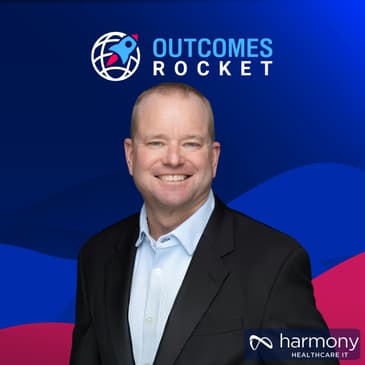
In this episode, Erik Johnson, Vice President of Marketing at Harmony Healthcare IT, discusses how healthcare organizations can preserve, manage, and activate decades of clinical, financial, and operational data. He explains how a comprehensive data lifecycle strategy helps reduce legacy system costs, improve interoperability, and build a stronger foundation for AI adoption. Erik also shares marketing insights from both established brands and startups, emphasizing the value of brand equity and achieving product-market fit. He explores the potential of agentic AI to support clinical decision-making, reduce administrative burden for clinicians, and improve patient outcomes.
Tune in to learn how a strong healthcare data strategy can prepare organizations for the future of AI-enabled care!
Resources:
[00:00:03] Hello everyone and welcome back to the Outcomes Rocket. So excited you tuned in to another episode. Today I have the privilege of hosting Erik Johnson. He's the Vice President of Marketing at Harmony Healthcare IT. I love talking to marketing leaders. You guys know that's what we do in the business. And just like sharing notes, best practices, but also figuring out what's going on in the market.
[00:00:30] Marketers tend to have the data. They tend to have the insights. And so I'm excited to have Erik here on the podcast to share more about him, Harmony Healthcare IT, and what's going on in healthcare. Erik, thanks for joining us. Yeah, thanks. So happy to be here and appreciate the opportunity to join the podcast. Yeah, of course. Of course. Glad we finally did it. And so Erik, tell me a little bit about your story. What got you into healthcare and then a little bit more on Harmony Healthcare IT?
[00:00:59] Yeah, absolutely. At risk of dating myself, but at this point, it is what it is. I've been fortunate enough to be in healthcare for a couple of decades now. And the one thing that drew me to healthcare, because I didn't start my career in healthcare, I followed my way into it.
[00:01:18] But what drew me in and has kept me in that entire time has certainly been very much a mission-driven focus in working on technology that ultimately helps patients and providers drive better care.
[00:01:34] And with that thesis in mind and the ability to inform, and I've just been fortunate enough to work with companies and people and great customers that has always kept that my focus and have found that to be very inspiring.
[00:01:52] And as I was thinking about reflecting my answer to this question, the fact of the matter is, I've actually now my career has spanned multiple domains in terms of watching healthcare move from paper to digital to decision support, and now to the movement in AI. And so therefore, watching these evolution of technology across that intersection is fascinating.
[00:02:20] I wake up every day believing what we do impacts patients and providers in a positive way. And to me, that's what has always been the mission for why I still really enjoy doing what I do. That's great, Erik. I love that. And you're so right. These stages of evolution that we're seeing and now with AI, things are moving fast and there's a lot of confusion in the market. There's a lot of desire to not miss an opportunity.
[00:02:49] Am I doing the right thing? At the same time, there's security and threat vectors around data. So it's a dynamic time that we live in. And your motivations are awesome. I love them because that's what drives me too and what drives a lot of our listeners. Talk to us about Harmony. What are you guys doing in the ecosystem? How are you adding value? Yeah, absolutely.
[00:03:10] Harmony Healthcare IT, we are a data migration, extraction, and archiving provider for healthcare, hospitals, ambulatory clinics, really essentially any entity that really needs assistance in moving and making that data accessible. And really trying to find ways that those organizations can unlock the value of that data. So we're there to preserve, manage, and make that data accessible.
[00:03:39] And we're talking decades of clinical, financial, operational information. With at the end of the day, so providers can really reduce costs, improve interoperability, support AI initiatives. Probably touch on that here in a bit. Of course, stay compliant. And most importantly, make sure information is really available when it matters most for patient care.
[00:04:03] And so what is a bit of a misnomer about when you hear the word archiving, it sounds as if, okay, put it in a closet and lock it away. Yeah. This is not that, right? We're talking about tapping into data that's been made accessible and can be interoperable in a different state inside an EHR. And so therefore, this is much more of an active notion of how to activate data that's typically quite disparate in most cases.
[00:04:32] And we can do so, we can make that, we can do so to help reduce that cost footprint dramatically for systems and then make it interoperable. That's great. Right. Yeah. And as I understand it, there's a lot of mergers and acquisitions. And what happens is you've got health systems with two instances of Epic or one's on Meditech and they want to get rid of them and one's on Cerner. And then you're sort of stuck with these licensing fees just to keep the data.
[00:05:02] And it's like millions of dollars a year that people are paying. Yes, that's exactly right. There is the notion of a very much hard ROI for savings for what we can do for the health systems, right? And it's certainly something that really attracted me to this space and working in a number of other clinical environments.
[00:05:25] The notion of how we can do that through making their data more usable and accessible and also saving them costs is very much the notion of what we do for this space. I love it. Yeah, it's important. And so how does what Harmony Healthcare IT does, how is it different or better than what's already out there? Yeah, absolutely. People have been moving data around for a really long time.
[00:05:53] And as we've seen through what you just talked about, through M&A, consolidation, all the pressures that exist and certainly, especially in the rural health sector. And in some cases, just the underperforming EHRs that happen to be out there has caused a lot of technology consolidation.
[00:06:13] So therefore, what we do is really try to come in and provide a full, broad data lifecycle approach to how we can help organizations preserve access that data, integrate it, release it, and then activate historical data in its true form. And then stay with these organizations for a really long time.
[00:06:35] When you're talking about big system moves from, let's just say, a Cerner or Epic, these are projects that start and then go on. But you're also talking about the fact that they're usually rationalizing hundreds of applications around that ecosystem, as well as multiple different type of instances of EHRs. So these are really large projects. They require a different kind of data strategy.
[00:06:59] And I would say that's what we do is really try to come in and be that strategic partner for them to help guide them throughout that strategy. And, of course, you can't not talk about this without talking about the AI component in terms of really AI being dependent on really good, clean data to help drive those models to success.
[00:07:28] And so, therefore, archiving, if you will, is all about making discrete data available and usable, which ultimately we believe for our institutions helps set them up for that net set of how they can tap into that data to drive a bigger strategy. We've been doing this for 20 plus years. We've done it for 700 plus software brands.
[00:07:53] So there's not too many platforms we haven't ever really seen, 500 plus organizations out there doing what we do. So at the end of the day, it does come down to your level of breadth and experience. And we've been fortunate enough to be doing this and only this for a really long time. Awesome. I mean, that expertise is critical. I saw I ran into a class report with kind of you guys on the top there. And so you guys are definitely doing a really great job in the space.
[00:08:22] Appreciate you helping us understand the context of how you're different. Talk to us about setback. What are you seeing in the industry right now and key learnings coming out of those? Yeah. And I actually almost took this question more and I'll answer it from the perspective of a marketer. Right. Yeah. Let's talk about marketing. Yeah. And I've been fortunate enough to work for some really great brands. 3M, Wolters Kluwer.
[00:08:50] Back in the days when people use business cards and you could present a business card and it would get you access. That's an amazing feeling where the brand credibility walk you right in the door. So that's how I start. 3M is like solventum now, right? Did you do 3M Medical or? I did. Yeah. So I was within an emerging business unit within 3M and that's how I got my start into healthcare. Super cool.
[00:09:16] In true 3M fashion, we took a box of parts and put together a solution that ended up solving a problem for a really large pharma company that was losing drug in a supply chain. And we figured out how to track that drug at the time and associate dispensing information to a patient and created a solution around that. Wow. That's amazing. Yeah. Yeah.
[00:09:45] So I got to work firsthand in clinical environments and find process improvement areas as part of that. And that's what got me hooked. It did. You got the bug. Yeah. But fast forward to working with smaller startup companies, right? And I remember the first time I transitioned from these big brands where the door opened for you versus you got to go knock on the door. Yeah.
[00:10:13] And I would say some of the biggest challenges that I experienced in going through that, which were very important as part of, I think every marketer has to go through figuring that out. I had to do it from this perspective. The notion of number one, the brand equity and experiencing what that means in terms of trying to get access to your customers that want to buy. Number two, product market fit. Coupled with brand equity, you can drive, you can do a lot of things.
[00:10:42] But if you don't have that or you don't even know what it means or what it means to go build that, right? And especially in startup environments where you have very low brand equity typically, right? You think you've got product market fit. And if you haven't experienced both of those things or you've been the beneficiary of not having to go build it, your marketing tool set needs to adjust, right? In terms of what you need to do and how you're going to go build that in order to experience the benefits of once you're there.
[00:11:12] So, my challenges were all about retooling my skill set to be able to go do those things. And by the way, it's not like I cracked open a book and had to learn that. You experience it the hard way, right? I mean, these are the things that basically are academic, right? Where you crack open the book and just say, follow this. And oh, by the way, somebody's going to tell you that you're going to have to fail, right? Right. Yeah. So, figuring those things out is important as part of that.
[00:11:40] I think every marketer has to go deal with that at some point in their career. And those are challenges that I had to overcome and I'm certainly better for it. That's awesome, Eric. Yeah. Like you, I was big brands. My last gig before I started our marketing agency was I was at Medtronic for eight years. Talk about a door opener, striker, and then starting my own thing. Definitely, right? You have to do all of that stuff.
[00:12:08] The brand, the product market fit, delivery, all that stuff. So, yeah, I love it, man. I think it's so true. And you can read it in a book, but it's another thing to face the reality of the market and actually operationalize it in a way that is reproducible. So, I think you hit a nerve there with me, Eric. Yeah. There's, everybody builds a little scar tissue along the way too, right?
[00:12:33] But I think that's part of the biggest successes come as a result of figuring that out, right? And all of the, and it just feels that much more satisfying when I've figured that out. So, you put that into your tool bag, right? And hopefully teach others along the way, right? Oh, totally. So, as you think about technology, we've talked about AI. We've talked about the importance of clean data. What's a trend or tech right now?
[00:13:03] And if you say AI, then maybe let's dig deeper on it that you feel is just going to change healthcare as we know it. Yeah. I draw this from a context from a number of different areas, primarily from my background in clinical decision support and clinical surveillance tech. And when we go back to those early days of watching EHR adoption, I worked, this is my days of Wolters Kluwer.
[00:13:29] We were working on the first generation of embedding evidence-based order sets into an EHR to help with clinical decision making. So, if you use that as one reference point, and then later on in my career, I worked on a clinical surveillance technology that surveyed all sorts of data, right? And it was very rules-based and create triggers inside a workflow.
[00:13:53] And this happened to be very much inside pharmacy surveillance and infection control surveillance. Both of these are very important pieces of technology and very relevant in their early days at helping accelerate identifying problems as early on as you can, recommending evidence, and then triggering solutions that can intervene and prevent more destructive care situations, right?
[00:14:20] And so, that's all a setup to basically me answering, of course, the notion of using agentic AI to be able to collapse all of that kind of decision making on behalf of a clinician and making a recommendation still to the clinician that can take action on that. Yeah. To me, if I, and I've always had the perspective of, if I have to go, at some point,
[00:14:49] I'm going to be in the hospital, I hate to say it, right? Or somebody family member. Yeah. This is the kind of technology that I want to make sure that the hospital has in place that might be able to better prevent and help a clinician detect a problem before it ever becomes such, right? Agendic AI in the care continuum can do that. If I tie that back then to the kinds of things that we're doing at Harmony, it's these data
[00:15:18] sets that are going to ultimately be, the data sets that are going to train those models to be better at doing that. And so, that is a tie-in that I see that's going to help those workflows for healthcare workers become so much better. And what the EHR did for digitization ultimately is fundamentally changing how care is going to be delivered.
[00:15:42] And so, this all needs to play itself out, but this is where I get excited from spending time in these spaces. And from a personal perspective going, man, I hope they get it right. Because at the end of the day, the amount of impact that this can have on patient care is tremendous. And the reduction of burden on clinicians to be able to act on that is also extremely important today too.
[00:16:11] So, for me, it's a real culmination of all of that technology. And I like the role that Harmony plays in enabling that from a big data perspective. Now, Eric, that's really insightful. And as I'm seeing these agents and this AI get deployed across the industry, but also health systems, you touched on the word workflow.
[00:16:36] And we're seeing workflows change massively across the board. And I think that's the theme here. It's like, what is going to happen to workflows as a result of agentic? We'll see. It's interesting times. That's an understatement, truly. But yes, absolutely. I love it. We could do a whole podcast on workflows, Eric. Yes. Yeah, we could. We could go really deep on that. By persona type, by physician type, et cetera.
[00:17:05] So, I love it. Obviously, we don't have time for that on today's podcast, but perhaps we do a part two. So, stay tuned, folks. Eric, this has been a lot of fun. And a lot of the folks listening and watching our podcast are looking for solutions. And they're looking for partnerships. So, if you wanted to leave them a closing thought, what is that? And then where can people find you and Harmony Healthcare IT? Yeah, absolutely. Closing thoughts.
[00:17:33] Things that I think about, especially being in the age of AI right now, is organizations that have trusted, accessible, well-governed data are going to be best positioned to accelerate care delivery, reduce clinician burden, unlock new opportunities to impact patient outcomes. Because of all of that, it's such an exciting time to be in healthcare technology, to be a marketer in this space as well, too.
[00:18:01] And then, at the end of the day, I'm just really grateful for our role in that and helping health systems prepare for what's next here at Harmony. If anybody would like to connect with me, feel free to reach out to me on LinkedIn. I'm pretty active out there on those networks. We do run a podcast at Harmony called Health Data Talks. And so, we try to keep that thread going. So, please tap into that content related to what we do.
[00:18:28] But we also try to have a number of interesting industry guests on there as well, too. And yeah, reach out. I'm happy to connect. Thank you for that, Eric. And folks, we'll make sure to leave all the ways you can get in touch with Eric, his team at Harmony Healthcare IT. We're going to leave it all in the show notes for you. So, if you're driving right now, don't worry. Hit pause. Pull over. I don't want you getting in an accident. But take advantage of all the ways you can get in touch with Eric and his team in the show notes.
[00:18:56] Thanks for tuning in to this episode. The transformation's up to us. The data has to be available. It's got to be clean. You got to have good governance. Harmony does a fantastic job of helping you guys get there if it's a need. So, check them out. And Eric, thanks so much for spending time with us today. Yeah, thanks. So, I really appreciate and enjoyed our conversation. Likewise.