
What if the key to transforming healthcare lies in fearless leadership, innovative technology, and a relentless focus on prevention?
In this episode, Dr. Kwadwo Kyeremanteng discusses his healthcare journey, emphasizing values-based leadership and innovative solutions for resource optimization, burnout reduction, and improved patient outcomes through prevention and personalized medicine. He also champions bold changes like exploring privatization and leveraging technology for precision medicine.
Tune in as Dr. Kwadwo Kyeremanteng shares his inspiring journey, groundbreaking initiatives, and bold ideas for reshaping the future of medicine!
Resources:
- Connect with and follow Dr. Kwadwo Kyeremanteng on LinkedIn, Facebook, Instagram, TikTok, and YouTube. @Kwadcest
- Visit Dr. Kyeremanteng’s website!
- Check out the Prevention Over Prescription Podcast.
- Pick up Dr. Kyeremanteng’s book, Unapologetic Leadership, here!
- Learn about Osler AI here!
- Visit Mariya Filipova’s website and learn about her here!
- Discover the Systemic Health Investor website!
- Learn about the Care Convergence Thought Leader: Dental Economics.
- Visit Jonathan Levine’s website, as well as JBL New York City, GLO Science LLC, and the GLO GOOD Foundation.
Watch the entire episode on YouTube and get more details at Think Oral Health.
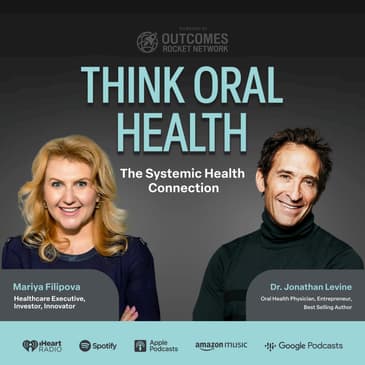
[00:00:04] Welcome to Think Oral, where we connect the unconnected between oral and physical health. I'm your host, Dr. Jonathan Levine. And I'm your host, Maria Filipova. Let's get at it.
[00:00:23] Hello, everyone, and welcome to our first episode of 2025. I am so pleased to welcome, first of all, Jonathan, my co-host and partner in crime. Jonathan, Happy New Year. And are you ready to rock and roll after 46 episodes last year? I don't believe we did that many. Yeah, it's great. It's great. We had some great people. It was a great year. Great first year.
[00:00:50] Well, we have to top that. I mean, it was kind of a tall order to figure out who is going to be our first episode for 2025. And so I think maybe it's likely biased opinion here, but I absolutely think we took the challenge head on and I think we met the challenge head on. And so I'm super excited about our guest today. Our guest is a practicing clinician. He's a researcher.
[00:01:16] He's a fellow podcaster. He's an author. And most importantly, he is a fellow troublemaker for good. And so I couldn't be happier to introduce Dr. Kwonjo. And I am actually going to give you a little bit of a background on Dr. Kwonjo Kieramantag. Kwonjo, happy to have you. Welcome to the podcast.
[00:01:38] Let me just, at the risk of making you feel uncomfortable, read out a couple of your accolades and all the amazing things you've done in your career. You're currently the department head of clinical care at the Ottawa Hospital, where you not only take care of patients in the ED, but you also take care of patients in the ICU. That's the intensive care unit. You spend a lot of your time in your research work on ways to improve ICU resources.
[00:02:07] You founded the Resource Optimization Network, which is a great multidisciplinary research group working on reducing health spending in this area without compromising a quality care, which is something that we in this podcast and in our conversations are really excited to pick your brain on. And then on top of that, you are launching or have launched your first episode of a newly rebranded podcast, Prevention Over Prescription.
[00:02:36] Very aptly named, so can't wait to talk to you about that. And I did mention that you are an entrepreneur. You founded during COVID Solving for Wellness, this virtual health and wellness platform for healthcare professionals that continues to help address healthcare burnout for practicing clinicians, which is a huge issue and highly important now. And finally, we'll touch on your book. You have Unapologetic Leadership.
[00:03:05] This is the book you already have there, but you have an upcoming book that we'll be asking you about as well. So with that, Kwanjo, welcome to Think Oral Health Podcast. Listen, guys, number one, that intro was gangster. Second of all, it's a true privilege. I got to hear a couple episodes after meeting Maria at health, and I had to have her on our show talking about all things oral health. So I am jacked. I'm ready to go. I'm excited. This is going to be amazing.
[00:03:35] Oh, this is amazing. And maybe we'll start with our favorite question that drives both Jonathan and I is, Kwanjo, what is your personal why? You've had a meandering path of being an entrepreneur, an author, a researcher, a practicing clinician. We like people who take the non-traditional, unbeaten path to where they are. So tell us a little bit about your personal why and how you landed where you are today. Yeah, that's a great question, Maria.
[00:04:04] Yeah, well, in terms of like the personal why, like initially I always thought as someone that was drawn to practice that is very sporadic and unpredictable in the intensive care unit. You don't know what's walking through the door. I just figured that was part of me. But actually, the more I thought about the why for me, it really came down to justice, I think. That's like a real strong value for me. And taking care of people when they're the most vulnerable so that they get the best care possible.
[00:04:33] That's important to me. My research area was in resource use utilization. Like, because we were constantly spending so much money in health care, but we weren't seeing the outcomes that patients and families deserve. And so to me, that was a huge area where we need to serve our public better. And when you would see that resources being wasted, that meant that people, you know, it's a fixed plot, at least in Canada. A lot of people aren't getting the care that they need in underserviced areas. So to me, that was a real passion.
[00:05:02] And because of that, it's led me into a focus on prevention. And I've seen a lot of people suffer when they land in the hospital, in the intensive care unit or anywhere in hospital. And it took a while for me to get there. But to me, the 80-20 of all this is just don't land in hospital. What can we do to prevent you from getting sick in the first place?
[00:05:27] And so this is why you see a lot of our content is on, like, how you eat, how you move, how you reduce your stress, how you connect with others, but also innovative ways that people are doing to address some of these issues. And I must say, Jonathan, you don't know this about me, but I have two sisters that are dentists. So when I started to hear about some of these connections in terms of the oral health and long-term outcomes, I was embarrassed. A lot of light bulbs starting to light up. Exactly.
[00:05:56] Tell us a little bit about those connections or in your search to utilize ICU resources better and ED cost without compromising quality. What are the things that you are now doing differently as the head of the department in the ED and as the individual to help you optimize resources as an organizational leader, but also as an individual preventing burnout?
[00:06:23] Because I venture to guess you do not need a stress-free life. You're probably, your stress levels are probably relatively high. Yeah. So, I mean, there's two components to that. So from a reduction in resource use, one of the key components for that to me is how do we prevent people from landing in ICU in the first place? So we've done a lot of initiatives.
[00:06:47] For example, we have a virtual critical care program that we initiated about a year and a half ago where we see patients in the periphery that are sick enough to potentially come to our center. But because we address their needs early, they're less likely to come in and land in tertiary or quaternary ICU. So that's a big area of interest in what we've been trying to lead, being more involved in less acute beds so that you have that level of expertise.
[00:07:14] That's at, you know, a technical corporate level what I'm doing. But then there's a whole wellness side. I always tell clinicians, especially during the pandemic, this was a big epiphany for me when I saw some of our most stoic and most, for lack of a better word, really resourceful clinicians succumb to burnout. And to me, that was like a canary in the gold mine when I saw some of our colleagues just suffering.
[00:07:42] It's a lot of the stuff that we talk about, like, you know, trying to take care of ourselves before we take care of others. And so that's, again, about how we eat, how we move, how we reduce our stress and connecting with others. But then also at an institutional level, like there's some responsibilities I also think that organizations can do. Get rid of the red tape. Get rid of redundant work.
[00:08:07] Let clinicians and experts do the work that they're best at and not get caught up in activities that don't really leverage that. And this is where I do. We do a lot of work in AI, too, for that reason. Like, how does AI make your work more efficient? And so I think those are the ways at a high level anyway, Maria, how we're trying to...
[00:08:28] I mean, if we pick up on that theme and Jonathan, I know you're itching to jump in here, too, because the theme around burnout and clinician performance is huge in dental clinics on the medical side. And sometimes it comes down to getting staffing for the dental clinics, like shortage in hygienists, shortage in building out the right team around you.
[00:08:51] So if we think about some of those lessons learned for the universal theme, unfortunately, is our clinical teams are burnt out. Dental teams, medical side. And I wonder if there is, you know, technology as an augmentation tool, not a replacement tool, but as an augmentation tool in that sense and what role it plays. All right, let's talk about burnout. Because burnout, my take is burnout can happen in every industry.
[00:09:18] You could be an analyst, you could be working in finance, you could be working for a lunatic private equity leader. You know, we've seen plenty of great TV shows. It never happens. Probably if it doesn't have any of those, I don't know what you're talking about. One of the things, and I got a feeling we're aligning, Roger, on this, is that we have to physically and mentally take care of ourselves.
[00:09:41] And the four domains of anti-aging and longevity is what I have spent, you know, kind of almost unaware of, but kind of trying to live, which is nutrition and sleep and fitness and stress management or mindfulness. You know, and if you, whatever industry you're in, you know, we're going to get headwinds. Look what's happening in Los Angeles right now. How are people dealing with this? Oh my God, it's just so sad. And we all have to do our part and try to help.
[00:10:10] And that's why, you know, we all believe deeply in helping each other. Tell me a little bit about how you use AI in your practice to help with helping clinicians practice at the top of their license. Who are you asking? Both of you. Roger, you go first. You're the guest. The guest always comes. It was the first place. I'm enjoying the conversation. I'm easy.
[00:10:35] But okay, so at a corporate level, we just started to use the AI scribes, which I think we're a little bit late to the party. But basically, the ambient scribes are listening on a patient interaction and take notes and allow you to be more efficient that way. My personal dream would be to use it for our nurses. Yeah. Because a lot of the time, their workload isn't in the physical workload. It's the paperwork and the charting.
[00:11:01] So if we could offload them, to me, that would be massive. So that's a dream of mine. The other areas that we're exploring, we started a company called Osler AI. And it's basically a virtual platform. You call a number and you can get, take OSCEs or oral standardized, what's the C? Oral standardized clinical exam.
[00:11:24] So you're able to not only practice clinical scenarios, but you're also getting feedback from the software. And why I think this is great is because we're quite short on clinicians globally, but in Canada especially. And so this is an opportunity for, for example, foreign trained grads to get the opportunity to be trained up and coached up. And saying, Hey, instead of, because normally you would have to practice in a live clinical scenario or in a formalized test.
[00:11:53] Whereas now you could do this from your home. You could do this anywhere globally. And so these are the little things that we're doing. And with the software, we'll be able to like tutor people on specific topics. So really just becoming more efficient and educating folks and getting them up to speed. So that they could just be part of the workforce. Yeah. Tremendous. I look at AI. Tremendous co-pilot, as they say.
[00:12:19] And as technology gets inculcated into our industries, it's going to be pervasive in everything we do. So it's very exciting. But let me switch gears a little bit and give me a moment here, Filipova, because I just need a moment. Because I want to switch gears because I am really excited about it. Give one more use case for your clinic, though, please. The AI use case. Give us one AI use case. What? For me? Yeah. Oh, God. We have it everywhere. It's like medicine. You know, adoption, 17 years of medicine.
[00:12:49] Dentistry is even slower. But no, what's happening is we have AI reading our x-rays. We now will have it reading our CAT scans. You know, CBCTs are going to be a standard of care in dentistry. We have robotics, just like the DaVinci robot in orthopedics. We now have it in implant placement in the mouth. And that's all AI driven. We have it in note-taking for sure. You know, everywhere you can think about it, you know, whether you're an AI reading x-rays and you want to do treatment planning.
[00:13:17] Now, remember that conversation we had with the CEO of Overjet. They're doing that in Pearl also. It's like how will AI, the biggest thing is trying to get consistency in the diagnostics, right? So you have to get to a fact base. And unfortunately, it's all about there's too much subjectivity because if you ask five dentists and you put up a set of x-rays, you're going to get probably three to four treatment plans. So how do we stand up? So that's a big plus. So there's so many places where AI is very exciting. Marie, is it okay? Can I go over now?
[00:13:47] Yes, please. Now we've covered both. I want to do the mirror side, then dental and the medical. Okay, I understand. We're symmetrical now. Yeah. So this is my Canadian brother here. We got an American and Canadian clinician. But I'm really excited about that you've been a leader in your role as, you know, kind of gone through your own career, your own journey. And you wrote this book about unapologetic leadership. And I'd love to hear as you handle your teams, what's your philosophy on leadership? What was that book all about?
[00:14:17] What did you learn along the way that you see really helps you build that high-performance team and high-performance culture? Yeah, thanks for that, Jonathan. I think, first of all, I never perceived myself doing anything on the leadership side per se. Like in medicine, I was just survival mode. And it was really the pandemic, to be honest with you, that helped propel me into leadership and to write the book.
[00:14:42] So I, in Canada here, I saw a lot of underserviced, marginalized, racialized communities not being treated the same and not getting enough resources to manage the pandemic. I saw our kids really suffer. We had some of the longest school closures in North America, up here in Ontario. And this was a very different time where it was, I shouldn't say very different time. It was a different time where it was easy to get canceled. It was easy to have your job threatened, which, unfortunately, we had a lot of threats.
[00:15:12] But one of the points during this pandemic, my wife and I, who's a psychologist, we say, you know, we're seeing a lot of things that are being misrepresented. Yeah, during the pandemic where we were like, do we risk our careers or do we stand up for what we think is right? And we decided to stand. So I, you know, was very vocal on the need to get healthy and the fact that I wasn't seeing people that were unhealthy as patients.
[00:15:40] Like to this day, I still hadn't seen one unhealthy person in the ICU related to COVID. So, you know, and amongst the other things that we were talking about, the school closures, racialized communities. And so it was a very trying time, but it was that lack of value-based leadership that made me want to write a book about it. I'm like, we need to dial into our values and not let fear overwhelm our decision making.
[00:16:07] Because when we let fear dictate the way we operate, we're never operating at an optimal level. And I see this in the ICU. If I do fear-based decision making there, my patients will suffer. And so to me, it was a very important message to get out there, especially when I think about my boys. I got three sons and it's important to me that they have a roadmap for how to lead when they, when this comes to be their time.
[00:16:32] Because what we saw during, at least locally here, what we saw during that time was not value-based leadership. And like, and just to put some context in it, like I'm trying to think of the U.S. version, but I was doing like national updates about every day. Well, actually every day, sometimes twice a day during the peak of the pandemic. Reporting to the CDC, probably that's the equivalent or. Yeah. Like you would have been on, I would have been on the equivalent of your CNN, probably. Like TV updates. Yeah.
[00:17:02] Okay. So I was going on at the most, it was twice a day, but most of the time it was daily giving updates on what we're seeing on the ground. And with those opportunities, I felt strongly about highlighting some areas where we needed to do better. And it was scary. I still get PTSD from it. Like we had threats to our family. We had threats to your job.
[00:17:26] Cause you know, when people are scared and you get that messaging that if you don't close down schools, we're all going to die or whatever message that was coming across. And people were, would react. And so, but luckily we're out of that situation and I'm just grateful for the opportunity to be a spokesperson during that time. It's changed me dramatically. Exactly.
[00:17:48] And it's the way I lead to like, uh, not to drag this on too much, but what I say to my teams, like I'm not one for red tape and I'm not one for like rules for the sake of rules. So if you are treating your patient the best way possible, you think it's the best way possible, but it's against some arbitrary rule. I will always back you. That's what I tell my staff. I'll take the bullet as long as you're looking out for the best interest of the patient. That's our value right there.
[00:18:15] That's value based leadership values based leadership. Yeah. Yeah. So, uh, it's not always easy, but it's the way to go. It's what they say. The true character shows in times when times get tough, not when times are good. So what you are made of, what your leadership is, is really when times get tough. Exactly. And COVID was exactly that, especially in the emergency rooms everywhere around global, everywhere around the world.
[00:18:44] So when you take that learning and let's play it forward, you know, we don't have COVID anymore. You're building businesses and you think about how do I create these high performance teams? How do I gain alignment and play that forward? Let's see how to do a V2 on unapologetic leadership. I love that name, by the way. Thank you. It reminds me of Unreasonable Hospitality that Matt Duderow has written about, which is just a great read. That's a good book. That's a good book. How we need to treat our people and treat the people we're serving.
[00:19:14] But so going after that, you know, taking that fundamental, what you've learned, play it forward for me a little bit as you look into the future of the things that you're working on. And how would you define your leadership style and go deeper with us on value-based leadership? There's always a few things that I would always want to do better. And the times I've failed is when I haven't communicated this as best, as likely as I would like to.
[00:19:41] And so I think if I were to put a lens on some of this is like being more consistent and vocal at what's important to our organization, what is important to our entrepreneurial or to our business. And the other concept, Jonathan, that we talk about, there's four principles that we talk about. The main ones are values, not fear. The other one is like action, like move. Like we, in medicine especially, there's an analysis paralysis.
[00:20:10] And a lot of people actually, when they see me talk or act, they're surprised I'm in medicine because of my approach. But I highly encourage that on my teams. I want you to fail, like in a constructive way. Like this is totally got a left field. I had this buddy named Brian who was one of the least attractive dudes I can remember. But in the primetime bar days, he would always go home with someone, almost always.
[00:20:36] Everyone would always ask like, how's Brian like wheeling? And I'm like, he swings the bat so often. He's just like, he's hitting on everyone. And he's relentless. He has failed. Like I would say his batting percentage was like less than 100. But because he's swinging the bat all these times, like you're going to get home. And so if I've learned anything as an entrepreneur, that is one of the probably the most important things is action and being willing to fail.
[00:21:04] Because like, I think if you swing the bat enough times, you are going to be successful. And so this is one of the things I really encourage on the team. And the last thing that I really get excited about is how do you create an environment where you can think outside the box? Like, I think there's entrepreneurs and we're all entrepreneurs. So you can appreciate this, that there's always the triple win. Like, I always feel like there's a spot where we all could win.
[00:21:31] And if you have that mindset going in, you're going to amount to some beautiful things. But so many people are so close minded and they have that black and white thinking. And once you kind of get out of the black and white and think of the gray, it's wonderful. There's a book, Integrative Thinking with Roger Martin. Oh, yeah. Yeah, this guy is amazing. But the concept is basically, you know, say we're putting on a film festival.
[00:21:56] Some people would say either we're going to make it like Cannes or we're going to make it like the Toronto Film Festival. And then they're just trying to base it like it's going to be either or. And he's like saying, why don't we take the best of Cannes? Why don't we take the best of Toronto Film Fest and create our own magic? And this is exactly what Integrative Thinking is. It's like create your own choices. You see it everywhere. And this is not really something you teach in schools. It's not even at a post-secondary level. You don't really have this appreciation of outside the box thinking.
[00:22:26] But it is the opposite. In dental school, in medical school, they teach you don't deviate from the practice. You've got a checklist. Don't deviate from the checklist. If the checklist is met, that's the decision tree. That's how it works. Absolutely. And the beautiful thing, why I think I'm so attracted to entrepreneurship is like, I think you could always think of something to battle your way out. Like, oh man, sales are down or no one's tapping into that lead magnet or book sales.
[00:22:55] There's always that creative switch that you could lean in on and crawl out of. Anyway, so long story short, any group or any time I can lead in front of folks and say, like, let's think outside the box. Like, how do we do this? To me is one of my favorite topics and things to explore. Yeah. I love that. Yeah. So many threads to pull on here, Jonathan, right? So many of our favorite topics. But just stay with everybody's an entrepreneur.
[00:23:25] From a standpoint, people who are looking to do things differently, people who are not satisfied with the status quo, people who's a change agent or wants to make- Who take the unpopular decision, right? Because that's what leadership is. You have to be okay not being popular for a while. Absolutely. And that's a very uncomfortable place to be in. Principle of innovation that one of the few things that fuel innovation very effectively is staying in your comfort zone.
[00:23:56] Yeah. 100%. You know the famous line, get comfortable with being uncomfortable. That's right. Well, I mean, and it's very hard. So I have a lot of empathy for that because it's not for everybody, right? That's where there are people who are really great at optimizing. I'll make that process 2% better. And that's a whole different skill set. And it's much needed. Yeah. And you need that person on your team for sure. Yeah. But this, yeah. This is one of the things that I like. The other draw to entrepreneurship, like, I'm a little late to the game.
[00:24:26] But to realize this is that entrepreneurs are the ones that create change. They're the change makers. Like, if I look back at some of the bigger shifts that we've made, at least even in healthcare, like, especially nowadays, it's entrepreneur driven. And so this is why I think I'm drawn to it personally. Because as a person that was really looking to remedy many of our ailments in our current healthcare system,
[00:24:52] I think a lot of it can come from entrepreneurship where there's an environment where you're okay to think outside the box, where you're okay to innovate. So let's talk about that for a little bit, because you're in a safe place here when you talk about entrepreneurship and change agents. And I'm curious for, maybe for all of us, let's talk about those unpopular decisions that entrepreneurs and unapologetic leaders would have to make.
[00:25:20] As clinicians, as business executives, frankly, even as patients, right? Changing our own lifestyle. What are those unpopular decisions that every one of us needs to be making to be able to bridge the gap between unsustainable cost of care, high quality outcomes? Jonathan and I have made a career out of figuring out how we could bridge the silos on the medical and the dental side.
[00:25:46] But those unpopular decisions, it seems to me, are very common, whether you're trying to bridge nutrition and clinical outcomes, mental health and clinical outcomes, oral health and clinical outcomes. These are kind of a holistic, integrated thinking type decisions that are different from current status quo.
[00:26:09] So let's assume the world was populated with entrepreneurs who were not afraid of change. So, Kwanjo, what would be your top two or three unpopular decisions you think we need to make at a system level, at a patient level, at a business level? This is a good question. I'm just going to go with, I don't know if this is the right order, but I'm just going on top of my mind.
[00:26:32] So in Canada, I think I'm going to get a dropkick for saying this, but I do think we're going to have a certain amount of privatization in our healthcare system that has to come. Like we're not meeting the needs of the public. If you're waiting for a hip replacement at this stage, it could be 18 months to three years. Like it's not right. And so we're going to have to explore other ways of trying to meet demand. So that's an unpopular one.
[00:26:58] And the other unpopular one, I think is learning from, this is going to get me in trouble too. I think there's a lot to be learned from our naturopathic colleagues where, and it's not so much what they're prescribing or whatever, but what they do is like many engineers and like they look at root causes. Like what is actually what's driving disease? And we don't approach disease states in medicine with that question. We learn, hey, you got type two diabetes? I got some insulin for you.
[00:27:28] I got some metformin. I got myoxampic. We're ready to go, right? I got that. Are you mentally ill? I got that antipsychotic antidepressant. Instead of saying, hmm, what is truly driving this? And this is why it's such an exciting time in medicine right now where, for example, in the mental health space, when you hear Chris Palmer throw out like, yeah, I think this is a metabolic health disease, mental health. Like you improve somebody's metabolic health and you fix their mental concerns. Like that's a big dip.
[00:27:58] Like curing people's psychosis on ketogenic diets. Like that's a big shift. Like I think looking at root causes and learning from some of our colleagues that clinicians that are approaching it right in terms of looking at root causes. I think we can learn from that. The other areas just in terms of. Unfortunate. I don't think it's that controversial, but I do think I would be putting a bigger lever on technology than we are now.
[00:28:28] Like I think we're going there, but certainly I think precision and personalization of medicine is coming. And I think whether it's information from your wearable, whether it's from some blood work that maybe is non-traditional genetic testing, I'm not sure.
[00:28:44] But I do think leveraging tech, we'd be remiss not to really embrace it because I think it's going to just allow for a more precise care because we're not very precise when it comes to prescribing and treatment in many areas. There's so much art to it. More art than science in some cases. Exactly. But let's stay there a little bit, Maria. Let me jump in for a second. The question is, where do you start? How do we make change? How do we become these change agents?
[00:29:13] Where do we start? And here's a good data point. In North America, U.S., less than half of every medical school, less than half, about 42% by the current numbers, teaches the required baseline for nutrition in medical school. Now, when I was in medical school, first two years, we were all combined MDs and DMD students at Boston University. There was no nutritional course.
[00:29:41] So today, look how many decades, and it hasn't really changed that much. I'll give you one better. In dentistry, this connection of the mouth and the rest of the body, oral systemic medicine, which is kind of what we call the discipline. And by the way, there's 58 systemic inflammatory diseases directly connected to inflammation in the mouth. And you find the pathogenic bacteria in the amyloid plaque, in the carotid artery, cardiovascular disease, and pancreatic cancer. I mean, on and on and on and on and on.
[00:30:10] So thinking about this, it's like, well, if we want to get upstream a little bit and we want to go root cause, we really got to understand and really dive into these basics.
[00:30:21] So I think there's got to be a movement, and that's why we all got to get together on this as a movement where educationally, the young people coming out and becoming the doctors and the oral health physicians and the dentists that are, A, working together, understanding the connection, and have a more holistic approach to their education and get away from that siloization of education. Yeah. Yeah. So your unpopular decision would be education, right? Then we have to hit.
[00:30:49] I'm a bit biased. Like, I know there's a lot of opposition within some of these traditional means. Like, you talk to an average clinician about some of this. There's going to be a lot of opposition. Oh, nutrition, what are you? Just listen to the food guide. You're good. Like, this is not that important. So part of me is like, you slap it in the face by empowering patients and really making sure they know about this. And they ask more of clinicians.
[00:31:17] Because if you're not getting your answers, you know, four out of five people coming to your clinic are saying, hey, man, I heard there's ties to my oral health and this or there's ties to the way I eat and this. At some point, you're going to be either irrelevant or you're going to have to, like, pivot and start being part of the, like, educate yourself and being part of the solution. I'm a bit more optimistic about the youth coming in. I do think they see the benefits of being more holistic.
[00:31:45] But, you know, I don't trust, like, hey, University X, can you start a holistic nutrition program? I think we're... I think it's part of it. But at the end of the day, you get what you measure and you get what you pay for. And we currently measure 30, 60, 90-day readmission rates. We measure hospital-borne infections. And we pay for care gaps. Yeah. Right?
[00:32:12] That's kind of where the education is part and parcel. And frankly, it's education, to Jonathan's point, not only in the clinician, clinical settings. Our business leaders need to be educated on the impact of their bottom line on, frankly, poor benefits. Right? Cost of care, right? The famous example where Howard Schultz said that Starbucks spends more money on healthcare costs for their employees and their dependents than on coffee beans.
[00:32:42] Right? So it really doesn't matter what business you're in. If you're running your own business and you're an executive and you're not aware of what the healthcare costs for your employees is, that's bad business. Yeah. So education on the clinical and the medical and the business side. But also, I believe that we need to find a way to pay for, measure, and incentivize that reversal to equilibrium.
[00:33:08] Because I go back to my personal patient experience, and all of us are first and foremost patients. Right? Healthcare is personal. We know somebody who's going through it. We're going through it. I remember when I was gearing up for a pretty major surgery diagnosed with a giant, very rare, benign tumor, but fairly rare. Everybody on my medical team was concerned with removing the tumor, not with getting Maria back to health. And these are two very different outcomes.
[00:33:38] Because removing my tumor, it was very successful surgery. Six hours at Mass General. Preserved both my kidneys. Success. But that outcome sent me home with two months worth of opioids to manage my pain. And no conversation around movement, nutrition, managing inflammation in other ways. Exactly. If somebody had said, I was the patient who was asking, okay, well, how do I get off the opioids? Because that's not health for me. Right?
[00:34:07] Getting me back to health is living my lifestyle where I'm active and I'm healthy and I'm not reliant on medication. Yeah. You know, look, it goes back to this integrative thinking. And it's really taking more of this, what we're talking about, a holistic approach. Look, the healthcare system's broken. 20% of the United States GDP we talk about all the time is costing just on healthcare because we're a sickness model. We've got to get more preventative. We've got to get upstream. We know it. But it takes a village and we've got to hit it with everything we got to make change.
[00:34:37] And that's just the way it is. Leadership and unpopular decisions, right? Exactly. And you're at the front lines there and you had the ability to create change with your people. And that's where it's going to start. It's all of us doing what we can do to impact and help this next generation. Yeah. It's been a great conversation. Really great conversation. Thank you so much. Thank you so much. For our listeners who want to listen to your podcast, find your book, please tell them where they can find you.
[00:35:06] And we will make sure we put the links to your book and your podcast in our show notes as well. Yeah. No, thanks for this, Jonathan and Maria. Like, you can go to drquedro.ca to find out more of what we do, whether it's a talks, podcast, our supplement brand, Gaeta. There's links there. We're pretty active on social media, whether it's LinkedIn or Facebook, Instagram, YouTube, TikTok, at Quadcastle, K-W-A-D-C-A-S-T.
[00:35:36] On the show, we call it changing the boogie. We really want to be able to, like, put a different lens on how we're approaching things. So it starts with conversations, but we want to be a change, you know what I'm saying? Yeah. Thank you for changing the boogie and for your unapologetic leadership. So with that, I think we absolutely kicked out the air in the right way and with the right caliber of conversation. And thank you to everybody and see you next time. Thanks, guys. Thank you.
[00:36:06] Thanks for listening to the Think Oral podcast. For the show notes and resources from today's podcast, visit us at www.outcomesrocket.health.com or start a conversation with us on social media. Until then, keep smiling and connecting care.