
Focus on innovation that addresses high-demand and high-liquidity channels for greater impact.
In this episode, Dr. Martin Gershon delves into the importance of investing in oral health, especially in its early stages, highlighting the challenges faced by investors and the need for a thematically constrained approach to success. He emphasizes the importance of strategic partnerships and a focus on innovation that integrates into larger systemic problems and advocates for innovation in the oral and systemic health medicine field to create effective wellness approaches for patients.
Tune in and learn how you can contribute to bridging the gap between medicine and dentistry for better healthcare outcomes!
Resources:
[00:00:00] Welcome to Think Oral
[00:00:06] where we connect the unconnected between oral and physical health.
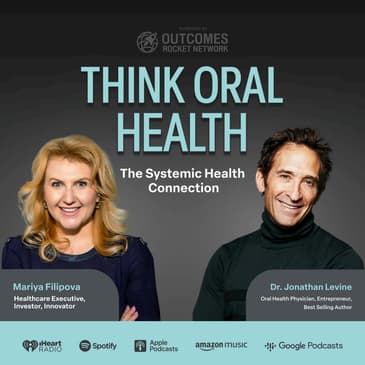
[00:00:10] I'm your host Dr. Jonathan Levine
[00:00:13] and I'm your host Maria Filipova.
[00:00:15] Let's get at it!
[00:00:23] Hello everyone and welcome to the next exciting episode of Think Oral Health, the podcast.
[00:00:29] I am excited to be joined today as usual by my co-host and partner in crime, Dr. Jonathan Levine.
[00:00:36] And we're very much privileged to have a visionary, a trailblazer
[00:00:42] and a pretty unprecedented executive and investor joining us today
[00:00:47] who has made a career out of following the non-traditional path
[00:00:50] and we are going to continue our conversation around what scales,
[00:00:56] how do we choose the appropriate investments to balance both return on investment and transformation
[00:01:03] and how do we do well by doing good.
[00:01:06] Today, we're joined by Dr. Martin Gershaw.
[00:01:09] He's the managing partner and CIO of Endeavor Life Sciences Venture Funds and Venture Studio.
[00:01:16] He is also a well-recognized senior executive investor in residence at Techstars
[00:01:22] and a member of the Techstars New York Powered by J.P. Morgan Selection Committee.
[00:01:27] Now, Martin has been recognized by Standard & Poor's as the top 100 healthcare industry leaders,
[00:01:35] the top voice in venture capital and entrepreneurship by LinkedIn.
[00:01:38] He is an award-winning Google scholar in entrepreneurship
[00:01:42] and a contributor and author of multiple important columns in venture capital at Fast Company.
[00:01:49] He earned all these accolades because over the last two decades,
[00:01:53] he has raised over $1 billion and funded and exited six startups
[00:01:59] and he leads Endeavor funds to over 140 investments including Moderna, Grail
[00:02:04] and a number of other companies that we all know and recognize.
[00:02:09] Currently, he spends his time not only investing and thinking about transformation in industries,
[00:02:13] but also advising large established incumbents, companies like Goldman Sachs, McKinsey, AIG, Fidelity
[00:02:21] and many, many others.
[00:02:23] He's joining us today not only as a successful investor and entrepreneur,
[00:02:27] but also as a Harvard and Columbia train neuroscientist, oncologist, immunologist,
[00:02:32] FDA at Thurnee and a junk professor at multiple universities.
[00:02:36] So with that, I couldn't think of a better conversation partner to dig into the investment opportunities
[00:02:42] in health overall, including overall and oral health.
[00:02:48] So with that, Martin, welcome to the podcast.
[00:02:51] You know, it's a real pleasure to be here with both of you.
[00:02:55] I'm a big fan.
[00:02:56] I really think that the message that you deliver to the audience is a compelling message
[00:03:02] and it's unique.
[00:03:03] So it's a real delight to continue our conversations which always are inspiring
[00:03:11] and energy producing here today in front of your audience.
[00:03:15] Fantastic.
[00:03:16] Well, appreciation goes both ways.
[00:03:18] And so with that in mind, I also want to give you the disclaimer that that appreciation also comes with a lot of candor and honesty.
[00:03:25] So we won't shy away from the uncomfortable topics in the conversations.
[00:03:29] This is what I know you love to dig into.
[00:03:32] So maybe with that, perhaps for our listeners who are not familiar with endeavor and your work at the moment,
[00:03:39] just hit the highlights for where do you currently see the biggest opportunities
[00:03:45] and what gets you excited across the multiple hats you wear today?
[00:03:50] Yeah, from a 30,000 per perspective, the most important thing for endeavor really is to constantly question
[00:03:56] what is the definition of success for people who do come to the table with multiple hats.
[00:04:02] So success for me as a physician and as an entrepreneur and as an investor is singular.
[00:04:08] I want to improve the healthcare system by improving patient outcomes.
[00:04:12] In order for us to do that, we need to be thematically constrained, if you will.
[00:04:17] And so for the past several decades, the venture capital community has been very focused in on unicorns.
[00:04:24] Development of unicorns as a benchmark for success.
[00:04:28] It is not our benchmark.
[00:04:29] So endeavor has been very fortunate.
[00:04:31] We started our fund in 2009 when the world was coming apart.
[00:04:35] We had 69 investments.
[00:04:37] Some of those investments turned out to be quite important for people across the globe, as you mentioned.
[00:04:44] In the transition from 2009 to 2022, we decided that it's very, very important to recognize that the investments that we made
[00:04:52] were later stage, series B and C and onward for the most part, although we did have a few early stage investments as well.
[00:05:00] But we felt that in keeping authentic to this theme of producing as much in the healthcare kind of commercial space so that patients can make their own decisions,
[00:05:12] and power themselves by choosing as many different products as possible in collaboration with their doctors, of course.
[00:05:19] We felt that it was important to shift to an earlier stage, pre-seed, seed and A level focus.
[00:05:24] And so we started the Venture Studio.
[00:05:26] With that, we see incredible opportunity, almost never ending supply of great new entrepreneurs and CEOs and founders who are working with amazing organizations like Techstars,
[00:05:39] like MassChallenge, like Plug & Play, all of whom have different characteristics in terms of how they run their accelerator.
[00:05:47] But the key thing for me is finding opportunity in new leaders who understand that there is a cause now that will allow endeavor and other partners to step in,
[00:06:00] not only with financing but also with leadership training, strategic involvement, bringing our ecosystems that we've developed over the past several decades to define success.
[00:06:11] And so for us, that means the key metric is that accelerators fail 90% of the time as measured by one metric, survival rate.
[00:06:22] In five years, 90% of the accelerator companies will no longer be in existence.
[00:06:27] Compare that to the Venture Studio model and we've evaluated 216 studios.
[00:06:32] In that model, 91% will still be operational. There is a 9% failure rate, so a 10-fold difference.
[00:06:42] I think we have the reasons why, which I'm glad to be able to share some of those with you because I do think that it applies very much into the world of oral health.
[00:06:52] Absolutely.
[00:06:53] And we do want to go into that model of de-risking early stage investments because they typically are associated rightfully or wrongfully so with increased risk, higher volatility,
[00:07:05] much more demands on the investor in terms of their attention and additional resources because writing the check is not the only thing that an early stage investor needs to be ready to deliver.
[00:07:17] And so maybe let's pick up on that thread.
[00:07:20] Maria, can we go exactly where Martin went because I know it's hitting a great note for us.
[00:07:27] We talk about leadership all the time and Martin you were just starting to touch on it.
[00:07:32] The reason for that success in your earlier stage.
[00:07:36] That's where we're going.
[00:07:37] Yeah.
[00:07:38] Oh yeah, so go after that. I thought you were going to go.
[00:07:40] No, no, that's exactly where we're going.
[00:07:42] Exactly.
[00:07:43] Come on, tell the truth. Is that exactly where you're going?
[00:07:45] That's exactly where I'm going.
[00:07:47] Let's go.
[00:07:48] I'll tell you why though, because we currently know that investing in early stage companies in oral health is only a fraction of the investment that goes into health companies and digital health companies.
[00:08:04] And you, John, want to know if I ask you what percent of the total healthcare spending is spent on oral health services?
[00:08:11] The number is 4%.
[00:08:13] 4% of the total healthcare spending goes into dental.
[00:08:17] What percent of the total healthcare investments, early stage VC investments goes into oral health?
[00:08:24] About one, right?
[00:08:26] So we have some work to do and a lot of the reasons why investors say the disparity is is because they perceive three things.
[00:08:33] One, oral health companies are early stage investments are hard to come by.
[00:08:38] So deal flow is a concern and risk, perceived risk in that field.
[00:08:44] So that teased up very nicely where Marking was going, which is how do you do risk and take the risk profile 10x lower or the success rate 10x higher?
[00:08:54] Please go ahead.
[00:08:55] Yeah, I think risk it's funny because the world of investment, it's all about risk reward.
[00:09:00] And how you define the risk and how you define the reward is part of a process that often gets attention early in the development of a fund.
[00:09:09] But it doesn't always sustain that level of attention.
[00:09:13] And just like in any business, you need to iterate, you need to adapt and pivot at times.
[00:09:19] So I think what I would focus in on right now is what is the state of 2024?
[00:09:25] Where are we right now?
[00:09:26] In terms of risk assessment in the market, and that takes into account a number of different factors, the macroeconomics, the fact that we're in an ill liquid environment, which I expect will be in for the next 10 years or so.
[00:09:39] It's not about recession.
[00:09:41] Recessions are relatively constrained and short lived by historical standards.
[00:09:46] Liquidity crises and liquidity changes are 10 year cycles up to 14 years.
[00:09:54] And we started that.
[00:09:55] So depending on where you consider the start gate, we've got another 10 years or so to go.
[00:10:01] I think that it is important to recognize that in a risk off or illiquid environment where valuations are compressed, that means that mistakes are more costly.
[00:10:12] So in the past 20 years, it was kind of a badge of honor for you to say, yes, I did a startup.
[00:10:18] Yes, it's no, that doesn't work anymore.
[00:10:20] Now it's not about a vision and try it, learn from it.
[00:10:26] There's no room for error here.
[00:10:28] So within the space of startups, it's critically important that from the get-go you have a strategic partner.
[00:10:35] That partner validates your commercial track, your roadmap.
[00:10:39] That partner doesn't necessarily have to be a venture investor or a corporate venture investor.
[00:10:46] It has to be a partner that says we believe that there is something in a combination of important elements.
[00:10:53] You as a leader, as a CEO founder or co-founder, the ability for you to make a team that can execute on what you're telling me you can deliver because there's no proof yet that you can deliver this.
[00:11:04] The ability for you to capture enough financing to be able to put skin in the game so that you can work with us and work on various projects.
[00:11:13] Some people call them pilots.
[00:11:14] I don't like to work pilots.
[00:11:16] Pilots has for me the connotation that if it doesn't work, we'll drop you as opposed to a project which can be an ongoing series of events which continue to grow and stack on each other.
[00:11:30] And so what we look for on the investment side is a great CEO leader who can build teams that can execute.
[00:11:37] We want to have a strategic partner in place early even on the seed stage level.
[00:11:42] We want to be able to extend that out into the series A level where there's actually data.
[00:11:46] There is results that this team has produced with a strategic partner.
[00:11:51] We want to make sure that this company is in a high demand, high liquidity channel.
[00:11:56] And that means that whatever they are going to be using innovation for in terms of solving a problem, improving a system, doing it better, faster, cheaper, whatever the solution is,
[00:12:10] that there's a high demand for that on the buyer side.
[00:12:15] And that can be both from a strategic as well as a consumer.
[00:12:19] And this is a little bit of the rub that there has to be a high liquidity channel.
[00:12:24] And that's where big problem is in oral health.
[00:12:27] There's not a high liquidity channel, meaning that as an investor we don't want to be the first door.
[00:12:33] We're brave or courageous but we don't want to take the first bullet.
[00:12:37] And so we would rather learn by watching for a given period of time and then iterate on that.
[00:12:44] But there has to be other investors who are willing to come in and jump in as co-investors in a syndicate.
[00:12:51] That piece, just alongside valuation, has a strong psychological overtone which we can talk a little bit about.
[00:13:00] And so part of the focus right now is how do we look as an investor at the investment side of oral health?
[00:13:09] And I would argue that it's an underserved, under-recognized class that doesn't get enough respect.
[00:13:16] In part it's because we as physicians, we define certain things as wellness or illness.
[00:13:24] Many years ago, hypertension was completely different in terms of its benchmarks and its standards as it is now.
[00:13:30] And we didn't treat a lot of people.
[00:13:32] I think it's the same thing with oral health.
[00:13:34] I think that there are different ways to look at different disease categories, different health and wellness categories.
[00:13:42] And depending on the branding of that and the psychological recognition of that and the emotional impact of that,
[00:13:50] you can kind of love oral health in with hypertension because it's not generally something that causes you concern until you have pain.
[00:14:01] And when you have pain, it's too late by the way.
[00:14:04] Have you losing tears? You're losing bone structure. That's too late.
[00:14:08] Yeah. So I think that this is a chronic disease category just like hypertension is a chronic disease category.
[00:14:14] And I'm here really in support of everything that both of you are doing to promote awareness for investors, for patients.
[00:14:22] Look, there are large, large corporations who have unmet needs.
[00:14:27] And I think part of this conversation hopefully is the same as with Endermal Better Health.
[00:14:33] It's an open source platform for discussing where collaboration and partnership can bring that.
[00:14:39] Yes. Yes. Yes.
[00:14:41] Let me jump in for a second on this conversation.
[00:14:44] Boy, Maria, there's so many spots we could all jump in on what Martin is talking about.
[00:14:48] But the underserved underappreciated notion of oral health, we call it oral systemic medicine, that division,
[00:14:57] the question is how do we build awareness?
[00:15:00] How do we take innovative ideas and research and how do we drive new capital there?
[00:15:07] And I think that's part of our conversation.
[00:15:10] What Maria was pointing out is the fact that the dollars are not flowing into oral health as quickly as it goes into medicine, of course.
[00:15:19] And we know that adoption of new technologies and taking new research and applying it from a standpoint of improving the care of the patient
[00:15:28] takes a long time.
[00:15:30] I think in average in healthcare about 17 years in dentistry is probably a little bit longer.
[00:15:35] But where I would love to take you, Martin, is talk to us a little bit about your background of neuroscientists, of immunologists.
[00:15:46] You deeply understand how inflammation of the mouth and inflammation anywhere in the body works its way into all these other areas because of our circulatory system.
[00:15:56] Oral health, of course, has a very interesting pathway because we do have two.
[00:16:00] One is through the top of the digesting tract and P. ginger ballast ends up in the interstitial cells of leaky gut syndrome, for instance.
[00:16:08] And of course through the circulatory systems throughout the whole body.
[00:16:12] So as we understand the science and we understand the impact of let's shine a light of getting people healthy and going upstream in diagnostics before they're showing those diseases.
[00:16:26] Get away from the sickness model of medicine. And in fact, it exists in dentistry. How do we get upstream?
[00:16:32] We go back to the notion and what you're dedicating your life on which is funding and putting capital and helping build these early stage companies and also a little bit later stage.
[00:16:44] Tell us your thinking a little bit about understanding this appreciation now of oral health and how you're thinking about it and how you could make this difference to improve really our patient outcome.
[00:16:56] Yeah, it's such a great question. As human beings, you know, we're emotional. We're moved by psychological pressures were moved by physical pressures.
[00:17:07] So all of these things I think shape how we look at ourselves as human beings as other people at the world around us.
[00:17:15] Now within medicine, we artificially construct systems to help us delineate a framework of what we're looking at.
[00:17:25] We like as human beings to have a structure that has parameters around it otherwise we're uncomfortable.
[00:17:33] I would argue that the dental industry at large, as you were talking about oral systemic health, I think with authenticity needs to come and collaborate with the American Medical Association and form a new perspective mindset that really looks at the system of oral health.
[00:17:57] We clearly understand that there's a cardiologist who looks at the cardiac system of pulmonologists and looks at the respiratory system, etc. etc.
[00:18:07] It's not necessary, you know, vocabulary that dentists look at an oral system. It's more that they are solving focal problems.
[00:18:17] And I think that this is a mistake. I also think that just a simple extension out into where medicine is going and where dentistry is going is about health and wellness.
[00:18:27] And if you look at nutrition and you look at our overall thematically important decision making to move from hospital to physician to home care and patient empowerment of their own health, I think oral health and hygiene as a system has to be a part of that.
[00:18:49] And I think once again the notion of systems means to physicians the notion that we can bring specialists in. So there's no reason, there is no rational intellectual reason why the specialist can't be a dentist for health, wellness, nutrition, oral hygiene as a system and components of those systems,
[00:19:14] as well as all the other technical things that you, Jonathan, briefly begin to allude to in terms of infection, in terms of overall the chronic conditions that spawn within and of the oral cavity, if you will, defining them as approachable subjects.
[00:19:34] Not just it's nice to have proper oral hygiene. That would be like it's nice to have a reasonable blood pressure.
[00:19:43] Well, in some, I think this is all possible once you bring this into the forum and I'm worn and happy to help host some of these events here in New York City are up in Boston or in San Francisco or in London or in Zurich.
[00:19:58] Many of the cities that we frequent to talk and bring in at the very kind of early stage level a meeting of the minds between organizations between investors between strategic.
[00:20:10] Absolutely. And the reason why these conversations are always so good at sparking action is that fundamentally there's this constant weaving between the clinical case and the business case.
[00:20:25] In fact, I would argue the clinical case is well established in the clinical literature. In fact, if you look at the guidelines of the American Diabetes Association, it clearly states that if you want to manage A1C hemoglobin levels
[00:20:39] for patients, you should treat their period on disease. The piece that's missing is that business side of it the layer that says, OK, now that I know that clinical connection.
[00:20:49] How do I operationalize it in the current model of care delivery? How do I coordinate care across specialists and how do I pay for care, given that we have differences in insurance models if we could call dental benefits insurance.
[00:21:04] And so that's the piece that really comes back to A, why Jonathan and I collaborate together because we try to weave business and clinical decision making together and remove the barriers for some of these solutions that are system level solutions, systemic health solutions.
[00:21:22] And to that point, I want to go back to Zigg and Zag back to the business case and some of the investment opportunities because if you're an investor looking at oral health and looking at scarce liquidity, looking at systemic barriers, how do you partner with some of the
[00:21:41] strategic, that's where the kind of creating a syndicate for investment doesn't always only consist of investors. It also consists of health plans, dental plans, associations to help raise awareness and remove some of the structural barriers.
[00:21:56] So with all of that complexity in mind, Martin, are there any parallels that you could think of from other industries or sub sediments of health care that we could look for parallels who overcome those same barriers that we were talking about like
[00:22:14] liquidity, high risk per se. Where can we look for some parallels so we could draw in some of those learnings to accelerate investment and adoption of systemic health solutions?
[00:22:25] Yeah, I know it's such a great point. And as you mentioned earlier, I do have a legal background that was an FDA attorney. So attorneys look at things in case studies, we look at what has happened in the past, what have court systems ruled and business schools as well look at case studies.
[00:22:42] So I think it's important to look at case studies. Before getting a look at that, I would say one thing you touch on an important issue which speaks to, again, the way that we as investors look at things or at least how I look at things with an endeavor.
[00:22:54] You know, great CEO leader, great team that can execute important strategic have to come to the table early. But there also has to be a high demand, high liquidity channel.
[00:23:04] So that means that there has to be enough demand that whatever we're ultimately bringing to market that there has to be a market for that. And there has to be liquidity, there has to be investors coming to the table to put money not only in round one but throughout the growth scaling process, which can be many, many years if not decades.
[00:23:23] So I think that in a current in this is an artificial constraint by insurance providers and frankly by the government. There is absolutely no rational reason that eye care and dental care should not be covered as part of insurance.
[00:23:40] There is no explanation that I can think of from a scientific or medical perspective, why these should be carved out. This is purely a political and financial definition. And to some degree, it creates barriers to make these two disciplines kind of second class citizens in the world of healthcare, which is just all wrong.
[00:24:05] Now, to get to your question. So I think that the area of eye care is actually now verging as a view into many different healthcare systems. Certainly because of the direct connection to the CNS, examining eyes is an important potential biomarker to Alzheimer's disease.
[00:24:30] So there are companies that are looking at eye exams as part of this biomarker technology. And I certainly think that within the oral systemic healthcare structure biomarkers play a critical role.
[00:24:44] We clearly know that within the history of medicine, evaluation for various types of bacteria or virus leads to, let's say the understanding of a pathway of disease like gastrointestinal ulcers. So I think that finding a market that is large enough is one of the important issues.
[00:25:08] So Alzheimer's obviously very large. That is why there is funding for companies that are looking at eye exams as a biomarker, plain and simple. The second issue is drug development. I mean this is kind of the life's blood of farmer and biotech.
[00:25:22] And so the drugs that are prominent for oral systemic health are not as robust in terms of the actual dollar value of those treatments compared to rare diseases, which two or three million dollars per patient.
[00:25:38] And so I think that that is a second, not artificial but real constraint that the actual dollars spent in that system is less. Now you could argue that it's less because of the constraints by insurance.
[00:25:55] It's a supply demand issue to some extent. In general, patients do not want to spend money on healthcare. So insurance has made us comfortable with the notion that if we go to a doctor, we have an out of pocket, you've got an deductible. It's a modest amount generally.
[00:26:11] And we're comfortable with that system. In most other countries, the way that the healthcare system and structural works is quite different. So there's really lower expectations in terms of how frequently patients are going to see doctors, dentists, ophthalmologists.
[00:26:30] There's a different level of expectation about the number of tests they're going to get from blood work to MRI. There is a dynamic there that I think is more what I would call sustainable. So there is kind of an ecosystem that looks at healthcare as a scarce resource.
[00:26:48] So within this construct, there's pluses and minuses. Entrepreneurship is not as robust in other countries because there are these limitations about what you can charge and how often you can charge it.
[00:27:01] And here in the US, we've kind of created our own monster, if you will, because there's no limit. I mean, yes, I'm a big fan of genetic therapies. Huge fan want to develop genetic therapy companies as a major impact on often fatal diseases.
[00:27:20] Do I think that the development of genetic therapies would happen if we didn't have the approval from the FDA and from CMS to pay two or three million dollars? Absolutely not.
[00:27:34] Because the market size, by definition of rare diseases means that it's small.
[00:27:38] Now, where do I get the data from this? Sadly, developing countries. Most of the diseases in the world are prominent in developing countries that are untreated, unappreciated by large pharma because there is no payment mechanism.
[00:27:57] I had the good fortune of working with Goldman Sachs and the foundations were a bit, and really my focus was to help early stage companies evolve in a social entrepreneur channel.
[00:28:09] So I helped a company called One World Health, which was sponsored by a great woman named Victoria Hale came out of Genentech. She and her husband were scientists.
[00:28:17] They left the company, which is still a fantastic company. And they decided that they wanted to focus in on developing countries and the rare diseases that were not rare to them, but rare to us.
[00:28:28] Leshmanias' Chagos disease, malaria, over the decades now has been a tremendous voice. And One World Health is now partnered with a number of imported companies to collaborate on finding things like malaria vets.
[00:28:44] So I think that this is all about the beauty of human beings taking their vision, being persistent and driving new change.
[00:28:56] And I think you mentioned early on that we're in an era of change. In our conversations, you always bring incredible energy to our conversations.
[00:29:05] You always bring the glass half fold to the equation within a practical framework. So I want to say now, so 2024, we should look back 10 years from now, 2034.
[00:29:18] And we should really benchmark what has the decade done in oral systemic health care.
[00:29:24] And I would put this as a challenge, just like Bill Gates put out these amazing incredible global challenges, which have been extraordinarily successful.
[00:29:32] I think that we need to challenge dentists, physicians and investors. And we needed to be focused in on one important thing.
[00:29:41] We defining the importance of oral systemic health as a disease category, as a channel just like cardiology or pulmonology. It's a system.
[00:29:51] And the second is we need to be better listeners to the strategic partners who bring these important oral systemic innovations to the public.
[00:30:04] And that can be on the consumer side for health and wellness. It can be more on the technical and scientific and medical side.
[00:30:12] But we need to, there's no reason that biotechnology cannot play an increasingly important role in oral systemic health care.
[00:30:20] And there's no reason that we can't work more hand in glove with corporate venture capital.
[00:30:26] If I could quickly jump in on that.
[00:30:28] I love where you went on thinking about change. It reminds me of the old expression, if we're going to make change, we have to work on ourselves first.
[00:30:35] And if we think of medicine and dentistry, we don't have to go that far back.
[00:30:39] I enjoyed my four years in dental school, my first two years here in medical school. We're all together at Boston University.
[00:30:46] And I remember that nutrition wasn't even something that we looked at. We didn't even listen to it.
[00:30:52] And we now understand, and especially the functional medicine and longevity people,
[00:30:58] top of the list of the foremost important things for longevity is nutrition.
[00:31:02] And it's just emblematic of the fact that we need to embrace this new science and the new research.
[00:31:08] And where your point is with oral systemic medicine, we don't teach it in dentistry.
[00:31:14] If you ask the dentist about the connection, they'll know a little bit.
[00:31:18] So Maria's point about A1C and diabetes, yes, we learn a little bit about that.
[00:31:22] But we don't take that systematic approach. We don't build the systems and we don't have it in dentistry
[00:31:27] and we don't have it in medicine, and that's the working on ourselves.
[00:31:31] That I think your point on that, Martin, is really spot on.
[00:31:34] And then if we cast out and we look at the future, we look at our technology,
[00:31:38] I mean because of the genomics and because we've been able to do what we've done with DNA,
[00:31:44] we now know that you can understand there's a predisposition to caries, predisposition,
[00:31:50] genetic predisposition for periodontal disease.
[00:31:53] And if we're doing full system genomic testing now, if we are looking at that
[00:31:58] and we can look at that in oral health, this is one of the ways when we think about the future
[00:32:03] where salivary diagnostics could potentially be the new future blood diagnostics
[00:32:08] that we understand genetic predisposition for oral diseases.
[00:32:11] Well, why aren't those opportunities, why aren't they funded better, right?
[00:32:18] Or instead another way, Martin, if you think about the future opportunities,
[00:32:23] what you've learned in healthcare and medicine and you say, hey, if those data points are true,
[00:32:28] that salivary diagnostics could be the new blood diagnostics.
[00:32:32] The genetic testing and microbiome testing of the mouth could help us get ahead
[00:32:37] and get upstream in systemic inflammatory diseases as an investor and a scientist
[00:32:43] and a doctor and a couple more labels that you have and letters after your name.
[00:32:48] How you look at things with this multiple lens that you have,
[00:32:51] can you see that as some future opportunities for investment
[00:32:55] for people like you and your team to help bridge that, yeah, of medicine and dentistry
[00:33:01] and have much better of a wellness approach?
[00:33:04] Yeah, the short answer is absolutely.
[00:33:06] As I said, I think over the next 10 years we should benchmark this conversation
[00:33:10] and see what has been moved forward.
[00:33:13] On a very kind of case study basis, I would look to history.
[00:33:17] And so history, just to take a flashback.
[00:33:21] So many, many years ago when I started my medical practice,
[00:33:25] I did not want to work for anybody to start at my own medical practice,
[00:33:28] which was a double-edged sword.
[00:33:30] So it turned out to be quite successful.
[00:33:33] I know so quite a challenge.
[00:33:34] I was up until 1, 2 in the morning trying to figure out how to run a business.
[00:33:38] But I think the point of all this was in this,
[00:33:42] I was constantly curious and looking for how other people did things
[00:33:47] and how they were successful and look for templates
[00:33:50] to be able to use what they've done and essentially improve on.
[00:33:54] And one of the templates brought me an acute awareness
[00:33:57] of what I would call packaging of devices, diagnostics and drugs.
[00:34:03] And so this was not popular actually at all when I started out in my career.
[00:34:10] And I did a lot of reading at that time.
[00:34:13] I didn't know the difference between buy side and sell side at that time.
[00:34:16] But the sell side essentially are the large investment houses
[00:34:19] who want to sell their mutual funds and their products to consumers.
[00:34:23] And one of the large groups was then out of Merrill Lynch,
[00:34:27] who was a very prominent biotech group.
[00:34:29] They wrote some great pieces.
[00:34:31] They did great coverage about biotechnology, but they were drug focused.
[00:34:35] That was it.
[00:34:36] And I came to them and I said, you know, I love what you write,
[00:34:40] but with all due respect, I think there's a piece that might be additive.
[00:34:45] You're not necessarily seeing it.
[00:34:46] It's the regulatory side.
[00:34:48] And as a former regulatory attorney,
[00:34:50] I think that the whole area of combining devices, diagnostics with drugs
[00:34:56] is going to be an explosive opportunity to be able to bring more product
[00:35:03] into the patient environment because it quantitatively validates
[00:35:10] the need for an expensive drug.
[00:35:13] That's the whole purpose of a diagnostic.
[00:35:16] A device is a delivery system.
[00:35:18] A diagnostic is a validation of the use case.
[00:35:22] That's right.
[00:35:23] So they politely said to me, well, that's very interesting,
[00:35:26] but you're just a doctor.
[00:35:27] Where do you know?
[00:35:28] What do you know?
[00:35:30] Yeah, so that's okay.
[00:35:32] They asked me to write an industry update,
[00:35:34] which was their polite way of saying, would you please leave my office?
[00:35:37] So I did.
[00:35:38] I wrote an industry update and four weeks later,
[00:35:41] I delivered it to them.
[00:35:42] They were kind enough to put my name in size for thought that the end
[00:35:45] of this long report, there's in the size 16 thought in the beginning.
[00:35:49] That's okay because they distributed this to their private clients.
[00:35:54] They're best three months later.
[00:35:57] It was a huge acquisition by Junentec for a diagnostic company.
[00:36:02] They had this pairing with their expensive biotech.
[00:36:06] And all of the clients were like, well, how did you guys know this?
[00:36:11] So they brought all the clients in.
[00:36:13] Unfortunately, they didn't read my article and read my industry update.
[00:36:16] So they didn't know how to answer.
[00:36:18] So then they recalled the meeting, they had me come in and they put me
[00:36:21] in the back of the room, but they still couldn't answer the questions.
[00:36:26] So at the end of this meeting, they put me in the front.
[00:36:28] I answered all the questions.
[00:36:30] And that is how the advisory business got started because a substantial
[00:36:36] number of those clients came to me for advice.
[00:36:39] So you mentioned, you know, how about some of the clients in Fortress
[00:36:43] 100 and prominent organizations?
[00:36:45] That was an outgrowth of many of buy side and sell side investors
[00:36:50] looking to advice.
[00:36:52] And so my advice ending this kind of long story to people who are
[00:36:58] interested as entrepreneur founders in the area of oral systemic
[00:37:03] health medicine is to look creatively about how your
[00:37:08] innovation can pair within the current investor system to bring
[00:37:14] and unlock unique value.
[00:37:16] That's the take home message.
[00:37:18] You need to be creative, you need to be disruptive,
[00:37:20] you need to think like Elon a bit.
[00:37:22] Big hairy audacious goal is what HBS tries to put.
[00:37:27] That's the technical term, yeah.
[00:37:29] Yeah, bohad, big hairy audacious goal.
[00:37:31] So think about how your innovation is not necessarily going
[00:37:34] to solve a dental problem alone.
[00:37:37] Think about how it's going to integrate into a larger systemic
[00:37:42] problem which unlocks that high demand, high liquidity channel
[00:37:46] that is currently not nearly there.
[00:37:49] Take home, I think right there.
[00:37:51] It's a great opportunity to do that.
[00:37:53] I think we got it.
[00:37:55] Love what you're where you've taken us throughout the last
[00:37:58] couple of minutes.
[00:37:59] You heard it here first.
[00:38:01] I think that we're making an invitation not issuing a challenge
[00:38:06] but definitely issuing an invitation for everybody out there
[00:38:09] who is in a clinical capacity, business capacity, investor
[00:38:12] capacity or any decision maker in the health industry to look
[00:38:17] at the next 10 years as the decade of oral systemic health.
[00:38:21] We certainly are and we are taking on that invitation.
[00:38:25] Martin, we will take you up on the offer to host a follow-up
[00:38:30] conversation.
[00:38:31] This type of podcast is just the beginning and it sparks
[00:38:35] multiple other initiatives and conversations.
[00:38:38] Please be sure that we will take you up on this and for our
[00:38:41] listeners, stay tuned for the details of where this conversation
[00:38:45] will be continued virtually or in person.
[00:38:47] Absolutely would love to keep that in mind.
[00:38:51] The last thing is this is an investor conversation.
[00:38:55] We've tried to start it as an investing conversation.
[00:38:58] We meandered into clinical and definitely into strategic
[00:39:01] partners.
[00:39:02] Let's take that as a truly a model of what these conversations
[00:39:09] could be because we can't have an investment conversation
[00:39:12] alone without taking into effect all the other dependencies.
[00:39:15] Similarly, we cannot have a clinical conversation without
[00:39:19] understanding the pressures or limitations of that patient
[00:39:22] from an insurance perspective or socioeconomic perspective.
[00:39:26] What I loved about our conversation was the fact that
[00:39:30] we truly norm-bridged multiple disciplines and so these are
[00:39:34] opportunities to build bridges, not as opportunities to give up
[00:39:38] because there's huge gaps.
[00:39:40] With that, thank you for joining us.
[00:39:43] More to come and please stay tuned and let's hold ourselves
[00:39:47] accountable for that to that decade of oral health.
[00:39:50] I just want to say it's such a pleasure talking with both of
[00:39:52] you today.
[00:39:53] It's always exciting to talk about things that are going
[00:39:56] to impact people and at the end of the day, this impacts people.
[00:40:00] I think it's also very exciting to challenge ourselves to try
[00:40:04] to take ourselves out of our comfort zones and to be able to
[00:40:09] move into discussions with people who might not necessarily
[00:40:13] agree with us or might not necessarily share the same road
[00:40:17] map.
[00:40:18] And that's the challenge here.
[00:40:20] To be able to go beyond the current norm, bring a little
[00:40:24] Elon to the table.
[00:40:26] That's right.
[00:40:28] Another happy note.
[00:40:30] Thank you and we'll see you next time at our next episode.
[00:40:40] Thanks for listening to the Think Oral Podcast.
[00:40:43] For the show notes and resources from today's podcast,
[00:40:46] visit us at www.outcomesrocket.health.
[00:40:53] Or start a conversation with us on social media.
[00:40:57] Until then, keep smiling and connecting care.