
Neurology care is in high demand, but long waitlists and specialist shortages continue to delay access for millions of patients.
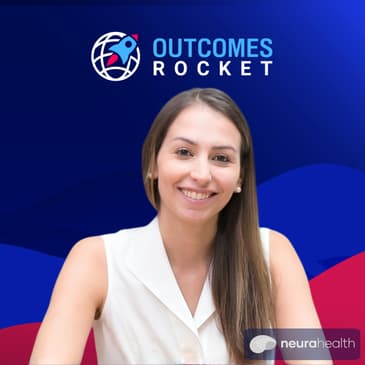
In this episode, Elizabeth Burstein, CEO and Co-founder of Neura Health, shares how her personal experience with delayed neurological care inspired a more accessible, technology-enabled care model. She explains how Neura Health supports patients with chronic neurological conditions while helping neurologists and care teams work more efficiently. Liz discusses how AI, workflow automation, clinical decision support, and neurological data can expand specialist capacity and reduce administrative burden. She also explores how these innovations can improve access to high-quality neurological care.
Tune in to learn how technology-enabled neurology care is helping make specialists more accessible without replacing the human side of medicine.
Resources:
-
Connect with and follow Elizabeth Burstein on LinkedIn.
-
Reach out to Liz at Liz@NeuraHealth.co
[00:00:03] Hello, everyone. Welcome back to the Outcomes Rocket. I'm really excited to be hosting another episode today. I'm so excited to be hosting Elizabeth Burstein on the podcast today. She is the CEO and Co-founder of Neura Health. They're doing some extraordinary work in the space where there's so many bottlenecks to get this type of care. Her and her team are doing an extraordinary job of improving access to the podcast.
[00:00:32] As well as improving outcomes in this neurology space. So such a pleasure to have you join us, Liz. Yeah, thanks for having me, Saul. Really excited to connect with you and share more about the founder journey. Yeah, for sure. Let's cover it. Before we get into it, Liz, talk to us about you. What got you interested in health care, but in particular, this neurology space?
[00:00:54] Yes, I've always been interested in the intersection of health and technology. My background is in computer science with a focus in vital computation. And before Neura, I was head of product at the Maiman Clinic, one of the largest telehealth companies in the women's health space. And prior to that, was a director of product at ZocDoc, which is one of the largest online marketplaces for health care. I love ZocDoc, by the way. Like great product. Looking to people.
[00:01:24] If only all our health care experiences would just be that slick and easy, right? Easy button. Yeah. Yeah. So that's been a huge passion of mine is building a more consumer friendly front door for health care. And the interest in neurology started around 2020. It was a pandemic. Telehealth skyrocketing. I myself was a patient, so I had a trap nerve and was on a six month wait list, even in New York City. Come on. Yeah.
[00:01:52] I was a neurologist. And it was tough when it was after, even that referral started after about a two and a half year journey, ping-ponging between pain management, psychology, physical therapy, and eventually learned that the specialist I should be seeing is a neurologist. I didn't even know much. Yeah. You sigh. Yeah.
[00:02:14] And so, yeah, so that really was the genesis of couldn't there be a way to access this type of specialist sooner? There wasn't really much in the appointment that required like physical co-location. I was just talking when I got to that appointment. So incubated this concept of essentially an all in one place to manage one's chronic neurological issues. And that's actually what we do today.
[00:02:38] Man, what a story, Liz. Thanks for sharing that. And I know your co-founder, Samir Madan, also has a story. So two founders that are just like affected by this, wanted to do something better. And Liz, this is so great that you have. Let's talk about it. Obviously, your story is an example that many Americans are faced with. But talk to us a little bit more about the platform and what you guys are doing to unlock this problem.
[00:03:06] Yeah. So if you look at the numbers in this space, there's over 145 million Americans who suffer from a neurological issue, but then only 21,000 neurologists in the whole country. So if you run the math, each neurologist would effectively have to see 10 times the number of patients in a year to adequately meet demand. So that is really the challenge that we put in front of ourselves, building this technology-enabled care delivery model where we have our own clinic.
[00:03:35] We hire, onboard, train specialists, but we also have our own technology platform. And thankfully, we're living in this amazing time of AI where so much of what happens in a clinic, everything from booking to explaining what the clinic is to all the admin around scheduling, clinical workflow, prescription, prior off. We're just living in this amazing time where there's so many great AI tools that we can use.
[00:04:05] We can also build to run a 10x more efficient clinic than a old school brick and mortar neurology clinic. So that is really the core focus of our platform is really thinking about how might we empower this type of specialist, which is one of the worst applied specialists in all medicine, to be better with their time, more efficient. How do we summarize the intake for them? How do we empower them as scribes?
[00:04:31] How do we then help them with clinical decision support and also that longitudinal care for the patient that they just don't have enough time to really be there for? So that is essentially what our platform does is it's workflow efficiency for the neurologists, the RNs, the registered nurses, the physician assistants to help them be most efficient with all that they do, both clinical and then admin around the patient care journey.
[00:04:59] And that's really a big differentiator of ours is a big focus. In order to provide access, we need to have efficiency. Amen to that. And so, OK, and then to better understand then, on the one hand, you guys have providers and the platform. On the other hand, you also empower other providers to be more efficient and be able to meet the demand. Right. So you do both. Yeah. So we, for example, will work with hospitals and health systems. So Emory Health Care in Georgia is one of our bigger partners.
[00:05:28] So their neurology department had a really long wait list. Patients, if you go to their Google reviews, there's a lot of patients that would like to be seen sooner. And so health systems like that can partner with NERA to accelerate access, allowing essentially access to their care team within less than a week. So we work there as essentially bandwidth extenders to augment their staff and provide our telehealth providers to see their patients literally within a week.
[00:05:58] But it's not just the providers, right? It's also the tooling, the workflow efficiency, the integration that we have with their electronic health record that makes it really seamless and easy to get these patients seen faster and with high quality. That's awesome. That's a major unlock. So folks like thinking about these bottlenecks that oftentimes happen in care delivery there, the time is unlike no other.
[00:06:25] And we have solutions like NERA that could help be that unlock for your patients because there's so many downstream costs to that come along with not being able to see them, ER visits, etc. So Liz, help us understand more about these moats that you're creating, right? The neurological data set is one of them that I've heard you talk about and engagement between visits. Help us understand those. For us, it's faster, more efficient, high quality, right?
[00:06:53] So it's those three pieces and the technology that facilitates that. All this data, you're right in that we are collecting a really unique data set, one of the largest data sets around neurological symptoms, neurological treatments, and neurological outcomes. That gives us a competitive advantage in thinking about how do we turbocharge a neurologist and also how do we take a generalist?
[00:07:17] So someone who's more of like a primary care provider or a physician assistant or nurse practitioner and then empower them with all this data with the clinical decision support to make really high quality neurological decisions, diagnosis decisions, and treatment decisions. I think that's brilliant.
[00:08:04] The biggest challenge is often how do I unlock this really high volume of patients? So that is honestly one of the hardest pieces of building any kind of tech-enabled care delivery service. There was a trend a couple years ago around companies like ours really get into the masses by launching as an employee benefit for large companies and being this health benefit perk.
[00:08:30] So we did spend some time working on that channel, talking to benefit buyers, trying to kind of follow that playbook. And what we've learned really in our own journey is just because a channel or strategy worked for a similar company does not mean it will work for your company.
[00:08:46] So we have had to think really critically and take in lots of data, qualitative, quantitative customer feedback to really identify the sweet spot for us of, you know, where is there the highest need from an enterprise perspective? So that's how we learned to essentially pivot from employers to what we do today, which is health systems and larger clinic franchises.
[00:09:11] Yeah, it's so interesting because, yeah, a lot of these tech-enabled care delivery platforms do go to the employer as a benefit. But given that there's such a bottleneck, it makes sense now that you've figured it out, right? But in retrospect, you're like, oh, man, wish we had known. But it's great that you've landed in this spot. Yeah. Yeah, I think there's only salt lakes you can learn by looking at other models.
[00:09:36] And what's most important is to quickly understand from your own data, from your own feedback of your specific services, your specific numbers, your specific ways of bending the financial cost curve for B2B buyers to really understand the ideal go-to-market fit for your service. That's awesome. Yeah. And so, look, congrats on the latest round. The American Heart Association Go Red for Women Venture Fund was one of the leaders in that investment.
[00:10:06] And so talk to us about the significance, the importance of that for you and for the company, and maybe a trend that you see happening in the space that I think could be a tailwind for you guys. Yeah. The American Heart Association, the Go Red for Women Fund, their focus is in conditions that disproportionately and differently impact women's health. And many of our conditions from migraine to dementia to brain health to concussion fall into that category.
[00:10:36] So the investment made a ton of sense strategically for them. And then for us, it's the network of health systems research. They run massive registries in these condition areas. So really great fit. And then, yeah, so it's been in terms of the competitive moat and some of our focus areas on the data side. It's been just an amazing time to build. I was alluding to this earlier with all the AI tools that make care more efficient.
[00:11:04] Everything from prior off to workflow optimization to headless EHRs. A lot of these tools didn't exist a couple of years ago. And they make companies like ours all the more differentiated from a brick and mortar clinic or a hospital. And they further deepen that wedge of data that we're able to rapidly collect by scaling our companies and then feeding that data back as feedback to make us more and more efficient.
[00:11:33] So that's really like our flywheel that differentiates companies like ours from the status quo. That's fantastic, Liz. I appreciate that. Congratulations. And just like more of a nuanced question for the providers listening. So then are you then able to white label this or do you come in as a partner that talk to us about that so they could better understand the offering? Yeah, so we work with hospitals. We also work with clinics and we have white labeled our solution.
[00:12:02] One of the easiest integrations we've done is starting similar to like a locums model where we'll basically just provide our stack and help immediately address shortages. They can build directly within their electronic health record. And there's a very clear win for patient access and then win for revenue as we essentially will send all the relevant referrals back into the health system or client. That's great. Appreciate you sharing that use case. It makes a lot of sense.
[00:12:29] Let's take advantage of solutions like Neura Health, folks. If something in today's podcast resonated with you or maybe you have a friend in the care delivery business, hit forward on this podcast, text it to them. Because ultimately, it's about how we solve these problems for our community that we help move the business forward and outcomes and obviously the business of health care, too. So, Liz, this is awesome. I want to thank you for joining us. What closing thought would you want to leave with us?
[00:12:58] And then where can people reach out to you and the team at Neura Health to learn more? Yes, I'm really passionate about access and health care generally, even like outside of neurology. Heart in God is just, wow, what an exciting time to be building in. And sometimes there is fear of, oh, AI is going to replace doctors. Like, I think that is absolutely not. I'm not worrying about that. I am thinking about how can we make doctors more efficient? How can we make them more accessible?
[00:13:24] So, just very passionate and always excited to connect with people that have the same interests. And I can be reached at liz at neurahealth.co. Outstanding. Liz, thank you so much for that. Really appreciate the work you and your team are doing. Folks, thanks for tuning in to another episode of our podcast today with Liz Burstein. She is the CEO and co-founder of NeuroHealth. Again, check out the show notes for all the ways to get in touch with her and the team.
[00:13:54] Forward this episode to your friends. Share it on social media. Get the word out because that's how we improve outcomes. Thank you all for tuning in. And Liz, thanks for joining us. Thanks for having me. Appreciate it.